Compound Interest Mistakes That Cost You Money
A clear, practical breakdown of the compound interest mistakes that quietly cost people the most money over time, and simple, actionable fixes so your savings and investments actually get the benefit of compounding the way it's meant to work.
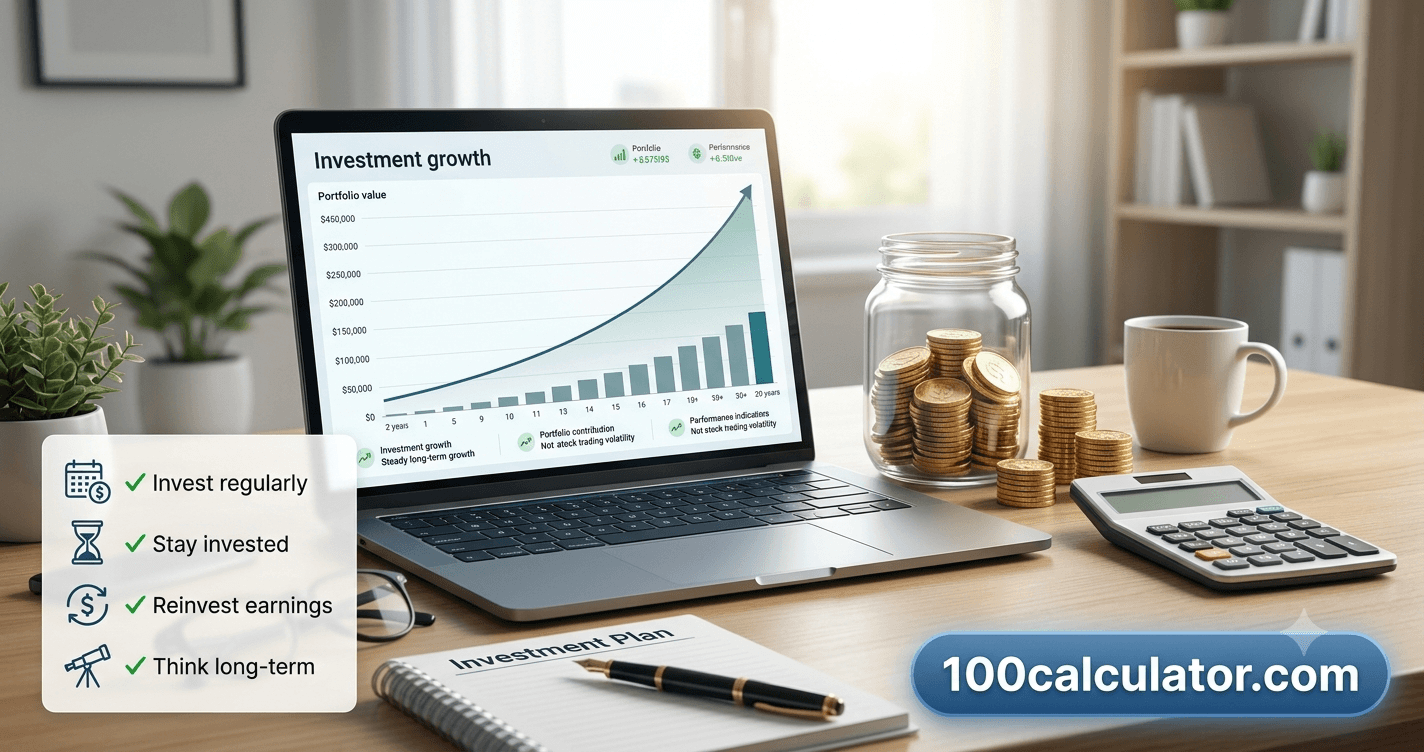
Compound interest is sometimes called the closest thing to a free lunch in personal finance, but only if you let it actually work the way it's supposed to. A handful of avoidable habits, like waiting too long to start, pulling money out early, or overlooking fees, can quietly cost you tens or even hundreds of thousands of dollars over a few decades.
The biggest compound interest mistakes are starting too late, withdrawing or pausing contributions, ignoring compounding frequency and fees, contributing inconsistently, and chasing high returns instead of steady ones. Avoiding these gives compounding the time and consistency it needs to actually snowball.
This guide walks through each of these mistakes in plain language, using real numbers so you can see exactly how much they cost. You'll also find the Rule of 72, a look at how compounding frequency changes your results, and an explanation of how the same math that grows your savings can work against you in debt. If you want to run your own numbers as you read, 100 Calculator's Premium Compound Interest Calculator does the math instantly.
Before getting into the mistakes themselves, it helps to have a quick refresher on how compound interest actually works, since that's what makes each mistake easier to spot.
What Is Compound Interest?
Compound interest is interest calculated on both your original money, called the principal, and on the interest that money has already earned. Once you've earned interest once, that interest starts earning its own interest the next time around. It's why savings and investment balances often look like they barely move for the first several years, then noticeably speed up later on.
How Compound Interest Actually Works
Say you put $1,000 into an account paying 5% a year. After year one, you'd have $1,050. In year two, you don't just earn 5% of the original $1,000 again, you earn 5% of $1,050, or $52.50, bringing your balance to $1,102.50. That extra $2.50 doesn't look like much on its own, but repeated year after year, decade after decade, it's the entire reason compounding accelerates over time instead of growing in a straight line.
Compound Interest vs. Simple Interest
Simple interest, by comparison, only ever calculates interest on the original principal, so it grows in a straight line instead of a curve. Our guide to simple interest vs. compound interest breaks down exactly how the two compare side by side, but the short version is that compound interest almost always grows faster over a long enough timeline, which is exactly why it matters so much for long-term goals like retirement.
Small mistakes are expensive specifically because of this curve. A habit that shaves even a percentage point or two off your return, or costs you a few years of growth, doesn't just cost you that percentage point, it costs you everything that percentage point would have compounded into by the time you needed the money.
Mistake 1: Waiting Too Long to Start
Of all the compound interest mistakes on this list, waiting too long to start is usually the most expensive, and the hardest to undo later.
Why Time Matters More Than the Amount You Invest
Because compound growth accelerates over time, the years you invest early are worth disproportionately more than the years you invest later, even if you contribute the exact same amount every month. Someone who starts at 25 isn't just investing for 10 more years than someone who starts at 35, they're giving their earliest contributions 10 extra years to compound on top of everything that comes after.
Example: Starting at 25 vs. Starting at 35
Assume two people each invest $200 a month at a 7% average annual return, compounded monthly:
- Person A starts at 25 and invests until 65 (40 years). Total contributed: $96,000. Estimated balance at 65: about $525,000.
- Person B starts at 35 and invests until 65 (30 years). Total contributed: $72,000. Estimated balance at 65: about $244,000.
Person A contributed only about 33% more money in total, yet ends up with more than double the balance. The chart below shows why: most of the growth happens in the last decade or two, so losing those early years costs far more than it seems to at the time.
If you're not sure where you'd land with your own numbers, plugging a few scenarios into 100 Calculator's Premium Compound Interest Calculator is a quick way to see the gap for yourself.
Mistake 2: Ignoring How Often Interest Compounds
Interest can compound annually, monthly, or even daily, and it's easy to assume a bigger compounding frequency automatically means a meaningfully bigger return. It helps, but usually by less than people expect.
Compounding Frequency, Compared
Here's what happens to $10,000 invested at a 6% annual rate for 10 years, depending on how often the interest compounds:
| Compounding Frequency | Balance After 10 Years |
|---|---|
| Annual | $17,909 |
| Semi-Annual | $18,061 |
| Quarterly | $18,140 |
| Monthly | $18,194 |
| Daily | $18,221 |
Is Monthly Compounding Really Better Than Yearly?
Yes, monthly compounding will always produce a slightly higher return than annual compounding at the same stated rate, since interest gets added to your balance more often. But as the table shows, the actual difference between annual and daily compounding on $10,000 over a decade is only about $312, a small fraction of what starting a few years earlier or contributing more consistently would add. If you're comparing two accounts, it's usually more useful to check the effective annual yield each one advertises, since that already accounts for compounding frequency. 100 Calculator's Daily Compound Interest Calculator can show you exactly how a specific rate and frequency plays out for your own numbers, and our guide on how daily compounding differs from monthly or yearly goes further into the mechanics if you want the full picture.
Mistake 3: Withdrawing Money or Interrupting Growth
Pulling money out of a long-term account, even occasionally, does more damage than the withdrawal amount alone suggests.
Why Interruptions Cost More Than They Seem To
When you withdraw money, you're not just losing that amount, you're losing every year of compounding it would have gone on to earn. For example, withdrawing $5,000 from an account 35 years before you plan to use it, assuming a 7% average annual return, means giving up roughly $53,000 in future value, more than ten times the amount actually withdrawn. The earlier in your timeline a withdrawal happens, the more compounding time gets erased.
Emergency Funds vs. Long-Term Growth Accounts
This is exactly why financial educators generally recommend keeping a separate emergency fund in an easily accessible account, rather than treating retirement or long-term investment accounts as a backup source of cash. A true emergency fund is meant to be spent when needed. A compounding account is meant to be left alone. Mixing the two roles usually means the long-term account gets tapped right when the market, and your balance, is already down, which locks in losses instead of giving them time to recover.
Mistake 4: Forgetting About Inflation and Fees
Two quiet costs, inflation and fees, chip away at compound growth every single year, even while your account balance keeps climbing.
Nominal Returns vs. Real Returns
The interest rate your account advertises is a nominal rate, the raw percentage before adjusting for anything else. Your real return subtracts inflation from that number, since a dollar next year buys less than a dollar today. If your investments earn 7% a year and inflation runs at 3%, your real, purchasing-power adjusted return is closer to 4%. This matters most for long-term planning, since projecting a future balance using the nominal rate alone can make your money look more powerful than it will actually be once prices rise.
How Fees Quietly Erode Growth
Fees might look small on paper, often just 1% or so a year, but compounding applies to fees the same way it applies to growth. Here's $100,000 growing for 30 years at 7% versus 6%, a 1-percentage-point difference that a fee could easily account for:
| Scenario | Annual Return | Balance After 30 Years |
|---|---|---|
| Lower-fee account | 7% | $761,220 |
| Higher-fee account (1% fee) | 6% | $574,350 |
That single percentage point is worth roughly $187,000 by year 30. Before committing to any long-term account, it's worth checking the expense ratio or fee structure, since a seemingly minor difference compounds into a very real cost.
Mistake 5: Being Inconsistent With Contributions
Compound interest rewards consistency more than it rewards big, occasional deposits, which is part of why irregular contributions are such a common, costly habit.
Why Regular Contributions Beat Sporadic Lump Sums
Every month you skip is a month that particular contribution never gets to start compounding. Skipping contributions during a busy month, a tight budget, or "I'll catch up later" thinking adds up over a career, and unlike a missed workout, there's no way to make up lost compounding time later without contributing significantly more than you otherwise would have. Investing smaller amounts on a predictable schedule, sometimes called dollar-cost averaging, also naturally smooths out the effect of buying at market highs and lows, since you're purchasing at whatever the price happens to be each time.
Automating Contributions to Remove the Guesswork
The most reliable fix is also the simplest: automate contributions so they happen on payday, before you have a chance to decide not to. Treating your contribution like a fixed bill, rather than whatever is left over at the end of the month, is one of the most effective ways to keep compounding working in the background without relying on willpower alone.
Mistake 6: Chasing High Returns Instead of Consistency
It's tempting to assume that maximizing compound interest means finding the investment with the highest possible return. In practice, chasing returns often backfires, because losses and gains don't cancel out symmetrically.
Why Losses Hurt More Than Gains Help
A loss requires a proportionally larger gain to recover from, since you're recovering from a smaller base. The table below shows how quickly this adds up:
| Loss | Gain Needed to Break Even |
|---|---|
| -10% | +11% |
| -20% | +25% |
| -30% | +43% |
| -50% | +100% |
A 50% loss doesn't need a 50% gain to break even, it needs a full 100% gain, since you're now growing back from half your original balance. This is a big part of why extremely volatile, high-return investments can underperform steadier ones over the long run, even if their average annual return looks higher on paper.
Consistency vs. Chasing the Next Big Thing
A more reliable approach is usually a diversified investment that captures a reasonably steady long-term return, rather than concentrating your money in whatever recently performed the best. Past performance says very little about future results, and the emotional cost of large swings often leads people to sell at exactly the wrong time, locking in losses instead of riding them out.
Compound Interest Works Against You in Debt, Too
Everything covered so far assumes compounding is working in your favor. It can just as easily work against you, and credit card debt is the clearest example.
How Compounding Debt Grows Faster Than People Expect
Credit card balances typically compound daily rather than monthly or annually, meaning interest is calculated and added to your balance every single day, and the next day's interest is then charged on that new, slightly larger balance. Many card issuers calculate interest using a daily periodic rate applied to your average daily balance.(CFPB) On a $5,000 balance at a 24% APR, that works out to roughly $1,200 a year in interest if the balance never shrinks, money that goes entirely to the card issuer rather than toward what you actually owe.
Breaking the Cycle: Paying More Than the Minimum
Minimum payments are calculated to keep an account in good standing, not to pay off a balance efficiently, so paying only the minimum lets compounding work against you for far longer than necessary. Paying any amount above the minimum, even a modest amount, reduces the balance that interest compounds on and shortens how long that daily compounding has to work against you. If you want to see how a specific balance and APR would grow if left untouched, 100 Calculator's Premium Compound Interest Calculator can run the numbers in seconds.
The Rule of 72: A Fast Way to Estimate Growth
The Rule of 72 is a shortcut for estimating how long it takes an investment to double, without running a full compound interest calculation.
How to Use the Rule of 72
Divide 72 by your annual interest rate, and the result is roughly the number of years it takes your money to double. The U.S. Securities and Exchange Commission's investor education site highlights this same shortcut as a way to sanity-check how a rate of return translates into growth over time.(SEC)
Rule of 72 Examples at Different Rates
| Annual Return | Years to Double (72 ÷ Rate) |
|---|---|
| 3% | 24 years |
| 4% | 18 years |
| 6% | 12 years |
| 8% | 9 years |
| 9% | 8 years |
| 12% | 6 years |
The Rule of 72 is an approximation, not an exact figure, since it assumes a fixed rate the whole time, which real investments rarely deliver. Even so, it's a genuinely useful way to compare two rates in your head, or to get a rough sense of how a delay in starting might change your timeline, without needing a calculator on hand. For an exact answer using your own numbers, 100 Calculator's Premium Compound Interest Calculator will always be more precise than the Rule of 72 estimate.
Compound Interest Myths vs. Facts
A few persistent myths about compound interest lead people straight into some of the mistakes covered above. Here's how they hold up against how compounding actually works.
| Myth | Fact |
|---|---|
| You need a lot of money to start | Consistency matters more than your starting amount. Small, regular contributions compound significantly over decades. |
| Compound interest guarantees you'll get rich | It requires time, consistent contributions, and a reasonable return. It doesn't remove investment risk. |
| Compounding frequency is the biggest factor | How often interest compounds matters far less than how long you stay invested and how consistently you contribute. |
| Chasing the highest possible return is best | Steady, moderate returns often outperform volatile high returns, since losses require disproportionately larger gains to recover from. |
| Once you start, you don't need to check back | Reviewing fees, contributions, and performance periodically helps you catch costly drift early. |
Most of these myths share a common thread: they treat compound interest as something automatic or guaranteed, when it's really a mathematical result of time, consistency, and a reasonable rate of return working together.
Related Calculators
Put what you just read into practice, try these free tools instantly, no sign-up required.
Premium Compound Interest Calculator
Calculate compound interest growth on your investments over time.
Premium Simple Interest Calculator
Quickly calculate simple interest earned or owed on a principal.
Daily Compound Interest Calculator
See how daily compounding interest grows your savings over time.
FIRE Financial Independence Calculator
Plan your path to financial independence and early retirement.
4 Percent Rule Calculator
Estimate safe retirement withdrawals using the 4% rule.
How to Maximize Compound Interest
Avoiding the mistakes above is most of the work, but a few proactive habits help compounding work even harder in your favor.
- Start as early as you reasonably can, even with a small amount
- Automate contributions so they happen without relying on memory or willpower
- Reinvest interest and dividends instead of taking them as cash
- Keep fees as low as possible, since they compound too
- Leave long-term accounts alone except for genuine emergencies
- Increase your contribution amount whenever your income grows
- Stay invested through short-term volatility instead of reacting to it
None of these steps requires a large income or advanced investing knowledge, they're habits anyone can build gradually. If your longer-term goal involves retiring early or reaching financial independence, 100 Calculator's FIRE Financial Independence Calculator and our guide on what the FIRE movement is and how it works both build directly on these same compounding principles, just applied to a specific savings target.
When to Use a Compound Interest Calculator
Reading about compound interest mistakes is useful, but running your own numbers is what actually turns the concept into a plan.
A compound interest calculator is worth reaching for whenever you want to compare contribution amounts, test different interest rate assumptions, see how a delay in starting changes your final balance, or check how much a fee difference costs over decades. It's also a fast way to sanity-check any of the examples in this guide against your own age, timeline, and monthly budget, instead of relying on general averages that may not match your situation.
Free Online Tool
See your own numbers in seconds
100 Calculator's Premium Compound Interest Calculator lets you enter your own starting balance, contribution amount, interest rate, and timeline to see exactly how your money could grow, with no signup required.
If you're weighing a withdrawal strategy for retirement instead of the accumulation phase covered in this guide, 100 Calculator's 4 Percent Rule Calculator and our guide on how the 4 percent rule works for retirement planning are natural next steps once you've built up savings using the habits above.
Financial disclaimer: This article is for general educational purposes only and isn't personalized financial, investment, or tax advice. The examples and figures throughout assume specific interest rates, contribution amounts, and time periods for illustration only; actual investment returns vary and are never guaranteed. Talk with a licensed financial advisor or tax professional before making decisions about your own savings, investments, or debt.
More From Finance Guides
Still building your understanding of interest, savings, and long-term financial planning? These related guides dig deeper into the topics covered above.
Frequently Asked Questions
What are the biggest compound interest mistakes?
The costliest mistakes are starting late, withdrawing money or pausing contributions, ignoring fees and compounding frequency, contributing inconsistently, and chasing high returns instead of steady ones. Each mistake either shortens the time your money has to grow or shrinks the base compounding works on. Since compounding accelerates over time, mistakes made early in your investing life usually cost far more than the same mistakes made later, which is exactly why avoiding them from the start matters so much.
How can compound interest make you rich?
Compound interest builds wealth by paying returns on your original money and on the returns it already earned, so your balance grows faster every year without extra effort on your part. Given enough time, modest, regular contributions can grow into a large sum. For example, investing $200 a month starting at 25 can grow to roughly $525,000 by 65 at a 7% average annual return, compared to about $244,000 if the same contributions start at 35. Time and consistency matter more than a large starting amount.
What reduces the power of compound interest?
Anything that shortens your investing timeline or shrinks your balance reduces compounding's power. Withdrawing money early, pausing contributions, paying high fees, and chasing volatile returns all interrupt the snowball effect that makes compounding work. Taxes and inflation also quietly reduce your real return every year. Because compounding depends on time and consistency, even small disruptions can cost far more in lost future growth than they save in the moment.
Why is starting early important for compound interest?
Starting early gives your money more time to compound, which matters more than how much you contribute each month. In a 7% return example, someone who invests $200 a month for 40 years starting at 25 ends up with roughly double the balance of someone who invests the same amount for 30 years starting at 35, even though the early starter only contributed about 33% more in total. Most of that gap comes from growth in the final years, not the extra contributions.
How does inflation affect compound interest?
Inflation reduces the real purchasing power of your returns even while your account balance keeps growing on paper. If your investments compound at 7% a year and inflation runs at 3%, your real, inflation-adjusted growth is closer to 4% a year. That's why financial planners often use a lower, inflation-adjusted rate when estimating what a portfolio will actually be worth in the future, rather than relying on the nominal return alone.
Is monthly compounding better than yearly compounding?
Monthly compounding produces a slightly higher return than yearly compounding at the same stated interest rate, since interest gets added to your balance more often. On $10,000 at 6% for 10 years, annual compounding grows to about $17,909, while monthly compounding grows to about $18,194, a difference of roughly $285. Compounding frequency matters, but far less than starting early, contributing consistently, and keeping fees low.
Does withdrawing money reduce compound interest?
Yes. Withdrawing money removes both the amount you take out and every future year of growth that money would have earned. For example, pulling $5,000 out of an account 35 years before retirement, assuming a 7% average annual return, could mean giving up roughly $53,000 in future value. The earlier a withdrawal happens, the more compounding time is lost, which is why long-term accounts are usually kept separate from short-term savings or emergency funds.
Can compound interest work with small investments?
Yes. Compound interest doesn't need a large starting balance to be effective, it needs time and consistency. Contributing a modest, regular amount, like $50 or $100 a month, into an account that compounds over 20 or 30 years can grow into a meaningful sum, especially compared with holding the same cash with no growth at all. Starting small and staying consistent usually beats waiting until you can contribute a larger amount.
How often should interest compound?
More frequent compounding, such as daily or monthly instead of annually, produces slightly higher returns at the same interest rate, but the difference is usually small compared with other factors like your contribution amount and how long you stay invested. Most savings accounts and investment products already have a fixed compounding schedule set by the provider, so it's more useful to compare the effective annual yield across products than to search for the most frequent compounding schedule specifically.
What investments benefit most from compound interest?
Investments that reinvest earnings automatically tend to benefit the most, since each round of returns immediately starts earning its own returns. Common examples include stock index funds and mutual funds with dividend reinvestment, retirement accounts like 401(k)s and IRAs, and interest-bearing savings or certificate of deposit accounts. Returns and risk vary by investment type, so it's worth matching the investment to your own timeline and risk tolerance rather than chasing the highest possible rate alone.
How can I maximize compound interest returns?
Start as early as you reasonably can, contribute consistently rather than sporadically, reinvest interest and dividends instead of withdrawing them, and keep fees as low as possible. Avoid pulling money out of long-term accounts unless it's a genuine emergency, and try to increase your contribution amount over time as your income grows. None of these steps guarantees a specific return, but together they let compounding work the way it's designed to.
What is the Rule of 72 and how does it work?
The Rule of 72 is a quick way to estimate how many years it takes an investment to double at a given annual return. Divide 72 by the interest rate to get the approximate number of years. For example, at 8% a year, money doubles in roughly 9 years, and at 6% a year, it takes about 12 years. It's an estimate, not an exact figure, but it's a handy way to compare the growth potential of different rates quickly.
Does compound interest work for debt as well as savings?
Yes, and this is one of the most overlooked compound interest mistakes. Credit card balances typically compound daily, meaning interest is added to your balance every day, and the next day's interest is then charged on that new, larger balance. A $5,000 balance at 24% APR accrues roughly $1,200 a year in interest if the balance never shrinks, which is why paying more than the minimum payment each month matters so much for debt.
What are common investment mistakes beginners make?
Beginners commonly wait too long to start, invest inconsistently, panic-sell during downturns, chase whatever investment recently performed well, ignore fees, and keep too much money in cash instead of letting it grow. Many of these mistakes come from treating investing as something to time perfectly rather than something to do consistently over a long period. A simple, low-cost, diversified approach that you stick with usually outperforms searching for the perfect investment.
How long does compound interest take to grow money?
There's no fixed timeline, since it depends on your contribution amount, interest rate, and starting balance, but noticeable growth usually takes several years, and the most dramatic growth tends to happen in the final third of a long investing period. In a 40-year projection at a 7% return, for example, more total growth happens in the last 10 years than in the first 20, since compounding accelerates as the balance grows larger.
About 100 Calculator
100 Calculator is a free hub of online calculators and educational guides covering finance, health, trading, crypto, education, and more. Every tool is built to be fast, accurate, and genuinely free, with no account or signup required.
We built this guide, and tools like the Premium Compound Interest Calculator referenced throughout it, to make everyday financial questions a little easier to work through. Head back to the 100 Calculator homepage to explore the full library of tools, or learn more about the team behind them on our About Us page.