What Is the FIRE Movement and How Does It Work?
A plain-English breakdown of Financial Independence, Retire Early — what your FIRE number actually is, how the 4% rule works, and the practical steps for building a plan that fits your own income and goals.

If you've spent time in personal finance forums or seen the term trending on social media, you've probably run into FIRE. It has nothing to do with fire safety or emergency preparedness — in personal finance, FIRE stands for Financial Independence, Retire Early, and it describes both a goal and a lifestyle built around reaching that goal on a much shorter timeline than most people expect.
The FIRE movement is a personal finance approach where people save and invest an unusually large share of their income — often 50% or more — so their investments can eventually cover their living expenses, long before the traditional retirement age. Instead of working until 65 and hoping Social Security and a modest 401(k) stretch far enough, FIRE followers work backward from a specific savings target, often called a FIRE number, and treat hitting it as the real finish line.
You don't have to quit your job at 35 to benefit from thinking this way. Even a partial commitment to FIRE principles — a higher savings rate, lower fixed costs, more consistent investing — can shave years off a traditional retirement timeline. If you want to see where you personally stand, 100 Calculator's FIRE Financial Independence Calculator does the math for you once you enter your income, expenses, and current savings.
In this guide, we'll walk through what the FIRE movement actually means, the math behind the 4% rule, the different flavors of FIRE, and the steps to build your own plan — along with a few well-known money rules people often compare it to, and the mistakes worth avoiding along the way. First, it helps to understand exactly where the term came from.
Understanding the FIRE Movement
FIRE is short for Financial Independence, Retire Early. The "financial independence" half means having enough invested assets that you no longer need a paycheck to cover your living costs. The "retire early" half is more flexible than it sounds, since plenty of people who reach FIRE keep working — just on their own terms, because the paycheck is no longer the point.
What Does FIRE Actually Stand For?
The acronym breaks down into two connected ideas. Financial independence is the finish line: your investments generate enough income, at a safe withdrawal rate, to pay for your lifestyle indefinitely. Retire early is what that independence makes possible, though "retire" in FIRE circles rarely means doing nothing. Many people who reach FIRE switch to part-time work, start a business without financial pressure attached, volunteer, or simply keep their job because they enjoy it. The difference is that continuing to work becomes optional rather than required.
Where the FIRE Movement Came From
The ideas behind FIRE are older than the acronym. Vicki Robin and Joe Dominguez popularized many of the movement's core principles in their 1992 book Your Money or Your Life, which reframed everyday spending in terms of the hours of paid work required to afford it. The modern FIRE community took shape later, through blogs like Jacob Lund Fisker's Early Retirement Extreme in 2007 and Pete Adeney's Mr. Money Mustache soon after, which popularized the idea that a high savings rate, more than a high income, is what actually determines how fast someone reaches financial independence. (Wikipedia) The movement gained real momentum through the 2010s as more bloggers, podcasters, and online communities documented their own paths to financial independence.
How the FIRE Movement Actually Works
Strip away the blogs and the terminology, and FIRE comes down to a fairly simple relationship: the percentage of your income you save and invest determines how many years stand between you and financial independence. Your salary, your specific investments, and your career all matter, but they matter less than most people assume.
The Three Levers: Savings Rate, Investing, and Time
Three variables drive every FIRE plan:
- Savings rate — the share of your after-tax income you save and invest instead of spending
- Investment growth — the return your invested money earns over time, usually through low-cost, diversified index funds
- Time — how many years you let your savings rate and investment growth compound together
Of the three, savings rate is the one you can move the most. Doubling your investment returns is largely outside your control and historically unusual. Doubling your savings rate is a matter of spending and income decisions you can start making this month, which is exactly why the FIRE community treats it as the main lever.
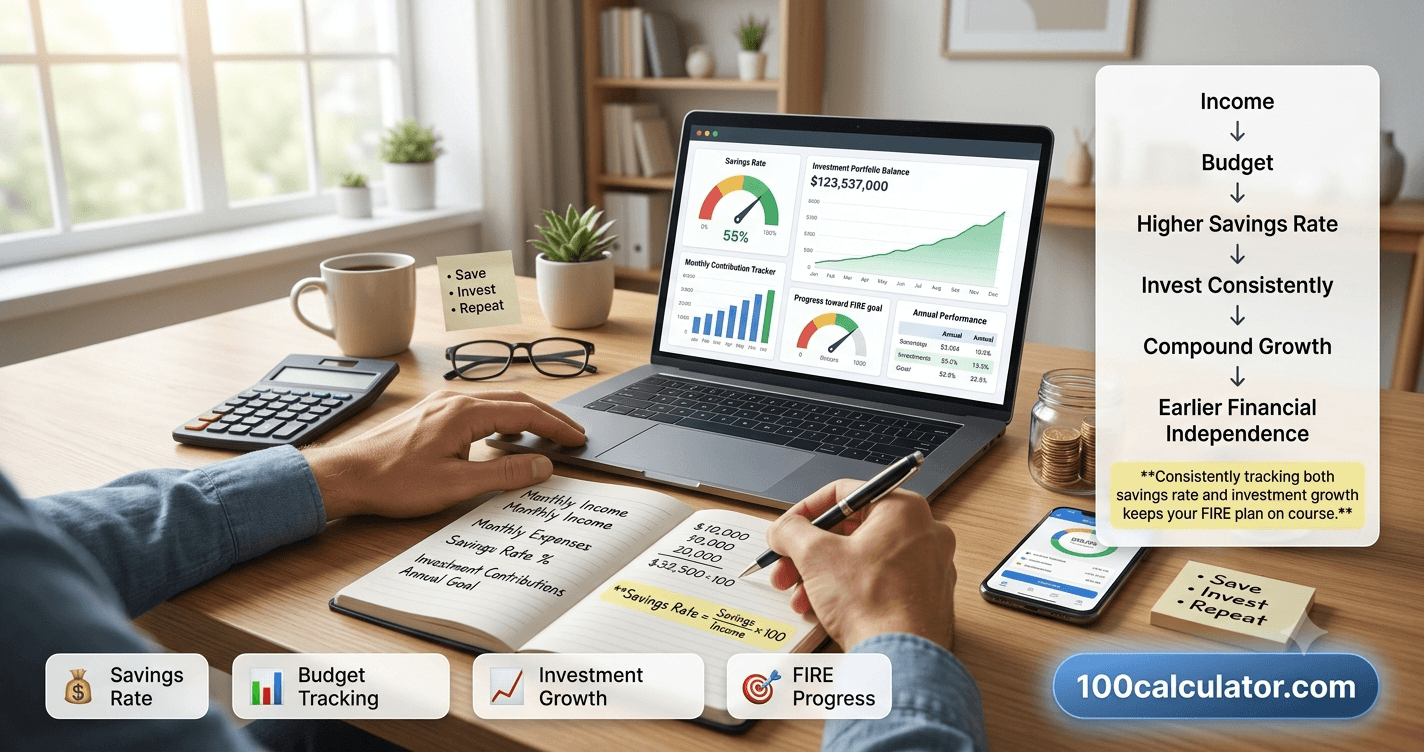
The table below shows roughly how savings rate connects to years until financial independence, based on the standard FIRE formula: a target of 25 times your annual expenses (the 4% rule, covered next), a 5% real annual return after inflation, and starting from $0 invested.
| Savings Rate | Approx. Years to Financial Independence |
|---|---|
| 10% | ~51 years |
| 15% | ~43 years |
| 20% | ~37 years |
| 25% | ~32 years |
| 30% | ~28 years |
| 40% | ~22 years |
| 50% | ~17 years |
| 60% | ~12 years |
| 70% | ~9 years |
Notice how much the curve bends at higher savings rates. Going from a 10% to a 20% savings rate cuts about 14 years off the timeline, but going from 50% to 70% only cuts about 8 years. Early progress on your savings rate matters most, which is part of why so much FIRE advice focuses on cutting big fixed costs early rather than income alone.
What Is a "FIRE Number"?
Your FIRE number is the amount of invested assets you need before you can safely stop relying on a paycheck. Most FIRE plans calculate it as 25 times your annual expenses, which comes directly from the 4% rule covered in the next section. Someone who spends $40,000 a year would need roughly $1,000,000 invested; someone spending $80,000 a year would need roughly $2,000,000. Your FIRE number has nothing to do with your income — two people earning identical salaries can end up with very different FIRE numbers depending on how much they actually spend.
For a deeper walkthrough of the calculation itself, see our guide on how to calculate your FIRE number for retirement, or plug your own numbers into 100 Calculator's FIRE Financial Independence Calculator to see an estimated timeline instantly.
The 4% Rule Explained
The 4% rule is the single most important piece of math in the FIRE movement. It's the reason FIRE plans target 25 times annual expenses, and it's worth understanding in plain terms rather than just taking it on faith.
What the 4% Rule Actually Says
The rule states that if you withdraw 4% of your investment portfolio in your first year of retirement, then adjust that dollar amount for inflation every year after, your money has a historically high probability of lasting at least 30 years, even accounting for market downturns along the way. Withdraw more than that consistently, and the odds of running out of money climb. Withdraw less, and your portfolio is more likely to keep growing even as you spend from it.
Where the 4% Rule Comes From
The 4% figure isn't a guess. Financial planner William Bengen first proposed it in a 1994 paper, after testing every 30-year retirement period in U.S. market history back to 1926 to find the highest withdrawal rate that would have survived even the worst starting years, such as retiring right before a major market downturn. (Wikipedia) Three professors at Trinity University confirmed and popularized his findings in a widely cited 1998 paper that's since become known simply as the Trinity Study. (Retirement Researcher) Their research found that a 4% withdrawal rate, paired with a balanced mix of stocks and bonds, succeeded in the large majority of historical 30-year periods tested.
Using the 4% Rule to Calculate Your Own FIRE Number
Turning the 4% rule into your own FIRE number is simple arithmetic: divide your annual expenses by 0.04, or multiply them by 25 — both give the same result. If you spend $50,000 a year, your FIRE number is $1,250,000. If you spend $30,000 a year, it drops to $750,000. Lowering your expenses shrinks your FIRE number twice over: it lowers the target itself, and it raises your savings rate at the same income, which gets you there faster too.
Free Online Tool
Skip the manual math
100 Calculator's 4 Percent Rule Calculator and FIRE Financial Independence Calculator both run right in your browser. Enter your expenses, savings, and expected return, and they estimate your FIRE number and timeline instantly, with no account required.
Curious whether the 4% rule still holds up given today's market conditions? Our guide on whether the 4% rule is still safe for retirees today digs into the criticisms and updates in more detail.
The Different Types of FIRE
Not everyone pursuing FIRE wants the same lifestyle at the end of it. Over time, the community settled on a few common variations, mostly differing in how much annual spending they're built around and how much of the traditional workforce they leave behind.
| Type | What It Targets | Best Fit For |
|---|---|---|
| Lean FIRE | A smaller FIRE number, built around minimal, intentional annual expenses | People comfortable with a frugal, low-cost lifestyle |
| Fat FIRE | A much larger FIRE number, built around a comfortable or upscale annual budget | People who want to maintain their current lifestyle, or better, in retirement |
| Coast FIRE | Enough invested early that compound growth alone reaches a full retirement number by a traditional age, without further contributions | People who want to stop saving aggressively but keep working to cover today's costs |
| Barista FIRE | A portfolio that covers most expenses, topped up with part-time or lower-stress work | People who want more freedom and flexibility without fully leaving the workforce |
None of these is inherently the "right" version of FIRE. Someone with a paid-off house in a low-cost area might land comfortably in Lean FIRE territory without feeling deprived, while someone supporting a family in an expensive city may need a Fat FIRE number just to maintain their current standard of living. The label matters less than picking a target that reflects how you actually want to live.
Steps to Start Your Own FIRE Journey
Here's a practical, step-by-step way to move from "interested in FIRE" to an actual plan:
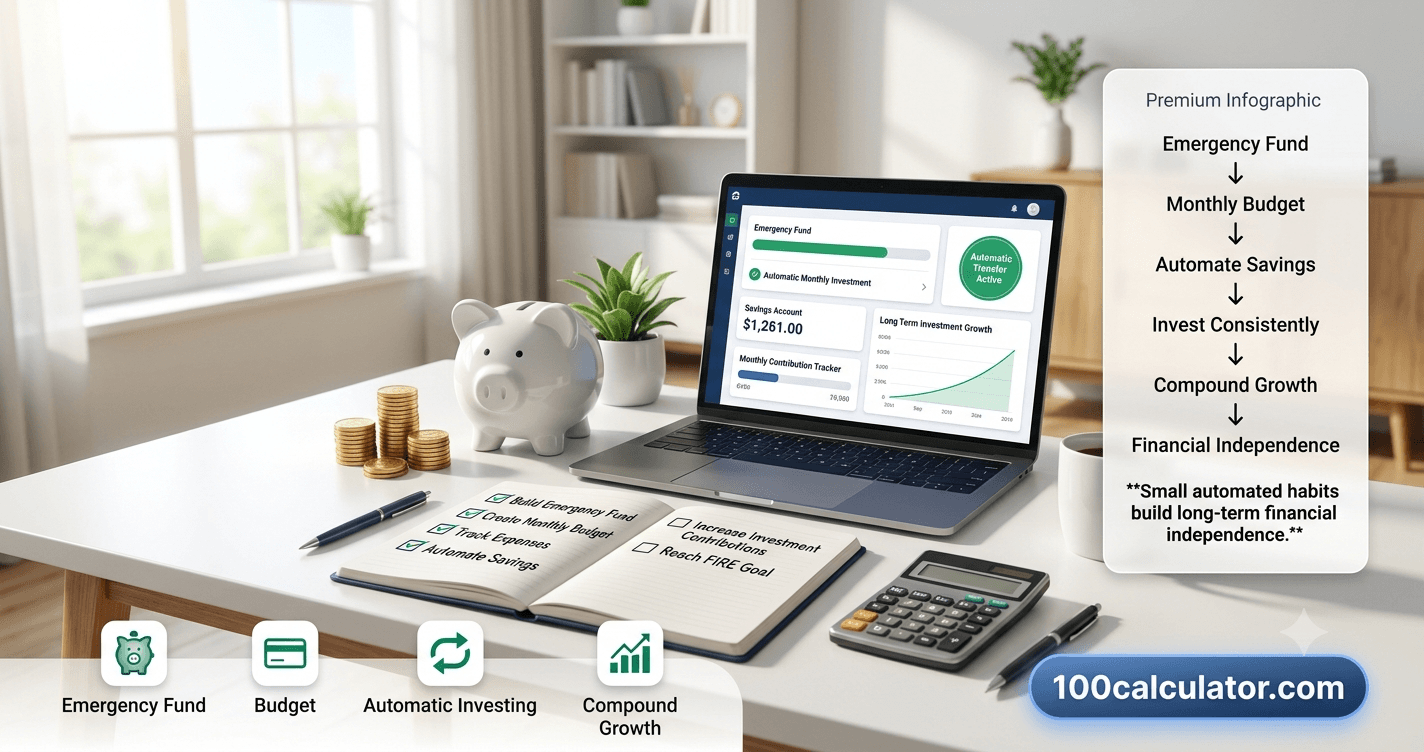
- Calculate your FIRE number. Take your realistic annual expenses and multiply by 25, or divide by your target withdrawal rate, to get a concrete number to build toward.
- Know your current savings rate. Add up everything you invest — retirement accounts, brokerage contributions, extra payments toward appreciating assets — and divide it by your after-tax income.
- Build a starter emergency fund first. Before investing aggressively, most FIRE educators recommend setting aside three to six months of expenses in cash, so a job loss or emergency doesn't force you to sell investments at a bad time.
- Cut fixed costs before cutting the things you enjoy. Housing, transportation, and recurring subscriptions are usually the biggest, most permanent wins, and they free up money without requiring daily willpower.
- Automate consistent investing. Set up automatic transfers into low-cost, diversified index funds so your savings rate doesn't depend on remembering to do it every month.
- Redirect raises toward investing, not just spending. Sending part of every raise or bonus straight to investments, instead of letting spending rise to match income, is one of the fastest ways to increase your savings rate over time.
- Revisit your number every year. Life circumstances change, so update your expenses, savings rate, and FIRE number annually instead of setting it once and forgetting it.
Free Online Tool
See compounding do the work
100 Calculator's Premium Compound Interest Calculator and Daily Compound Interest Calculator let you enter your own contribution amount and expected return, so you can see exactly how a higher savings rate changes your projected balance over time.
Pros and Cons of the FIRE Movement
Like most financial strategies built around discipline and delayed gratification, FIRE has real benefits and real trade-offs. Weighing both honestly makes for a better plan than treating it as an all-or-nothing lifestyle.
The Benefits of Pursuing FIRE
- More control over how you spend your working years, since continuing to work becomes optional rather than mandatory
- Built-in resilience against a single employer or industry, since your finances no longer depend entirely on one paycheck
- A financial cushion for career changes, sabbaticals, or health issues, even for people who never fully retire
- Habits — budgeting, investing consistently, living below your means — that hold up regardless of whether you reach full FIRE
- A concrete, calculable number to work toward, which turns a vague goal like "save more" into something measurable
The Drawbacks and Risks to Consider
- Extreme versions of FIRE can mean years of very tight budgeting, which isn't sustainable or enjoyable for everyone
- Retiring in your 30s or 40s means a much longer retirement horizon than the 30-year window the original 4% rule research tested
- Healthcare costs before Medicare eligibility at 65 can be a major, easy-to-underestimate expense in the U.S.
- A market downturn in your first few retirement years, known as sequence-of-returns risk, can hurt an early retiree more than someone with less time left to recover
- A high savings rate is harder to reach on a lower or irregular income, which is a common and fair criticism of the movement
Common Money Rules Compared to FIRE
FIRE isn't the only framework people use to organize their finances. A handful of other well-known money rules come up constantly in the same conversations, and it helps to know how they relate to what you've just read.
The 70/20/10 Rule (and How It Compares to 50/30/20)
The 70/20/10 rule is a simple budgeting split: 70% of after-tax income goes toward living expenses, 20% toward savings and investing, and 10% toward debt payoff or giving. It's often compared to the more widely known 50/30/20 rule, which splits income into 50% needs, 30% wants, and 20% savings.
Neither rule is objectively better than the other. 70/20/10 tends to fit higher cost-of-living areas or people focused on paying down debt, since it allows a larger share for fixed costs, while 50/30/20 draws a clearer line between needs and discretionary wants. Either way, both land on a similar starting savings rate of around 20%, which lines up with the low end of typical FIRE savings targets, but well below the 50% or higher rates that get people to FIRE within a decade or two. If part of your 10% debt bucket is going toward a loan, our guide on how to calculate simple interest on any loan amount can help you see exactly how much of each payment is interest versus principal.
The 3-6-9 Rule for Emergency Savings
A different "3-6-9 rule" shows up in personal finance, this one focused on emergency funds rather than budgeting splits. It suggests keeping three, six, or nine months of essential expenses in cash, depending on your situation: three months if you're single with no dependents and steady income, six months if you have dependents or a mortgage, and nine months if you're self-employed or the sole earner in your household. This lines up directly with the emergency-fund step in a FIRE plan covered earlier — building that cash cushion before investing aggressively protects your invested portfolio from being sold off at a bad time.
Rule of 69 (and Rule of 72) for Doubling Your Money
If you've heard someone mention "rule 69" in a finance context, they're most likely talking about a quick mental-math shortcut for estimating how long it takes an investment to double. Divide 69 by your expected annual rate of return to estimate the number of years, assuming continuous compounding. At a 9% return, for instance, money would take roughly 69 ÷ 9, or about 7.7 years, to double. Most everyday investors instead lean on the closely related rule of 72, which uses the same divide-by-return approach but is built for standard annual compounding and stays reasonably accurate across a wider range of typical investment returns.
Both shortcuts only work because of compound growth, not simple interest, which is exactly why FIRE plans lean so heavily on compounding rather than just saving cash. For the full comparison, see our guides on simple interest vs. compound interest and how daily compounding differs from monthly or yearly.
Warren Buffett's 90/10 Rule and "Rule No. 1"
Warren Buffett has become a go-to reference point in FIRE conversations, mostly because of two pieces of advice. In a 2013 letter to Berkshire Hathaway shareholders, he explained that he had instructed the trustee managing his wife's future inheritance to put 90% of the cash into a low-cost S&P 500 index fund and the remaining 10% into short-term government bonds, an allocation that's since become known as Buffett's 90/10 rule. (CFA Institute)
It's worth being careful about how far to stretch this specific advice, since Buffett designed it for his wife's particular, extremely well-funded situation, not as one-size-fits-all guidance for every retiree. Financial planners commonly point out that a 90% stock allocation carries more short-term volatility than most people withdrawing income year to year can comfortably sit through.
Buffett is also widely associated with a much simpler idea, often summarized as protecting your principal first and treating that as rule number one. It's less a specific formula than a mindset: before chasing higher returns, make sure a strategy doesn't put your core savings at serious risk of a permanent loss.
| Rule | Typical Split | Best For |
|---|---|---|
| 50/30/20 | 50% needs, 30% wants, 20% savings | A clear, simple line between needs and wants |
| 70/20/10 | 70% living expenses, 20% savings/investing, 10% debt or giving | Higher cost-of-living areas or aggressive debt payoff |
| 30/30/30/10 | Varies by source, but commonly 30% housing, 30% other essentials, 30% savings and investing, 10% discretionary spending | People who want a heavier built-in savings allocation than the two rules above |
None of these percentage-based rules are laws of finance. They're starting points. FIRE simply pushes the "savings" column much higher than any of them recommend by default, which is exactly why it produces a much shorter timeline to financial independence.
How Much Do You Actually Need to Retire?
This is the question the whole FIRE movement is built around, and the honest answer is that it depends entirely on your own spending, not on a single dollar figure that applies to everyone.
Can You Live Off the Interest on $1 Million?
Using the 4% rule, a $1,000,000 portfolio supports about $40,000 a year in sustainable withdrawals, adjusted for inflation each year after. That figure blends investment growth with a small drawdown of principal over time, which is different from living purely off interest or dividend income alone. A pure-interest approach typically supports a lower, less predictable amount, since it depends on current interest rates and yields rather than total portfolio growth. For most people, spending from total returns — the approach the 4% rule uses — is more realistic and flexible, but it does mean the portfolio itself may shrink and grow slightly from year to year rather than staying perfectly stable. If you want to model a straightforward interest-income scenario for comparison, 100 Calculator's Premium Simple Interest Calculator can show what a given rate generates on a lump sum.
Is $2 Million Enough to Retire at 70?
At a 4% withdrawal rate, $2,000,000 supports about $80,000 a year, which is a comfortable income for most households once you factor in Social Security and any pension income. Retiring at 70 also works in your favor mathematically, since a shorter expected retirement horizon than the 4% rule's 30-year benchmark generally supports a somewhat higher, still historically reasonable, withdrawal rate. Whether $2 million is genuinely "enough" ultimately depends on your fixed costs, health, location, and any dependents you're supporting financially. It's a strong starting point for many people, but not a universal guarantee, and it's worth running your own numbers rather than relying on a round figure.
| Portfolio Size | Annual Income at 4% |
|---|---|
| $500,000 | $20,000 |
| $1,000,000 | $40,000 |
| $1,500,000 | $60,000 |
| $2,000,000 | $80,000 |
| $2,500,000 | $100,000 |
For more on how this framework holds up across different market conditions, see our guide on how the 4% rule works for retirement planning.
The Average Retirement Age and Why It Matters for FIRE
Most people don't retire exactly when they plan to. Gallup's long-running tracking on this question consistently finds that non-retired Americans expect to retire around age 66, while people who are already retired report having stopped working closer to 61 on average, a gap that has held fairly steady for years. (Gallup) The most common reasons behind that gap — health problems, layoffs, and caregiving needs — are largely outside anyone's control. That's one of the strongest practical arguments for FIRE: building financial flexibility well before you're forced to use it, rather than assuming you'll get to choose your own retirement date.
Retirement Regrets to Avoid
Surveys of retirees consistently turn up the same handful of regrets, and most of them are avoidable with earlier planning. A few patterns show up again and again across multiple studies:
- Not saving enough, or not saving consistently — this is the single most frequently cited regret across nearly every major retirement survey
- Starting too late — many retirees say they wish they had begun investing in their 20s or early 30s instead of waiting
- Retiring earlier than planned, but not by choice — health problems, layoffs, and caregiving needs push a majority of retirees out of the workforce sooner than they expected
- Not knowing enough about retirement investing — limited financial literacy shows up repeatedly as something retirees wish they had addressed earlier
- Carrying high-interest debt into retirement, which limits how much income is actually available to spend each month
None of these regrets are unique to people who never thought about retirement. Even careful planners sometimes look back and wish they had started a year or two earlier. The takeaway isn't guilt over past decisions; it's evidence that starting now, even imperfectly, tends to beat waiting for the "right" moment.
Related Calculators
Put what you just read into practice, try these free tools instantly, no sign-up required.
Premium Compound Interest Calculator
Calculate compound interest growth on your investments over time.
Premium Simple Interest Calculator
Quickly calculate simple interest earned or owed on a principal.
Daily Compound Interest Calculator
See how daily compounding interest grows your savings over time.
FIRE Financial Independence Calculator
Plan your path to financial independence and early retirement.
4 Percent Rule Calculator
Estimate safe retirement withdrawals using the 4% rule.
Common FIRE Mistakes
Beyond general retirement regrets, people specifically pursuing FIRE tend to run into a handful of avoidable missteps:
- Ignoring healthcare costs before Medicare eligibility — this is one of the most consistently underestimated expenses for anyone retiring before 65 in the U.S.
- Treating 4% as a floor instead of a guideline — spending up to, or beyond, the withdrawal rate every year erodes the safety margin the rule is built on
- Not planning for sequence-of-returns risk — a market downturn in the first few years of retirement can do more lasting damage than the same downturn happening later
- Being too rigid with spending — extreme frugality that isn't sustainable can lead to burnout and abandoning the plan altogether
- Forgetting about taxes — withdrawals from tax-deferred accounts like a traditional 401(k) are still taxable income, which changes how much you actually get to spend
- Comparing your number to someone else's — a FIRE number built for a Lean FIRE blogger in a low-cost area doesn't apply to a family with a mortgage in an expensive city
Many of these mistakes echo a broader pattern that shows up in personal finance generally, not just FIRE. See our related guide on compound interest mistakes that cost you money for more on how small missteps add up over time, in the wrong direction.
Building a Plan That Fits Your Life
FIRE doesn't have to mean an all-or-nothing sprint to retire by 35. The math behind it — a higher savings rate, consistent investing, a clear number to target — is useful at any intensity level.
Full FIRE, with a 50% or higher savings rate and a goal of leaving full-time work within a decade, is one end of a spectrum. A slower, more moderate approach applies the same principles at a savings rate closer to 20% to 30%, aiming for a traditional-length career with more breathing room along the way and a comfortable retirement rather than an unusually early one. Both versions use the same formula: know your number, know your savings rate, and let compound growth and time do most of the remaining work.
To see the effect of compounding over your own timeline, our guide on how compound interest grows your money over time walks through the mechanics in more detail, and our piece on why daily compounding can boost your savings growth covers a smaller, second-order factor worth knowing once your basics are in place.
Whatever pace you choose, the same short list of decisions matters most: spend meaningfully less than you earn, invest the difference consistently in low-cost, diversified funds, and give the plan enough years to work. 100 Calculator's FIRE Financial Independence Calculator is a good place to turn those decisions into an actual projected date.
When to Talk to a Financial Professional
Everything in this guide is meant to help you understand the concepts and run your own numbers, not to replace individual financial advice. A few situations are worth bringing to a licensed financial advisor, tax professional, or both:
- You're within a few years of your FIRE number and want a second opinion on your withdrawal strategy
- Your income includes complex elements like stock compensation, self-employment, or a significant windfall
- You're weighing early withdrawals from retirement accounts, which can carry penalties and tax consequences that are easy to miscalculate on your own
- You're supporting dependents, aging parents, or a blended family with competing financial priorities
- Health coverage before Medicare eligibility is a major unknown in your plan
A good advisor won't take away your ability to make your own decisions. They'll stress-test the plan you've already built and help flag the blind spots that are hard to see from the inside.
Financial disclaimer: This article is for general educational purposes only and isn't a substitute for individualized financial, investment, or tax advice. The examples, formulas, and figures here are illustrations based on stated assumptions, not guarantees of future performance. Savings rates, investment returns, and withdrawal strategies that work well for one person's circumstances may not be appropriate for another. Always consult a licensed financial advisor or tax professional before making significant decisions about saving, investing, or retiring early.
Sources & References
This guide draws on the following sources for the historical and statistical claims referenced above:
More From Finance Guide
Still building your understanding of compounding, interest, and retirement math? These related guides go deeper into the topics covered above.
Frequently Asked Questions
What is the FIRE movement and what does FIRE stand for?
FIRE stands for Financial Independence, Retire Early. It's a personal finance approach built around saving and investing a much larger share of income than typical financial advice recommends, often 50% or more, so your investments can eventually cover your living expenses without a paycheck. The goal is reaching that point of financial independence far sooner than a traditional retirement age, though many people who reach FIRE keep working in some form, just by choice rather than necessity.
What is the 4% rule in the FIRE movement?
The 4% rule says that if you withdraw 4% of your investment portfolio in your first year of retirement, then adjust that dollar amount for inflation every year after, your money has a historically high probability of lasting at least 30 years. It comes from research by financial planner William Bengen in 1994, later confirmed by the Trinity Study in 1998. Most FIRE plans use it in reverse, multiplying annual expenses by 25 to calculate a target savings number.
How much money do I need to retire early?
There's no single dollar amount, since it depends entirely on your annual expenses. The standard FIRE formula multiplies your yearly spending by 25, based on the 4% rule. Someone spending $40,000 a year would need roughly $1,000,000 invested, while someone spending $80,000 a year would need roughly $2,000,000. Lowering your expenses reduces the number you need to reach twice over, since it shrinks both your target and the amount you need to save each month.
Can I live off the interest on $1 million?
Using the 4% rule, a $1,000,000 portfolio supports about $40,000 a year in sustainable, inflation-adjusted withdrawals. That figure comes from spending a mix of investment growth and a small amount of principal over time, which is different from living purely off interest or dividend payments alone. A pure-interest approach typically generates a lower, less predictable amount, since it depends on current rates and yields rather than total portfolio returns.
Is $2 million enough to retire at 70?
At a 4% withdrawal rate, $2,000,000 supports roughly $80,000 a year, which is a comfortable income for many households once Social Security and any pension are added in. Retiring at 70 also helps mathematically, since a shorter retirement horizon than the 4% rule's 30-year benchmark generally supports a somewhat higher withdrawal rate. Whether it's genuinely enough depends on your fixed costs, health, and location, so it's worth running your own numbers rather than relying on a round figure.
What are the different types of FIRE?
The most common types are Lean FIRE, built around minimal annual expenses and a smaller FIRE number; Fat FIRE, built around a larger, more comfortable budget; Coast FIRE, where early aggressive saving lets compound growth alone reach a traditional retirement number without further contributions; and Barista FIRE, where a portfolio covers most expenses and part-time or lower-stress work fills the rest. None is inherently better than the others — the right fit depends on the lifestyle you actually want.
What is a good savings rate to reach FIRE?
There's no single required savings rate, but the FIRE community generally targets 50% or higher to reach financial independence within 10 to 15 years. Even much lower rates still help significantly: a 20% savings rate points toward roughly 37 years to financial independence under standard FIRE assumptions, while 30% cuts that to around 28 years. Any increase in your savings rate shortens your timeline, so it's worth treating as a spectrum rather than an all-or-nothing target.
What is the average retirement age?
Gallup's long-running surveys find that non-retired Americans typically expect to retire around age 66, while people who are already retired report having stopped working closer to 61 on average. That gap has held fairly steady for years, and it's usually driven by circumstances outside anyone's control, like health problems, layoffs, or caregiving needs, rather than people choosing to retire earlier than planned.
What is Warren Buffett's 90/10 rule?
In a 2013 shareholder letter, Warren Buffett explained that he had instructed the trustee managing his wife's future inheritance to put 90% of the cash into a low-cost S&P 500 index fund and the remaining 10% into short-term government bonds. It's since become known as his 90/10 rule. It was designed for his wife's specific, well-funded circumstances, so most financial planners suggest treating it as an illustration of simple, low-cost investing rather than a literal blueprint for every retiree.
What is the biggest retirement regret people have?
Across multiple retirement surveys, the most frequently cited regret is simply not saving enough, or not saving consistently enough, during working years. Starting too late and not knowing enough about retirement investing also show up repeatedly. Many retirees additionally report leaving the workforce earlier than they had planned, usually due to health issues or job loss rather than choice, which is one reason FIRE emphasizes building financial flexibility well before it's needed.
Is the FIRE movement realistic for average earners?
FIRE is more achievable for people with higher incomes or lower cost-of-living areas, since a high savings rate is easier to sustain when there's more room between income and essential expenses. That said, the underlying principles — spending intentionally, investing consistently, and tracking a concrete savings rate — still help at any income level, even if the realistic timeline looks more like a modestly earlier retirement than a full exit from work in your 30s.
What are the main criticisms of the FIRE movement?
The most common criticisms are that FIRE requires a savings rate that's out of reach for lower or irregular incomes, that early retirees face a much longer retirement horizon than the 30-year window the 4% rule was tested on, and that pre-Medicare healthcare costs are easy to underestimate. Critics also point out that the movement's most visible voices skew toward high earners in specific industries, which doesn't reflect every reader's starting point.
Do I need a financial advisor to pursue FIRE?
It isn't required, but it can help, especially as your portfolio grows or your situation gets more complex. A financial advisor is particularly useful for stress-testing your withdrawal strategy, navigating early withdrawals from retirement accounts, and planning around taxes, since mistakes in these areas can be costly and hard to reverse. Many people manage the saving and investing phase on their own and bring in a professional closer to their target date.
Can I still get Social Security if I retire early through FIRE?
Yes, though the timing and amount depend on your work history and when you choose to claim benefits. Retiring early through FIRE doesn't disqualify you from Social Security, but stopping work sooner can mean fewer years of earnings counted toward your benefit calculation. Most FIRE plans treat Social Security as a bonus on top of their invested portfolio rather than a primary income source, since eligibility doesn't begin until your early 60s at the earliest.
About 100 Calculator
100 Calculator is a free hub of online calculators and educational guides covering health, finance, trading, crypto, education, and more. Every tool is built to be fast, accurate, and genuinely free, with no account or signup required.
We built this guide, and tools like the FIRE Financial Independence Calculator and 4 Percent Rule Calculator referenced throughout it, to make big financial questions a little easier to work through on your own terms. Head back to the 100 Calculator homepage to explore the full library of tools, or learn more about the team behind them on our About Us page.