How Daily Compounding Differs from Monthly or Yearly
A plain-English breakdown of how compounding frequency changes what you actually earn or owe, with real numbers comparing daily, monthly, and yearly compounding side by side.
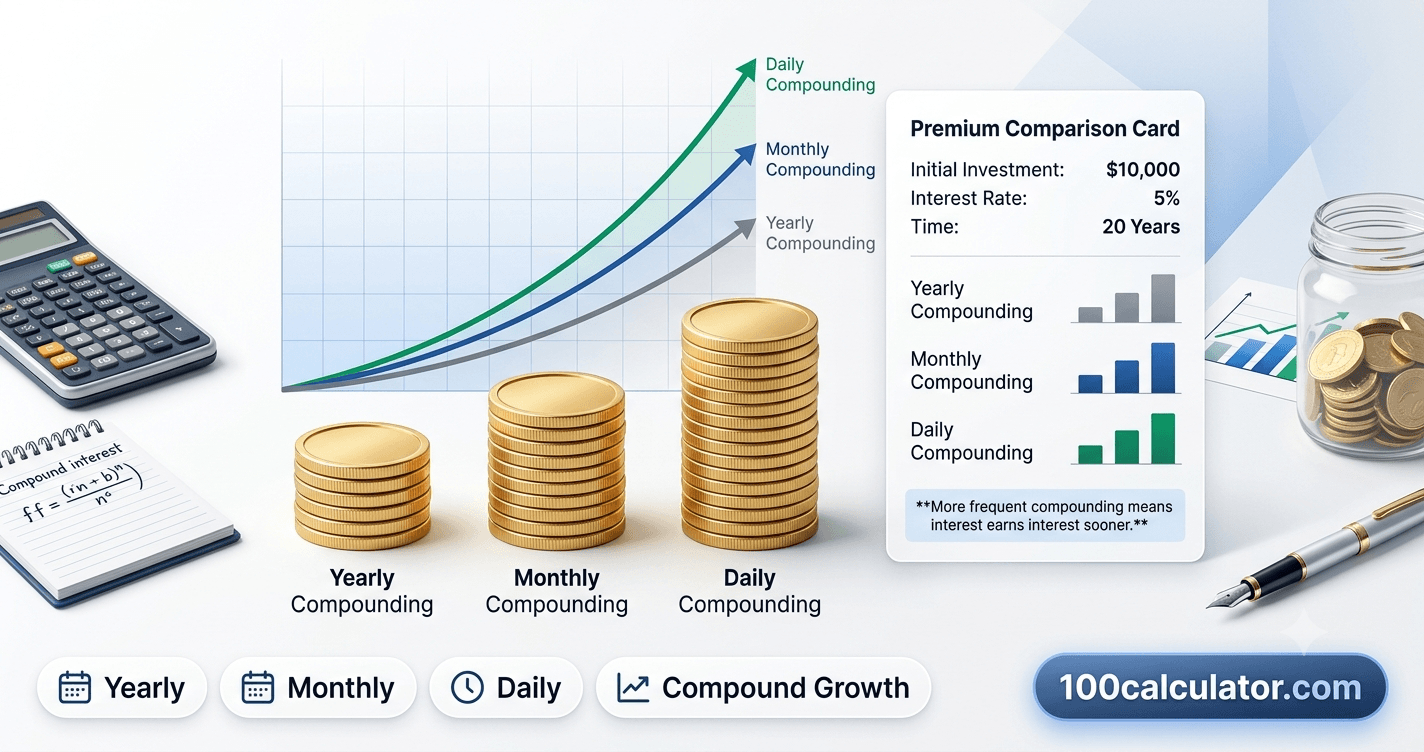
Ask anyone with a savings account or a loan and they'll tell you interest "compounds." Far fewer people can tell you what that actually means in dollars, or why a bank advertising daily compounding isn't automatically a better deal than one that compounds monthly.
Compounding frequency is simply how often interest gets calculated and added to your balance — once a year, once a month, or once a day — and the more often it happens, the sooner each bit of interest starts earning interest of its own. A 5% annual rate compounded daily will always earn a little more than the same 5% compounded yearly, because daily compounding turns more of that rate into real, credited interest throughout the year.
The tricky part is that the gap between compounding frequencies isn't always as big as people assume. Going from yearly to monthly compounding usually makes a real difference. Going from monthly to daily barely moves the needle by comparison. Neither of those facts is obvious just from looking at a percentage sign, which is exactly why so many people get tripped up comparing a 12% annual rate against 1% a month, or wondering whether their bank's daily compounding is quietly making up for a lower headline rate.
This guide walks through how yearly, monthly, and daily compounding each work, shows the real dollar differences using a worked $10,000 example, and answers the specific rate-conversion questions people run into most, including whether 1% a month really equals 12% a year (it doesn't, and we'll show you why). By the end, you'll be able to look at any compounding schedule and know what it actually means for your money.
What Compounding Frequency Actually Means
Before comparing daily, monthly, and yearly compounding, it helps to be clear on what compounding is doing in the first place.
With simple interest, you only ever earn interest on your original amount, your principal. Our guide on simple interest vs. compound interest covers this in more detail, but the short version is that simple interest never changes: you earn the same dollar amount every period, no matter how long you've held the money.
Compound interest works differently. Once interest is added to your balance, that interest becomes part of the balance future interest gets calculated on. Interest earns interest. That's the whole idea, and "compounding frequency" is just how often this interest-on-interest process happens over a year.
The Compound Interest Formula, Broken Down
Every compounding calculation, no matter how frequent, comes from the same formula:
A = P(1 + r/n)nt
- A is the final amount, after interest
- P is your principal, the amount you start with
- r is the nominal annual interest rate, written as a decimal (5% becomes 0.05)
- n is the number of compounding periods per year — the "frequency" this article is about
- t is the number of years
The letter that decides everything discussed here is n. Change n, and you change how much interest actually accumulates, even if r and t stay exactly the same.
Compounding Frequency by Name
Financial products describe compounding frequency in words rather than making you count periods yourself. Here's what each term means for n:
| Term | What It Means | Value of n |
|---|---|---|
| Annually (Yearly) | Once per year | 1 |
| Semi-annually | Twice per year | 2 |
| Quarterly | Four times per year | 4 |
| Monthly | Twelve times per year | 12 |
| Daily | 365 times per year | 365 |
So if you're asking what number "annually" represents in the compound interest formula, the answer is simple: n equals 1. When a product says it's "compounded monthly," that always means n equals 12, twelve compounding periods a year, one per month. Compounded daily almost always means n equals 365, matching the days in a standard year. A small number of financial contracts use a 360-day count for certain calculations, but that's the exception rather than the rule.
Why the Number of Compounding Periods Changes Your Return
It helps to picture what's physically happening. Imagine $10,000 earning 8% a year.
With annual compounding, that 8% is calculated once, at the very end of the year, and added to your balance. For the entire 365 days leading up to that moment, your balance just sits there unchanged. With monthly compounding, roughly 0.67% (8% divided by 12) gets added every single month, and each of those small additions then earns its own interest for the rest of the year. With daily compounding, an even smaller slice, about 0.022%, gets added every day, and that tiny amount starts compounding immediately.
The more frequently interest gets added, the sooner it starts earning interest on itself, which is why more frequent compounding always produces a slightly higher return for a saver, and a slightly higher cost for a borrower, assuming the nominal rate stays the same.
Nominal Rate vs. Effective Annual Rate
This is where a lot of confusion starts. The nominal rate is the plain percentage a product advertises, like "8% annual interest." The effective annual rate (EAR), often shown as APY on savings products, is what you actually earn once compounding is factored in.
At 8% nominal:
- Compounded annually, the EAR is exactly 8%, since there's no compounding within the year to boost it.
- Compounded monthly, the EAR rises to about 8.30%.
- Compounded daily, the EAR rises further to about 8.33%.
Notice the EAR keeps climbing as compounding gets more frequent, but by smaller amounts each time. That pattern, diminishing returns as frequency increases, is the single most useful thing to understand about compounding frequency, and it's exactly what the next section shows in dollar terms.
How Yearly (Annual) Compounding Works
Annual compounding is the simplest version: interest is calculated once, at the end of each year, using whatever your balance was at the start of that year.
Say you deposit $10,000 at 8%, compounded annually. After year one, you'd have $10,800. That new $10,800 balance is what earns interest in year two, growing to $11,664. Each year's growth builds on the last, but only once a year.
Annual compounding shows up less often than you might expect in everyday products. You're most likely to run into it with certain bonds, some fixed annuities, and a handful of long-term certificates of deposit (CDs) that pay interest once a year instead of crediting it monthly. It's also the easiest version to calculate by hand, which is why textbooks tend to start here before introducing more frequent compounding.
How Monthly Compounding Works
Monthly compounding divides your nominal annual rate by 12 and applies that smaller rate to your balance every month. On $10,000 at 8%, roughly 0.667% gets added each month, and each month's interest is calculated on the balance left over from the month before, not on the original $10,000.
Monthly compounding is genuinely common. It's the default for most mortgages and auto loans, many credit card balances calculate interest on a similar monthly or even daily cycle, and a large share of standard savings accounts and CDs credit interest monthly even if they calculate it daily behind the scenes.
Because monthly compounding sits between annual and daily, it's a useful middle ground to understand: it captures most of the benefit of frequent compounding without needing daily-level calculation. On our $10,000 example, monthly compounding for 10 years grows to about $22,196, already most of the way to what daily compounding delivers, which we'll get to next.
How Daily Compounding Works
With daily compounding, your nominal annual rate is divided by 365, and that tiny daily rate is added to your balance every single day, including weekends and holidays. On $10,000 at 8%, that's about 0.022% credited daily, a fraction of a cent at first, but it adds up because every day's interest immediately starts earning its own interest.
Daily compounding is the standard for most high-yield savings accounts and many money market accounts today, largely because it's simple for banks to automate and it produces a small but real edge for savers compared to monthly compounding. Some CDs also compound daily internally, even if they only display or pay out the interest monthly.
If you want to see exactly how a specific deposit and rate will grow, our Daily Compound Interest Calculator runs this math automatically. Enter your principal, rate, and time frame, and it handles the day-by-day calculation instead of asking you to work through the formula by hand.
Daily vs Monthly vs Yearly: The Numbers Side by Side
Explanations only go so far. The clearest way to see how compounding frequency plays out is with real numbers. Here's $10,000 growing for 10 years at a fixed 8% nominal annual rate, compared across five common compounding schedules.
| Compounding Frequency | Periods per Year (n) | Balance After 10 Years | Effective Annual Rate |
|---|---|---|---|
| Annually | 1 | $21,589.25 | 8.00% |
| Semi-annually | 2 | $21,911.23 | 8.16% |
| Quarterly | 4 | $22,080.40 | 8.24% |
| Monthly | 12 | $22,196.40 | 8.30% |
| Daily | 365 | $22,253.46 | 8.33% |
Two things stand out. First, every step up in frequency does increase your balance: daily compounding really is the best of these five options, dollar for dollar. Second, the size of each improvement shrinks fast. Moving from annual to monthly compounding adds about $607 over 10 years. Moving from monthly all the way to daily compounding, a much bigger jump in frequency, adds only about $57 more.
That's the diminishing-returns pattern from the last section, made concrete: whether an account compounds monthly or daily barely matters next to whether it compounds at all versus just once a year. If you're comparing two accounts and one shows a slightly higher rate but compounds monthly instead of daily, the rate difference is almost always more important than the compounding-frequency difference.
Converting Between a Monthly Rate and an Annual Rate
This is where a lot of the confusion behind questions like "is 1% a month the same as 12% a year?" actually comes from. The short answer is no, and the reason is compounding itself.
If you simply multiply a monthly rate by 12, you get the nominal annual rate, the number lenders quote before compounding is applied. But if that monthly rate is actually compounding every month, the real, effective annual rate is always a bit higher than the simple multiplication suggests.
Take 1% per month. Multiply by 12 and you get a nominal 12% a year. But compound that 1% monthly for 12 straight months, and the effective annual rate works out to about 12.68%, not 12%. That extra 0.68 percentage points comes entirely from interest earning interest within the year.
The same pattern holds at higher rates, and it gets more pronounced the higher the monthly rate is:
| Monthly Rate | Nominal Annual (Rate × 12) | Effective Annual Rate (Compounded) |
|---|---|---|
| 1% | 12% | 12.68% |
| 1.5% | 18% | 19.56% |
| 2% | 24% | 26.82% |
Nominal Rate vs. APR vs. APY
You'll sometimes see this same idea described with different labels. APR (annual percentage rate) is typically the nominal rate; it doesn't factor in compounding. APY (annual percentage yield) is the effective rate, and U.S. banks are required by federal rules to disclose it on savings products, so you can compare accounts on equal footing no matter how often each one compounds. If two accounts both show you an APY, you don't need to do any of this conversion math yourself; the compounding frequency is already built into that single number.
The 8-4-3 Rule of Compounding, Explained
The 8-4-3 rule is a popular rule of thumb, especially among people using a Systematic Investment Plan (SIP), a recurring, fixed monthly investment, to build wealth over the long run. It isn't a formula you'd plug into the compound interest equation above; it's a teaching tool for understanding how compounding accelerates the longer you stay invested.
Assuming a consistent monthly investment and an average annual return of around 12% (a commonly used, though never guaranteed, long-term equity assumption), the rule breaks a 15-year investment horizon into three stages:
- Years 1–8: Growth is steady but can feel slow. Your invested amount and your returns are still roughly comparable in size.
- Years 9–12 (the next 4 years): Growth visibly picks up, since your returns are now large enough to generate meaningful returns of their own.
- Years 13–15 (the final 3 years): Growth accelerates the most, as the accumulated returns from earlier years compound on top of each other.
The 8-4-3 rule isn't specific to compounding frequency; it's about time and consistency. But it illustrates the same underlying mechanism this whole article is about: interest, or investment returns, earning returns of their own, given enough time. Treat it as an illustration rather than a promise, since it assumes a steady 12% return that real markets rarely deliver in a straight line.
What Warren Buffett Says About Compound Interest
Warren Buffett has talked about compounding for decades, usually through the same image: a snowball rolling down a long, snow-covered hill. The snowball picks up more snow, and gets bigger faster, the longer and farther it rolls. His point isn't about any single year's return; it's that time is the ingredient that makes compounding powerful. Buffett has pointed out that the overwhelming majority of his own net worth was built after he turned 65, once decades of compounding had given his "snowball" enough size to grow dramatically.
Buffett's 90/10 Rule
Separately, Buffett is known for what's often called his "90/10 rule." In his 2013 Berkshire Hathaway shareholder letter, he laid out instructions for how a trustee should invest money left to his wife after his death: 90% in a low-cost S&P 500 index fund, and 10% in short-term government bonds.
It's worth being clear that this is an asset-allocation idea, not a rule about compounding frequency. It doesn't say anything about daily versus monthly compounding. What it shares with the rest of this guide is the same underlying principle: keep costs low, stay invested, and give compounding as many years as possible to work, rather than trying to optimize smaller details like exactly how often interest is credited.
A Related Idea: The 70/20/10 Rule for Money
You may also come across the "70/20/10 rule," which is a budgeting framework, not a compounding rule. It suggests splitting after-tax income roughly into 70% for living expenses, 20% for savings and investing, and 10% for debt repayment or giving. It's worth mentioning here because that 20% savings portion is the money that actually gets to benefit from compound interest over time; the more consistently it's set aside, the more compounding has to work with.
Related Calculators
Put what you just read into practice, try these free tools instantly, no sign-up required.
Premium Compound Interest Calculator
Calculate compound interest growth on your investments over time.
Premium Simple Interest Calculator
Quickly calculate simple interest earned or owed on a principal.
Daily Compound Interest Calculator
See how daily compounding interest grows your savings over time.
FIRE Financial Independence Calculator
Plan your path to financial independence and early retirement.
4 Percent Rule Calculator
Estimate safe retirement withdrawals using the 4% rule.
Common Mistakes When Comparing Compounding Frequencies
A few habits consistently lead people to misjudge what compounding frequency actually means for their money.
- Comparing nominal rates instead of effective rates. An account offering 6% compounded monthly isn't directly comparable to one offering 6.15% compounded annually just from the headline numbers alone; convert both to the same effective annual rate first.
- Assuming daily compounding is always dramatically better. As the comparison table above shows, the jump from monthly to daily compounding is usually small. A meaningfully higher rate on a monthly-compounding account will almost always beat a lower rate compounded daily.
- Ignoring fees. A small compounding-frequency advantage disappears fast next to an account maintenance fee, an early withdrawal penalty, or a higher expense ratio on an investment fund.
- Confusing "calculated daily" with "compounded daily." Some accounts calculate interest daily but only credit and compound it monthly. Read the actual account terms rather than assuming from a single word in the marketing.
- Forgetting taxes. Interest earned in a regular, taxable account is usually taxed in the year it's earned, which reduces the amount left to keep compounding, regardless of how often the account itself compounds.
Which Compounding Frequency Should You Actually Look For?
The honest answer is that compounding frequency should rarely be the deciding factor on its own.
If you're saving or investing, look first at the APY, since it already reflects both the nominal rate and the compounding frequency in one number you can compare across accounts. Between two accounts with the same APY, it genuinely doesn't matter whether one compounds monthly and the other compounds daily; they'll pay out the same. Between two accounts with different APYs, the one with the higher APY wins, regardless of how it compounds.
If you're borrowing, more frequent compounding works against you, not for you, so pay attention to whether a loan compounds monthly, daily, or continuously, especially on revolving debt like credit cards, where daily compounding on an unpaid balance can add up faster than the same nominal rate compounded monthly.
Free Online Tools
See the actual dollar impact for your own numbers
Our Premium Compound Interest Calculator lets you test any combination of principal, rate, frequency, and term, and our daily compounding calculator is built specifically around the day-by-day version of this math. Comparing against a fixed, non-compounding return? Our Premium Simple Interest Calculator makes that side-by-side comparison easy.
If your goal is longer-term, like building toward financial independence, the compounding frequency of any single account matters far less than starting early and staying consistent, the same idea behind Buffett's snowball and the 8-4-3 rule above. Our guides on the FIRE movement and calculating your FIRE number go deeper into building that kind of long-term plan.
Financial disclaimer: This article is for general educational purposes only and isn't financial or investment advice. Interest rates, account terms, and product features vary by institution and can change over time. Always review the specific terms of an account or loan, and consider talking with a qualified financial advisor before making decisions based on any calculation shown here.
More From Our Finance Guide
Want to keep building your understanding of interest, saving, and long-term investing? These related guides dig deeper into the topics touched on above.
Frequently Asked Questions
What is compounding frequency, and why does it matter?
Compounding frequency is how often interest gets calculated and added to your balance each year, such as annually, monthly, or daily. It matters because interest that's added more often starts earning its own interest sooner. Two accounts can quote the same 8% annual rate, yet the one compounding daily will grow slightly faster than the one compounding once a year, since it converts more of that stated rate into actual, earned interest throughout the year.
How does daily compounding work?
With daily compounding, the annual rate is divided by 365, and that small slice of interest is added to your balance every single day. Each day's interest is calculated on the new, slightly larger balance from the day before, not just on your original deposit. Over a full year, this adds up to a few dollars more per $10,000 than monthly compounding, and noticeably more than compounding just once a year.
Which is better: daily compounding or monthly compounding?
Daily compounding is technically better, but the difference is usually small. On $10,000 at 8% for 10 years, daily compounding earns about $57 more than monthly compounding, compared to about $607 more than compounding just once a year. In practice, compounding frequency matters far less than the actual rate you're being offered, so compare the annual percentage yield (APY) first.
Is it better to have interest compounded monthly or annually?
Monthly compounding is better for savers and worse for borrowers, compared to annual compounding, because interest is added to the balance 12 times a year instead of once. On $10,000 at 8% over 10 years, monthly compounding grows to about $22,196 versus about $21,589 with annual compounding, a difference of roughly $607. If you're paying interest on debt, annual compounding would actually cost you less.
Is compounded monthly the same as 12 times a year?
Yes. Compounded monthly always means interest is calculated and added to the balance 12 times per year, once every month. In the compound interest formula A = P(1 + r/n)nt, monthly compounding sets n equal to 12. Each month's interest is one-twelfth of the nominal annual rate, applied to whatever the balance has grown to by that point.
Is compounded daily the same as 365 times a year?
Almost always, yes. Most calculators and financial institutions treat compounded daily as 365 compounding periods per year (366 in a leap year), matching the actual number of days. A small number of financial products use a 360-day convention for certain interest calculations, but for everyday savings accounts and the standard compound interest formula, 365 is the usual assumption.
Is 1% per month the same as 12% per year?
Not quite. A flat 1% per month adds up to 12% over a year only if you don't compound it. Once you compound 1% monthly for 12 months, the effective annual rate works out to about 12.68%, not 12%, because each month's interest is calculated on a slightly larger balance than the month before.
Is 1.5% per month the same as 18% per year?
No. Multiplying 1.5% by 12 gives you 18%, but that's the nominal rate, not what you actually earn. Once compounding is factored in, 1.5% per month for 12 months works out to an effective annual rate of about 19.56%, roughly one and a half percentage points higher than the simple 18% figure.
Is 2% per month the same as 24% per annum?
No. Multiplying 2% by 12 months gives a nominal rate of 24%, but compounding that 2% monthly actually produces an effective annual rate of about 26.82%. The higher the monthly rate, the bigger the gap becomes between the simple, multiplied-out figure and what compounding actually delivers.
What does "18% per annum" mean?
"Per annum" simply means "per year," so "18% per annum" is stating an annual interest rate of 18%. On its own, that phrase doesn't tell you how often the interest compounds; it could be compounded annually, monthly, or daily. To know your real return, you also need the compounding frequency, since 18% compounded monthly grows faster than 18% compounded once a year.
What is the 8-4-3 rule of compounding?
The 8-4-3 rule is a popular rule of thumb, mainly used to illustrate how consistent monthly investing, like a recurring SIP, grows over 15 years at an assumed return of around 12% a year. It splits that period into three stages: roughly 8 years of steady, unremarkable-looking growth, another 4 years of visibly faster growth, and a final 3 years where compounding produces the biggest gains of all. It's a teaching tool, not a guarantee, since real returns vary year to year.
What does Warren Buffett say about compound interest, and what is his 90/10 rule?
Buffett often compares compound interest to a snowball rolling down a long, snowy hill: it picks up size the longer and farther it rolls, which is why he emphasizes starting early and staying invested. Separately, his 90/10 rule, from his 2013 Berkshire Hathaway shareholder letter, refers to investment instructions he left for his wife's inheritance: 90% in a low-cost S&P 500 index fund and 10% in short-term government bonds. It's an asset-allocation idea, not a compounding-frequency one, but it's built around the same principle of letting money compound undisturbed for decades.
What is the 70/20/10 rule for money?
The 70/20/10 rule is a simple budgeting framework, not a compounding rule. It suggests dividing your after-tax income into roughly 70% for living expenses, 20% for savings and investing, and 10% for debt repayment or giving. It's worth mentioning here because that 20% savings slice is the money that actually benefits from compound interest over time; the more consistently you set it aside, the more compounding has to work with.
How do you calculate compound interest on Rs 10,000 at 10% per annum for 1 year 6 months, compounded half-yearly?
Half-yearly compounding splits the rate in two: 5% every six months. Over 1 year 6 months, that's 3 compounding periods. Using A = P(1 + r/n)nt, the amount grows to 10,000 × (1.05)3 = Rs 11,576.25, which means the compound interest earned is Rs 1,576.25.
About 100 Calculator
100 Calculator is a free hub of online calculators and educational guides covering finance, health, trading, crypto, education, and more. Every tool is built to be fast, accurate, and genuinely free, with no account or signup required.
We built this guide, along with tools like the Daily Compound Interest Calculator referenced throughout it, to make everyday money questions a little easier to answer. Head back to the 100 Calculator homepage to explore the full library of tools, or learn more about the team behind them on our About Us page.