Is the 4 Percent Rule Still Safe for Retirees Today?
A clear, no-nonsense look at where the 4% retirement withdrawal rule came from, why some experts now call it outdated while others don't, and how to find a starting withdrawal number that actually fits your own retirement.

If you've spent any time reading about retirement, you've run into the 4% rule. Withdraw 4% of your portfolio in year one, adjust that dollar amount for inflation every year after, and your money is supposed to last about 30 years. It's simple, it's memorable, and it's more than 30 years old — which is exactly why so many people are now asking whether it still holds up.
Short answer: yes, with caveats. Morningstar's most recent research puts a safe starting rate closer to 3.9% for someone retiring today, while the rule's own creator now argues a well-diversified retiree can reasonably start closer to 4.7%. The classic 4% figure still works as a rough, worst-case-tested starting point, but it was never meant to be a guarantee, and the "right" number for you depends on your time horizon, your other income, and how much flexibility you're willing to build in.
If you'd rather skip straight to the math, 100 Calculator's 4 Percent Rule Calculator will turn your own portfolio balance into a starting withdrawal amount in a few seconds. But understanding where this number comes from — and where it starts to break down — makes it a lot easier to trust the result you get.
In this guide, we'll walk through where the 4% rule came from, what current research says about whether it's still safe, and how it compares to more conservative and more aggressive alternatives. First, let's nail down exactly what the rule says and doesn't say.
What Is the 4% Rule, Exactly?
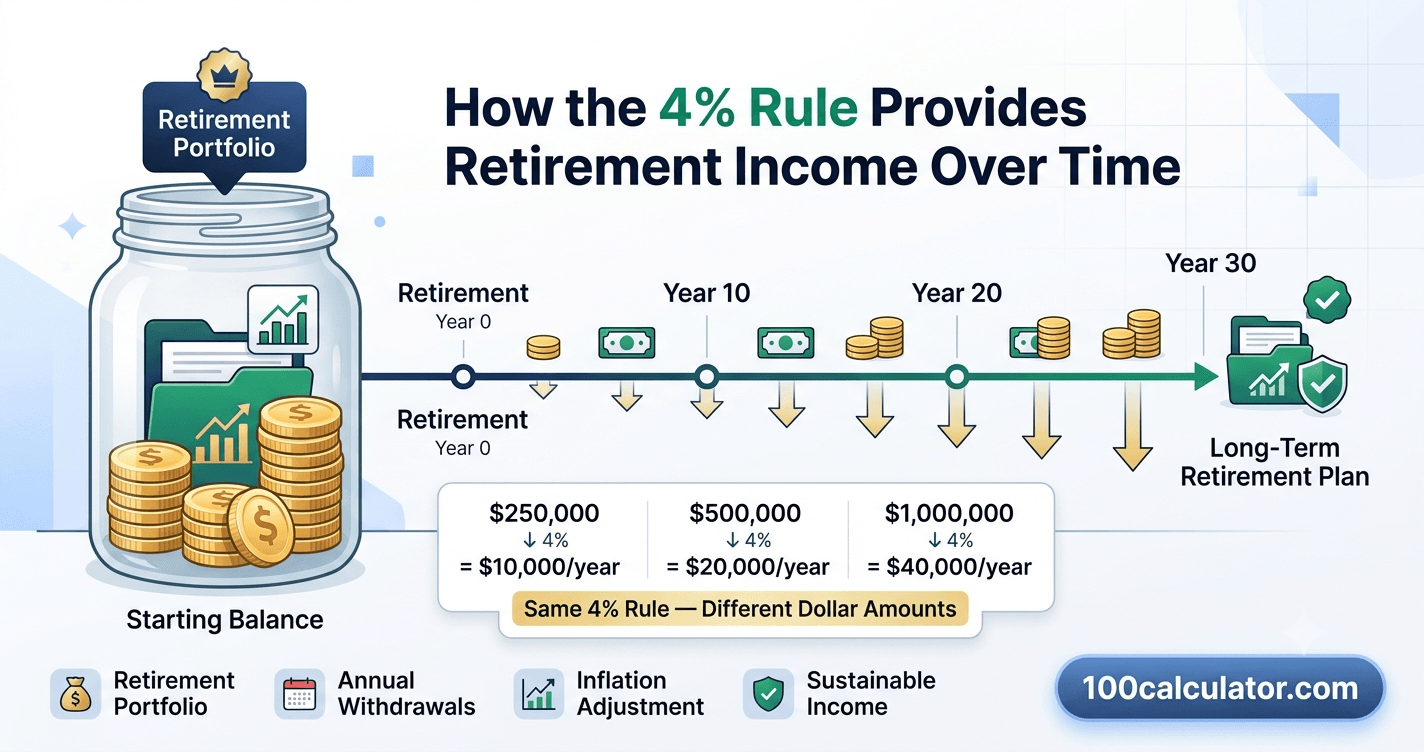
The 4% rule is a rough guideline for how much you can withdraw from a retirement portfolio each year without running out of money over a roughly 30-year retirement. In year one, you withdraw 4% of your total portfolio balance. In every year after that, you withdraw the same dollar amount, adjusted upward for inflation, regardless of what the market did that year.
The Simple Formula Behind It
The math itself is nothing more than multiplication. Take your starting portfolio balance and multiply it by 0.04. That's your year-one withdrawal. From year two onward, you take that same dollar figure and increase it by whatever inflation did that year, so your buying power stays roughly constant even as prices rise.
A Quick 4% Rule Example
Say you retire with $1,000,000 in savings. In year one, 4% of that is $40,000, or about $3,333 a month. If inflation runs at 3% that year, your year-two withdrawal becomes $41,200 — still $40,000 worth of buying power, just adjusted for rising prices. You'd repeat that pattern every year, regardless of whether your portfolio went up or down.
Want to run your own numbers instead of a generic example? 100 Calculator's 4 Percent Rule Calculator does this calculation for you, using your actual portfolio balance.
Where the 4% Rule Came From
The 4% rule isn't a government guideline or an industry standard set by a regulator. It came from one financial planner asking a very practical question, and it was later confirmed by a separate group of researchers using their own data.
William Bengen's Original Research
In October 1994, a California financial planner named William Bengen — who had spent years as an aerospace engineer before switching careers — published a study in the Journal of Financial Planning called "Determining Withdrawal Rates Using Historical Data." His clients kept asking him the same question: how much could they safely spend each year without running out of money? At the time, there wasn't a good, data-backed answer.
So Bengen built one. He reconstructed how a retirement portfolio would have performed for every retiree going back to 1926, using real historical stock and bond returns and real historical inflation, and tested withdrawal rates against every one of those starting points. He was looking for the highest rate that never ran out of money over a 30-year retirement, no matter which year someone happened to retire.
(Bengen) That number came out to about 4.15%, which got rounded down to the simpler "4%" in later commentary. Bengen's original test portfolio was split between U.S. stocks and intermediate-term Treasury bonds. The worst starting year in his data was 1966 — a retiree who quit working right before nearly two decades of high inflation, oil shocks, and choppy markets that didn't really recover until the early 1980s. Even for that unlucky group, (Forbes) a withdrawal rate at or near 4% held up for the entire 30 years. That's really the whole idea behind the rule: it's built around the worst stretch U.S. markets have produced, not an average one.
The Trinity Study Confirms the Idea
Four years later, in 1998, three finance professors at Trinity University in Texas — Philip Cooley, Carl Hubbard, and Daniel Walz — published a related paper that people nicknamed the Trinity study. It used the same basic approach as Bengen's work, but tested many more combinations of withdrawal rate, stock-to-bond mix, and time horizon using historical S&P 500 and long-term government bond returns. (Trinity Study)
Their conclusion echoed Bengen's: a 4% starting withdrawal rate, adjusted for inflation each year, had a historically high success rate over 30 years, especially for portfolios with a meaningful allocation to stocks. Two independent research teams landing on roughly the same number, using slightly different data and methods, is a big part of why 4% stuck as the go-to figure for so long.
If you want a deeper walkthrough of the mechanics behind the rule, our companion guide on how the 4 percent rule works for retirement planning covers the assumptions in more detail.
How to Calculate Your Own 4% Rule Number
You don't need a finance degree to use the 4% rule as a starting point. It takes one multiplication problem to get a rough withdrawal figure, and a second one to work backward from your spending needs to a savings target.
Step-by-Step Calculation
- Add up your investable savings. This means 401(k)s, IRAs, taxable brokerage accounts, and similar investment holdings — not your home equity or expected Social Security income.
- Multiply that total by 0.04. The result is a rough estimate of your year-one withdrawal.
- Divide by 12 if you want a monthly figure instead of an annual one.
- Working backward instead? Divide your desired annual spending by 0.04 (or simply multiply it by 25) to estimate the portfolio size you'd need to support that spending using the classic 4% figure.
- Adjust for what the 4% figure leaves out — taxes, investment fees, and any Social Security or pension income you'll also have coming in.
Using the 4 Percent Rule Calculator
Free Online Tool
Skip the manual math
100 Calculator's 4 Percent Rule Calculator runs this calculation for you. Enter your portfolio balance and it estimates your starting annual and monthly withdrawal instantly, with no account or signup required.
Is the 4% Rule Still Safe for Retirees Today?
This is the question that actually matters, and the honest answer is that reasonable experts disagree — not about the math, but about which assumptions to trust looking forward.
The Case That It's Outdated
Bengen and the Trinity study both leaned on historical U.S. market returns. Critics point out that today's bond yields, stock valuations, and life expectancies don't always look like the historical averages baked into that data. Retirements are also getting longer: someone retiring early through the FIRE movement might need their money to last 40 or 50 years, not 30, which changes the math meaningfully. On top of that, the original research didn't fully account for investment fees or taxes, both of which quietly eat into the same safety margin the 4% figure is built on.
There's also sequence-of-returns risk to consider — the danger that a few bad years early in retirement can permanently damage a portfolio, even if the 30-year average return ends up looking perfectly normal. Researchers sometimes call the five years before and the five years after retirement the "retirement red zone," since a downturn during that window does far more damage than the same downturn hitting 15 years into retirement.
The Case That It Still Holds Up
On the other side, Morningstar has published an updated "safe withdrawal rate" every year since 2021, using forward-looking return estimates instead of historical averages. Their number has moved around — 3.3% in 2021, 3.8% in 2022, 4.0% in 2023, 3.7% in 2024, and 3.9% in their most recent 2025 report — but it has never strayed dramatically from the original 4% figure, and it's currently sitting almost exactly there. (Morningstar)
Even more notably, Bengen himself revisited his own math using decades of additional data and a wider mix of asset classes. In his 2025 book, he argues that a diversified retiree can reasonably start closer to 4.7%, and that some retirees relying on a flat 4% may be leaving safe, spendable money on the table. (CNBC) And the worst historical case — that unlucky 1966 retiree — still made it the full 30 years at close to 4%, even through nearly two decades of stagflation. True historical failures have been rare and tightly clustered around that one specific stretch, not spread evenly across a century of data.
What the Historical Success Rate Data Shows
One of the clearest ways to see why 4% became the standard number is to look at how sharply the odds of success change as the withdrawal rate creeps upward. Using a balanced 50/50 stock-and-bond portfolio over a 30-year retirement, historical analysis of U.S. market data shows success rates that look roughly like this:
The takeaway isn't that 5% or 6% is reckless — plenty of retirees with shorter time horizons or extra income sources use higher rates successfully. It's that the further you push past 4%, the less margin for error you have if markets don't cooperate, which is exactly why Morningstar, Bengen, and the Trinity researchers all keep landing in a fairly narrow band around that number rather than somewhere wildly different.
Is the 4% Rule Too Conservative?
For a lot of retirees, yes — at least if it's followed exactly and never revisited. Because the 4% figure is calibrated to the worst historical stretch rather than a typical one, most retirees who follow it end up with more money than they started with, not less.
Why Retirees Often End Up With Money Left Over
Morningstar's own Monte Carlo modeling of its base-case strategy finds that in roughly 90% of simulated 30-year retirements, there's money left over at the end — often quite a bit more than a token amount. (Morningstar) Bengen has made a similar point: the historical "average" successful withdrawal rate across all starting years has been well above 4%, sometimes north of 6-7%. The 4% figure only shows up because it's built to survive the single worst starting year in the data, not to reflect what usually happens.
Flexible (Dynamic) Withdrawal Strategies
If a fixed, never-adjusted withdrawal feels overly cautious for your situation, dynamic strategies offer a middle ground. A common example is a "guardrails" approach: you raise your withdrawal when your portfolio performs well and pull back somewhat after a down year, within upper and lower limits you set in advance. A simpler version just skips the inflation adjustment in any year following a market loss. Morningstar's research suggests retirees willing to accept that kind of year-to-year variability could reasonably start withdrawals at rates approaching 6%, in exchange for potentially smaller cutbacks if markets turn against them.
Does the 4% Rule Preserve Your Principal?
No — and it was never designed to. The Trinity study and Bengen's research both define "success" as the portfolio lasting the full payout period without hitting zero. Preserving the original balance wasn't the primary goal; the "ending value" of the portfolio was tracked separately, mainly for retirees who cared about leaving an inheritance.
In practice, plenty of historical scenarios do leave a retiree with a similar or larger balance than they started with, simply because the 4% rate is set well below what most historical periods could actually support. But that's a side effect of building in a safety margin, not a guarantee. If preserving your full principal indefinitely — say, to fund a permanent gift or guarantee a specific inheritance — is a priority for you, that typically calls for a meaningfully lower withdrawal rate than 4%, since you'd want your withdrawals to stay within the portfolio's long-term growth rather than periodically dipping into the balance itself.
Does the 4% Rule Include Social Security or Pensions?
No. The 4% rule, and the research behind it, applies strictly to your investment portfolio — 401(k)s, IRAs, and taxable accounts. Social Security, pensions, and annuity income are treated as separate, guaranteed income layered on top, not folded into the 4% calculation. Morningstar's own base-case research is explicit about this, excluding Social Security and other non-portfolio income entirely from its withdrawal-rate estimate. (Morningstar)
This matters in practice because the more guaranteed income you have coming in, the less pressure your portfolio withdrawals need to carry. Delaying Social Security is one of the more effective levers here: for every year you wait past full retirement age, up to age 70, your benefit permanently increases by about 8% through delayed retirement credits. (SSA) Morningstar's research finds that pairing a delayed Social Security claim with a flexible portfolio withdrawal strategy tends to work especially well together, since the larger guaranteed check reduces how much your portfolio has to cover on its own.
The 4% Rule vs Other Withdrawal Approaches
The 4% rule isn't the only option on the table, and it isn't always the right fit. Here's how it stacks up against the more conservative and more aggressive alternatives you'll come across.
| Approach | Typical Starting Rate | General Risk Level | Best Fit For |
|---|---|---|---|
| Very conservative / capital-preservation style | About 3% or less | Very low | Leaving a large inheritance or funding a permanent gift |
| Morningstar's current guidance | About 3.9% | Low | New retirees who want one fixed, unchanging paycheck for 30 years |
| Classic 4% rule (Bengen / Trinity) | 4% | Low to moderate | A simple, worst-case-tested starting point for a traditional retirement |
| Bengen's updated rule | About 4.7% | Moderate | Diversified retirees comfortable with some added flexibility |
| Guardrails / dynamic strategies | Roughly 5–6%, variable | Moderate (spending varies) | Retirees willing to adjust annual spending based on performance |
| Informal "7% rule" | 7% or more | High | Short retirement horizons, or those accepting real depletion risk |
The 3% and 3.5% "More Conservative" Approaches
Retirees planning for an unusually long retirement — early retirees under the FIRE movement often plan for 40 years or more instead of 30 — tend to gravitate toward lower starting rates in the 3% to 3.5% range. A longer time horizon simply means more years for a bad early stretch to compound, so trimming the starting withdrawal builds in extra room.
The 7% Rule and Why It's Riskier
You'll occasionally see an informal "7% rule" floated as a more aggressive alternative. It doesn't carry anywhere near the same research backing as the 4% figure. Based on the historical success-rate pattern above — dropping from 100% at 4% to 68% at 5% to 43% at 6% — a 7% starting withdrawal would be expected to fail considerably more often than it succeeds over a full 30-year retirement. It can make more sense for a much shorter time horizon, such as someone retiring in their late 70s or 80s, but it's a poor fit as a general-purpose retirement rule.
Guardrail and Percentage-of-Portfolio Strategies
Beyond a single starting percentage, some retirees use a percentage-of-portfolio approach instead — withdrawing a set percentage of the current balance every year, which automatically shrinks in bad years and grows in good ones. This trades a bit of spending stability for a much lower risk of ever running out completely, since you're never withdrawing more than a share of whatever is actually left.
Common Mistakes People Make With the 4% Withdrawal Rule
The math behind the 4% rule is simple, which is exactly why it's easy to misapply. These are the slip-ups that come up most often.
- Treating it as a guarantee. It's a historically tested guideline, not a promise your specific portfolio will behave the same way going forward.
- Using a 30-year figure for a 40+ year retirement. Early retirees need a lower starting rate to account for the extra years their money has to last.
- Ignoring taxes and fees. A 4% withdrawal that's taxed or eaten into by high investment costs doesn't stretch as far as the raw percentage suggests.
- Panic-selling during a downturn. Locking in losses by selling after a drop — rather than withdrawing from cash or bonds first — is one of the fastest ways to undermine a withdrawal plan.
- Never revisiting the plan. A number calculated on day one of retirement isn't meant to be set in stone for 30 years without ever checking in on it.
- Forgetting about required minimum distributions. RMDs can push withdrawals from tax-deferred accounts higher than your planned rate later in retirement.
A few of these mistakes — especially ignoring fees — compound quietly over time. Our guide on compound interest mistakes that cost you money covers several related habits worth fixing well before retirement.
How Long Will Your Savings Last? Real Examples
One common misconception is that a smaller portfolio "runs out faster" under the 4% rule than a larger one. That's not quite right — as long as you withdraw 4% of your own starting balance (adjusted for inflation after that), the rule is designed to last roughly the same 30 years regardless of your portfolio's size. What changes is the dollar amount you can withdraw, not the duration.
| Portfolio Size | Annual Withdrawal (4%) | Monthly Amount |
|---|---|---|
| $250,000 | $10,000 | $833 |
| $500,000 | $20,000 | $1,667 |
| $750,000 | $30,000 | $2,500 |
| $1,000,000 | $40,000 | $3,333 |
| $1,500,000 | $60,000 | $5,000 |
| $2,000,000 | $80,000 | $6,667 |
$500,000 Portfolio Example
A retiree with $500,000 following the classic 4% rule would withdraw $20,000 in year one, then adjust that figure for inflation each year after. In practical terms, that means the same roughly 30-year design horizon as a much larger portfolio — the plan just supports a smaller monthly budget, which usually needs to be supplemented by Social Security or other income to cover typical living expenses.
$1,000,000 Portfolio Example
This is the classic reference case in most 4% rule discussions, mainly because the math is easy to follow: $40,000 a year, or about $3,333 a month, from a $1 million balance. It's also a useful benchmark for context — according to an analysis of Federal Reserve Survey of Consumer Finances data, only about 4.7% of Americans hold $1 million or more in retirement accounts, so this example represents a comfortably funded, though far from typical, starting point. (SmartAsset)
The Worst Historical Case: Retiring at the Wrong Time
As we covered earlier, the toughest test in the data is a retiree who started in 1966. The problem wasn't really the raw investment returns — it was the combination of high inflation and a long wait for a real market recovery, which meant withdrawals kept climbing in dollar terms while the portfolio's real value struggled to keep pace. Even in that scenario, a withdrawal rate at or near 4% made it the full 30 years, which is exactly why that single bad stretch — not an average year — is what defines the "safe" rate in the first place.
Related Calculators
Put what you just read into practice, try these free tools instantly, no sign-up required.
Premium Compound Interest Calculator
Calculate compound interest growth on your investments over time.
Premium Simple Interest Calculator
Quickly calculate simple interest earned or owed on a principal.
Daily Compound Interest Calculator
See how daily compounding interest grows your savings over time.
FIRE Financial Independence Calculator
Plan your path to financial independence and early retirement.
4 Percent Rule Calculator
Estimate safe retirement withdrawals using the 4% rule.
Retirement Regrets Worth Learning From
Retirement research and financial planners tend to flag the same handful of regrets over and over. None of them are exotic — they're mostly about timing and preparation, not investment performance.
- Retiring without a withdrawal strategy. Plenty of people save diligently for decades, then arrive at retirement without a clear plan for how much to actually spend each year.
- Claiming Social Security early without weighing the trade-off. Filing before full retirement age locks in a smaller check for life, while delaying to age 70 increases it by roughly 8% per year of delay.
- Underestimating healthcare costs. Fidelity's most recent retiree healthcare cost estimate puts average out-of-pocket medical spending for a 65-year-old retiring today at around $172,500 over the course of retirement — a figure many retirees don't budget for directly.
- Retiring earlier than planned. Morningstar's research notes that unplanned early retirement, often due to health issues or layoffs, is a common shock to retirement plans — commonly arriving about three years sooner than expected.
- Reacting emotionally to a downturn. Cutting spending too drastically, or selling investments at a loss out of fear, can do more long-term damage than the downturn itself.
Most of these come down to planning ahead rather than reacting in the moment — which is really the whole case for using something like the 4% rule as a starting framework instead of figuring it out for the first time after you've already stopped working.
Building a Withdrawal Plan That Fits Your Life
The 4% rule is a solid starting point, not a finished plan. Turning it into something that actually fits your retirement means answering a few questions it doesn't ask on its own.
Questions to Ask Before You Retire
- How many years does my retirement actually need to cover — 25, 30, or 40-plus?
- What guaranteed income (Social Security, pension, annuity) will I have outside my portfolio?
- How comfortable am I adjusting my spending in a bad market year, versus wanting a fixed paycheck?
- Have I budgeted realistically for healthcare and long-term care costs?
- Is leaving an inheritance a priority, or is spending down the portfolio during my own retirement acceptable?
If your portfolio still has years of growth ahead of it before you start withdrawing, it's worth understanding how that growth compounds in the meantime. Our guide on how compound interest grows your money over time breaks down that side of the equation, and 100 Calculator's Premium Compound Interest Calculator can help you estimate where your savings might land by the time you retire.
Planning to retire well before the traditional age? Our guide on how to calculate your FIRE number for retirement and 100 Calculator's FIRE Financial Independence Calculator both account for the longer time horizon that early retirement requires.
When to Get Professional Help
A simple withdrawal-rate calculation can only take you so far. It's worth talking to a fee-only financial planner or a certified financial planner (CFP) if your situation includes multiple income sources, significant tax planning decisions, pension election choices, or a retirement horizon that's meaningfully longer or shorter than 30 years. A professional can also help you weigh required minimum distributions, healthcare planning, and Social Security timing together, rather than one at a time.
Financial disclaimer: This article is for general educational purposes only and isn't individualized financial, tax, or legal advice. The 4% rule and every alternative discussed here are based on historical or projected market data; past performance doesn't guarantee future results, and any withdrawal strategy carries some risk of running out of money. Talk with a qualified, licensed financial advisor about your own retirement timeline, income sources, and risk tolerance before making withdrawal decisions.
Sources & References
- Bengen, William P. — "The 4% Rule," Bengen Financial Services
- Cooley, Hubbard & Walz — Trinity Study overview, Wikipedia
- Morningstar — "What's a Safe Retirement Withdrawal Rate for 2026?"
- Social Security Administration — "Delayed Retirement Credits"
- SmartAsset — "What Percentage of Retirees Have a Million Dollars?" (citing Federal Reserve and EBRI data)
- CNBC — "Why early retirees may be 'cheating themselves,' says 4% rule creator"
More From Our Finance Guide
Still building out your retirement and savings strategy? These related guides dig deeper into the topics covered above.
Frequently Asked Questions
What is the 4% rule in retirement, and how does it work?
The 4% rule is a guideline for how much to withdraw from a retirement portfolio each year. You withdraw 4% of your starting balance in year one, then adjust that same dollar amount for inflation every year after, regardless of market performance. It's designed, based on historical U.S. market data, to make a portfolio last roughly 30 years for a traditional retirement.
Is the 4% rule outdated?
Not really, though it's evolved. Morningstar's current forward-looking research puts a safe starting rate at about 3.9%, close to the original figure, while the rule's creator now argues a diversified retiree can reasonably start closer to 4.7%. Most experts still treat 4% as a solid rough starting point rather than a rule that's been disproven.
How long is the 4% rule designed to last?
It's built around a 30-year retirement, which fits someone retiring in their mid-60s reasonably well. Early retirees planning for a 40-year or longer retirement typically need to use a lower starting withdrawal rate, since a longer horizon leaves more time for a rough early stretch to compound.
Does the 4% rule include Social Security or pensions?
No. The 4% rule applies only to your investment portfolio — accounts like 401(k)s, IRAs, and brokerage accounts. Social Security, pensions, and annuity income are treated as separate, guaranteed income that supplements your portfolio withdrawals rather than being folded into the 4% calculation itself.
Is the 4% rule too conservative?
For many retirees, yes, if it's followed exactly and never adjusted. Because it's calibrated to the worst historical 30-year stretch rather than an average one, most retirees who use it end up with money left over. Flexible strategies that adjust spending based on market performance can often support a somewhat higher starting withdrawal.
Does the 4% rule preserve principal?
No. It's designed to keep your portfolio from running out of money over 30 years, not to preserve the original balance. "Success" in the underlying research simply means the money lasted the full payout period — many scenarios do leave a surplus, but that's a side effect of the safety margin, not the goal. Preserving principal indefinitely typically calls for a lower withdrawal rate.
What is the 7% rule for retirement, and is it safe?
The "7% rule" is an informal, more aggressive withdrawal rate that doesn't have the same research backing as the 4% figure. Historical success-rate data shows a sharp decline as withdrawal rates climb past 4%, so a 7% starting rate would be expected to fail more often than it succeeds over a full 30-year retirement. It's generally considered risky except for much shorter retirement horizons.
Who created the 4% rule for retirement?
William Bengen, a California financial planner and former aerospace engineer, introduced it in a 1994 paper in the Journal of Financial Planning. Three Trinity University professors — Philip Cooley, Carl Hubbard, and Daniel Walz — confirmed a similar conclusion with their own research in 1998, in what's now nicknamed the Trinity study.
What's an example of the 4% rule in practice?
A retiree with a $1,000,000 portfolio would withdraw $40,000 in year one, or about $3,333 a month. If inflation runs 3% that year, the year-two withdrawal becomes $41,200, keeping the same buying power. This pattern repeats annually, regardless of how the portfolio performs in any single year.
How long will $500,000 last using the 4% rule?
Using the classic 4% rule, a $500,000 portfolio is designed to last roughly the same 30 years as a larger portfolio — the starting withdrawal is simply smaller, at $20,000 a year, or about $1,667 a month. The duration comes from the withdrawal percentage, not the account size, as long as you stick to 4% of your own balance.
What was the worst historical time to retire using the 4% rule?
Historical research points to 1966 as the toughest starting year in the U.S. data, largely because retirees who began that year faced nearly two decades of high inflation and sluggish markets that didn't fully recover until the early 1980s. Even in that scenario, a withdrawal rate at or near 4% still lasted the full 30 years, which is exactly why that worst-case stretch defines the "safe" rate.
What are the most common mistakes with the 4% retirement withdrawal rule?
The most common mistakes include treating the rule as a guarantee instead of a guideline, applying a 30-year figure to a much longer early retirement, ignoring taxes and investment fees, panic-selling during downturns, and never revisiting the plan once it's set. Required minimum distributions can also force withdrawals that don't match your intended rate later in retirement.
What's the biggest retirement mistake to avoid?
Retiring without any withdrawal strategy at all is one of the most frequently cited regrets. Related mistakes that compound the problem include claiming Social Security early without weighing the long-term trade-off, underestimating healthcare costs, and reacting emotionally to market downturns instead of sticking with a plan.
How many Americans actually have $1,000,000 saved for retirement?
Not many. Based on an analysis of Federal Reserve Survey of Consumer Finances data, only about 4.7% of Americans have $1 million or more in retirement accounts, and the median balance for households aged 65 to 74 is closer to $200,000. A $1 million example is useful for illustrating the math, but it isn't the typical starting point.
What's considered a safer investment approach for retirees right now?
There's no single "safest" investment that fits everyone. Retirees often look at a mix of diversified stocks and bonds, inflation-protected securities, and sometimes annuities to create a more predictable income floor. Morningstar's research also highlights delaying Social Security as one of the more reliable ways to strengthen a retirement plan. A licensed financial advisor can help match these options to your own risk tolerance and goals.
About 100 Calculator
100 Calculator is a free hub of online calculators and educational guides covering finance, health, trading, crypto, education, and more. Every tool is built to be fast, accurate, and genuinely free, with no account or signup required.
We built this guide, and tools like the 4 Percent Rule Calculator referenced throughout it, to make everyday retirement math a little easier to work through. Head back to the 100 Calculator homepage to explore the full library of tools, or learn more about the team behind them on our About Us page.