Simple Interest vs Compound Interest: Key Differences
A plain-English breakdown of how simple interest and compound interest actually differ, with formulas, worked examples, a growth chart, and a free calculator so you can check your own numbers.
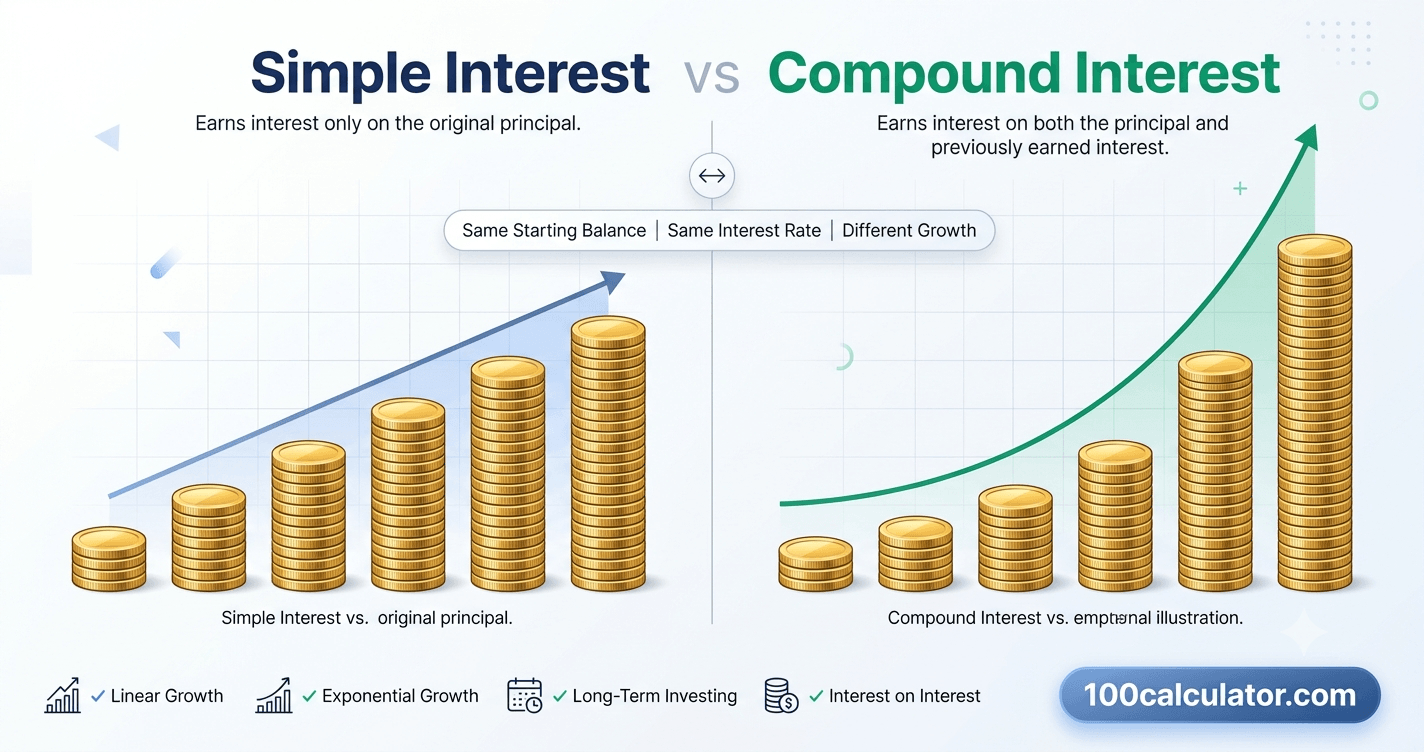
Simple interest and compound interest are the two ways lenders and financial institutions calculate what you owe or earn over time. Simple interest is calculated only on your original principal, so the amount added stays the same every period. Compound interest is calculated on your principal plus any interest that has already accumulated, so the amount added grows larger each period. Both describe an interest rate, but they tell very different stories about how your money moves.
That single difference changes how a loan or savings balance behaves over months and years. A $10,000 balance earning 8% simple interest adds exactly $800 every year, like clockwork. The same $10,000 growing at 8% compound interest adds a little more than $800 in year two, and by year twenty it's adding over $6,600 in that one year alone, because each year's interest becomes part of the balance that earns interest the next year.
Knowing which type applies to your loan, credit card, or savings account changes how you should read the numbers on your statement. This guide breaks down both formulas, walks through side-by-side examples, shows you how to find the exact difference between the two for any principal and rate, and points you to 100 Calculator's free Premium Simple Interest Calculator so you can check your own numbers in seconds.
What Is Simple Interest?
Simple interest is interest calculated only on the original amount of money you borrow or invest — your principal. It doesn't matter how much interest has already added up over time; every calculation goes back to that same starting number. (CFPB) That makes it predictable: once you know the rate and term, the total cost or return never changes.
The Simple Interest Formula
The formula for simple interest is:
Formula
I = (P × R × T) / 100
I is the interest earned or owed, P is the principal, R is the annual interest rate as a percentage, and T is the time in years.
Say you borrow $5,000 at 6% simple interest for 4 years. Multiply 5,000 × 6 × 4, then divide by 100, and you get $1,200 in total interest. Add that to your principal, and you'd repay $6,200 by the end of the loan — no surprises, no recalculating along the way.
Because it's so predictable, simple interest shows up most often in short-term personal loans, certain auto loans, and government securities like Treasury bills. If you want to run your own loan's numbers without doing the arithmetic by hand, 100 Calculator's Premium Simple Interest Calculator handles it instantly — just enter your principal, rate, and term. For a closer walkthrough of applying this formula to a real loan, see our guide on how to calculate simple interest on any loan amount.
What Is Compound Interest?
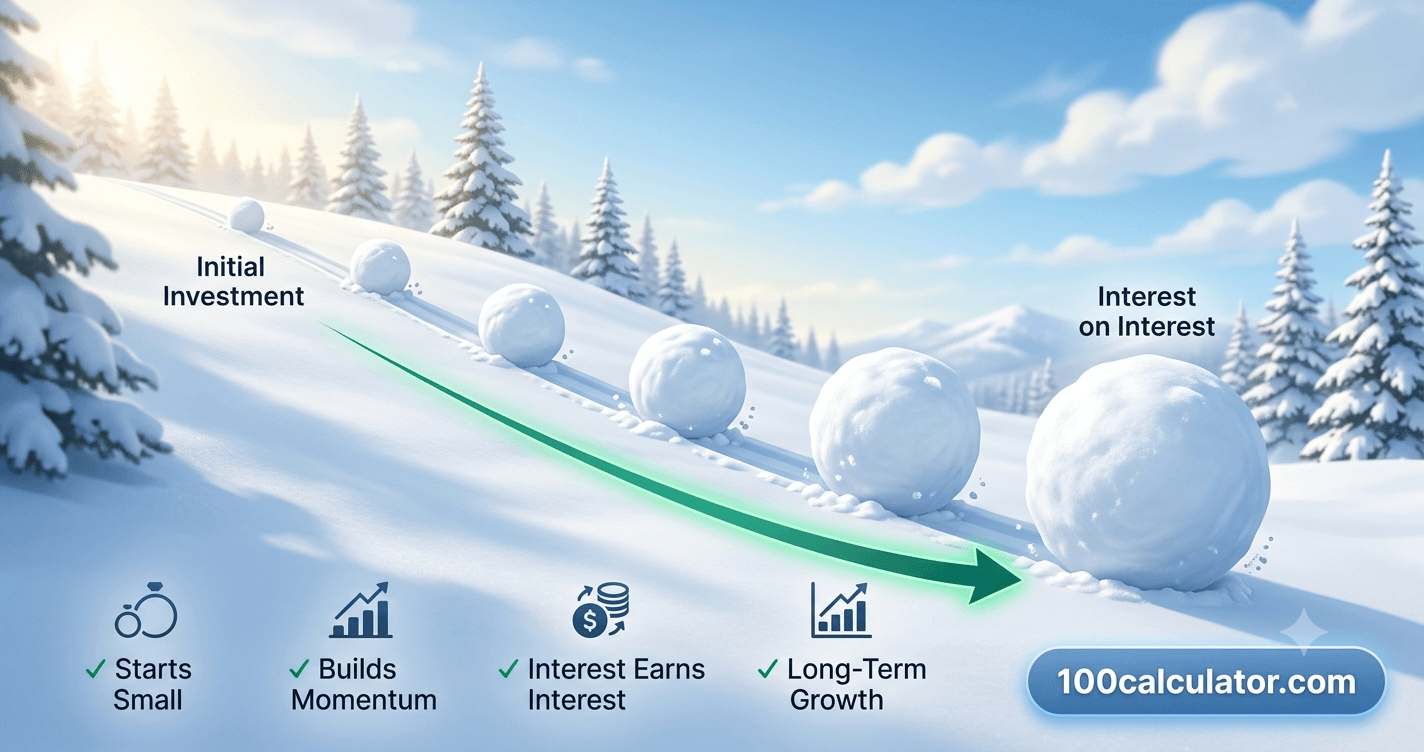
Compound interest is interest calculated on your principal plus any interest that's already been added to it. (CFPB) Once a compounding period passes, that period's interest joins the principal, and the next round of interest is calculated on the new, larger total. (SEC) That's why compound interest is often described as "interest on interest," and why it grows faster the longer you leave it alone.
The Compound Interest Formula
The most common version of the compound interest formula, for interest compounded once a year, is:
Formula
A = P × (1 + R/100)^T
A is the total amount after interest, P is the principal, R is the annual interest rate as a percentage, and T is the time in years. To find just the interest earned, subtract the principal: Compound Interest = A − P.
Using the same $5,000 at 6% for 4 years from the simple interest example above: A = 5,000 × (1.06)⁴ ≈ 5,000 × 1.2625 ≈ $6,312.38. Subtract the $5,000 principal, and you get about $1,312.38 in compound interest — roughly $112 more than the $1,200 you'd get with simple interest, on the exact same rate and time period.
When interest compounds more than once a year — say, monthly or daily — the formula adjusts slightly to account for each shorter period, which we'll cover later in this guide. Compound interest is the standard for savings accounts, certificates of deposit, credit cards, mortgages, and most investment accounts, because it reflects how financial institutions actually calculate growth — in your favor when you're saving, and against you when you're carrying a balance. For a closer look at how this plays out over the years, see our guide on how compound interest grows your money over time.
Key Differences at a Glance
Once you see both formulas side by side, the practical differences become clearer. Here's how simple interest and compound interest stack up against each other:
| Factor | Simple Interest | Compound Interest |
|---|---|---|
| Calculated on | Original principal only | Principal plus previously earned interest |
| Growth pattern | Linear — the same amount every period | Exponential — the amount grows every period |
| Formula | I = P × R × T / 100 | A = P × (1 + R/100)^T |
| Common uses | Short-term loans, some auto loans, Treasury bills | Savings accounts, credit cards, mortgages, investments |
| Tends to favor | Borrowers who want a predictable cost | Savers and investors playing the long game |
| Math complexity | Easy to calculate by hand | Usually needs a calculator |
The biggest takeaway is the growth pattern. Simple interest moves in a straight line — the same dollar amount, every period. Compound interest curves upward, adding a bit more each time, which is exactly what you'll see when we chart both side by side later in this guide.
A Side-by-Side Example
Numbers make this easiest to see. Imagine you put $10,000 into two identical accounts, both paying 8% a year — one using simple interest, one using compound interest compounded annually. Here's how the balances compare over 20 years:
| Year | Simple Interest Balance | Compound Interest Balance | Gap |
|---|---|---|---|
| 0 | $10,000 | $10,000 | $0 |
| 5 | $14,000 | $14,693 | $693 |
| 10 | $18,000 | $21,589 | $3,589 |
| 15 | $22,000 | $31,722 | $9,722 |
| 20 | $26,000 | $46,610 | $20,610 |
For the first few years, the two accounts barely differ — at year 5, compounding has only pulled ahead by $693. But the gap doesn't grow steadily; it accelerates. By year 20, the compound interest account is worth over $20,600 more than the simple interest account, even though both started with the same $10,000 at the same 8% rate. That's the entire advantage of compounding in one table.
Visualizing the Growth Gap
Seeing the two growth patterns as a chart makes the difference even more obvious. Below is the same $10,000-at-8% example from the table above, plotted over 20 years:
How to Calculate the Difference Between Simple and Compound Interest
You don't need a full year-by-year table every time. For 2-year and 3-year periods — the most commonly asked version of this question — there are shortcut formulas that get you straight to the difference.
The 2-Year Shortcut Formula
For exactly 2 years, the difference between compound interest and simple interest is:
2-Year Difference Formula
Difference = P × (R/100)²
Example: on $20,000 at 10% for 2 years, Difference = 20,000 × (0.10)² = 20,000 × 0.01 = $200. Simple interest gives $4,000; compound interest gives $4,200 — a $200 gap, exactly as the formula predicts.
The 3-Year Shortcut Formula
For exactly 3 years, the formula extends to:
3-Year Difference Formula
Difference = P × R² × (300 + R) / 1,000,000
Example: on $8,000 at 10% for 3 years, Difference = 8,000 × 100 × 310 / 1,000,000 = $248. Simple interest gives $2,400; compound interest gives $2,648 — again, a $248 gap.
Beyond 3 years, it's simplest to calculate simple interest and compound interest separately using the formulas from earlier in this guide, then subtract one from the other. Working through the algebra by hand gets tedious fast, which is exactly the kind of repetitive math a calculator is built for — 100 Calculator's Premium Compound Interest Calculator and Premium Simple Interest Calculator can run both side by side in seconds.
Which Is Better: Simple Interest or Compound Interest?
It depends on which side of the transaction you're on. If you're borrowing money, simple interest usually costs you less, because interest never builds on itself. If you're saving or investing, compound interest works in your favor, because your balance grows faster the longer you leave it alone. Neither type is universally "better" — what matters is whether you're the one paying or the one earning.
Advantages of Simple Interest
- Easy to calculate and verify by hand, with no hidden surprises
- Predictable total cost from the day you take out the loan
- No risk of interest snowballing on top of itself if a payment runs late
- Common in short-term loans, where keeping the math simple matters to both sides
Advantages of Compound Interest
- Your balance grows faster the longer you leave it untouched
- Reinvested interest keeps earning its own interest, without extra effort
- Rewards patient, long-term saving and investing habits
- Even small, regular contributions can grow significantly over decades
How Compounding Frequency Changes Things
Compound interest doesn't have to compound just once a year. It can compound semi-annually, quarterly, monthly, or even daily — and how often it compounds changes your real return, even if the stated annual rate never changes. Here's what $1,000 at a 12% annual rate earns in one year, depending on how often it compounds:
| Compounding Frequency | Interest Earned |
|---|---|
| Annually | $120.00 |
| Semi-annually | $123.60 |
| Quarterly | $125.51 |
| Monthly | $126.83 |
| Daily | $127.47 |
The stated rate stays at 12% the whole time — only the compounding frequency changes, yet it's worth over $7 more by the end of the year purely from compounding daily instead of annually. That gap grows much larger over longer time periods or higher rates, which is exactly why the fine print on savings accounts and credit cards usually specifies how often interest compounds. For more on this specific topic, see our guides on how daily compounding differs from monthly or yearly and why daily compounding can boost your savings growth. If your account compounds daily, 100 Calculator's Daily Compound Interest Calculator handles that math directly.
Nominal Rate vs Effective Annual Rate
A rate quoted as "1% per month" and a rate quoted as "12% per year" sound identical, but they usually aren't, because of compounding. Multiplying 1% by 12 months gives you the nominal annual rate — the number often advertised up front. But if that 1% actually compounds every month, your real cost or real return is higher: (1 + 0.01)¹² − 1 ≈ 12.68%. That 12.68% is the effective annual rate, and it's the number that actually reflects what you'll pay or earn over a full year. When comparing two loans or two savings accounts, knowing if you're looking at a nominal rate or an effective rate matters just as much as comparing the rate itself.
Where You'll See Each Type in Real Life
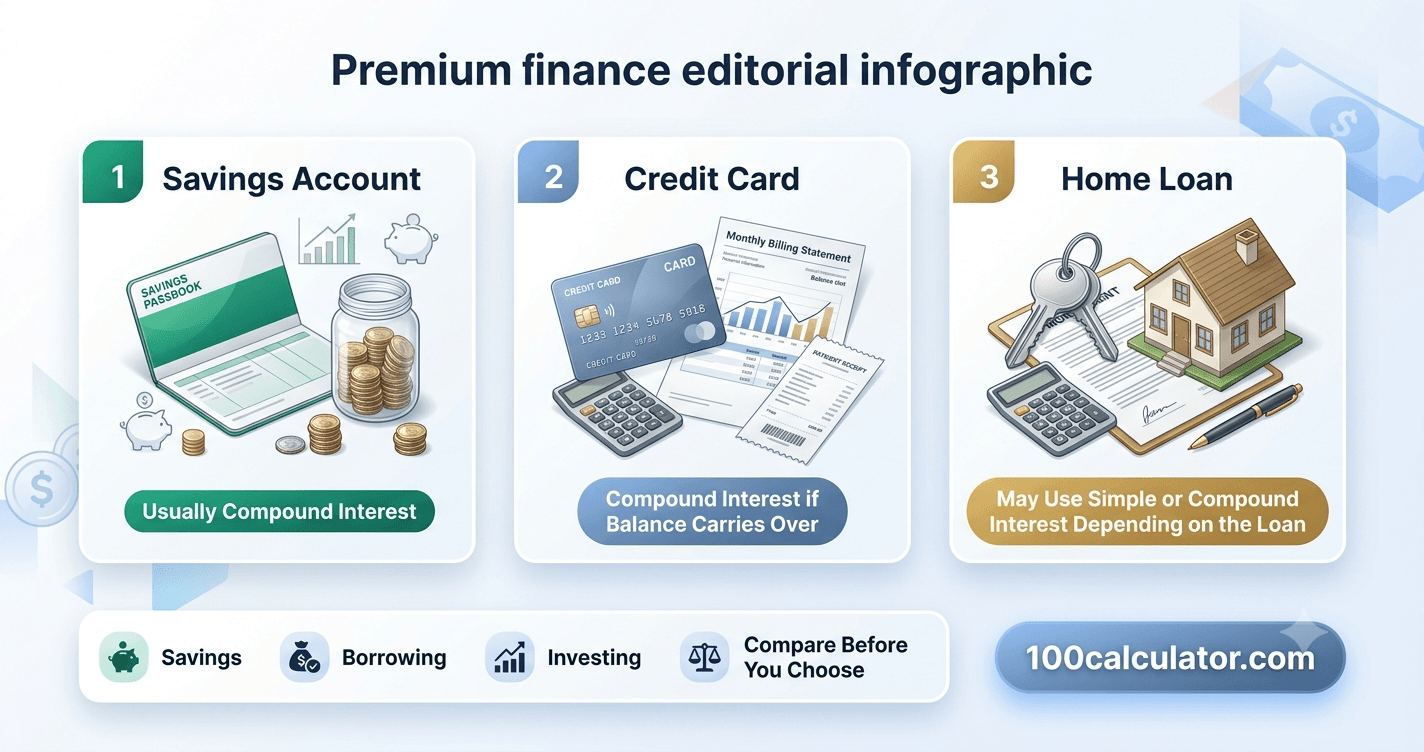
Most people encounter both types of interest without necessarily labeling them. Here's a general guide to where each one typically shows up:
| Financial Product | Typically Uses |
|---|---|
| Savings accounts | Compound interest |
| Certificates of deposit (CDs) | Compound interest |
| Credit cards | Compound interest, often daily |
| Mortgages | Compound interest, amortized monthly |
| Personal and some auto loans | Often simple interest |
| Short-term promissory notes | Simple interest |
| Retirement and investment accounts | Compound growth |
Loan terms vary by lender, so always confirm which method applies to your specific account or loan agreement rather than assuming based on the product type alone.
Related Calculators
Put what you just read into practice, try these free tools instantly, no sign-up required.
Premium Compound Interest Calculator
Calculate compound interest growth on your investments over time.
Premium Simple Interest Calculator
Quickly calculate simple interest earned or owed on a principal.
Daily Compound Interest Calculator
See how daily compounding interest grows your savings over time.
FIRE Financial Independence Calculator
Plan your path to financial independence and early retirement.
4 Percent Rule Calculator
Estimate safe retirement withdrawals using the 4% rule.
Common Mistakes to Avoid
A few habits can quietly throw off how you compare loans, cards, or savings accounts. Here's what to watch for:
- Comparing rates without checking the method. A lower simple interest rate can cost less than a higher compound rate, or the reverse, depending on the term.
- Assuming a monthly rate times 12 equals the annual cost. If that rate compounds monthly, the real annual cost is higher than simple multiplication suggests.
- Ignoring compounding frequency when comparing offers. Two accounts advertising the same rate can pay out differently based on how often interest compounds.
- Judging compounding by a single short period. The gap between simple and compound interest is tiny in year one and can be enormous by year twenty.
- Forgetting fees and APR. The interest calculation method is only part of the picture — origination fees and other charges affect your real cost too.
For a closer look at how these mistakes play out with compound interest specifically, see our guide on compound interest mistakes that cost you money.
Choosing the Right Calculator
Once you know which type of interest applies to your situation, the fastest way to see the real numbers is to run them through a calculator built for that exact job, rather than reaching for the shortcut formulas every time:
- For a straightforward, fixed-term loan, 100 Calculator's Premium Simple Interest Calculator gives you the exact interest and total repayment amount in one step.
- For savings, investment, or long-term growth projections, the Premium Compound Interest Calculator shows how your balance grows year over year.
- For accounts or cards that compound daily, the Daily Compound Interest Calculator accounts for that shorter compounding period automatically.
Running the same principal, rate, and term through both the simple and compound calculators side by side is often the fastest way to see exactly how much difference compounding makes for your specific numbers, without doing any of the exponent math yourself.
Building a Smart Borrowing and Saving Habit
Understanding the difference between simple and compound interest is really about knowing which question to ask before you sign anything or open an account:
- Ask which method applies. Don't assume — check the loan agreement or account terms for whether interest is simple or compound, and how often it compounds.
- Compare the effective rate, not just the advertised rate. A slightly lower nominal rate with monthly compounding can cost more than a slightly higher rate with annual compounding.
- Run the numbers before you commit, using a calculator rather than estimating in your head, especially for anything longer than a year or two.
- Let compound growth work for you when saving, by starting early and leaving contributions untouched as long as your goals allow.
- Use the Rule of 72 as a quick sanity check for long-term compound growth: divide 72 by your annual rate to estimate how many years it takes your money to double.
If you're thinking further ahead about long-term compound growth toward retirement, our guides on the FIRE movement and how to calculate your FIRE number build directly on the compounding concepts covered here — and 100 Calculator's FIRE Financial Independence Calculator turns those concepts into a real target based on your own savings rate. Our breakdown of how the 4 percent rule works for retirement planning (along with whether the 4 percent rule is still safe for retirees today, and 100 Calculator's own 4 Percent Rule Calculator) is a natural next step once you're comfortable with how compounding works.
Financial disclaimer: This article is for general educational purposes only and isn't financial advice. Interest calculations shown here are simplified examples; actual loan and savings terms vary by lender, may include fees, and can compound differently than shown. Always review the specific terms of any loan or account, and consult a licensed financial professional before making borrowing or investment decisions.
Sources & References
The interest formulas in this guide are standard calculations used across the finance industry. For further reading on how simple and compound interest work in practice, these official resources are a helpful starting point:
More From Our Finance Guide
Want to keep building your understanding of interest and long-term money growth? These related guides dig deeper into the topics covered above.
Frequently Asked Questions
What's the main difference between simple interest and compound interest?
Simple interest is calculated only on your original principal, so it adds the same dollar amount every period. Compound interest is calculated on your principal plus any interest you've already earned or owed, so the amount added grows larger each period. Over short periods the difference is small, but over many years compound interest produces significantly more growth, or cost, than simple interest at the same rate.
Which is better, simple interest or compound interest?
It depends on your role in the deal — borrowing or saving. If you're paying off a loan, simple interest usually costs you less because interest doesn't build on itself. If you're saving or investing, compound interest works in your favor because your balance grows faster the longer you leave it. Neither type is "better" on its own — what matters is which side of the transaction you're on.
What is the formula for finding the difference between compound interest and simple interest?
For most cases, calculate each separately and subtract: Simple Interest = (P × R × T) / 100, and Compound Interest = P × [(1 + R/100)^T − 1], where P is principal, R is the annual rate, and T is time in years. For exactly 2 years, there's a shortcut: Difference = P × (R/100)². For exactly 3 years: Difference = P × R² × (300 + R) / 1,000,000.
What is the difference between simple interest and compound interest over 2 years, with an example?
Say you invest $20,000 at 10% annual interest for 2 years. Simple interest gives you 20,000 × 10% × 2 = $4,000. Compound interest gives you 20,000 × [(1.10)² − 1] = $4,200. The difference is $200. You can also find that instantly with the shortcut formula: Difference = P × (R/100)² = 20,000 × 0.01 = $200.
What is the difference between compound interest and simple interest on $45,000 at 12% for 2 years?
Simple interest comes to 45,000 × 12% × 2 = $10,800. Compound interest comes to 45,000 × [(1.12)² − 1] = $11,448. The difference is $648. The 2-year shortcut formula confirms this instantly: Difference = P × (R/100)² = 45,000 × 0.0144 = $648.
What is the difference between simple interest and compound interest over 3 years, with an example?
Say you borrow $8,000 at 10% annual interest for 3 years. Simple interest totals 8,000 × 10% × 3 = $2,400. Compound interest totals 8,000 × [(1.10)³ − 1] = $2,648. The difference is $248, which matches the shortcut formula: Difference = P × R² × (300 + R) / 1,000,000 = 8,000 × 100 × 310 / 1,000,000 = $248.
If the difference between compound interest and simple interest over 3 years is $228 at a 4% annual rate, what is the principal?
Using the 3-year difference formula, Difference = P × R² × (300 + R) / 1,000,000. Plugging in the numbers: 228 = P × 16 × 304 / 1,000,000, which simplifies to 228 = P × 0.004864. Solving for P gives a principal of $46,875. You can check this by calculating simple and compound interest separately on $46,875 at 4% for 3 years and confirming the $228 gap.
What is the compound interest on $2,500 for 2 years at 4% per annum?
Compound interest is calculated as P × [(1 + R/100)^T − 1]. For $2,500 at 4% over 2 years, that's 2,500 × [(1.04)² − 1] = 2,500 × 0.0816 = $204. For comparison, simple interest on the same amount would be 2,500 × 4% × 2 = $200, so compounding adds just $4 extra over this short period — the gap grows much larger over longer terms.
Does compounding daily instead of yearly make a big difference?
Compounding daily instead of yearly increases your effective return, but usually by less than most people expect over short periods. On a typical savings account rate, the difference between daily and annual compounding might only be a fraction of a percent per year. The gap becomes more meaningful with higher interest rates or over many years, which is why compounding frequency matters more for long-term savings and high-rate debt like credit cards.
Does paying interest half-yearly instead of yearly change the total compound interest?
Yes. Compounding more frequently, even at the same annual rate, increases the total interest because each compounding period adds interest that then earns its own interest sooner. For example, $50,000 at 12% for 1 year comes to $6,000 in compound interest when compounded yearly, but $6,180 when compounded half-yearly at 6% every 6 months — a difference of $180 from the compounding frequency alone.
Is 1% interest per month the same as 12% interest per year?
Not exactly. 1% per month compounds 12 times a year, so it actually works out to slightly more than 12% annually. Using the compound interest formula, (1 + 0.01)¹² − 1 ≈ 12.68%. That 12.68% is called the effective annual rate, while the "12%" you'd get by simply multiplying 1% × 12 is the nominal rate. The difference matters most when comparing loan or credit card offers that quote monthly versus annual rates.
Why is the number 72 used in the Rule of 72?
The Rule of 72 is a quick way to estimate how long it takes an investment to double under compound interest: divide 72 by the annual interest rate. The number 72 works well as a rough estimate because it divides evenly by many common rates, like 2, 3, 4, 6, 8, 9, and 12, and it closely approximates the more precise mathematical formula for typical interest rates between roughly 6% and 10%.
What are the main advantages of simple interest and compound interest?
Simple interest is easier to calculate and predict, which makes it useful for short-term loans where you want to know the exact total cost upfront. Compound interest rewards patience: because interest earns interest, your money grows faster the longer you leave it invested, which makes it valuable for long-term savings and retirement accounts. Each type suits a different financial goal rather than one being universally superior.
How much would 7% interest come to on $100,000?
With simple interest, 7% on $100,000 for one year equals $7,000, giving you a total of $107,000. With compound interest, the first year looks identical since there's no prior interest to compound yet, but if you leave the money for multiple years, compound interest pulls ahead. Over 10 years at 7% compounded annually, your $100,000 would grow to roughly $196,715, compared with $170,000 under simple interest.
Can I use a calculator to compare simple interest and compound interest automatically?
Yes. 100 Calculator's free Premium Simple Interest Calculator and Premium Compound Interest Calculator let you enter your principal, rate, and time period to see the exact interest and final balance for each method, without doing the math by hand. Running the same numbers through both tools side by side is often the fastest way to see exactly how much of a difference compounding makes for your specific situation.
About 100 Calculator
100 Calculator is a free hub of online calculators and educational guides covering health, finance, trading, crypto, education, and more. Every tool is built to be fast, accurate, and genuinely free, with no account or signup required.
We built this guide, and tools like the Premium Simple Interest Calculator and Premium Compound Interest Calculator referenced throughout it, to make everyday finance questions a little easier to work through. Head back to the 100 Calculator homepage to explore the full library of tools, or learn more about the team behind them on our About Us page.