How to Calculate Your FIRE Number for Retirement
A plain-English walkthrough of the FIRE number formula — the 25x rule, the 4% rule, inflation, and Coast FIRE — so you can figure out exactly how much you need to save for financial independence, and check your work with a free calculator.

"How much do I actually need to retire?" is one of those questions that sounds simple until you try to answer it. Most people either guess at a round number like a million dollars, or avoid the question entirely because the math feels intimidating. Neither approach gets you very far.
Your FIRE number is the amount of money you need invested so that your portfolio can cover your living expenses indefinitely, without you needing to earn another paycheck. The most common way to estimate it is the 25x rule: multiply your expected annual expenses in retirement by 25. That single calculation, based on a withdrawal rate of 4% a year, is the starting point for almost every FIRE plan you'll come across.
From there, the real work is making that number personal — adjusting it for inflation, picking a withdrawal rate that matches how long your retirement needs to last, and understanding variations like Coast FIRE that change the math depending on your goals. If you'd rather skip to the arithmetic, 100 Calculator's FIRE Financial Independence Calculator does it for you the moment you enter your expenses.
This guide walks through where the FIRE number formula comes from, how to calculate your own number step by step, how inflation and withdrawal rates change the result, and the retirement "rules of thumb" you'll run into along the way. Let's start with what the FIRE movement actually is.
Understanding the FIRE Movement
FIRE stands for Financial Independence, Retire Early. It's a personal finance approach built around saving and investing a large share of your income — often well beyond the 10% to 15% that's typically recommended — so you can reach financial independence years or even decades before a traditional retirement age. The ideas behind it trace back to the 1992 book Your Money or Your Life, though the modern FIRE community really took shape through blogs and online forums built around the same core idea: your time is worth more than your stuff.
FIRE isn't a single fixed plan. It's a spectrum, and most people land somewhere in the middle rather than at either extreme. Some savers cut spending aggressively to retire as fast as possible. Others keep a comfortable lifestyle and simply save consistently for a somewhat earlier exit. What ties them together is the same underlying question this guide answers: how much invested money does it take to stop needing a job?
The Different Types of FIRE
Before you calculate a number, it helps to know which version of FIRE you're actually aiming for, since it changes both your target expenses and your timeline.
| Type | What It Means | Best For |
|---|---|---|
| Lean FIRE | A minimalist retirement budget, often paired with a savings rate above 50% | People comfortable living on a lower, tightly-managed budget |
| Fat FIRE | A retirement budget closer to, or above, your current lifestyle | People who want more spending flexibility later, and can save a large amount now |
| Barista FIRE | Enough saved to cover most expenses, with part-time work filling the rest | People who want to step back from full-time work sooner rather than later |
| Coast FIRE | Enough saved that compound growth alone reaches your number by a target age, with no further contributions needed | People who want to keep working, just without the pressure to keep saving |
Our companion piece on what the FIRE movement is and how it works goes deeper into the philosophy and daily habits behind each style. This guide focuses specifically on the math: turning any of these goals into one concrete number you can save toward.
What Is a FIRE Number, Exactly?
Your FIRE number is the total amount you need invested — in a brokerage account, retirement accounts, or a mix of both — so that a small, sustainable annual withdrawal covers your living expenses for the rest of your life, without your savings running out. Once your portfolio reaches that number, working becomes optional rather than required.
It isn't a net worth target in the broader sense. A paid-off house you live in, for example, doesn't generate income you can spend, so most FIRE calculations focus specifically on investable assets: index funds, retirement accounts, taxable brokerage accounts, and similar holdings that can actually be drawn down over time.
Every FIRE number rests on two inputs you control directly:
- Annual expenses — what you actually expect to spend each year once you're not working
- Withdrawal rate — the percentage of your portfolio you plan to spend each year
Everything else in this guide, including inflation adjustments and Coast FIRE, is really just a more detailed way of refining those two numbers.
The FIRE Number Formula: The Rule of 25
The fastest way to estimate your FIRE number is what's commonly called the rule of 25:
Where the Rule of 25 Comes From
The number 25 isn't arbitrary. It's simply the inverse of a 4% withdrawal rate: dividing 1 by 0.04 gives you 25. The 4% figure itself comes from research by financial planner William Bengen, who published what became known as the 4% rule in the Journal of Financial Planning in 1994, and from the later Trinity Study, which tested similar withdrawal rates against historical market returns.
Bengen found that a retiree who withdrew 4% of their starting portfolio in year one, then adjusted that dollar amount for inflation every year after, would have had a very high chance of their money lasting at least 30 years across nearly every historical period he tested, including retirements that began right before major market downturns. Multiply your annual expenses by 25, and you've effectively built a portfolio sized to support a 4% withdrawal rate.
A Simple Worked Example
Say you expect to spend $40,000 a year in retirement. Using the rule of 25:
| Annual Expenses | × Multiple | FIRE Number |
|---|---|---|
| $40,000 | 25 | $1,000,000 |
| $60,000 | 25 | $1,500,000 |
| $80,000 | 25 | $2,000,000 |
Notice the relationship: every $1,000 you trim from your annual spending lowers your FIRE number by $25,000. That's why the FIRE community pays so much attention to recurring expenses — housing, transport, subscriptions — rather than one-off purchases. A small, permanent change to your spending has an outsized effect on the total you need to save.
How to Calculate Your FIRE Number, Step by Step
The rule of 25 gives you the shortcut. Here's the full process for turning it into a number that actually reflects your life.
- Track your current annual spending. Pull three to six months of bank and card statements and total everything, then annualize it. This is your real baseline, not a guess.
- Project what you'll spend in retirement. Some costs disappear (commuting, work clothes, a paid -off mortgage), and others appear or grow (healthcare, travel, hobbies). Adjust your baseline up or down to reflect that.
- Choose a withdrawal rate. 4% is the standard starting point, but many FIRE savers use something closer to 3% to 3.5% to account for a much longer retirement than the 30-year horizon Bengen's research was built around. We cover this trade-off in detail in the next two sections.
- Multiply expenses by your chosen multiple. Divide 1 by your withdrawal rate to get the multiple (4% → 25x, 3.5% → about 28.5x, 3% → about 33x), then multiply that by your projected annual expenses.
- Subtract what you've already saved. Your FIRE number is a target, not what you need to find from scratch. Subtracting your current invested balance shows the actual gap left to close.
A Complete Worked Example
Here's how that looks for one hypothetical saver. Today, they spend about $52,000 a year. After projecting forward — no more mortgage payment, no commuting costs, but a bit more budgeted for healthcare and travel — they estimate their retirement-year expenses at $44,000.
| Step | Value |
|---|---|
| Projected annual expenses | $44,000 |
| Withdrawal rate used | 4% |
| FIRE number (44,000 × 25) | $1,100,000 |
| Already invested | $300,000 |
| Remaining gap to close | $800,000 |
That $800,000 gap is the number that actually matters day to day. It's what turns a savings rate and an expected return into a concrete timeline, which is exactly what a dedicated calculator is built to do instantly.
Free Online Tool
Skip the manual math
100 Calculator's FIRE Financial Independence Calculator runs every step above for you. Enter your expenses, current savings, and withdrawal rate, and it returns your FIRE number and an estimated timeline instantly, with no account required.
Calculating Your FIRE Number With Inflation
If you're retiring in five, fifteen, or thirty years, the sticker price of "$44,000 a year" today won't buy the same lifestyle by the time you get there. Inflation is one of the most commonly missed pieces of a FIRE calculation, and it's also one of the easiest to fix once you know where it belongs.
Why Inflation Changes the Math
There are two separate places inflation shows up in a FIRE plan, and mixing them up is where most confusion starts:
- Your target expenses need to grow over time if you're calculating a dollar figure for a future year rather than today's dollars.
- Your investment growth needs to be measured after inflation too, or you'll overstate how fast your portfolio is actually growing in terms of real purchasing power.
Real Returns vs. Nominal Returns
This is where "real" and "nominal" returns come in. Nominal return is the raw percentage your investments grew by. Real return is that same growth minus inflation for the year, and it's the number that actually reflects how much more you can buy. The U.S. stock market has historically returned roughly 10% a year before inflation, which works out to a real return closer to 6% to 7% after subtracting long-run average inflation.
The simplest way to handle both pieces at once, and the approach most FIRE calculators use by default, is to do every calculation in today's dollars: use your current spending level as the target, and use a real (inflation-adjusted) return assumption for growth projections. Done this way, you never have to guess at future prices — the math stays in terms you already understand, and the 4% rule's original research was itself built around inflation-adjusted withdrawals, so the two line up cleanly.
| Assumption | Typical Range |
|---|---|
| Nominal stock market return | About 9% to 10% per year, long-run average |
| Long-run average inflation | About 2.5% to 3% per year |
| Real (inflation-adjusted) return | About 6% to 7% per year |
Related Calculators
Put what you just read into practice, try these free tools instantly, no sign-up required.
Premium Compound Interest Calculator
Calculate compound interest growth on your investments over time.
Premium Simple Interest Calculator
Quickly calculate simple interest earned or owed on a principal.
Daily Compound Interest Calculator
See how daily compounding interest grows your savings over time.
FIRE Financial Independence Calculator
Plan your path to financial independence and early retirement.
4 Percent Rule Calculator
Estimate safe retirement withdrawals using the 4% rule.
The 4% Rule and Your Withdrawal Rate
Your withdrawal rate is the lever that changes your FIRE number the most, so it's worth understanding what it actually assumes, and where it can fall short.
Is 4% Still Considered Safe?
For a standard, roughly 30-year retirement, the 4% rule still holds up reasonably well in most research. Bengen himself has since revisited his original work and, using a wider mix of asset classes, suggested a starting rate closer to 4.7% could be sustainable under similar assumptions. Other researchers have looked at the opposite question: whether more flexible retirees with other income sources could safely use a higher rate, (Forbes) sometimes discussed as a "7% rule." That figure isn't a universally safe withdrawal rate; it's closer to an upper bound that only makes sense for retirees with real spending flexibility and other income to fall back on.
Why Many FIRE Savers Choose a Lower Rate
Bengen's original research was built around a 30-year retirement. FIRE savers retiring in their 30s or 40s might need their portfolio to last 50 years or longer, which is a meaningfully different problem. A longer time horizon means more years for a bad sequence of early market returns to do lasting damage, an effect researchers call sequence-of-returns risk. That's why it's common in the FIRE community to plan around 3% to 3.5% instead of 4%, effectively building in a bigger safety margin at the cost of needing a somewhat larger portfolio.
| Withdrawal Rate | Multiple of Expenses | Typical Use Case |
|---|---|---|
| 3% | About 33x | Very long retirements, extra safety margin |
| 3.5% | About 28.5x | Common choice for early retirees |
| 4% | 25x | The standard, research-backed starting point |
| 4.7% | About 21x | Bengen's updated figure, under specific assumptions |
There's no single "correct" withdrawal rate for everyone. It's a trade-off between how large a portfolio you're willing to build versus how much safety margin you want. If you want to explore that trade-off with your own numbers, 100 Calculator's 4 Percent Rule Calculator lets you test different withdrawal rates side by side, and our guide to how the 4% rule works and whether the 4% rule still holds up today both dig deeper into this specific question.
Coast FIRE: A Different Kind of FIRE Number
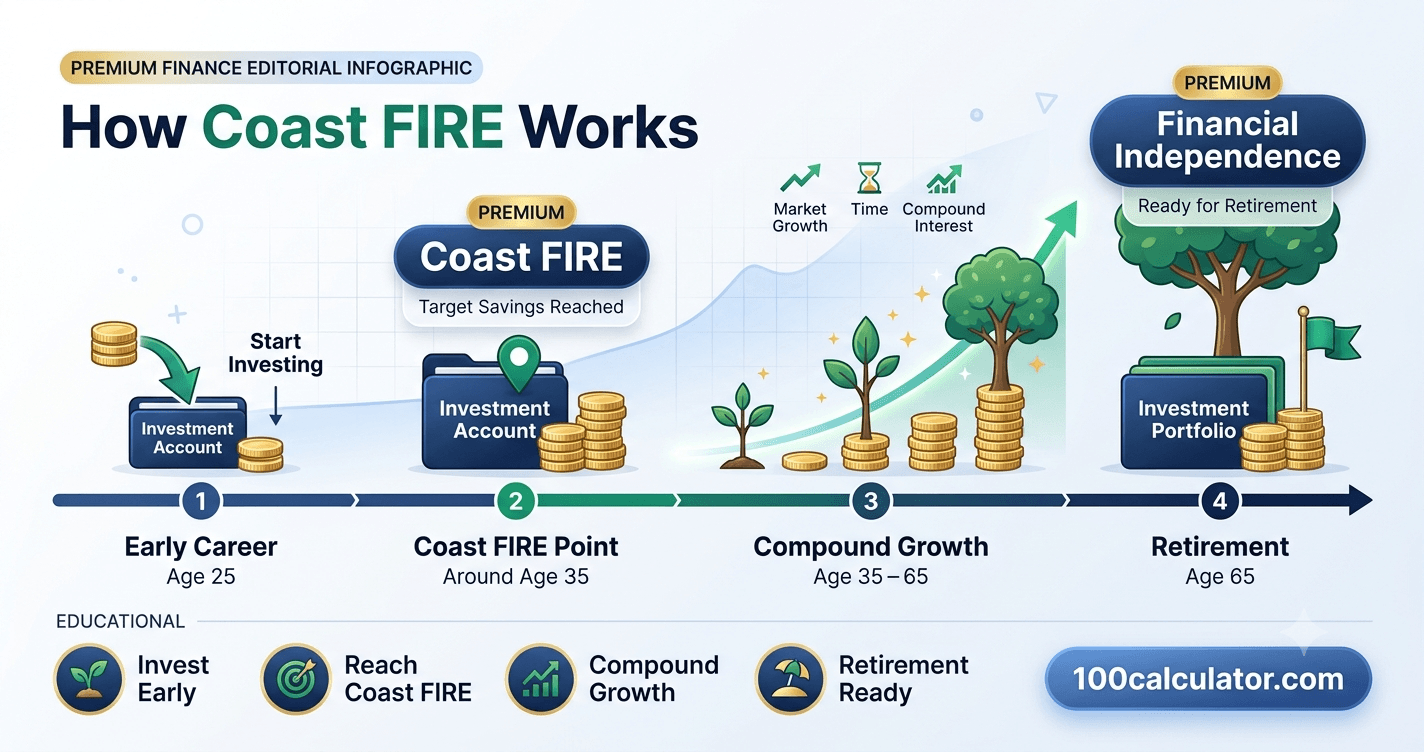
Not everyone wants to stop working entirely, and not everyone needs to keep saving aggressively forever either. Coast FIRE calculates a different, usually much smaller number: how much you need invested today so that, with zero further contributions, compound growth alone carries you to your full FIRE number by a target age.
The Coast FIRE Formula
Coast FIRE works backward from your full FIRE number using the number of years until your target retirement age and an assumed real rate of return:
A Coast FIRE Example
Using the $1,100,000 FIRE number from our earlier example, imagine this saver is 30 years old and wants to stop contributing to retirement accounts by the time they turn 65 — 35 years away — while still covering current bills with a part-time or full-time income along the way. Assuming a 7% average annual real return:
| Input | Value |
|---|---|
| Full FIRE number | $1,100,000 |
| Years until target retirement age | 35 |
| Assumed real annual return | 7% |
| Coast FIRE number | About $103,000 |
In other words, once this saver has roughly $103,000 invested, they could stop adding new money to retirement accounts entirely, and compound growth alone would carry that balance to $1.1 million by age 65 — assuming that 7% return holds up over the full 35 years, which is never guaranteed. The fewer years you have left, the higher your Coast FIRE number climbs, since compounding has less time to do the work.
Retirement Rules of Thumb You'll Come Across
Search around retirement planning long enough and you'll run into a whole collection of named "rules" — some genuinely useful shortcuts, others just catchy framings of the same basic ideas. Here's what the most common ones actually mean, so you can tell which apply to your FIRE number and which are simply general budgeting advice.
| Rule | What It Means |
|---|---|
| 50/30/20 rule | A budgeting split of 50% of after-tax income to needs, 30% to wants, and 20% to savings |
| 70/20/10 rule | 70% of after-tax income to living expenses, 20% to savings and investing, 10% to debt payoff or giving |
| 30/30/30/10 rule | A retirement-focused split sometimes used by insurers: 30% housing, 30% other living expenses, 30% savings and investments, 10% kept aside for emergencies |
| Warren Buffett's 90/10 rule | A simple portfolio allocation Buffett outlined in a 2013 letter for his own estate planning: 90% in a low-cost S&P 500 index fund, 10% in short-term government bonds |
| 3-6-9 rule | An emergency-fund guideline: keep 3, 6, or 9 months of essential expenses in cash, depending on how stable your income is |
70/20/10 vs. 50/30/20: Which Should You Use?
Neither is objectively better. The 50/30/20 rule separates "needs" from "wants," which can make it easier to spot discretionary spending to cut. The 70/20/10 rule lumps needs and wants together into one 70% bucket, which tends to suit people in higher-cost-of-living areas where necessities alone can eat up more than half of take-home pay. Either one works as a starting framework; what matters for your FIRE number specifically is the savings percentage you actually hit, not which label you use to get there.
Warren Buffett's "Never Lose Money" Rule
Alongside the 90/10 allocation, Buffett is widely credited with a much older, simpler piece of advice: Rule No. 1 is never lose money, and Rule No. 2 is never forget Rule No. 1. (Money) In practice, this isn't a promise that you'll never see a portfolio dip — markets do that regularly. It's a reminder to protect capital by avoiding speculative, poorly understood investments, especially once you're close to or living off your FIRE number, when a large permanent loss is far harder to recover from than it was decades earlier in your career.
What About Portfolio Splits Like 90/10, 70/30, or 60/40?
You'll also see these numbers used to describe a stock-to-bond allocation rather than a budget. A higher stock percentage, like 90/10 or 80/20, generally means more long-term growth potential alongside more short-term volatility. A more balanced split, like 70/30 or 60/40, trades some of that growth potential for a smoother ride. Whether a 90/10 split is "too aggressive" genuinely depends on your time horizon and how you'd react to a large, temporary drop — Buffett's own 90/10 example was written for a multi-decade horizon with no near-term need to sell. There's no single right answer here, and it's worth discussing your specific allocation with a financial advisor rather than copying any one public figure's approach exactly.
You may also come across framings like a "five pillars of retirement" or "three C's of retirement." These aren't standardized formulas the way the 4% rule is — different financial educators and firms define them differently — but they generally point at the same underlying idea: a secure retirement depends on more than a single account balance, and also involves things like income sources, healthcare costs, taxes, and having a plan for how you'll actually spend your time.
Common Mistakes When Calculating a FIRE Number
The formula itself is simple. Most FIRE number errors come from what goes into it, not the math.
- Using current spending instead of retirement spending. Work-related costs usually drop, but healthcare, travel, and hobbies often rise. Skipping this adjustment either step is the single most common miscalculation.
- Forgetting healthcare entirely. If you're retiring before you qualify for government-provided healthcare in your country, private coverage can be one of the largest and most variable costs in an early retirement budget.
- Ignoring taxes on withdrawals. Money pulled from a traditional retirement account is often still taxable income. A FIRE number based on pre-tax withdrawal amounts can understate what you actually need.
- Treating the withdrawal rate as fixed forever. A rate chosen at 35 for a potential 55-year retirement carries different risk than the same rate chosen at 62 for a 25-year one.
- Leaving out one-time costs. A new roof, a car replacement, or a wedding gift doesn't show up in a monthly budget, but it still needs to come from somewhere.
- Assuming the number never changes. A FIRE number calculated once and never revisited can drift out of date as your spending, family situation, or the markets change.
None of these mistakes make the rule of 25 useless — they just mean it works best as a starting estimate you refine over time, not a number you calculate once and never look at again.
How to Reach Your FIRE Number Faster
Once you have a target, the question becomes how to close the gap sooner rather than later. Of the three levers available — how much you save, how your investments grow, and how much you spend — one of them matters far more than the other two combined.
Your Savings Rate Matters More Than Your Return
It's tempting to focus on chasing a higher investment return, but for most savers, the percentage of income they save has a much bigger effect on their timeline than a percentage point or two of extra return. The chart below illustrates why, using a simplified example with a 5% assumed real annual return: a saver who consistently puts aside 3% of their FIRE number each year reaches it in about 21 years, while one who saves 10% a year reaches the same target in about 9.
Practical Ways to Raise Your Savings Rate
- Automate contributions the day you're paid, so saving happens before spending is even a decision
- Target your biggest recurring costs first — housing and transportation usually offer far more room than trimming small daily purchases
- Put raises toward savings instead of letting spending rise to match every pay increase
- Use tax-advantaged accounts where available, since lower taxes today can mean more money actually invested
Understanding how your invested money actually compounds over the years helps make the case for starting sooner rather than later. Our guide to how compound interest grows your money over time breaks down the mechanics in more depth, and compound interest mistakes that cost you money covers a few habits worth avoiding along the way. If you want to model your own contribution schedule, 100 Calculator's Premium Compound Interest Calculator lets you test different contribution amounts and time frames directly.
Choosing a FIRE Calculator
Doing the rule of 25 by hand takes thirty seconds. The harder part is testing "what if" scenarios — a higher savings rate, a lower withdrawal rate, a few extra years of work — and that's where a calculator earns its keep.
A number of free FIRE calculators exist across the web, including tools from larger financial sites like NerdWallet's FIRE number calculator, which applies the same rule-of-25 approach covered in this guide. Whichever calculator you use, look for a few things:
- Lets you set your own withdrawal rate instead of locking you into 4%
- Accounts for money you've already invested, not just your target number
- Shows an estimated timeline, not just a single dollar figure
- Doesn't require an account or personal financial details just to see a result
100 Calculator's FIRE Financial Independence Calculator is built around exactly those points: it's a free, simple FIRE calculator that runs entirely in your browser, so you can rerun it as often as your numbers change without creating an account. Pair it with the 4 Percent Rule Calculator to compare withdrawal rates side by side once you have a baseline FIRE number to work from.
Financial disclaimer: This article is for general educational purposes only and isn't financial, investment, or tax advice. FIRE numbers, withdrawal rates, and return assumptions discussed here are simplified planning estimates, not guarantees — actual market performance, inflation, taxes, and personal circumstances will all affect your results. Talk with a licensed financial advisor before making decisions about retirement savings, withdrawals, or investment allocation.
More From Our Finance Guide
Want to go deeper into the ideas behind your FIRE number? These related guides from our Finance Guide cover the withdrawal rates, compounding math, and FIRE concepts referenced throughout this article.
Frequently Asked Questions
What is a FIRE number, and how do you calculate it?
Your FIRE number is the amount of money you need invested so your portfolio can cover your living expenses indefinitely without earning more income. The fastest way to calculate it is the rule of 25: multiply your expected annual expenses in retirement by 25, which assumes a 4% annual withdrawal rate. For example, someone expecting to spend $40,000 a year would need a FIRE number of about $1,000,000. From there, you can adjust the multiple up or down based on the withdrawal rate you're comfortable using.
What is the 4% rule for FIRE?
The 4% rule says a retiree can withdraw 4% of their starting portfolio value in year one, then adjust that dollar amount for inflation every year after, with a strong historical chance of the money lasting at least 30 years. It comes from research by financial planner William Bengen and the later Trinity Study. Because 4% is also 1 divided by 25, it's the basis for the FIRE community's rule of 25: multiply annual expenses by 25 to estimate the portfolio needed to support that withdrawal rate.
How do you calculate your FIRE number with inflation?
The simplest approach is to do the whole calculation in today's dollars: use your current spending level as your target expenses, and use a real, inflation-adjusted return rate, typically around 6% to 7%, when projecting investment growth. This keeps the math consistent, since the 4% rule's original research was itself based on inflation-adjusted withdrawals. You don't need to guess future prices decades out — just keep both your expenses and your growth assumption in the same, inflation-adjusted terms.
What is a Coast FIRE number?
A Coast FIRE number is the amount you need invested today so that, with no further contributions, compound growth alone carries your portfolio to your full FIRE number by a target retirement age. It's calculated by dividing your full FIRE number by one plus your assumed real return rate, raised to the power of the years remaining. Coast FIRE numbers are typically much smaller than a full FIRE number, since they rely on decades of compounding to do most of the work.
How do you retire early once you reach your FIRE number?
Reaching your FIRE number is the milestone; the retirement itself usually involves a gradual transition rather than a single day. Many people set a withdrawal strategy in advance, often around 3.5% to 4% of the portfolio adjusted for inflation each year, keep some cash on hand to avoid selling investments during a market downturn, and revisit their expenses and portfolio balance regularly. Some FIRE retirees also keep part-time or freelance income for a while as a buffer before fully stepping away from work.
Is $2 million enough to retire at 70?
It depends entirely on your annual expenses, not just the total. Using the rule of 25, $2 million supports about $80,000 a year in spending at a 4% withdrawal rate. At 70, many retirees also have a shorter remaining time horizon and access to government retirement benefits, which can mean a somewhat higher withdrawal rate is reasonable compared to someone retiring decades earlier. Whether $2 million is enough really comes down to your own spending needs, health costs, and other income sources.
What is Warren Buffett's 90/10 rule?
Buffett's 90/10 rule refers to instructions he laid out in a 2013 letter to Berkshire Hathaway shareholders for managing his wife's inheritance: 90% in a low-cost S&P 500 index fund and 10% in short-term government bonds. It's often cited as a simple, low-fee approach to long-term investing. It was written for a very long time horizon and a specific set of circumstances, so it isn't automatically the right allocation for every FIRE saver, especially those closer to needing their money.
What is Warren Buffett's "never lose money" rule for retirees?
Buffett is widely credited with framing his top investing principle around protecting capital above all else, often summarized as "never lose money." It isn't a claim that a portfolio will never drop in value, since market declines are normal and expected. It's generally understood as advice to avoid speculative, poorly understood investments and unnecessary risk, particularly once you're relying on your portfolio for income, when a large permanent loss is much harder to recover from than it would be earlier in your career.
What is the 30/30/30/10 rule for retirement?
The 30/30/30/10 rule is a budgeting framework, sometimes used by insurers and financial educators, that splits income into 30% for housing, 30% for other living expenses, 30% for savings and investments, and 10% kept as an emergency buffer. It's one of several rule-of- thumb splits, alongside the more common 50/30/20 and 70/20/10 rules, and works best as a starting framework rather than a strict requirement — the actual percentage you save is what drives your FIRE timeline.
What is the 70/20/10 rule for money?
The 70/20/10 rule is a budgeting method that allocates 70% of after-tax income to living expenses, covering both needs and wants, 20% to savings and investing, and 10% to debt repayment or giving. It's similar in spirit to the 50/30/20 rule but groups needs and wants into one larger bucket, which can suit people in higher-cost areas. For FIRE purposes, what matters most is the savings percentage you consistently hit, regardless of which budgeting framework you use to get there.
Is a 90/10 stock-to-bond portfolio too aggressive for FIRE?
It depends on your time horizon and how you'd react to a large, temporary drop in value. A 90% stock allocation generally offers more long-term growth potential alongside more short-term volatility than a more balanced split like 70/30 or 60/40. Buffett's own 90/10 example assumed a very long investment horizon with no near-term need to withdraw. For FIRE savers getting close to their number, many gradually shift toward a more balanced allocation to reduce the impact of a downturn right before or after retiring.
What's the best free FIRE calculator to use?
There isn't one single "best" calculator — the right one depends on whether it lets you adjust your own withdrawal rate, account for money you've already saved, and show a projected timeline rather than just a dollar figure. 100 Calculator's free FIRE Financial Independence Calculator covers all three without requiring an account. Larger financial sites, including NerdWallet, also offer free FIRE calculators built around the same rule-of-25 approach described in this guide.
What are the biggest mistakes people make when calculating their FIRE number?
The most common mistakes are using current spending instead of projected retirement spending, forgetting healthcare costs before you qualify for government coverage, ignoring taxes owed on withdrawals, and calculating a FIRE number once without ever revisiting it as circumstances change. Choosing a withdrawal rate without considering how many years your retirement actually needs to last is another common gap, especially for people planning to retire decades earlier than a traditional retirement age.
About 100 Calculator
100 Calculator is a free hub of online calculators and educational guides covering health, finance, trading, crypto, education, and more. Every tool is built to be fast, accurate, and genuinely free, with no account or signup required.
We built this guide, along with the FIRE Financial Independence Calculator and 4 Percent Rule Calculator referenced throughout it, to make retirement math less intimidating. Head back to the 100 Calculator homepage to explore the full library of tools, or learn more about the team behind them on our About Us page.