Why Daily Compounding Can Boost Your Savings Growth
Compound interest already works in your favor. Compounding it daily instead of monthly or yearly squeezes a little more growth out of the exact same interest rate. Here's the math behind why, with real numbers you can check yourself.
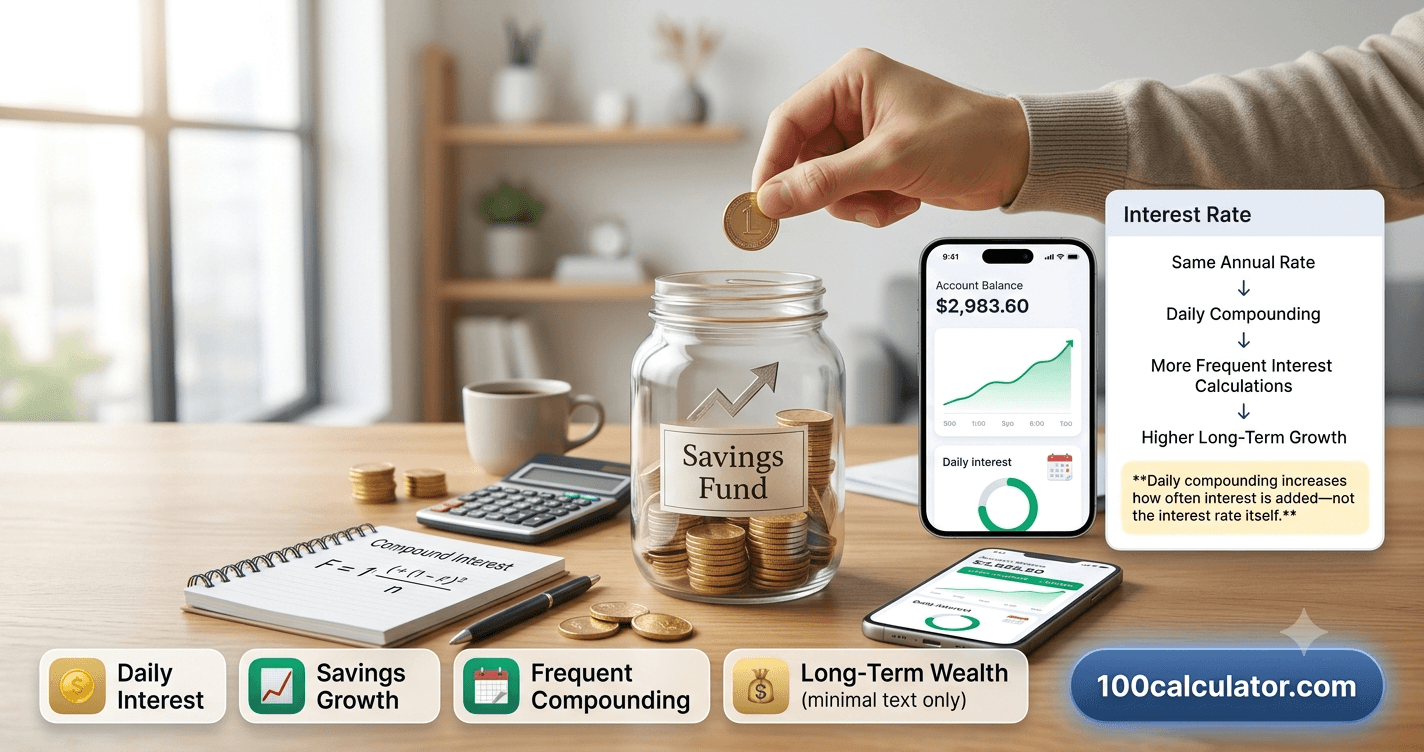
If you've ever compared two savings accounts with the same advertised rate and wondered why one grows a bit faster, the answer usually comes down to compounding frequency, not the rate itself.
Daily compounding means your interest is calculated and added to your balance every single day instead of once a month or once a year. Because that freshly added interest immediately starts earning its own interest, a daily-compounding account edges out an otherwise identical monthly or annual account, even though the stated interest rate is exactly the same. The gap is small in year one and gets noticeably wider the longer your money stays invested.
That's the whole idea behind this article: not that daily compounding is some secret trick, but that it's a free, built-in boost that costs you nothing extra to take advantage of. You just have to know what to look for when you're choosing where to keep your savings. If you want to see the exact numbers for your own situation, 100 Calculator's Daily Compound Interest Calculator does the math instantly once you enter your starting amount, rate, and timeframe.
Below, we'll break down exactly how daily compounding works, run through real worked examples, look at popular "rules of thumb" people search for (including the 8-4-3 rule and a few Warren Buffett quotes), and cover the honest limits of what compounding can and can't do for you. First, let's make sure the basic idea of compound interest is solid, since everything else builds on it.
What Is Compound Interest, Really?
Compound interest is interest calculated on both your original money (the principal) and on the interest that money has already earned. In plain terms: your interest starts earning interest of its own. That's different from simple interest, which only ever calculates interest on your original principal, no matter how long you leave the money alone.
Say you put $1,000 into an account paying 5% a year. With simple interest, you'd earn exactly $50 every single year, forever, because the calculation always uses that original $1,000. With compound interest, year one still earns $50, but year two calculates 5% on $1,050, not $1,000, because last year's interest is now part of the balance. Year two earns $52.50. Year three earns even more than that. The gap between simple and compound interest starts small and keeps growing every year you leave the money in place.
Compound Interest vs. Simple Interest, in a Nutshell
Simple interest is common on some personal loans and short-term lending. Compound interest is what you'll find on most savings accounts, certificates of deposit, credit cards, and long-term investments. As a saver, compound interest is almost always the better deal, since it's working in your favor. As a borrower, it's the opposite: compound interest on debt can grow a balance faster than you expect if you're only making minimum payments. Our full breakdown in Simple Interest vs Compound Interest: Key Differences covers this comparison in more depth, including which one shows up in which everyday financial products.
The Compound Interest Formula, Explained Simply
Here's the formula that makes all of this possible:
| Symbol | What It Stands For |
|---|---|
| A | The final balance after interest (what you end up with) |
| P | Principal — your starting balance |
| r | Annual interest rate, written as a decimal (5% becomes 0.05) |
| n | Number of times interest compounds per year (365 for daily, 12 for monthly, 1 for annual) |
| t | Number of years the money stays invested |
Written out, it's A = P(1 + r/n)ⁿᵗ. This is the same formula taught in most introductory finance and algebra classes, including the version many students first meet as "the formula of compound interest" in middle or high school math. The only thing that changes between a savings account, a CD, and an investment account is what values you plug in for r, n, and t. You don't need to solve this by hand, though — that's exactly what a daily compound interest calculator is built to do for you.
How Daily Compounding Works
Every compounding schedule uses the exact same formula above — the only thing that changes is n, the number of compounding periods per year. Annual compounding uses n = 1. Monthly compounding uses n = 12. Daily compounding uses n = 365. A higher n means interest gets calculated and folded back into your balance more often, so each new bit of interest has more chances to earn interest of its own before the year is up.
This is also why the same nominal interest rate can produce a different APY depending on how it compounds. Take a stated 5% annual rate:
| Compounding Frequency | Times Per Year (n) | Effective APY |
|---|---|---|
| Annual | 1 | 5.0000% |
| Monthly | 12 | 5.1162% |
| Daily | 365 | 5.1267% |
Notice that the jump from annual to monthly compounding (about 0.12 percentage points) is bigger than the jump from monthly to daily (about 0.01 percentage points). That pattern holds in general: going from infrequent to somewhat-frequent compounding matters more than going from frequent to extremely frequent. Daily compounding is close to the mathematical ceiling of how much compounding frequency alone can help — banks that offer "continuous" compounding get only a hair closer still.
The Daily Compounding Formula
To calculate daily compound interest by hand, you use the same A = P(1 + r/n)ⁿᵗ formula with n set to 365 (or 366 in a leap year, though most calculators simplify to 365 for consistency). The daily interest rate itself is just your annual rate divided by 365 — a tiny number, but one that gets applied every single day of the year, including weekends.
How Interest Actually Works on a Savings Account
This is where people sometimes get confused: many real-world savings accounts compound daily but only credit that interest to your visible balance once a month. The bank is still calculating interest on interest every day — you just see the total appear as one monthly deposit on your statement. When comparing accounts, check both numbers: compounding frequency drives your actual growth, while the payout schedule only affects when you see it.
Free Online Tool
See your own numbers, not just examples
100 Calculator's Daily Compound Interest Calculator lets you enter your starting balance, rate, and timeframe to see exactly how daily compounding affects your specific savings, instantly and with no sign-up required.
Why Daily Compounding Boosts Your Savings Growth
Here's a concrete example. Say you deposit $10,000 at a 5% annual rate and leave it alone for 10 years. The table below shows what you'd end up with under three different compounding schedules, all using the exact same 5% rate.
| Compounding | Balance After 10 Years | Total Interest Earned |
|---|---|---|
| Annual | $16,288.95 | $6,288.95 |
| Monthly | $16,470.09 | $6,470.09 |
| Daily | $16,486.65 | $6,486.65 |
Daily compounding earns about $197.70 more than annual compounding here, and about $16.55 more than monthly compounding, on the same $10,000, at the same 5% rate, over the same 10 years. That's not a typo or a marketing trick — it's simply what happens when interest gets to start earning interest 365 times a year instead of 12 times or once.
On its own, $197.70 over a decade might not feel life-changing, and it isn't meant to. Daily compounding is a small, reliable edge, not a strategy by itself. The real story is what happens when you combine that small edge with a much longer timeline, which is what the next section covers.
The Power of Time: Why Compounding Feels Slow, Then Fast
This is the part people mean when they talk about "the power of compound interest" or the "magic" of compounding. It isn't really magic — it's just what an exponential curve looks like. In the early years, the growth looks almost identical to simple interest, because there isn't much accumulated interest yet for the "interest on interest" effect to work on. Given enough time, that effect takes over, and the curve bends sharply upward.
Using the same $10,000 at 5% APY, daily compounding example from above, here's how the balance grows over 30 years instead of just 10:
By year 30, daily compounding's edge over annual compounding has grown to about $1,592.86 — roughly eight times the $197.70 gap at year 10. Compounding frequency doesn't just add a fixed bonus; its advantage compounds too, which is part of why financial educators emphasize starting early over trying to time the "perfect" moment.
Popular "Rules" of Compounding You'll See Online
A handful of catchy, numbered "rules" about compounding circulate constantly on social media and finance blogs. Some are genuinely useful shortcuts. Others are looser than they sound. Here's an honest look at the ones people search for most.
The Rule of 72 (A Genuinely Useful Shortcut)
The Rule of 72 is the oldest and most reliable compounding shortcut: divide 72 by your annual interest rate to estimate how many years it takes your money to double. It's an approximation, not an exact formula, but it stays remarkably accurate across typical savings and investment rates.
| Annual Rate | Rule of 72 Estimate | Exact Doubling Time |
|---|---|---|
| 4% | 18.0 years | 17.7 years |
| 6% | 12.0 years | 11.9 years |
| 8% | 9.0 years | 9.0 years |
| 10% | 7.2 years | 7.3 years |
| 12% | 6.0 years | 6.1 years |
It's a quick mental-math trick, not a substitute for an actual calculation — for a precise answer that accounts for your real compounding frequency, the Premium Compound Interest Calculator will get you an exact figure in seconds.
The "8-4-3 Rule" of Compounding
The 8-4-3 rule is a popular mental model, not an official financial formula, for illustrating how compounding accelerates when you invest a fixed amount regularly over a long stretch of time. The general idea is that a 15-year investing period can be thought of in three phases — roughly 8 years, then 4 years, then 3 years — where the total account balance takes progressively less time to grow by the same amount as compounding builds on itself.
To check whether that idea holds up mathematically, we ran the numbers ourselves: investing $500 every month at a 12% average annual return (compounded monthly, an assumption commonly used in these illustrations, not a promised return) produces this pattern:
| Milestone | Balance | Total Contributed |
|---|---|---|
| After 8 years | $79,963.65 | $48,000 |
| After 12 years (next 4) | $159,530.78 | $72,000 |
| After 15 years (final 3) | $249,790.10 | $90,000 |
In this example, the balance roughly doubled from year 8 to year 12 — about $79,964 to about $159,531 — which is a neat illustration of back-loaded growth and part of why the 8-4-3 framing caught on. The exact ratios depend heavily on the rate and contribution amount you assume, though, so treat it as a memorable illustration of acceleration rather than a formula to apply to any account.
Is There Really a "7-3-2 Rule"?
You may also come across a "7-3-2 rule." Unlike the Rule of 72, this one isn't standardized — different sources define it differently. Some use it to describe milestones (such as a savings goal) arriving in 7 years, then the next in 3 years, then the next in 2, as a variation on the same "acceleration" idea as the 8-4-3 rule. Others attach it to specific growth-rate assumptions instead. Because there's no single agreed definition, we'd treat any specific numbers attached to a "7-3-2 rule" with some skepticism, even though the underlying point — that compounding accelerates over time — is accurate regardless of which version you run into.
What Warren Buffett and Charlie Munger Have Said About Compounding
Warren Buffett and his longtime business partner Charlie Munger built Berkshire Hathaway largely by buying good businesses and letting compounding run for decades. Their comments on the subject get quoted constantly, sometimes accurately and sometimes not, so it's worth separating what's well documented from what's internet folklore.
Buffett's Own Words on Compound Interest
Buffett has credited compound interest directly for a large share of his success. In interviews and shareholder letters over the years, he's pointed to three factors behind his wealth: being born in America, good luck in life circumstances, and the simple effect of compound interest working over an unusually long career. It's a reminder that his edge wasn't picking one brilliant stock — it was staying invested for roughly seven decades and letting compounding do the heavy lifting.
Buffett's 90/10 Rule
Buffett's "90/10 rule" comes from his 2013 letter to Berkshire Hathaway shareholders, where he described the instructions he left for the trustee managing money for his wife after his death: put 90% into a low-cost S&P 500 index fund and the remaining 10% into short-term government bonds. It's less a rule about daily compounding specifically and more a simple, low-fee way to let long-term compounding work without needing to actively manage a portfolio. It was designed around his own family's circumstances and time horizon, so it's worth treating as an illustration of simplicity rather than a one-size-fits-all instruction.
Charlie Munger's "First Rule of Compounding"
Munger, Berkshire Hathaway's longtime vice chairman, put it memorably: the first rule of compounding is to never interrupt it unnecessarily. His point was that every time you cash out, sell early, or pause contributions without a real need to, you reset part of the clock that compounding depends on. It's frequently cited advice for staying invested through short-term market swings rather than reacting to every dip.
Is "The Eighth Wonder of the World" Really an Einstein Quote?
Almost certainly not. The line "compound interest is the eighth wonder of the world" is one of the most repeated quotes in personal finance, usually credited to Albert Einstein. Quote-tracking researchers have traced the phrase back to old bank advertising copy and found no evidence Einstein ever said it — the earliest documented print appearance linking it to his name shows up decades after his death in 1955, with no original source attached. It's a catchy line, and the underlying point about compounding being counterintuitively powerful is fair. Just don't expect to find it in anything Einstein actually wrote.
Can Compound Interest Really Make You Rich?
It can meaningfully build wealth, but it's worth being precise about what that takes. It's also worth separating two things that often get blurred together: the guaranteed math behind a fixed-rate account like a savings account or CD, and the historical-average illustrations used for stock market investing, where returns aren't fixed or guaranteed at all.
If You Only Add Money Once
Turning a single $5,000 deposit into $1,000,000 with no further contributions requires either a very high return or a very long timeline, since that's a 200-fold increase. Here's how long it would take at different annual rates, assuming no withdrawals and no additional deposits:
| Annual Rate | Approximate Years Needed |
|---|---|
| 6% | ~91 years |
| 8% | ~69 years |
| 10% | ~56 years |
| 12% | ~47 years |
That's longer than most people's working careers, which is exactly why relying on a single lump sum alone rarely gets anyone to $1,000,000 within a normal lifetime of saving.
A More Realistic Path
Combine that starting amount with regular contributions and the picture changes considerably. Starting with $5,000 and adding $500 every month at an assumed 8% average annual return, compounded monthly — a commonly used long-run assumption for diversified stock market investing, not a guarantee — here's what the math works out to:
| Years | Estimated Balance | Total Contributed |
|---|---|---|
| 30 years | $799,858 | $185,000 |
| 35 years | $1,228,404 | $215,000 |
| 40 years | $1,866,871 | $245,000 |
This is a far more realistic route to a seven-figure balance than a single deposit: a starting cushion, a few decades, and a disciplined monthly habit, doing most of the work through compounding rather than through picking winning investments. For a retirement-focused version of this same math, our guide to calculating your FIRE number and the FIRE Financial Independence Calculator can help you map out your own target.
Related Calculators
Put what you just read into practice, try these free tools instantly, no sign-up required.
Premium Compound Interest Calculator
Calculate compound interest growth on your investments over time.
Premium Simple Interest Calculator
Quickly calculate simple interest earned or owed on a principal.
Daily Compound Interest Calculator
See how daily compounding interest grows your savings over time.
FIRE Financial Independence Calculator
Plan your path to financial independence and early retirement.
4 Percent Rule Calculator
Estimate safe retirement withdrawals using the 4% rule.
The Benefits of Daily Compounding
Stepping back from the specific examples, here's what daily compounding offers in plain terms:
- A higher effective yield than the same nominal rate compounded less often, at no extra cost or effort to you
- No downside compared to other schedules — daily compounding never earns you less than monthly or annual compounding at the same rate
- A growing advantage over time, since the dollar gap between daily and less frequent compounding widens the longer your money stays invested
- Works automatically — you don't need to do anything differently to benefit; it's a feature of the account, not a strategy you have to manage
- Compounds alongside good habits, like regular contributions and reinvested interest, rather than replacing the need for them
If you're comparing two savings accounts with similar rates, checking the compounding frequency is a quick, easy way to squeeze out a little extra growth without taking on any additional risk.
The Disadvantages and Limits of Compound Interest
Compound interest gets talked about so glowingly that it's worth being clear-eyed about its limits, too.
- It works against you on debt. Credit cards and some loans use compound interest too, which means an unpaid balance can grow faster than expected if you're only covering the minimum payment.
- The frequency effect has a ceiling. As shown earlier, daily compounding is close to the mathematical limit of how much compounding frequency alone can add. Going from annual to daily won't turn a low rate into a high one.
- Inflation quietly erodes real returns. A 5% APY sounds solid until you account for rising prices; the "real" growth in purchasing power is smaller than the number on your statement suggests.
- Interrupting it resets the clock. Withdrawing your principal, cashing out early, or pausing contributions for long stretches gives up a disproportionate share of the long-term benefit, since most of the growth happens in the later years.
- Investment returns aren't guaranteed the way savings account rates are. The 8% and 12% figures used earlier in this article are illustrative long-run averages for diversified investing, not promises — actual year-to-year returns can be negative, and past performance doesn't guarantee future results.
- Taxes and fees take a bite. Interest and investment gains are often taxable, and account fees can quietly offset some of what compounding adds, especially in accounts without tax advantages.
None of this cancels out the benefits described earlier — it just means compounding works best as one part of a broader, realistic savings plan rather than a guaranteed shortcut to wealth. For a closer look at specific missteps to avoid, see Compound Interest Mistakes That Cost You Money.
How to Put Daily Compounding to Work for Your Own Savings
None of the math above matters much unless you actually apply it. A few practical steps make the difference:
- Compare compounding frequency, not just the advertised rate. Two accounts with the same APY are equivalent, but two accounts with the same interest rate and different compounding schedules are not — always check the APY, since it already reflects compounding frequency.
- Start as early as you reasonably can. As the 30-year chart earlier showed, most of the dollar growth from compounding happens in the later years, so time in the account matters more than trying to time the "perfect" moment to start.
- Automate regular contributions so compounding has fresh money to work with every month, rather than relying on a single deposit to do everything.
- Leave the interest in the account. Withdrawing earned interest as soon as it's paid out turns compound interest back into simple interest, in effect — the growth only compounds if you let it stay.
- Use a calculator before you commit. Run your actual numbers through 100 Calculator's Daily Compound Interest Calculator or the Premium Simple Interest Calculator if you're comparing against a simple-interest product, so you're deciding based on real projected numbers instead of guesswork.
Common Mistakes That Quietly Reduce Your Returns
A few habits undercut compounding without people noticing: withdrawing interest as soon as it posts, choosing a slightly higher rate at a bank that compounds less often, letting an account sit idle instead of contributing regularly, and pausing contributions during a tight month instead of just reducing them. Each one looks small on its own. Over a decade, they add up to a meaningfully smaller balance than a consistent, hands-off approach would produce.
Financial disclaimer: This article is for general educational purposes only and isn't personalized financial, investment, or tax advice. Interest rates, APYs, and investment returns vary by product, provider, and market conditions, and figures used for illustration in this article are not guaranteed. Speak with a licensed financial advisor about decisions specific to your own circumstances.
Sources & References
- U.S. Securities and Exchange Commission, Investor.gov — Compound Interest Calculator
- U.S. Securities and Exchange Commission, Investor.gov — Compound Interest (glossary)
- Consumer Financial Protection Bureau — Appendix A to Part 1030, Annual Percentage Yield Calculation
- Berkshire Hathaway Inc. — Shareholder Letters Archive
- Quote Investigator — The Eighth Wonder of the World Is Compound Interest
More From Our Finance Guide
Want to keep exploring how interest, retirement planning, and long-term saving fit together? These related guides dig deeper into the topics touched on above.
Frequently Asked Questions
What is compound interest, in simple terms?
Compound interest is interest calculated on both your original balance and on the interest that balance has already earned. In other words, your interest starts earning its own interest. That's different from simple interest, which always calculates interest only on your original amount, no matter how long the money sits. Compound interest is what makes savings accounts, investments, and some loans grow — or owe — faster the longer they're left alone.
What's the difference between compound interest and simple interest?
Simple interest is calculated only on your original principal, so you earn or owe the same dollar amount every period. Compound interest is calculated on your principal plus any interest already added, so the amount grows each period. Over short timeframes the difference is small; over years or decades, compound interest pulls noticeably ahead because each round of interest builds on the last.
How is daily compounding different from monthly or annual compounding?
They all use the same interest rate and the same formula — the only difference is how often interest gets calculated and added to your balance. Daily compounding does this 365 times a year, monthly compounding 12 times, and annual compounding just once. More frequent compounding means interest starts earning its own interest sooner, which produces a slightly higher effective yield even at an identical stated rate.
What is the formula for daily compound interest?
Daily compound interest uses the standard compound interest formula, A = P(1 + r/n)^(nt), with n set to 365. P is your starting balance, r is the annual interest rate as a decimal, t is the number of years, and A is your final balance. Dividing r by 365 gives you the daily rate that gets applied to your balance every day of the year.
Will my savings really grow faster with daily compounding than monthly compounding?
Yes, though the difference is modest at a typical savings-account rate. On $10,000 at 5% for 10 years, daily compounding earns about $16.55 more than monthly compounding, and about $197.70 more than annual compounding, using the exact same rate. The gap grows the longer the money stays invested, but daily compounding will never earn you less than a less-frequent schedule at an identical rate.
What is the 8-4-3 rule of compounding?
The 8-4-3 rule is a popular illustration, not an official formula, showing how regular investing can appear to double in progressively shorter stretches — commonly shown as 8 years, then 4, then 3 — as compounding builds on itself. It's a useful mental picture of how growth accelerates over time, but the exact numbers depend entirely on the rate and contribution amount you assume, so treat it as an illustration rather than a guarantee.
What did Warren Buffett say about compound interest?
Buffett has credited his wealth to three things: being born in America, favorable circumstances, and compound interest — built up by staying invested for roughly seven decades. His longtime partner Charlie Munger put a related idea more sharply, calling the first rule of compounding "never interrupt it unnecessarily," meaning that unnecessary selling or withdrawals quietly cost you a share of long-term growth.
What is Warren Buffett's 90/10 rule?
In his 2013 Berkshire Hathaway shareholder letter, Buffett described instructions for a trustee managing money for his wife: put 90% into a low-cost S&P 500 index fund and the remaining 10% into short-term government bonds. It's a simple, low-fee approach designed for his family's own situation and long time horizon, and it's often cited as an example of how simplicity can work alongside long-term compounding.
What did Charlie Munger say about compounding?
Charlie Munger, Berkshire Hathaway's longtime vice chairman, is widely credited with the line "the first rule of compounding: never interrupt it unnecessarily." He used it to explain why he and Buffett generally avoided selling good investments just because a price looked high, since every unnecessary sale or withdrawal interrupts the growth that compounding depends on building over many years.
Is "compound interest is the eighth wonder of the world" really an Einstein quote?
Almost certainly not. Quote-tracking researchers have found no evidence Albert Einstein ever said this, and the phrase appears to have originated in old bank advertising rather than in anything Einstein wrote or said. It's still a popular, widely repeated line in finance content, and the underlying point about compounding being surprisingly powerful over time holds up, even though the attribution doesn't.
Can compound interest realistically make you rich?
It can meaningfully build wealth, but usually through decades of consistent contributions rather than a single deposit. For example, starting with $5,000 and adding $500 a month at an assumed 8% average annual return can grow to roughly $1.2 million after 35 years. A single $5,000 deposit left untouched would take 50 to 90 years to reach $1,000,000 depending on the rate, which is why regular contributions matter so much.
What are the disadvantages of compound interest?
Compound interest also works against you on debt, since an unpaid credit card or loan balance can grow quickly if you're only covering the minimum payment. Inflation quietly reduces real returns even on a solid APY, withdrawing money early resets much of the long-term benefit, and investment-based compounding (unlike a fixed savings rate) isn't guaranteed year to year. Taxes and account fees can also offset some of what compounding adds.
What's a simple way to start benefiting from daily compounding?
Compare the APY, not just the interest rate, when choosing a savings account, since APY already reflects compounding frequency. Then leave the interest in the account instead of withdrawing it, add to your balance regularly if you can, and start as early as possible, since most of the dollar growth from compounding happens in later years. A daily compound interest calculator can show you the projected results before you commit.
About 100 Calculator
100 Calculator is a free hub of online calculators and educational guides covering finance, trading, crypto, health, education, and more. Every tool is built to be fast, accurate, and genuinely free, with no account or signup required.
We built this guide, and tools like the Daily Compound Interest Calculator referenced throughout it, to make the math behind everyday savings decisions easier to see. Head back to the 100 Calculator homepage to explore the full library of tools, or learn more about the team behind them on our About Us page.