How to Calculate Simple Interest on Any Loan Amount
A clear, step-by-step breakdown of the simple interest formula, with worked examples, an Excel method, rate conversions, and a free calculator so you always know exactly what a loan will cost.
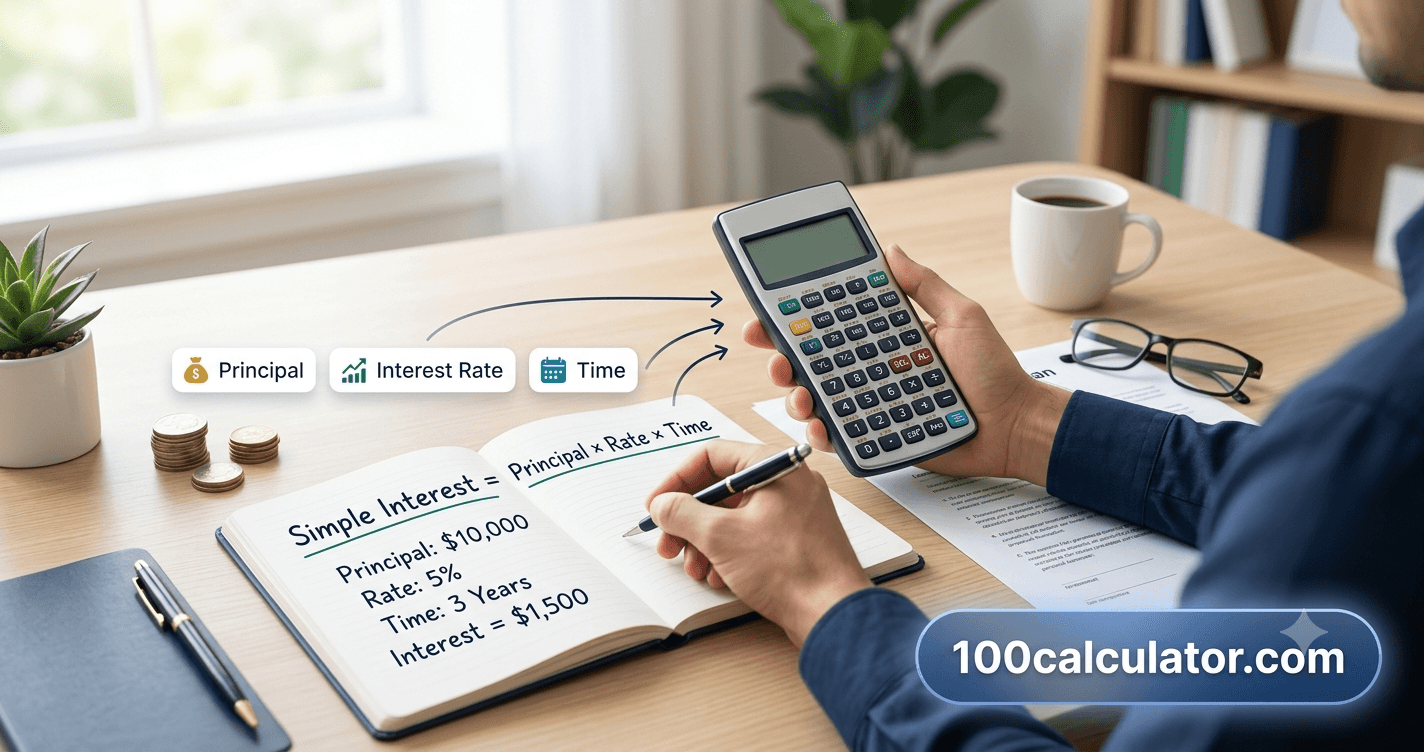
Loan paperwork loves to bury the one number you actually care about: how much extra you'll pay for borrowing the money. A lender quotes "8% interest," and unless you know how that percentage turns into real dollars, you're just taking their word for it.
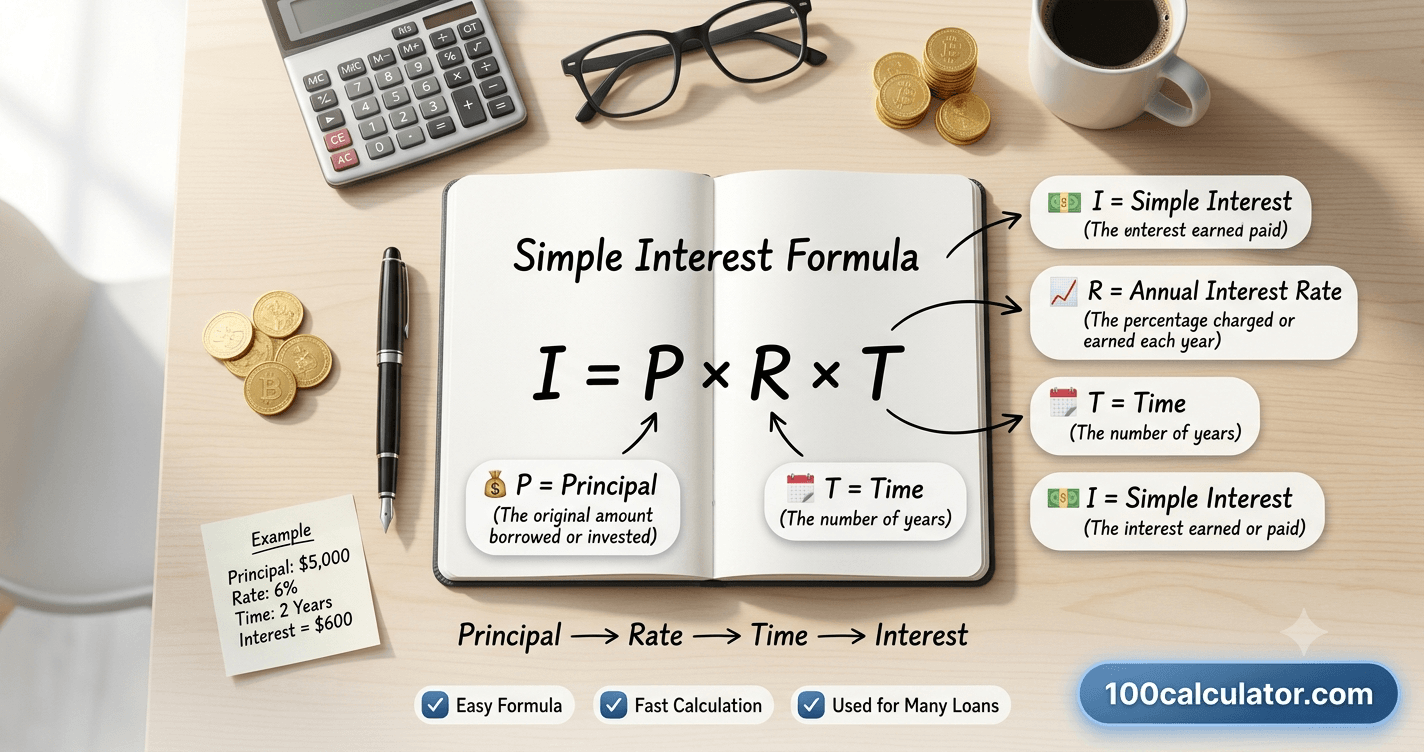
Simple interest is calculated with one formula: Interest = Principal × Rate × Time, or I = P × R × T. Multiply what you borrowed by the interest rate and the length of the loan, and you get the exact interest cost, with no compounding and no surprises. It's the most direct way a lender and a borrower can agree on what a loan actually costs, and the same formula applies whether the loan is a small personal loan or a much larger one.
The formula itself takes about ten seconds once you know your three numbers. The part that trips people up is usually matching rates and time periods correctly, like a rate quoted per month against a term measured in years. If you'd rather skip the manual math entirely, 100 Calculator's Premium Simple Interest Calculator does the work instantly. Enter your principal, rate, and term, and it hands you the interest owed and the total repayment right away.
This guide walks through the formula, several worked examples with real numbers, how to build it in Excel, how it compares to compound interest, and a few related loan concepts, like the Rule of 72 and loan-to-value ratio, that tend to come up in the same conversation.
What Is Simple Interest?
Simple interest is a way of calculating the cost of borrowing money, or the return on a deposit, using only the original amount. It never recalculates based on interest that has already been added, which is what separates it from compound interest.
That difference matters more than it sounds like it should. With simple interest, a $1,000 loan at 5% owes exactly $50 in interest every year, for as long as the loan runs. With compound interest, that $50 gets added to the balance, so next year's interest is calculated on $1,050 instead, and the amount owed grows a little faster each year. We'll cover that comparison in more detail later in this guide.
Key Terms You Need to Know
Before the formula makes sense, it helps to know what each piece of it actually represents:
- Principal: the original amount borrowed or deposited, before any interest is added.
- Rate: the interest rate, usually quoted per year, and always converted to a decimal before you calculate with it.
- Time: the length of the loan, expressed in the same units as the rate, typically years.
- Interest: the extra amount owed or earned, on top of the principal, once the formula is applied.
The Simple Interest Formula
The formula behind every simple interest calculation is short enough to memorize:
The Formula
I = P × R × T
Interest equals Principal multiplied by Rate multiplied by Time. Once you have those three numbers lined up correctly, the rest is just multiplication.
Breaking Down Each Part of the Formula
P is whatever currency amount you started with. R has to be written as a decimal, not a percentage, so 7% becomes 0.07 before you multiply. T needs to match whatever period your rate is quoted in. If the rate is annual, T is measured in years; a six-month loan would use 0.5, not 6.
Finding Your Total Repayment
The formula gives you the interest amount by itself, not the total you'll repay. To get the full amount owed, add the interest back to the principal: Total = P + I. On a $2,000 loan with $140 in calculated interest, the total repayment is $2,140.
How to Calculate Simple Interest Step by Step
With the formula in mind, here's the full process from scratch, useful for checking a loan offer or working out interest on your own paper:
- Identify the principal. This is the amount you're borrowing or depositing, before any interest.
- Convert the rate to a decimal. Divide the percentage by 100, so 9% becomes 0.09.
- Confirm your time period. Match it to the rate. An annual rate needs time in years; a 18-month term becomes 1.5 years.
- Multiply all three together. P × R × T gives you the interest amount owed or earned.
- Add the interest to the principal if you need the total repayment instead of just the interest portion.
That's the entire process. The math itself is simple; the part worth double-checking is always whether your rate and time period actually line up with each other.
Simple Interest Examples With Real Numbers
Formulas make more sense with real figures attached to them. The table below walks through five common examples, including amounts in lakhs, since "how much is 2% or 3% interest on 1 lakh" is one of the most searched versions of this question. One lakh equals 100,000, a numbering convention used across South Asia.
Five Worked Examples at a Glance
| Principal | Rate | Time | Interest | Total Repayment |
|---|---|---|---|---|
| ₹1,000 | 7% | 3 years | ₹210 | ₹1,210 |
| ₹30,000 | 7% | 1 year | ₹2,100 | ₹32,100 |
| ₹36,000 | 8% | 1 year | ₹2,880 | ₹38,880 |
| ₹1,00,000 (1 lakh) | 2% | 1 year | ₹2,000 | ₹1,02,000 |
| ₹1,00,000 (1 lakh) | 3% | 1 year | ₹3,000 | ₹1,03,000 |
What Changes When the Time Period Isn't a Full Year
The formula doesn't change, only the value of T does. For the ₹30,000 example above, six months of interest at 7% would use 0.5 instead of 1: 30,000 × 0.07 × 0.5 = ₹1,050, half of the one-year figure. Two years at the same rate would double it instead. Whatever the actual loan term is, expressed in years, drop it straight into T.
Converting Between Monthly, Daily, and Annual Rates
Interest rates get quoted in different time periods depending on the lender and the type of loan. Being able to convert between them is often the part of "calculating interest" people actually get stuck on, more than the formula itself.
Monthly Rate to Annual Rate
For simple, non-compounding interest, converting a monthly rate to an annual one just means multiplying by 12. A rate of 1.5% per month works out to 18% per year (1.5 × 12), and a 12% annual rate breaks down to exactly 1% per month.
Daily Interest Rate Calculations
To go the other direction, divide an annual rate by 365 to get a daily rate. A 7% annual rate works out to roughly 0.019% per day (7 ÷ 365). Some lenders use a 360-day year for this calculation instead of 365, which produces a very slightly higher daily figure, so it's worth checking which convention your loan agreement actually uses.
Is 1% Per Month the Same as 12% Per Annum?
In pure simple-interest terms, yes: 1% charged every month for 12 months adds up to exactly 12% for the year, since 1 × 12 = 12. The math changes if that 1% compounds monthly instead of simply repeating. Compounding 1% twelve times produces an effective annual rate of about 12.68%, slightly higher than a flat 12%. That gap is exactly why loan disclosures separate a nominal rate from an effective, or annual percentage, rate, and it's worth checking which one a lender is actually quoting you. Our guide on how daily compounding differs from monthly or yearly goes deeper into how compounding frequency changes the real cost of a loan.
How to Calculate Simple Interest in Excel
Excel doesn't have a dedicated "simple interest" function, but it doesn't need one. The formula fits into a single cell.
The Excel Formula for Simple Interest
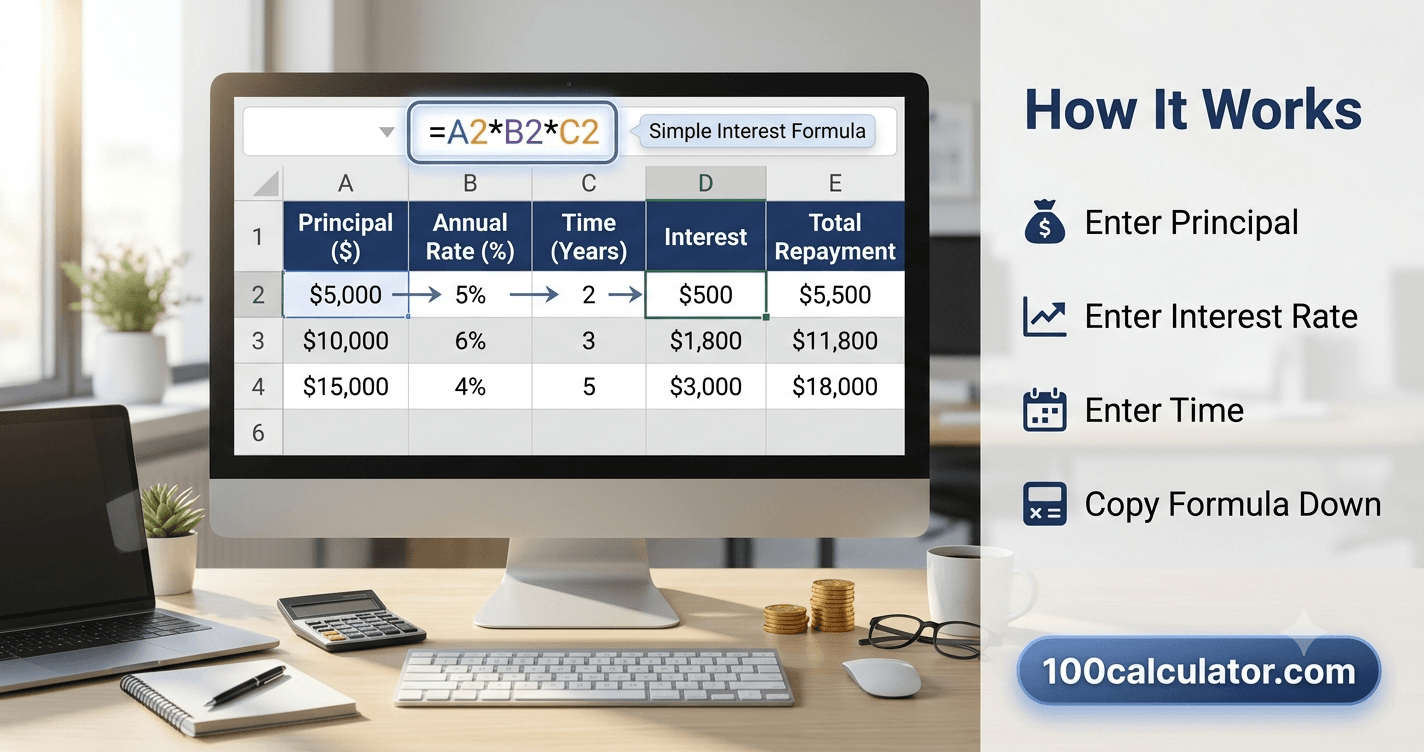
If your principal is in cell A2, your rate as a decimal is in B2, and your time in years is in C2, the interest formula in D2 is simply:
Excel Formula
=A2*B2*C2
Format cell B2 as a percentage so you can type 7% directly instead of 0.07 — Excel converts it to the decimal automatically behind the scenes.
Building a Reusable Loan Calculator in Excel
To turn that single formula into something you can reuse for any loan:
- Set up four column headers: Principal, Rate, Time (Years), and Interest.
- Enter your loan details in the first row, formatting the rate column as a percentage.
-
In the Interest column, enter the formula referencing
that row, such as
=A2*B2*C2. -
Add a fifth column for Total Repayment using
=A2+D2to add the interest back to the principal. - Drag the formulas down to compare as many loans as you want, each on its own row.
Calculating Simple Interest Online
Manual math and spreadsheets both work fine, but an online calculator skips the setup entirely.
Why Use an Online Calculator Instead of Manual Math
A calculator built specifically for simple interest handles the rate conversion and time-period matching for you, which removes the two spots where manual calculations most often go wrong. It's also faster when you're comparing several loan offers back to back and don't want to re-enter a spreadsheet formula each time.
Using the Premium Simple Interest Calculator
Free Online Tool
Skip the manual math entirely
100 Calculator's Premium Simple Interest Calculator runs right in your browser. Enter your principal, rate, and loan term, and it instantly returns the interest owed and the total repayment, with no account or signup required.
If your loan compounds instead of using simple interest, the Premium Compound Interest Calculator handles that version of the math, and the Daily Compound Interest Calculator is built specifically for rates that compound daily rather than annually or monthly.
Simple Interest vs Compound Interest
Simple and compound interest start from the same formula idea, but they grow very differently over time. Simple interest is always calculated on the original principal. Compound interest is recalculated on the principal plus whatever interest has already accumulated, so the amount owed (or earned) grows faster the longer the loan or deposit runs.
| Feature | Simple Interest | Compound Interest |
|---|---|---|
| Calculated on | Original principal only | Principal plus accumulated interest |
| Growth pattern | Straight line, same amount each period | Curved, grows faster over time |
| Common uses | Short-term personal loans, some auto loans, T-bills | Mortgages, credit cards, savings accounts |
| Best for borrowers when | You want predictable, lower total interest | Rarely — better suited to savers, not borrowers |
How $10,000 Grows Differently Over Time
The chart below shows a $10,000 amount at an 8% annual rate under both methods. In year one, the two lines match exactly, since compounding hasn't had a chance to take effect yet. From year two onward, compound interest steadily pulls ahead.
For a deeper look at exactly why that gap opens up, our guide on simple interest vs compound interest: key differences breaks down the math side by side, and how compound interest grows your money over time walks through what that curve means if you're saving rather than borrowing.
The Rule of 72 and the Rule of 78
Two other "rules" show up constantly in searches alongside simple interest, and it's worth being clear about what each one actually does, since neither is a simple interest calculation itself.
What the Rule of 72 Tells You
The Rule of 72 estimates how long it takes money to double at a given compound annual rate. Divide 72 by the interest rate to get the approximate number of years: at 8%, that's 72 ÷ 8 = 9 years to double. It's worth noting this rule is built specifically for compound growth. Simple interest grows in a straight line and never compounds on itself, so it doesn't "double" on the same predictable schedule. The SEC's Investor.gov offers a free compound interest calculator that demonstrates the Rule of 72 directly, which is a useful way to see the estimate against the exact math.
What the Rule of 78 Means for a Loan
The Rule of 78, also called the sum-of-digits method, is a way some lenders front-load interest on short-term installment loans. For a 12-month loan, the first month's payment includes 12/78 of the total interest, the second month includes 11/78, and so on down to 1/78 in the final month. Over the full loan term, the total interest ends up matching what a simple interest loan would charge; the difference only shows up if you pay the loan off early.
How Banks and Lenders Use Simple Interest
Not every loan uses the same interest method, and knowing which one applies to yours changes how you should read the numbers on your statement.
Where Simple Interest Shows Up in Real Loans
Many short-term personal loans, some auto loans, and certain government securities like Treasury bills calculate interest on the outstanding principal alone, which is straightforward simple interest, or something very close to it. On a simple interest auto loan, paying a little extra toward principal each month genuinely reduces the interest you'll pay for the rest of the term, since next month's interest is calculated on a smaller balance.
Where Compound Interest Takes Over Instead
Mortgages, credit cards, and most long-term loans use amortized or compound interest instead, recalculating the balance at regular intervals. Savings accounts and retirement accounts also typically compound, since that works in the saver's favor rather than the borrower's. Our guide on why daily compounding can boost your savings growth looks at that side of the equation in more detail.
Related Calculators
Put what you just read into practice, try these free tools instantly, no sign-up required.
Premium Compound Interest Calculator
Calculate compound interest growth on your investments over time.
Premium Simple Interest Calculator
Quickly calculate simple interest earned or owed on a principal.
Daily Compound Interest Calculator
See how daily compounding interest grows your savings over time.
FIRE Financial Independence Calculator
Plan your path to financial independence and early retirement.
4 Percent Rule Calculator
Estimate safe retirement withdrawals using the 4% rule.
Common Mistakes to Avoid When Calculating Interest
A handful of small errors account for most of the confusion around interest calculations. Here's what to watch for:
- Forgetting to convert the percentage. Multiplying by 7 instead of 0.07 inflates the result by a factor of 100.
- Mixing rate periods with time periods. A monthly rate needs time measured in months, not years, unless you've converted one of them first.
- Assuming a full year when a loan actually runs for a partial term, which skews the interest figure in either direction.
- Confusing "interest owed" with "total repayment." The formula gives you the interest only; you still need to add it to the principal.
- Assuming a loan uses simple interest when it actually compounds, or uses a method like the Rule of 78, which can make manual math and the lender's own numbers disagree.
Our article on compound interest mistakes that cost you money covers a related set of errors that show up specifically on the compounding side of these calculations.
Choosing the Right Loan
Once you can calculate simple interest confidently, the formula becomes a tool for comparing loan offers, not just checking one.
When Simple Interest Works in Your Favor
Simple interest tends to favor borrowers who plan to pay a loan off early or make extra payments toward principal, since every dollar paid down early stops accruing interest immediately. It also makes the total cost of a loan easy to predict from day one, since the rate never changes based on what's already been paid.
What Else to Check Before You Sign
The interest rate is only one part of what a loan actually costs. A few other things are worth confirming before you commit to any loan offer:
- Whether the loan uses simple interest, compound interest, or a precomputed method like the Rule of 78.
- The APR, which folds in fees along with the interest rate, making it a more complete number for comparing loans.
- Whether there's a prepayment penalty for paying the loan off ahead of schedule.
- For secured loans like mortgages or auto loans, the LTV, which compares your loan amount to the value of the asset securing it.
If you're weighing a loan against a longer-term savings or investing goal instead, our guides on the FIRE movement and how the 4 percent rule works for retirement planning cover the other side of the interest-rate equation: putting money to work instead of borrowing it. The FIRE Financial Independence Calculator and 4 Percent Rule Calculator are natural next steps once your borrowing math is settled.
Financial disclaimer: This article is for general educational purposes only and isn't a substitute for personalized financial or legal advice. Loan terms, fees, and interest calculation methods vary by lender and jurisdiction, so always review your actual loan agreement and talk to a licensed financial advisor or your lender before making borrowing decisions.
Sources & References
A couple of the lending concepts covered in this guide, including loan-to-value ratio and the Rule of 72, come from established consumer-finance and investor-education resources. These are worth a look if you want to dig deeper:
More From Our Finance Guide
Want to keep building your understanding of interest, compounding, and long-term money planning? These related guides dig deeper into the topics touched on above.
Frequently Asked Questions
How do you calculate simple interest?
Multiply the principal (the amount borrowed or invested) by the interest rate written as a decimal, then multiply that result by the loan term in years. The formula is Interest = Principal × Rate × Time, or I = P × R × T. For example, borrowing 5,000 at 6% for 2 years gives you 5,000 × 0.06 × 2 = 600 in interest. Add that to the principal, and the total amount owed is 5,600. The same formula works for interest owed on a loan or interest earned on a simple-interest savings product.
What is the basic formula for simple interest?
The basic formula is I = P × R × T, where I is the interest amount, P is the principal, R is the annual interest rate expressed as a decimal, and T is the time period in years. If you want the total amount owed instead of just the interest, add the interest back to the principal: Total = P + I. This formula only applies to simple interest; it doesn't work for loans or accounts where interest compounds over time.
What is the simple interest on 1,000 for 3 years at 7%?
Using I = P × R × T: 1,000 × 0.07 × 3 = 210. The simple interest comes to 210, and the total amount owed after 3 years is 1,210 (the original 1,000 plus 210 in interest). This calculation assumes the 7% rate applies per year and doesn't change or compound over the 3-year term, which is the standard assumption for simple interest problems.
What is the interest on 30,000 at 7 percent?
At a simple annual rate of 7%, interest on 30,000 for one year is 30,000 × 0.07 × 1 = 2,100. That means the total repayment after one year would be 32,100. If your time period is different, say 6 months instead of a full year, you'd use 0.5 in place of 1 for T, which would cut the interest to 1,050 instead.
What is the interest on 36,000 at 8 percent?
At a simple annual rate of 8%, interest on 36,000 for one year works out to 36,000 × 0.08 × 1 = 2,880. That brings the total amount owed to 38,880 after one year. For a different loan term, multiply by that number of years instead — over 2 years, for example, the interest would double to 5,760, assuming the rate and principal stay the same.
What is 2% interest on 1 lakh?
One lakh equals 100,000, so 2% simple interest on that amount for one year is 100,000 × 0.02 × 1 = 2,000. The total you'd owe or receive after that year would be 102,000. If the 2% rate applies monthly instead of annually, the math changes significantly, since repeated monthly interest adds up to a much larger amount over a full year, so it's worth confirming which time period a quoted rate actually refers to.
What is 3% interest on 1 lakh?
Three percent simple interest on 1 lakh (100,000) for one year is 100,000 × 0.03 × 1 = 3,000, bringing the total to 103,000. This is the same I = P × R × T formula used for any other amount; only the numbers change. Always double-check whether the rate you've been quoted is meant to apply annually, monthly, or for the full loan term, since that assumption changes the answer substantially.
Is 1% per month the same as 12% per annum?
In simple interest terms, yes: 1% charged every month for 12 months adds up to exactly 12% for the year, since 1 × 12 = 12. The math changes if the rate compounds monthly instead of simply repeating — compounding 1% twelve times actually produces an effective annual rate of about 12.68%, slightly higher than 12%. That's why loan disclosures often separate a "nominal" rate from an "effective" or annual percentage rate, and it's worth checking which one you're being quoted.
What does 10% or 12% simple interest actually mean?
It means the lender or account charges, or pays, that percentage of the original principal each year, with no compounding. A 10% simple annual rate on a 1,000 loan adds 100 in interest every year it's outstanding, always calculated from the original 1,000, not from a growing balance. This differs from a compound rate, where interest is calculated on the principal plus any interest that's already accumulated, so the amount owed grows faster over time.
How do you calculate interest rate per month or per day?
To estimate a simple monthly rate from an annual one, divide the annual rate by 12 — a 12% annual rate works out to roughly 1% per month. For a daily rate, divide by 365 instead, so a 7% annual rate is about 0.019% per day. These conversions work well for simple interest, but many real loans and credit cards compound daily or monthly, which produces a slightly higher effective rate than this straightforward division suggests.
What is the Rule of 72, and what is it used for?
The Rule of 72 is a quick way to estimate how long it takes money to double at a given compound annual rate — divide 72 by the interest rate to get the approximate number of years. At 8%, for example, 72 ÷ 8 = 9 years to double. It's worth noting this rule is built for compound growth, not simple interest, since simple interest grows in a straight line and never compounds on itself.
What is the Rule of 78?
The Rule of 78, also called the sum-of-digits method, is a way some lenders front-load interest on short-term installment loans, charging more interest in the earlier months and less toward the end. Over the full loan term, it adds up to the same total interest as a simple interest loan — the difference only shows up if you pay the loan off early, since you'll have already paid a larger share of the interest. U.S. law bans this method for loans longer than 61 months, and several states restrict or prohibit it entirely.
How do banks calculate interest on loans?
Banks use different methods depending on the loan type. Many short-term personal loans and some auto loans use simple interest, calculated only on the outstanding principal. Mortgages, credit cards, and most long-term loans use amortized or compound interest instead, where the balance is recalculated at set intervals. The loan agreement will state which method applies, along with the annual percentage rate, which is the clearest number for comparing loans from different lenders.
What does loan-to-value (LTV) mean, and how do you calculate it?
Loan-to-value (LTV) compares how much you're borrowing to the appraised value of the asset, usually a home or vehicle, securing the loan. To calculate it, divide the loan amount by the asset's value and multiply by 100. A 75% LTV on a 400,000 home means you're borrowing 300,000 and covering the rest with a down payment. LTV isn't part of the simple interest formula itself, but lenders use it alongside your interest rate to decide loan terms, required insurance, and overall risk.
About 100 Calculator
100 Calculator is a free hub of online calculators and educational guides covering health, finance, trading, crypto, education, and more. Every tool is built to be fast, accurate, and genuinely free, with no account or signup required.
We built this guide, and tools like the Premium Simple Interest Calculator referenced throughout it, to make everyday finance questions a little easier to answer. Head back to the 100 Calculator homepage to explore the full library of tools, or learn more about the team behind them on our About Us page.