Why Pip Value Matters for Managing Trading Risk
Pip value is the number that turns a stop-loss into an actual dollar amount. Here's how to calculate it for forex and gold, and how to use it to size every trade on purpose instead of by accident.
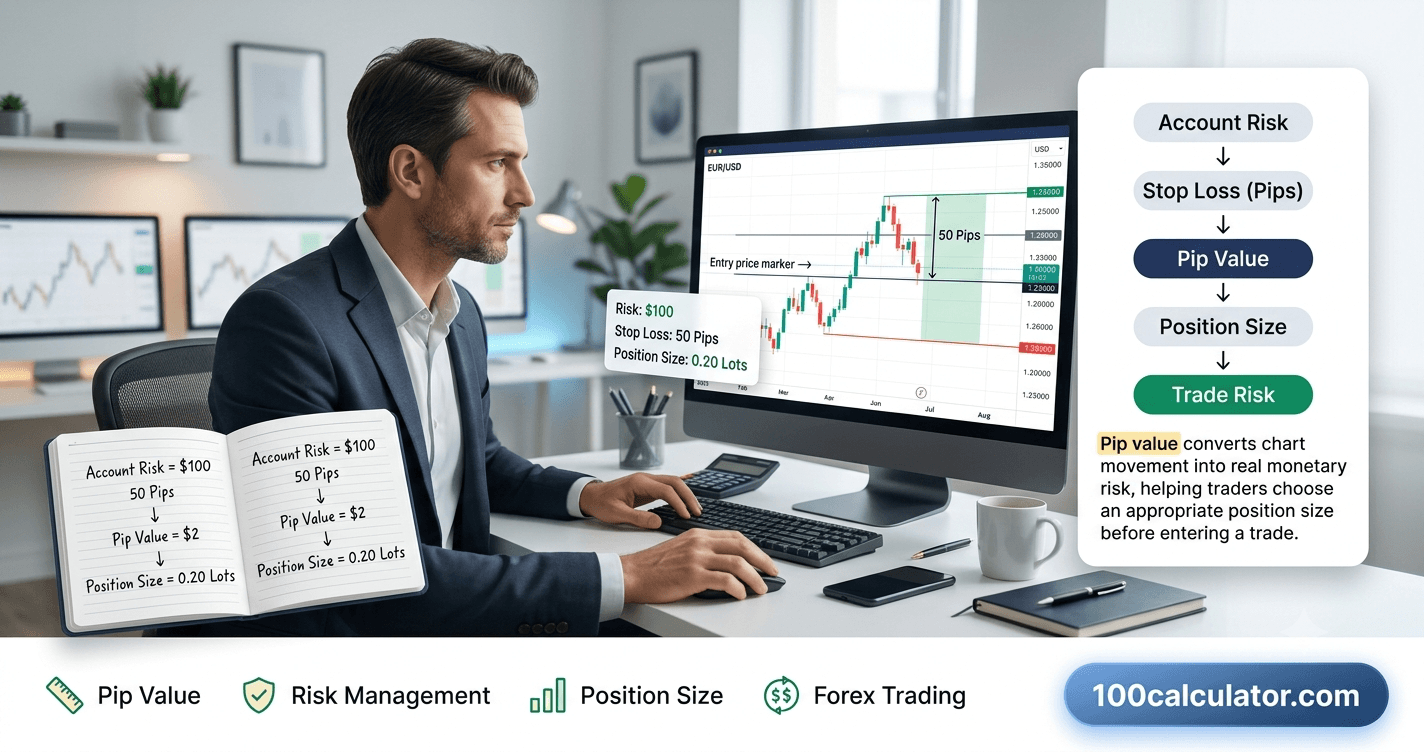
Every forex or gold trade you place moves in pips, and every pip that moves is worth a specific amount of money. That number is called pip value, and it's what turns a stop-loss written in pips into an actual dollar figure you could gain or lose.
Pip value is the dollar amount a single pip movement is worth for a given position size. For a standard lot (100,000 units) of a USD-quoted pair like EUR/USD, one pip is typically worth $10. For a micro lot (1,000 units) of that same pair, one pip is worth about $0.10. The exact figure shifts with the pair you're trading, your position size, and, for some pairs, the current exchange rate.
Here's why that number matters more than it sounds like it should: pip value is the missing link between where you place your stop-loss and how much money is actually at risk. Two traders can use the exact same 30-pip stop-loss and end up risking wildly different amounts, purely because they used different position sizes. Get pip value wrong, or skip the calculation entirely, and a stop-loss stops meaning much in dollar terms.
This guide walks through what a pip actually means, how to calculate pip value for forex pairs and gold (XAUUSD), and how to turn that number into a position size that matches the risk you intended. If you'd rather skip the manual math, 100 Calculator's Pip Value Calculator does this instantly for any pair and lot size.
What Is a Pip, Exactly?
Pip stands for "percentage in point," sometimes described as "price interest point." It's simply the standard unit traders use to describe how much a currency pair's price has moved. Instead of saying a price moved by 0.0037, traders say it moved 37 pips. Understanding what pips mean in practical, dollar terms is the first step toward using them for anything more than reading a chart.
Where the Term Comes From
The term traces back to how forex prices are quoted. Most currency pairs display prices to four decimal places, like 1.0847. The fourth decimal place, the smallest standard increment that price typically moves in, is one pip. If EUR/USD moves from 1.0847 to 1.0852, that's a 5-pip move. Pairs that include the Japanese yen are the exception: they're quoted to two decimal places, so a pip there sits at the second decimal instead of the fourth.
Pips vs. Pipettes
Many brokers now quote prices to one extra decimal place beyond the standard pip, called a pipette, or fractional pip. On EUR/USD, that's a fifth decimal place; on USD/JPY, it's a third. One pip equals 10 pipettes.
Pips in Forex vs. Pips in Gold (XAUUSD)
Gold complicates the picture because it isn't quoted like a currency pair. XAUUSD prices typically show two decimal places, such as 2,350.45, and most brokers treat a $0.01 move in that price as one pip, similar to how a JPY pair's pip sits at the second decimal. A move from 2,350.45 to 2,351.45 is a $1.00 move, or 100 pips under that convention.
Here's the catch: gold doesn't have one universally agreed pip definition the way major forex pairs do. Some brokers call a $0.10 move a pip and treat the $0.01 increment as a separate "point" instead. The dollar amounts at stake don't change, but the pip count used to describe the same move does. Before trading gold with a new broker, it's worth checking their contract specification page to confirm which convention they use. Our guide to calculating pip value for any currency pair walks through this same distinction in more depth.
How Pip Value Is Calculated
Once you know what a pip is, the next step is turning it into a dollar figure. Pip value depends on three things: the pip size for the pair you're trading, your position size, and, for some pairs, the current exchange rate. The core formula stays the same no matter which pair you're looking at.
The Basic Pip Value Formula
When your account currency matches the quote currency of the pair you're trading, the math is direct:
Pip Value Formula
Pip Value = Pip Size × Trade Size (in units)
Pip Size — 0.0001 for most forex pairs, 0.01 for JPY pairs and gold (XAUUSD)
Trade Size — units in your position: 100,000 for a standard lot, 10,000 for a mini lot, 1,000 for a micro lot
For a USD account trading EUR/USD, GBP/USD, or AUD/USD, the quote currency is already USD, so this formula gives you pip value directly: 0.0001 × 100,000 = $10 per pip on a standard lot. When the quote currency isn't your account currency, for instance USD/JPY or USD/CAD for a USD account, you take that same result and divide it by the current exchange rate to convert it into your account currency.
Pip Value by Lot Size (Standard, Mini, Micro)
Lot size is the biggest lever on pip value, and it's worth seeing all three side by side for a typical USD-quoted pair:
| Lot Size | Units Traded | Value of 1 Pip |
|---|---|---|
| Standard lot (1.00) | 100,000 | $10.00 |
| Mini lot (0.10) | 10,000 | $1.00 |
| Micro lot (0.01) | 1,000 | $0.10 |
Notice the pattern: every time you move down a lot-size tier, pip value drops by a factor of 10. That's exactly why lot size is the main tool traders use to control risk while keeping the same stop-loss distance. A wider stop doesn't have to mean bigger risk if the lot size scales down to match. Our guide on how lot size and pip value work together covers this relationship in more detail.
Calculating Pip Value in Gold (XAUUSD)
Gold uses the same logic with different starting numbers. Using the common convention where one pip equals a $0.01 move and a standard lot equals 100 troy ounces:
- Standard lot (100 oz): $0.01 × 100 = $1.00 per pip
- Mini lot (10 oz): $0.01 × 10 = $0.10 per pip
- Micro lot (1 oz): $0.01 × 1 = $0.01 per pip
Pip Value and Your Trading Risk
This is the part that actually matters for your account balance. A stop-loss set 30 pips away means nothing in isolation, because 30 pips can be worth $3 or $300 depending entirely on position size. Pip value is what converts a price-based decision, where to place your stop, into a risk-based one: how much money that stop actually protects.
The Link Between Stop-Loss and Position Size
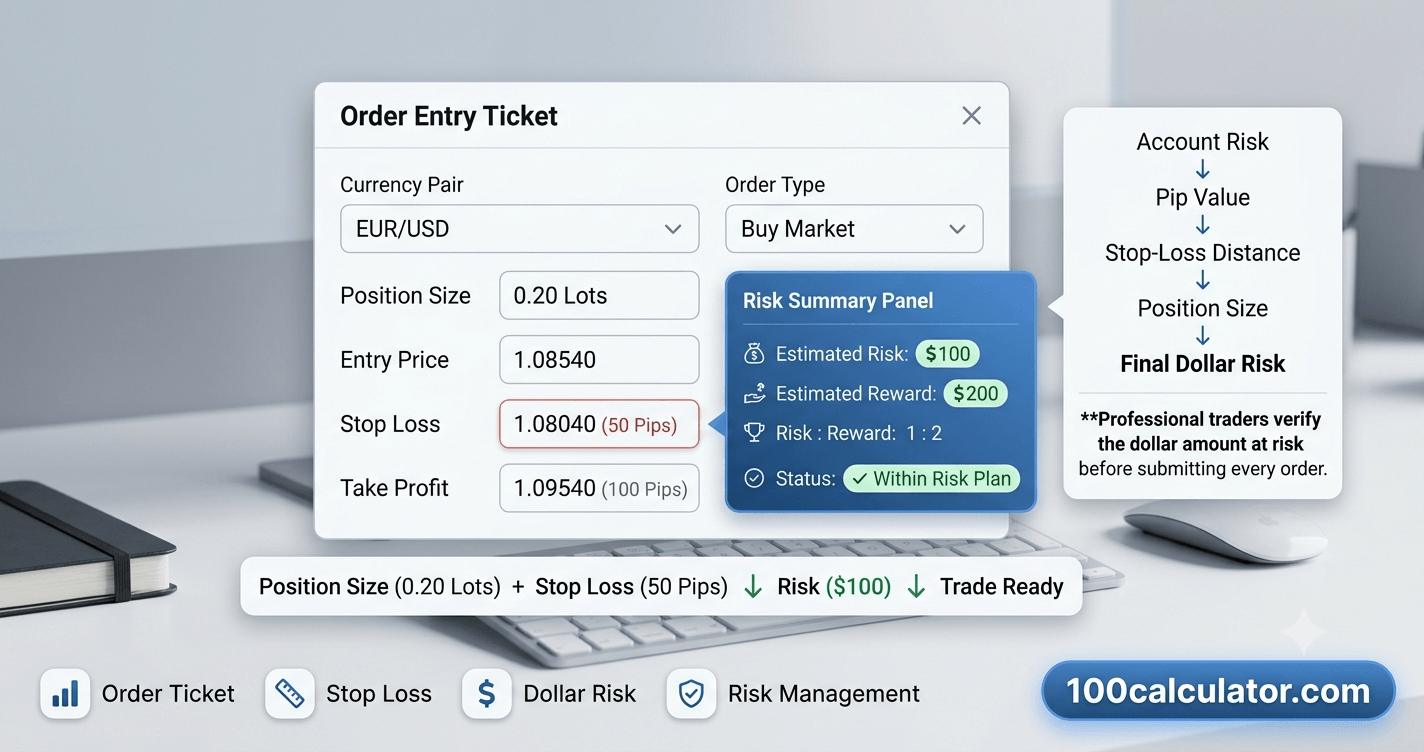
Every trade has two decisions buried in it: where the stop-loss goes, and how big the position is. Traders often think hard about the first one and barely think about the second, but pip value is what ties them together. Once you know pip value, you can work backward from "how much am I willing to lose" to "how many lots should I actually trade."
Here's what understanding pip value actually gives you:
- A stop-loss distance in pips that translates into a specific, known dollar amount
- The ability to size a position so a stop-loss hit costs what you planned, not more
- A consistent way to compare risk across pairs, even when their pip conventions differ
- A sanity check before entering a trade, instead of finding out the real risk after it's too late
What Happens When Traders Skip This Step
Skip pip value, and position sizing usually defaults to something arbitrary, like always trading one standard lot regardless of the pair or the stop distance. On a tight 10-pip stop, that might risk very little. On a 100-pip stop with the same lot size, it can risk ten times as much, often without the trader noticing until the trade closes.
How to Calculate Risk Per Trade Using Pip Value
With pip value in hand, position sizing becomes a short formula instead of a guess. The goal is simple: decide how much you're willing to lose on a specific trade, then size the position so a stop-loss hit costs close to that amount, not more.
The Position-Sizing Formula, Step by Step
- Decide your dollar risk. Many trading educators suggest risking no more than 1% to 2% of your account balance on a single trade, though the right number depends on your own risk tolerance and strategy.
- Set your stop-loss distance in pips, based on your chart analysis, not on how much you feel like risking.
- Find the pip value for your pair and lot size, using the formulas from the section above.
- Divide your dollar risk by your stop-loss pips multiplied by pip value per lot to get your position size.
Position Size Formula
Position Size = Dollar Risk ÷ (Stop-Loss Pips × Pip Value per Lot)
Dollar Risk — how much you're willing to lose if this specific trade fails
Stop-Loss Pips — the distance between your entry price and your stop-loss
Pip Value per Lot — from the pip value formula covered earlier in this guide
Worked Example: Risking 1% of a $5,000 Account
Say you have a $5,000 account and you're comfortable risking 1% ($50) on a EUR/USD trade. Your analysis puts the stop-loss 25 pips from your entry. Using the standard lot pip value of $10:
Position Size = $50 ÷ (25 × $10) = $50 ÷ $250 = 0.2 lots
That's 0.2 standard lots, or 2 mini lots, or 20 micro lots, depending on how your broker lets you size positions. If that trade hits its stop-loss, you lose close to $50, the exact amount decided on before entering, instead of finding out the real number after the fact.
The same formula works for gold. On a $5,000 account risking 1% ($50) with a 300-pip stop-loss on XAUUSD (a $3.00 price move) and a standard lot pip value of $1: Position Size = $50 ÷ (300 × $1) ≈ 0.17 lots, or about 17 micro lots. Our guides on how to calculate position size for safer trading and position size mistakes every trader should avoid go further into sizing decisions like these.
Free Online Tool
Skip the manual math
100 Calculator's Position Size Calculator takes your account size, risk percentage, and stop-loss distance, and returns the exact lot size to trade, right in your browser, with no signup required.
Pip Value Across Different Currency Pairs
Pip value isn't identical across every pair, mainly because of which currency sits in the quote position. Pairs quoted directly against the US dollar (EUR/USD, GBP/USD, AUD/USD, NZD/USD) give you pip value in USD immediately. Pairs where the US dollar is the base currency instead (USD/JPY, USD/CHF, USD/CAD) need one extra conversion step, since the pip value comes out in the quote currency first.
| Pair | Quote Currency | Standard Lot Pip Value |
|---|---|---|
| EUR/USD | USD | $10.00 |
| GBP/USD | USD | $10.00 |
| AUD/USD | USD | $10.00 |
| NZD/USD | USD | $10.00 |
| USD/JPY | JPY | Approx. $6–$7* |
| USD/CHF | CHF | Approx. $10–$11* |
| USD/CAD | CAD | Approx. $7–$8* |
*The USD/JPY, USD/CHF, and USD/CAD figures are illustrative ranges, not fixed numbers, because they shift with the current exchange rate. The pairs quoted directly in USD don't have this issue: their pip value stays fixed at roughly $10 per standard lot regardless of where the exchange rate sits, which is part of why they're often used in beginner examples. If your account currency isn't USD at all, the same logic applies, you're just converting into a different final currency.
How Many Pips It Takes to Hit Common Profit Targets
Questions like "how many pips to make $100" or "how much is 50 pips worth" come up constantly, and the honest answer is always "it depends on your lot size." The relationship is linear and easy to see laid out in a table, using the standard USD-quoted pip values from earlier.
| Pips Moved | Micro Lot ($0.10/pip) | Mini Lot ($1/pip) | Standard Lot ($10/pip) |
|---|---|---|---|
| 10 pips | $1.00 | $10.00 | $100.00 |
| 20 pips | $2.00 | $20.00 | $200.00 |
| 50 pips | $5.00 | $50.00 | $500.00 |
| 100 pips | $10.00 | $100.00 | $1,000.00 |
| 250 pips | $25.00 | $250.00 | $2,500.00 |
Reading the table backward answers the reverse question too. Want to know how many pips it takes to make $100? On a mini lot, it's 100 pips. On a standard lot, it's only 10. On a micro lot, you'd need 1,000 pips, which almost never happens in a single trade, so micro lots suit small, controlled risk far better than chasing a specific dollar target. The same logic applies to a $500 target: 500 pips on a mini lot, 50 pips on a standard lot. This is exactly why position size, not the pip count itself, is usually the thing worth adjusting when a target feels out of reach.
Leverage, Margin, and Pip Value Working Together
Leverage and pip value are often confused for the same thing, but they answer different questions. Pip value tells you how much a price move is worth. Leverage tells you how much margin your broker sets aside to let you hold that position in the first place. Mixing the two up is a common reason traders misjudge their real risk.
What Leverage Actually Changes (and What It Doesn't)
Leverage changes how much of your own capital you need to open a position; it does not change pip value. A 1-standard-lot EUR/USD position is still worth $10 per pip whether you're using 10:1 leverage or 500:1 leverage. What changes is the margin required to hold it: higher leverage means less margin tied up for the same position size.
That distinction matters because higher leverage can tempt traders into opening bigger positions simply because the margin allows it, not because the risk makes sense. The position-sizing formula from earlier doesn't care what leverage you're using; it only cares about your dollar risk, your stop-loss distance, and pip value. Leverage decides whether you have enough margin to open a position, not whether you should.
Choosing Sensible Leverage for Gold and Forex
Regulatory leverage limits vary by country. In the United States, the CFTC and NFA cap retail forex leverage at 50:1 for major currency pairs and 20:1 for minor pairs (CFTC). In the UK and EU, retail leverage on major forex pairs is typically capped lower, with gold and other instruments capped lower still. Many international brokers outside these jurisdictions offer considerably higher leverage.
There isn't a single "best" leverage number for gold or forex, since leverage itself doesn't determine your risk, position size does. A more useful question than "what's the maximum leverage I can get" is "what position size keeps my risk per trade at 1–2% of my account, given my stop-loss distance?"
Common Pip Value Mistakes Traders Make
A few habits quietly undo good risk management even when a trader technically understands pip value. Here's what to watch for:
- Using the same lot size on every trade. A 10-pip stop and a 60-pip stop on the same lot size risk very different amounts. Position size should adjust to the stop-loss distance, not the other way around.
- Assuming gold and forex pip values work identically. Applying a forex pip formula directly to XAUUSD without adjusting for gold's different pip size and contract convention leads to a badly miscalculated position.
- Forgetting to reconvert pip value for cross and JPY pairs. Skipping the exchange-rate conversion step on pairs like USD/JPY or EUR/GBP can leave your real risk noticeably different from what you planned.
- Confusing leverage with risk. Using the maximum leverage a broker allows isn't the same as sizing a position correctly; leverage affects margin, not the dollar value of a pip.
- Not checking a new broker's contract specifications or regulatory status. Contract size, pip definition, and lot conventions can all vary slightly between brokers, especially for instruments like gold. It's also worth confirming that a broker is properly registered before funding an account; the (NFA) maintains a public lookup tool for checking US-based forex dealers.
- Rounding position size instead of calculating it. Rounding 0.17 lots up to 0.2 "to keep it simple" quietly increases risk beyond what was planned. Our guide on how much return you need to recover from a drawdown shows exactly why small sizing errors compound into bigger problems over time, and the Drawdown Recovery Calculator shows just how much return it takes to dig back out.
Realistic Pip Targets and Everyday Risk Management
There's no single "best" strategy in day trading, and any resource that promises one is worth being skeptical of. What separates traders who last from those who don't is rarely the strategy itself, it's whether risk is sized consistently, trade after trade. Pip value is the tool that makes that consistency possible.
Is 100 Pips a Day a Realistic Goal?
Some pairs regularly move well over 100 pips in a single trading day, especially during high-volatility sessions or around major news releases, so capturing that much movement isn't impossible. The problem is treating "100 pips a day" as a fixed personal target rather than an outcome that depends on market conditions.
Setting a rigid daily pip quota tends to encourage exactly the habits good risk management is meant to prevent: taking lower-quality trades just to hit a number, increasing position size after a loss to "catch up," or holding trades open longer than the setup justifies. A 20-pip challenge or a 50-pips-a-day goal can be a useful practice exercise on a demo account, but as a live-trading target, it's worth replacing with a process goal instead, like sizing every position correctly and following your entry rules, and letting the pip count be whatever the market happens to give you.
Building a Simple Risk Management Routine
A short pre-trade routine keeps pip value from being something you only think about occasionally:
- Decide your dollar risk before you look at the chart, as a fixed percentage of your account, not a fixed dollar amount that ignores how the account has grown or shrunk.
- Set your stop-loss based on the chart, not on what lot size you'd like to trade.
- Calculate pip value for the pair and lot size you're using, rather than assuming it matches the last pair you traded.
- Run the position-sizing formula every time, even when the trade feels routine.
- Log the result, so you can see over time whether your actual losses match your planned risk.
Once you've calculated risk and stop-loss by hand a few times, plugging the same numbers into 100 Calculator's Pip Value Calculator turns this routine into a 30-second check before every trade.
Related Calculators
Put what you just read into practice, try these free tools instantly, no sign-up required.
Pip Value Calculator
Calculate the value of a pip for any currency pair and lot size.
Position Size Calculator
Determine the right position size based on your risk tolerance.
Risk Reward Ratio Calculator
Compare potential risk against reward before entering a trade.
Drawdown Recovery Calculator
Calculate the gain needed to recover from a trading drawdown.
Trading Compound Interest Calculator
Project compounded returns on your trading account balance.
Best Practices for Using Pip Value in Your Trading Plan
Pulling everything together, here's what consistently separates traders who use pip value well from those who treat it as an afterthought:
- Calculate position size from your stop-loss and dollar risk, not the other way around
- Recheck pip value whenever you switch pairs, especially between forex and gold
- Treat leverage as a margin tool, not a risk-sizing tool
- Confirm contract specifications with your broker before trading an unfamiliar instrument
- Keep your risk percentage consistent, and let position size change from trade to trade instead
- Weigh pip value alongside your risk-reward ratio, since the two work together when judging whether a trade is worth taking. Our guide on risk-reward ratio and long-term trading success covers that side of the equation, and the Risk Reward Ratio Calculator can run the numbers for a specific trade
None of this requires being a math expert. It requires doing the same short calculation every time, before the trade, not after. 100 Calculator's Pip Value Calculator and Position Size Calculator can handle the arithmetic instantly, but the habit of actually using pip value to size every trade is what protects an account over hundreds of trades, not just one.
Risk disclaimer: This article is for educational purposes only and does not constitute financial, investment, or trading advice. Trading forex, gold, and other leveraged or margined products carries a high level of risk and can result in the loss of some or all of your invested capital. Pip values, leverage limits, and contract specifications mentioned here are illustrative and can vary by broker, account type, and jurisdiction. Always confirm current contract specifications with your own broker, and consider consulting a licensed financial professional before trading with real capital.
More From Our Trading Guide
Still building out your risk management toolkit? These related guides dig deeper into the topics covered above.
Frequently Asked Questions
Why are pips important in trading?
Pips give traders a standard way to measure price movement and, more importantly, to translate that movement into an actual dollar amount at risk or in profit. Without pip value, a stop-loss is just a number on a chart; with it, that same stop-loss tells you exactly how much money is on the line before you enter a trade.
How do I calculate pip value for my trades?
Multiply the pip size for your pair (0.0001 for most forex pairs, 0.01 for JPY pairs and gold) by your trade size in units. If the quote currency matches your account currency, that figure is your pip value directly. If it doesn't, divide the result by the current exchange rate to convert it into your account currency.
How much is 1 pip worth in forex?
For a USD account trading a USD-quoted pair like EUR/USD, 1 pip is worth about $10 on a standard lot (100,000 units), $1 on a mini lot (10,000 units), and $0.10 on a micro lot (1,000 units). Pairs where USD isn't the quote currency, like USD/JPY, show a slightly different figure that shifts with the exchange rate.
How much is 1 pip worth in gold (XAUUSD)?
Using the common convention where 1 pip equals a $0.01 price move, 1 pip is worth $1.00 on a standard lot (100 troy ounces), $0.10 on a mini lot (10 ounces), and $0.01 on a micro lot (1 ounce). Some brokers define gold pips differently, so it's worth confirming the exact convention on your platform before trading.
How much is 0.01 pip worth in XAUUSD?
This usually refers to trading a 0.01 lot, a micro lot of 1 troy ounce, rather than a fraction of a pip. On a 0.01 lot XAUUSD position, one full pip (a $0.01 price move) is worth $0.01. That's why micro lots are commonly used for small accounts or for practicing position sizing without risking much per pip.
What does 20 pips mean in trading, and how much is that worth?
Twenty pips means the price moved 20 times the standard pip increment for that pair. In dollar terms, that's $200 on a standard lot, $20 on a mini lot, or $2 on a micro lot for a USD-quoted forex pair. A "20 pip challenge" typically means practicing entries and exits that target this kind of move with disciplined position sizing, not a guaranteed daily outcome.
How much is 50 pips worth?
On a USD-quoted forex pair, 50 pips is worth $500 on a standard lot, $50 on a mini lot, or $5 on a micro lot. The exact value depends entirely on your position size, which is why a pip count on its own never tells the full story.
How much is 250 pips worth in dollars?
For a standard lot on a USD-quoted pair, 250 pips equals $2,500. On a mini lot, that's $250, and on a micro lot, $25. A 250-pip move is a fairly large swing for most major pairs, so it usually spans more than a single trading session.
How many pips do I need to make $100, or $500?
It depends on lot size. On a standard lot, $100 takes 10 pips and $500 takes 50 pips. On a mini lot, $100 takes 100 pips and $500 takes 500 pips. On a micro lot, you'd need 1,000 pips for $100, which is rarely realistic in one trade. Matching your lot size to a realistic pip target, rather than the other way around, is usually the more useful approach.
How many pips is 1 tick?
Pip and tick aren't quite the same unit. "Pip" is the standard forex and CFD term, while "tick" more commonly describes the minimum price increment set by a futures exchange, and tick size varies by contract. Within forex itself, 1 pip equals 10 pipettes (fractional pips), which is the closest direct conversion most retail traders will need.
Is making 100 pips a day realistic?
Some currency pairs move well over 100 pips on an active trading day, so it's not impossible to capture that much movement. Treating it as a fixed personal target every single day is the riskier part, since it can push traders toward lower-quality trades or oversized positions just to hit a number. A more sustainable goal is following a consistent process and letting the pip count vary with market conditions.
How do brokers use pips?
Brokers use pips to quote spreads, the difference between the buy and sell price, display price movement on charts, and calculate profit and loss on open positions. A broker's spread might be listed as "1.2 pips" on EUR/USD, for example, which is effectively the built-in cost of entering and exiting a trade.
How do I calculate risk per pip for a trade?
Divide your total dollar risk, often 1-2% of your account, by your stop-loss distance in pips. The result is how much you can afford to risk per pip, which then tells you the maximum lot size you can safely use for that trade, using the pip value figures covered earlier in this guide.
What's the best leverage to use for XAUUSD?
There isn't a single best leverage number, since leverage affects the margin needed to open a position, not the size of your risk. Regulatory caps vary by region, for example, US retail forex leverage is capped at 50:1 for major pairs, while EU and UK rules cap gold leverage lower still, and many international brokers offer more. Whatever leverage is available, sizing your position using the risk-per-trade formula matters far more than maximizing leverage.
How should I manage risk when trading XAUUSD (gold)?
Start by confirming your broker's exact contract size and pip convention for gold, since these vary more than they do for standard forex pairs. From there, apply the same position-sizing formula used for forex: decide your dollar risk, set a stop-loss based on your analysis, calculate gold's pip value at your intended lot size, and size the position so a stop-loss hit costs what you planned, not more.
About 100 Calculator
100 Calculator is a free hub of online calculators and educational guides covering health, finance, trading, forex, crypto, education, and more. Every tool, including the Pip Value Calculator referenced throughout this guide, is built to be fast, accurate, and genuinely free, with no account or signup required.
We built this guide, and the trading calculators linked throughout it, to make everyday risk-management questions easier to answer without opening a spreadsheet. Head back to the 100 Calculator homepage to explore the full library of tools, or learn more about the team behind them on our About Us page.