What Risk Reward Ratio Should Beginner Traders Use?
A practical, no-jargon walkthrough of risk-reward ratio for traders just starting out — what it means, how to calculate it, and which ratio actually gives you room to be wrong sometimes and still come out ahead.
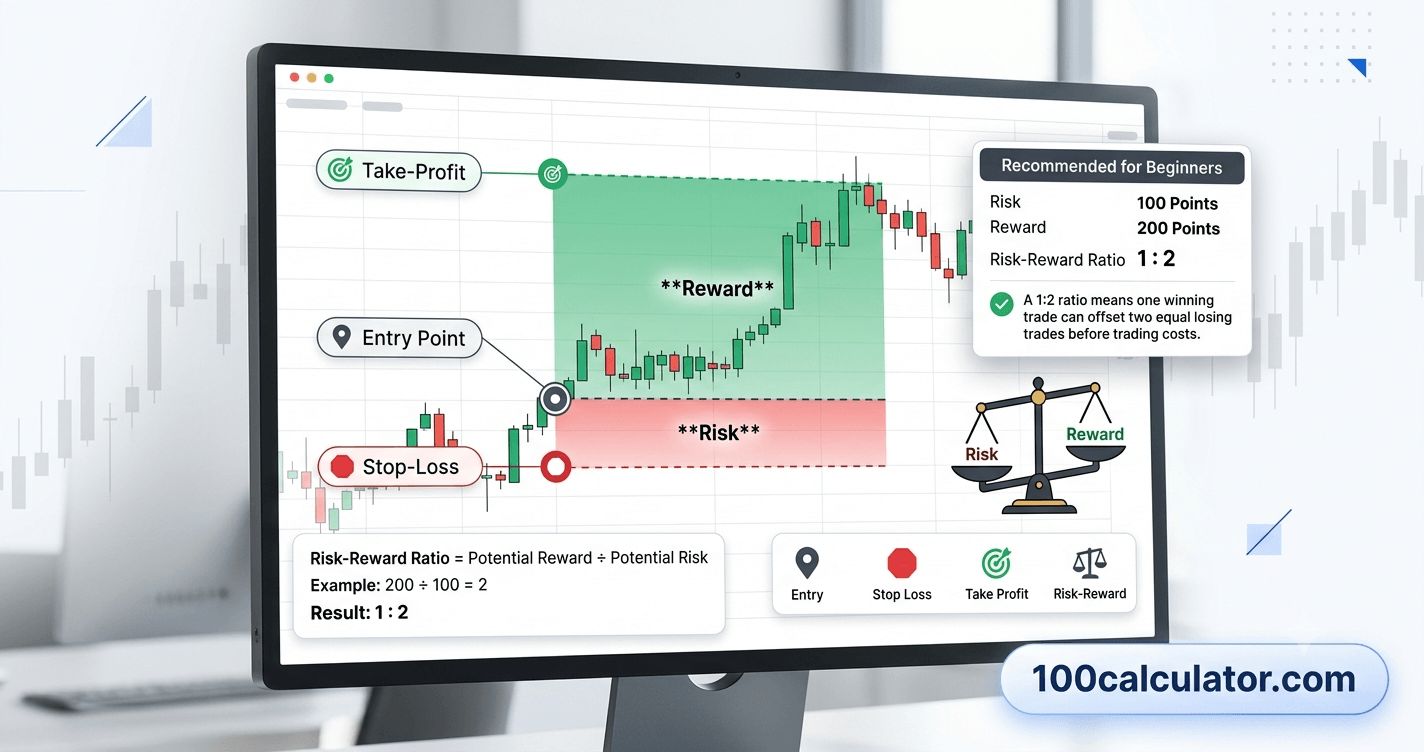
Every trade has two numbers attached to it, whether you write them down or not: how much you're willing to lose, and how much you're hoping to gain. The relationship between those two numbers is your risk-reward ratio, and for a beginner trader, getting it right matters more than almost anything else you'll learn early on.
A risk-reward ratio compares how much you stand to lose on a trade against how much you stand to gain, usually written as a ratio like 1:2 or 1:3 — and for most beginner traders, a ratio of at least 1:2 is a sensible starting point, since it means you can be wrong more often than you're right and still come out ahead. That single number shapes where you place your stop-loss, where you set your take-profit, and ultimately whether your strategy has any real chance of being profitable over time.
This guide walks through exactly how to calculate your risk-reward ratio, which ratio makes sense for someone just starting out, and how it connects to win rate, position size, and the stop-loss and take-profit levels you set on every trade. If you'd rather skip the manual math, our Risk Reward Ratio Calculator works it out for you instantly, though understanding how the numbers fit together will make you a sharper trader either way.
Before any of that math means much, it helps to know exactly what a risk-reward ratio is measuring and why traders write it the way they do.
What Is a Risk-Reward Ratio in Trading?
A risk-reward ratio is a comparison between two dollar amounts: how much you're risking on a trade, and how much you're aiming to make from it. Risk $100 to potentially make $200, and that's a 1:2 ratio. Risk $100 to make $300, and you're looking at 1:3.
The "risk" side of the equation is the distance between your entry price and your stop-loss, the price where you'll exit if the trade moves against you. The "reward" side is the distance between your entry price and your take-profit, the price where you'll exit if the trade moves in your favor. Position size and lot size get layered on top of this relationship, but the ratio itself only cares about these two distances.
Why Traders Write It as a Ratio, Not a Percentage
Percentages usually describe returns on your whole account. A risk-reward ratio describes a single trade in isolation, which is why it's written with a colon, like 1:2 or 1:3, rather than as a percentage. Writing it this way makes it easy to compare setups with completely different position sizes, since the ratio only reflects the relationship between the two distances, not the dollar amounts behind them.
Why Risk-Reward Ratio Matters for Beginner Traders
It's tempting to think trading success comes down to being right more often than you're wrong. In reality, a trader who's right only 40% of the time can still be solidly profitable, and a trader who's right 70% of the time can still lose money overall. The difference comes down to risk-reward ratio.
This matters because trading is genuinely difficult even before risk-reward ratio enters the picture. A widely cited academic study tracking retail day traders in Brazil's futures market found that 97% of people who kept trading for more than 300 days ended up losing money overall, with no evidence that experience improved their odds over time. (SSRN, 2020) In the United States, regulators require firms that promote day trading to warn customers in writing that it carries a high risk of loss and generally isn't appropriate for people with limited capital or experience. (FINRA) None of this means trading can't work. It means the traders who stay consistently profitable tend to take risk management, including their risk-reward ratio, seriously from their very first trade.
You Don't Have to Be Right Most of the Time
At a 1:3 ratio, you only need to win about one trade in four to break even, before costs. Win slightly more often than that, and the math starts working in your favor, even if three out of every four trades lose. That's a very different mental game than trying to be right on every single trade.
A Good Ratio Protects You From a Losing Streak
Every strategy has losing streaks, even good ones. A solid risk-reward ratio keeps each individual loss small and controlled, so a run of five or six losing trades in a row doesn't put a serious dent in your account. Beginners who skip this step tend to let losing trades run in hopes of a turnaround, which is exactly how a small, planned loss becomes a large, unplanned one.
How to Calculate Your Risk-Reward Ratio
Calculating a risk-reward ratio only takes four steps, and doing the math before you enter a trade, not after, is what actually makes it useful.
- Decide your entry price. This is the price where you plan to open the trade.
- Set your stop-loss based on chart structure. A recent swing low or high, a support or resistance zone, or a volatility-based distance all work better than a random round number.
- Set your take-profit at a realistic target. Look for the next meaningful resistance or support level, not just a level that happens to produce a ratio you like.
- Subtract to find your risk and reward, then divide. Reward divided by risk gives you your ratio.
Before you calculate anything, make sure you have:
- A specific entry price, not a rough estimate
- A stop-loss based on chart structure or volatility, not a guess
- A take-profit based on a realistic target, not just a round number
- Both levels set before you open the trade, not after
Risk-Reward Ratio Formula
Risk-Reward Ratio = Potential Reward ÷ Potential Risk Potential Risk = Entry Price − Stop-Loss Price Potential Reward = Take-Profit Price − Entry Price
Worked example: Buy at $50, stop-loss at $48, take-profit at $54.
Risk = $50 − $48 = $2. Reward = $54 − $50 = $4. Ratio = $4 ÷ $2 = 2, written as 1:2.
The same math works for a short trade, just in reverse — your stop-loss sits above your entry, and your take-profit sits below it. It also works in forex, where risk and reward are usually measured in pips before being converted to dollars using pip value and lot size; our Pip Value Calculator handles that conversion directly.
Free Online Tool
Skip the manual math
100 Calculator's Risk Reward Ratio Calculator works out your ratio instantly. Just enter your entry, stop-loss, and take-profit prices, and it handles the rest.
What Risk-Reward Ratio Should Beginner Traders Use?
For most beginners, a risk-reward ratio of 1:2 or higher is a sensible starting point. It's demanding enough to build good habits around stop-loss and take-profit placement, but not so ambitious that your take-profit targets become unrealistic.
Why 1:2 Is a Common Starting Point
At a 1:2 ratio, you need to win a little over 33% of your trades to break even, which leaves a wide safety margin for a strategy that's still being refined. Most beginner strategies, even solid ones, don't win more than 50-55% of the time, so a 1:2 ratio gives new traders room to make mistakes while they're still learning to read charts and manage emotions under pressure.
When a Higher Ratio Makes Sense
Some setups naturally support a 1:3 ratio or higher. A trade entered near strong support with a take-profit near the next major resistance level is a good example, where the distance to the target is genuinely much larger than the distance to a sensible stop-loss. Forcing a high ratio onto a setup that doesn't support it, by moving your take-profit further away without a chart-based reason, usually just lowers your win rate instead of improving your results.
When a Lower Ratio Can Still Work
A ratio below 1:1 isn't automatically wrong. Strategies with a high win rate, like some scalping or range-trading approaches, can be profitable with a 1:1 or even a 1:0.8 ratio, because they make up the difference in how often they win. The right ratio always depends on the strategy behind it, not a single number that works for everyone.
| Trading Style | Typical Risk-Reward Ratio | Why |
|---|---|---|
| Scalping | 1:1 to 1:1.5 | Very short holds, relies on a high win rate |
| Day trading | 1:1.5 to 1:2.5 | Intraday moves, moderate win rate needed |
| Swing trading | 1:2 to 1:3 | Multi-day holds, more room for price to develop |
| Position trading | 1:3 or higher | Long-term trends, fewer but larger wins |
1:2 vs 1:3 Risk-Reward Ratio: Which Is Better for Beginners?
1:2 and 1:3 are the two ratios beginners hear about most, and the honest answer is that neither one is universally better. They tend to suit different situations.
What Each Ratio Actually Requires
A 1:2 ratio needs a win rate of roughly 33% to break even. A 1:3 ratio only needs about 25%. On paper, 1:3 looks like the easier target. In practice, a 1:3 take-profit sits much further from your entry, which means the trade takes longer to play out and price has more time and room to reverse before it ever reaches your target.
A Side-by-Side Comparison
| Factor | 1:2 Ratio | 1:3 Ratio |
|---|---|---|
| Breakeven win rate needed | About 33% | About 25% |
| Distance to take-profit | Shorter | Longer |
| Typical hold time | Shorter | Longer |
| Best suited for | Day trading, faster setups | Swing trading, trending markets |
How to Decide Between Them
Look at where your stop-loss and take-profit naturally land based on the chart, not the ratio you'd prefer. If a nearby resistance level gives you a clean 1:2 setup, taking that trade is usually smarter than stretching your target further away just to hit a 1:3 label. Let the chart set the ratio, then check that the ratio makes sense, not the other way around.
How Win Rate and Risk-Reward Ratio Work Together
Risk-reward ratio only tells half the story. The other half is your win rate, how often your strategy actually wins, and the two numbers only mean something profitable when you look at them together.
The Breakeven Win Rate Formula
Breakeven Win Rate Formula
Breakeven Win Rate = Risk ÷ (Risk + Reward) × 100 At a 1:2 ratio: 1 ÷ (1 + 2) × 100 = 33.3% At a 1:3 ratio: 1 ÷ (1 + 3) × 100 = 25%
This is the win rate you need just to break even, before any trading costs.
Why This Changes How You See Losing Trades
Once you see the breakeven math, a losing trade stops feeling like a failure and starts looking like a normal, expected part of a strategy with positive expectancy. A trader using a 1:3 ratio who wins 30% of their trades isn't underperforming. They're beating their breakeven win rate by five percentage points, which over enough trades adds up to a real, growing edge.
Setting Your Stop-Loss and Take-Profit Levels
A risk-reward ratio is only useful if the stop-loss and take-profit behind it are placed sensibly. Picking numbers first and forcing a ratio around them later is one of the most common mistakes beginners make.
Where to Place Your Stop-Loss
A stop-loss works best when it sits just beyond a level that would actually prove the trade wrong: a recent swing low or high, a support or resistance zone, or a distance based on volatility, like the Average True Range. A stop-loss placed at a random round number, or one so tight it gets hit by normal price noise, undermines the ratio built on top of it.
Where to Place Your Take-Profit
A take-profit should sit at a level price has a real chance of reaching: the next meaningful resistance or support zone, a prior high or low, or a measured move based on the pattern you're trading. Setting a take-profit purely to hit a specific ratio, without a chart-based reason, tends to produce targets that look good in theory but rarely get reached in practice.
A Note on Fixed-Percentage Stop-Losses
Not every trader uses a chart-based stop. Some stock trading systems use a fixed percentage instead. The CANSLIM method popularized by investor William O'Neil, for example, suggests cutting a losing position once it falls about 7-8% below the purchase price, regardless of chart structure. Either approach can work, as long as you apply it consistently and factor it into your risk-reward math from the start.
- Your stop-loss sits beyond a level that would genuinely prove the trade wrong
- Your take-profit sits at a level price has realistically reached before
- You set both levels before entering the trade, not after
- Moving either level mid-trade is the exception, not the routine
How Much Should You Risk Per Trade?
Risk-reward ratio describes a single trade. Risk per trade describes how much of your entire account that single trade can cost you if your stop-loss is hit, and the two work together to determine how much damage a losing streak can actually do.
The 1-2% Rule
Risking around 1% to 2% of your account balance per trade is one of the most widely taught guidelines in trading, and for good reason. At 1% risk per trade, it takes more than 20 consecutive losses to cut an account in half. At 10% risk per trade, it takes about seven.
| Risk Per Trade | Consecutive Losses to Lose 50% of Account |
|---|---|
| 1% | About 69 |
| 2% | About 34 |
| 5% | About 14 |
| 10% | About 7 |
| 20% | About 3 |
Position Size Ties Risk Per Trade to Risk-Reward Ratio
Your risk-reward ratio doesn't set your position size. Your risk-per-trade rule does. Once you know your stop-loss distance and how much you're willing to risk in dollars, you can work backward to the position size that keeps you within that limit. Our Position Size Calculator handles this calculation directly, using your account size, risk percentage, and stop-loss distance.
Why Recovering From a Drawdown Gets Harder Fast
Losses and gains aren't symmetrical. A 20% loss requires a 25% gain just to get back to even. A 50% loss requires a 100% gain. Keeping risk per trade small is what keeps this math from turning against you. Our Drawdown Recovery Calculator shows exactly how much of a comeback a given drawdown requires.
Risk-Reward Ratio in Forex, Stocks, and Crypto Trading
The math behind a risk-reward ratio doesn't change from market to market, but how you apply it does, since forex, stocks, and crypto each come with their own quirks.
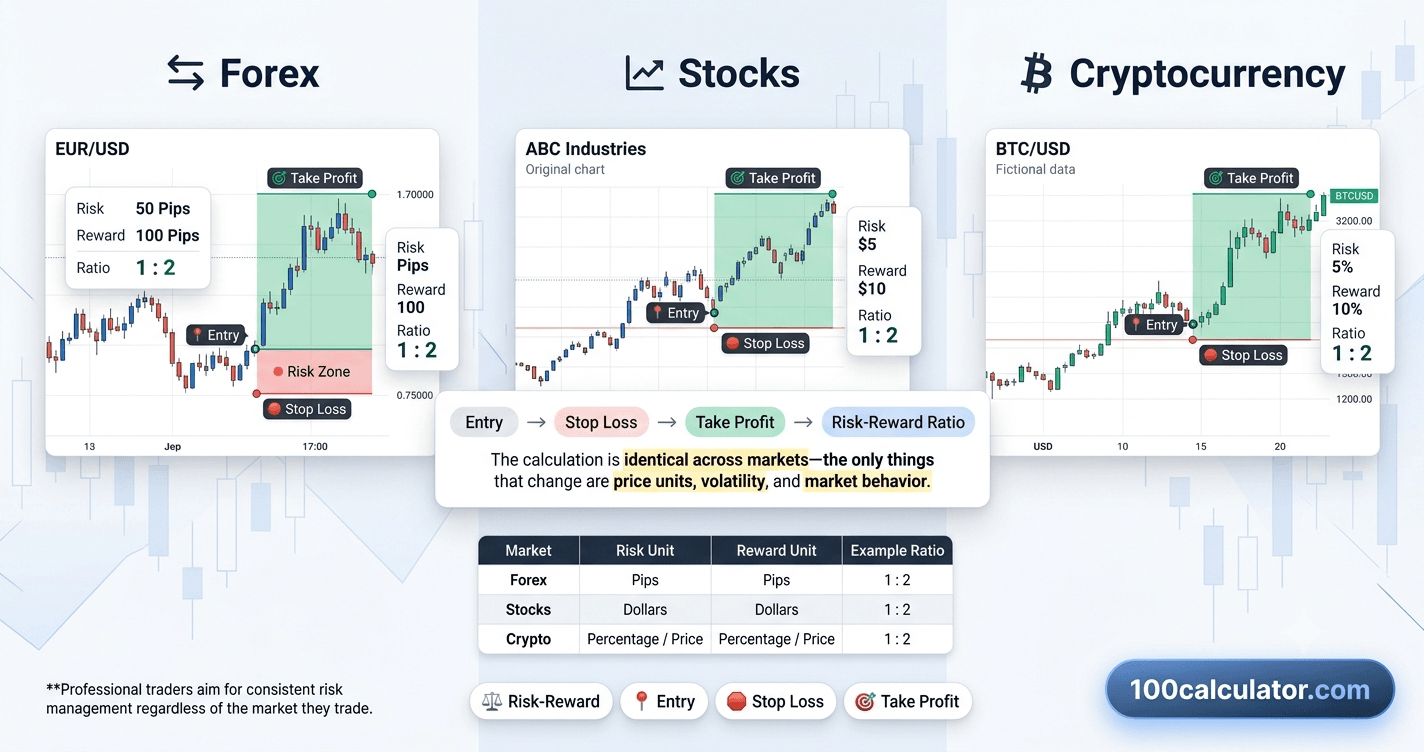
Risk-Reward Ratio in Forex Trading
In forex, risk and reward are usually measured in pips before being converted using pip value, which depends on the currency pair and your lot size. A trade risking 20 pips to make 40 pips is still a 1:2 ratio no matter which pair you're trading, but the dollar value of those pips can shift significantly between a micro lot and a standard lot. Our Pip Value Calculator and Forex Lot Size Calculator handle that conversion so your risk-reward math lines up with your actual account risk. Leverage deserves a specific mention here, since it's often described as the biggest single risk factor in forex. It magnifies both gains and losses relative to your account size, which is exactly why the 1-2% risk-per-trade rule matters even more in a leveraged market.
Risk-Reward Ratio in Stock Trading
Stocks generally move more slowly than forex or crypto, so risk-reward setups often play out over days or weeks rather than minutes or hours. Support and resistance levels, upcoming earnings dates, and the broader market trend all factor into where a realistic stop-loss and take-profit should sit.
Risk-Reward Ratio in Crypto Trading
Cryptocurrency's higher volatility cuts both ways for risk-reward ratio. Price can reach a take-profit target faster, but it can also blow through a stop-loss just as quickly during a sharp move. That's why many crypto traders widen their stop-loss distance slightly compared to a similarly structured stock or forex trade, then size their position down to compensate.
| Market | Typical Hold Time | Volatility | Key Consideration |
|---|---|---|---|
| Forex | Minutes to days | Moderate, amplified by leverage | Pip value changes with lot size and currency pair |
| Stocks | Days to weeks | Low to moderate | Earnings dates can gap price past your stop-loss |
| Crypto | Minutes to days | High | Wider stops are often needed; size down to compensate |
Common Risk-Reward Mistakes Beginner Traders Make
Even traders who understand the math above end up making a handful of avoidable mistakes. Here's what to watch for:
- Moving the stop-loss further away mid-trade. This is one of the fastest ways to turn a small, planned loss into a large, unplanned one, and it quietly undoes whatever risk-reward ratio you originally calculated.
- Setting an unrealistic take-profit just to hit a ratio. A 1:5 ratio looks great on paper, but if price rarely reaches that level, your real-world win rate collapses to compensate.
- Ignoring trading costs. Spread, commission, and slippage all eat into your reward side slightly, which is why your actual win rate needs to clear your theoretical breakeven rate by a small margin, not just match it.
- Risking a different percentage on every trade. Inconsistent risk per trade makes it hard to tell whether a strategy is actually working, since your results depend as much on position size as on the trades themselves.
- Chasing a high ratio instead of a good setup. A 1:1.5 trade on a clean, well-supported setup usually beats a forced 1:3 trade on a shaky one.
- Skipping the math before entering a trade. Calculating risk-reward ratio after a trade is already open doesn't help you decide whether to take it in the first place.
Related Calculators
Put what you just read into practice, try these free tools instantly, no sign-up required.
Pip Value Calculator
Calculate the value of a pip for any currency pair and lot size.
Position Size Calculator
Determine the right position size based on your risk tolerance.
Risk Reward Ratio Calculator
Compare potential risk against reward before entering a trade.
Drawdown Recovery Calculator
Calculate the gain needed to recover from a trading drawdown.
Trading Compound Interest Calculator
Project compounded returns on your trading account balance.
Building a Simple Risk Management Routine
The best risk-reward ratio is the one you actually calculate and follow on every trade, not the one that looks best in a strategy guide. A simple routine makes that far more likely.
- Set your risk-per-trade rule first, typically 1-2% of your account, before you even look at a chart.
- Find your stop-loss based on chart structure, not a fixed dollar amount you'd like to risk.
- Set your take-profit at a realistic level, then calculate the resulting risk-reward ratio. Don't reverse this order.
- Check the ratio against your rule. If it falls below your minimum, often 1:1.5 or 1:2, skip the trade rather than forcing it.
- Log every trade, including your planned risk, reward, and ratio, so you can see your real win rate after 20-30 trades instead of guessing.
- Review your numbers monthly, adjusting your target ratio based on what your actual win rate supports, not what you'd prefer it to be.
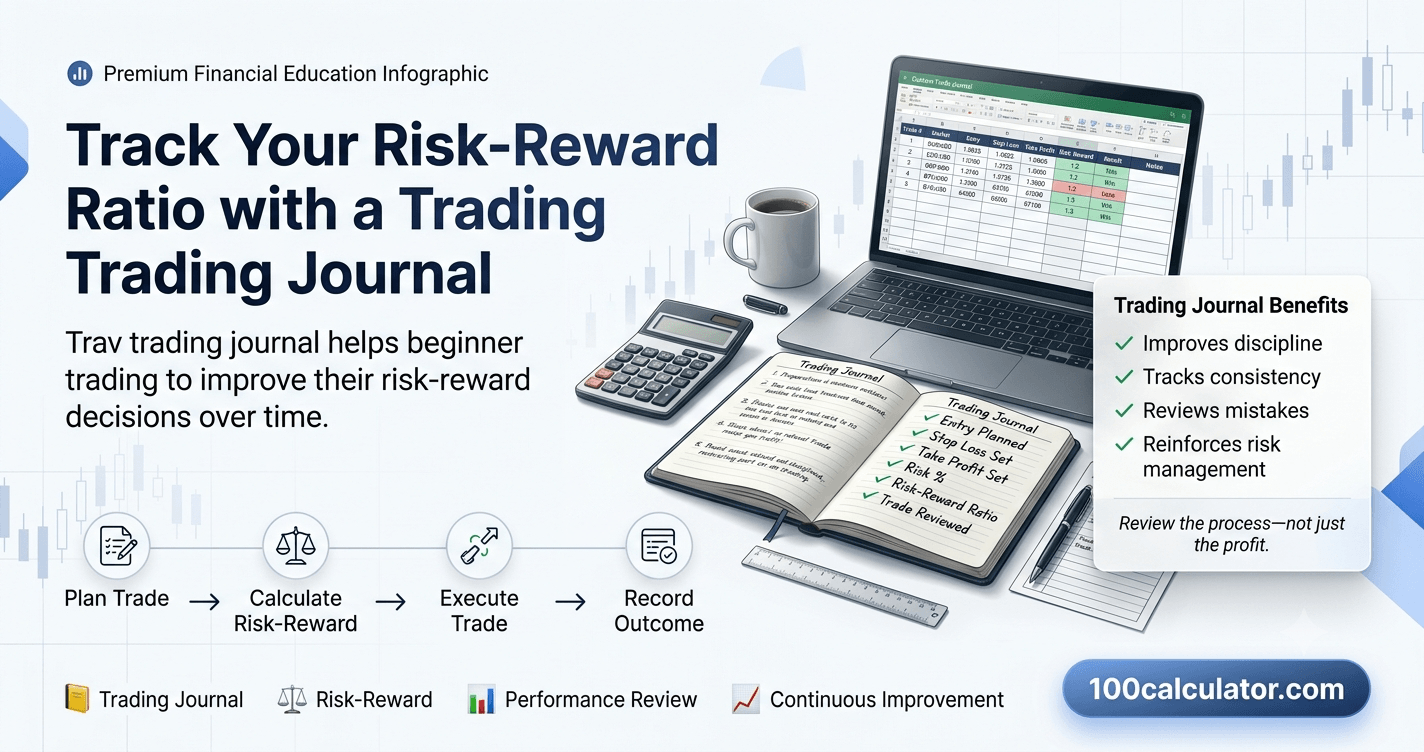
Once you've logged a few dozen trades, plugging your numbers into 100 Calculator's Risk Reward Ratio Calculator takes the manual math out of the equation, so you can spend more time analyzing charts and less time doing arithmetic.
Trading disclaimer: This article is for educational purposes only and isn't financial or investment advice. Trading forex, stocks, cryptocurrency, and other leveraged instruments carries a high level of risk and can result in the loss of some or all of your invested capital. Past performance and hypothetical examples don't guarantee future results. Always consider your own financial situation and risk tolerance, and speak with a licensed financial professional before making trading decisions.
More From Trading Guides
Still building your risk management toolkit? These related guides dig deeper into the topics covered above.
Frequently Asked Questions
What is a good risk-reward ratio for beginner traders?
Most trading educators recommend beginners aim for a risk-reward ratio of at least 1:2, meaning you're targeting twice as much profit as you're risking on a trade. This gives you room to be wrong more often than you're right and still come out ahead over time. Ratios between 1:2 and 1:3 tend to work well for beginners because they don't require an unrealistically high win rate to stay profitable, while ratios below 1:1 mean you generally need to win most of your trades just to break even.
What does a 1:2 risk-reward ratio mean?
A 1:2 risk-reward ratio means you're risking one unit of money to potentially make two. If you're risking $50 on a trade, the distance from your entry to your stop-loss, your take-profit target would be set to capture roughly $100 in gains. With a 1:2 ratio, you only need to win a little over 33% of your trades to break even, before accounting for spreads, commissions, and slippage.
Is a 1:3 risk-reward ratio better than 1:2 for beginners?
A 1:3 ratio needs a lower win rate to break even, around 25%, which sounds appealing on paper. But it also means your take-profit sits further away, so trades take longer to play out and price has more room to reverse before reaching your target. Neither ratio is universally better. 1:2 often suits faster setups, while 1:3 suits trades with more room to develop. Many beginners start around 1:2 and adjust once they understand their strategy's real win rate.
Should your risk-reward ratio be high or low?
A higher risk-reward ratio is generally more forgiving, since it lowers the win rate you need to stay profitable. But higher isn't automatically better. A 1:10 ratio might look impressive on paper, but if your take-profit sits somewhere price rarely reaches, your actual win rate can collapse. The goal is a ratio your strategy can realistically achieve based on chart structure, not simply the highest number you can write down.
How do you calculate a risk-reward ratio?
Subtract your stop-loss price from your entry price to find your risk, and subtract your entry price from your take-profit price to find your reward, then divide reward by risk. Buying at $50 with a stop-loss at $48 and a take-profit at $54 gives you $2 of risk and $4 of reward, for a 1:2 ratio. Our Risk Reward Ratio Calculator handles this math automatically once you enter your entry, stop-loss, and take-profit prices.
Is 2% risk per trade a good rule for beginners?
Risking around 1% to 2% of your account per trade is one of the most widely used guidelines in trading, since a string of losing trades is unlikely to wipe out your account at that level. Beginners are often better off starting closer to 1%, especially while they're still refining their strategy and stop-loss placement. This percentage refers to how much of your account you're willing to lose if your stop-loss is hit, not how much money you put into the trade overall.
Can I risk 10% per trade?
Technically yes, but it's considered high risk by most trading standards. At 10% risk per trade, it only takes about seven losing trades in a row to cut an account in half, and clawing back a 50% loss requires a 100% gain just to get back to even. Most risk management guidelines suggest staying well below 10% per trade, especially while you're still building consistency as a beginner.
Is a risk-reward ratio like 1.67 or 2.3 good?
Yes. Risk-reward ratios don't need to be round numbers. A ratio of 1.67 (roughly 1:1.67) or 2.3 (1:2.3) simply reflects wherever your stop-loss and take-profit levels naturally land based on chart structure, like support and resistance. What matters more than the exact decimal is whether that ratio comfortably clears the win rate your strategy actually achieves over a meaningful number of trades, not just a handful.
Do most day traders really lose money?
Independent research suggests a difficult picture for short-term trading. Regulators in the UK and European Union require CFD brokers to publish the percentage of retail client accounts that lost money over the past year, and those figures have typically landed somewhere between roughly 60% and 89% depending on the provider. A widely cited academic study of Brazilian futures day traders found that 97% of people who kept trading for more than 300 days ended up losing money overall. This doesn't mean trading can't work, but it's a strong argument for taking risk management seriously from the very first trade.
Is a lower risk-reward ratio ever better than a higher one?
Yes, if your strategy has a high enough win rate to support it. A scalping or range-trading approach that wins 65-70% of the time might do just fine with a 1:1 or even a 1:0.8 ratio, since the win rate alone can make it profitable. Risk-reward ratio and win rate always need to be looked at together. A lower ratio isn't automatically a bad strategy, and a higher ratio isn't automatically a good one.
Do proprietary trading firms use different risk-per-trade rules?
Many funded trading programs and proprietary trading firms set their own maximum risk-per-trade and maximum daily loss limits, which are often stricter than the general 1-2% guideline used for personal accounts. These rules vary from firm to firm and change over time, so if you're trading a funded account, check that program's current risk rules directly rather than assuming a general guideline applies across the board.
How much is a 0.01 lot size worth in dollars?
A 0.01 lot, often called a micro lot, represents 1,000 units of the base currency. On a pair like EUR/USD, that typically works out to around $0.10 per pip, compared to roughly $10 per pip on a full standard lot of 100,000 units. The exact dollar value shifts slightly with the current exchange rate, which is why a dedicated Pip Value Calculator is more reliable than memorizing a fixed number.
Is $10 enough to start trading forex?
Some brokers do allow accounts to be opened with as little as $10, especially using micro lots, but a very small account limits how precisely you can size positions while still following the 1-2% risk rule. Risking 2% of a $10 account is just 20 cents, leaving very little room to set a realistic stop-loss distance. It's technically possible to practice with an account this small, but most traders find it easier to manage risk properly with a larger starting balance.
About 100 Calculator
100 Calculator is a free hub of online calculators and educational guides covering health, finance, trading, crypto, education, and more. Every tool is built to be fast, accurate, and genuinely free, with no account or signup required.
We built this guide, and tools like the Risk Reward Ratio Calculator referenced throughout it, to make trading math easier to work through before you risk real money. Head back to the 100 Calculator homepage to explore the full library of tools, or learn more about the team behind them on our About Us page.