How Compounding Frequency Changes Your Crypto Yield
A plain-language look at how often your crypto rewards compound — daily, weekly, or monthly — and why that timing quietly changes how much you actually earn.
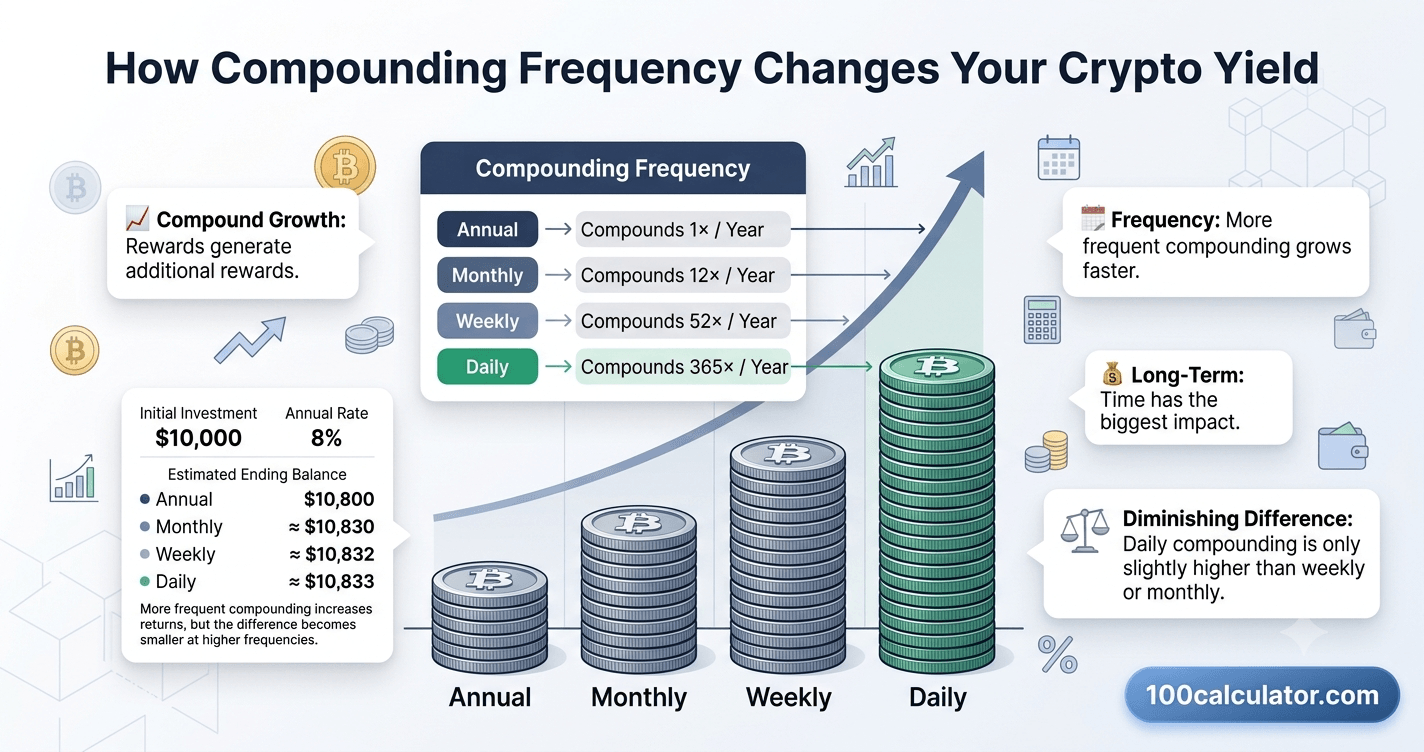
Two crypto platforms can advertise the exact same headline rate and still pay you different amounts by the end of the year. The reason usually comes down to one detail that's easy to skim past: compounding frequency, or how often your rewards get added back to your balance and start earning a return of their own.
Compounding frequency is how many times per year your crypto rewards are calculated and reinvested — daily, weekly, monthly, or continuously — and it's the reason APR (the simple, uncompounded rate) and APY (what you actually earn) are almost never the same number. A platform that compounds daily will always produce a slightly higher APY than one compounding monthly, even at an identical APR, because a growing balance earns rewards more often.
This guide breaks down exactly how that math works, what actually changes as compounding frequency increases, and why the gap between daily and monthly compounding is usually smaller than people expect, especially once transaction costs enter the picture. If you'd rather skip the manual math, 100 Calculator's APY ↔ APR Crypto Yield Calculator converts between the two instantly, based on whatever compounding frequency a platform lists.
Along the way, we'll cover how different types of crypto platforms typically compound rewards, the most common mistakes people make when comparing yields side by side, and a few practical ways to get the most out of compounding without losing your gains to fees.
What Are APY and APR in Crypto?
Both APR and APY describe the return on crypto you stake, lend, or deposit, but they measure it differently — and mixing the two up is one of the easiest ways to misjudge what you'll actually earn.
APR: The Simple, Uncompounded Rate
APR stands for Annual Percentage Rate. It's the nominal yearly return before compounding is applied. (CFPB) If a lending pool advertises a 12% APR, that means you'd earn 12% of your principal over a year if your rewards simply sat in your wallet without being reinvested.
In practice, APR is a starting point rather than a final number. It tells you the base rate a platform is paying, but not what happens once your rewards start generating rewards of their own.
APY: The Rate You Actually Earn
APY stands for Annual Percentage Yield. It factors in compounding, so it reflects what you'd actually earn if your rewards were reinvested at whatever frequency the platform uses. For any given APR, APY is always equal to or higher than that APR, since compounding lets your growing balance earn a little more each period.
This is why a platform quoting "10% APY" pays you more over a year than one quoting "10% APR," even though the two numbers look nearly identical at first glance. Our APY vs APR in Crypto guide covers this specific distinction in more depth if you want the fuller picture before moving on to compounding frequency itself.
| APR | APY | |
|---|---|---|
| Stands for | Annual Percentage Rate | Annual Percentage Yield |
| Includes compounding | No | Yes |
| Typical result | Lower headline number | Higher or equal number |
| Best used to | Compare simple, nominal rates | Compare real, effective returns |
Why Compounding Frequency Matters for Your Yield
Compounding works because rewards you've already earned start earning a return of their own. The sooner that happens, the sooner your balance grows, and the more times it happens over a year, the bigger that snowball effect becomes.
Think of it this way: if a reward sits untouched until the end of the year, it only ever earns the base rate on your original principal. If that same reward gets added to your balance right away instead, it starts earning a small amount of its own return immediately, even if that amount is tiny at first.
The "Interest on Interest" Effect
This is often called "interest on interest," and it's the entire reason APY tends to run higher than APR. Each time your rewards compound, your principal for the next period is slightly larger than before, so the next round of rewards gets calculated on a bigger number.
More frequent compounding means more of these small increases happen throughout the year. Daily compounding gives your balance 365 chances to grow a little larger before the next calculation, while monthly compounding only gives it 12. That's the mechanical reason daily compounding produces a higher APY than monthly compounding for the same APR — not because the platform pays you more, but because it applies the same rate to a larger number, more often.
The Math Behind Compounding Frequency
You don't need to memorize a formula to understand compounding frequency, but seeing the math makes it much easier to spot when a platform's numbers don't quite add up. (Investor.gov)
The APY Formula, Step by Step
The standard formula for converting APR into APY is:
Formula
APY = (1 + APR/n)^n − 1
APR = the nominal Annual Percentage Rate, written as a decimal
n = the number of times the rate compounds per year
APY = the effective Annual Percentage Yield you actually earn
For continuous compounding, where rewards are treated as compounding an infinite number of times per year, the formula simplifies to APY = e^APR − 1, using the mathematical constant e (about 2.71828). In practice, this only matters as a theoretical upper limit, since no real platform compounds infinitely often.
A Worked Example at 10% APR
Say a platform offers a 10% APR, compounded monthly. Plugging that into the formula gives APY = (1 + 0.10 / 12)^12 − 1, which works out to roughly 10.47%.
Now compare that to the same 10% APR compounded daily, using n = 365 instead of 12: APY = (1 + 0.10 / 365)^365 − 1. That comes out to approximately 10.52%. The gap between the two is real, but it's small — about 0.05 percentage points, or roughly a twentieth of one percent.
This same math applies far beyond crypto. If you want to see it play out on a traditional savings balance, 100 Calculator's Daily Compound Interest Calculator shows how daily compounding behaves on an ordinary bank deposit using the same underlying formula.
Daily vs Weekly vs Monthly vs Continuous Compounding Compared
Compounding frequency matters most when you can see it laid out side by side. Here's what a fixed 10% APR turns into as compounding frequency increases:
| Compounding Frequency | Compounds per Year (n) | Effective APY |
|---|---|---|
| Annually | 1 | 10.00% |
| Quarterly | 4 | 10.38% |
| Monthly | 12 | 10.47% |
| Weekly | 52 | 10.51% |
| Daily | 365 | 10.52% |
| Continuously | Infinite | 10.52% |
Two patterns stand out here. First, the biggest jump happens early: moving from annual to quarterly compounding gains more than moving all the way from monthly to continuous. Second, once you reach daily compounding, you've essentially captured all the benefit compounding frequency has to offer — weekly, daily, and continuous compounding land within a hundredth of a percentage point of each other.
Real-World Example: What Compounding Frequency Is Actually Worth
Percentages are useful, but dollar amounts make the difference easier to feel.
A Smaller Balance Over One Year
Imagine you deposit $1,000 at a 10% APR for one year. Compounded monthly, that grows to about $1,104.71 — a gain of $104.71. Compounded daily, it grows to about $1,105.16 — a gain of $105.16.
The difference between the two comes to about $0.45. On a balance this size, over a single year, compounding frequency alone barely moves your actual return.
A Larger Balance Over Two Years
Now scale it up. Imagine $5,000 at a 15% APR held for two years. Compounded annually, that grows to about $6,612.50. Compounded daily, it grows to about $6,748.88.
Here, the gap is roughly $136.38 — still not life-changing, but a real difference. Compounding frequency matters more as the rate, the balance, and the time horizon all grow larger.
How Crypto Platforms Typically Compound Rewards
Compounding frequency isn't standardized across the crypto industry, so it helps to understand the general patterns before assuming how a specific platform handles it.
Staking Pools and Validators
Many staking pools distribute rewards on a recurring schedule, often daily, though some networks calculate rewards per "epoch," a fixed block of time that can be shorter or longer than a day depending on the blockchain. Some staking platforms automatically restake your rewards for you; others require you to claim and restake manually.
DeFi Lending Protocols
Decentralized lending protocols often accrue interest continuously, or close to it, since rates can update with nearly every new block added to the chain. Even so, whether that accrued interest actually compounds usually depends on whether the protocol automatically reinvests it or leaves that step up to you.
Centralized Exchange Earn Products
Centralized exchanges that offer savings or "earn" style products commonly compound daily, weekly, or monthly, and typically state their compounding schedule directly in the product details. Because these platforms manage the technical side for you, the compounding usually happens automatically without any manual action required.
Liquidity Pool Rewards
If you provide liquidity to a trading pool, the fees you earn accumulate continuously as trades happen, but whether they compound depends on the platform. Some liquidity pools automatically reinvest earned fees back into the position; on others, you'll need to manually claim and re-add them, which brings transaction costs back into the picture. Fee income aside, liquidity providers should also weigh impermanent loss, which can offset some of what compounding fees would otherwise add.
Why More Frequent Compounding Doesn't Always Win
It's tempting to assume the platform with the most frequent compounding automatically comes out ahead. In practice, that's often not true once you account for how the math and the fees actually interact.
Diminishing Returns as Frequency Increases
As the comparison table earlier in this guide shows, each step up in compounding frequency adds a smaller benefit than the step before it. Going from annual to monthly compounding captures most of the available gain; going from monthly to daily, or daily to continuous, adds only a sliver more. There's a mathematical ceiling here, and most platforms already sit close to it.
Gas Fees Can Erase the Advantage
If compounding isn't automatic and you need to manually claim and restake your rewards, every restake is a transaction, and every transaction can carry a fee. (Ethereum.org) On networks where fees are noticeable, restaking small reward amounts daily can easily cost more in fees than the extra yield you gain from compounding daily instead of, say, weekly.
Before manually restaking on a fee-based network, it's worth checking what that transaction will actually cost. 100 Calculator's Ethereum Gas Fee to USD Calculator can give you a quick read on current costs before you decide whether frequent manual compounding is worth it.
Common Mistakes When Comparing Crypto Yields
Even careful comparisons can go wrong if a few key details get overlooked. Here's what tends to trip people up:
- Comparing an APR from one platform to an APY from another. These aren't the same measurement, and putting them side by side without converting one first makes the comparison meaningless.
- Assuming compounding is automatic. Some platforms handle it for you; others expect you to manually claim and restake, which changes your real return once fees are factored in.
- Ignoring the compounding frequency altogether. Two platforms quoting the same APY can compound differently, and the underlying APR — along with any associated risk — can differ even when the final yield looks similar.
- Treating advertised rates as fixed. Crypto yields are usually variable and can change with little notice, so a rate you compared last week may not be the rate you're earning today.
- Forgetting that fees can outweigh small gains. As covered above, chasing more frequent compounding on a fee-based network can cost more than it earns, especially on smaller balances. 100 Calculator's Crypto Profit & Exchange Fee Calculator can help you see how trading and exchange fees affect your bottom line too.
How to Use the APY ↔ APR Crypto Yield Calculator
Running the compounding formula by hand works fine for a single comparison, but it gets tedious fast once you're checking more than one platform or an uncommon compounding frequency.
Free Online Tool
Skip the manual math
100 Calculator's APY ↔ APR Crypto Yield Calculator converts between APR and APY instantly. Enter the rate a platform lists, choose its compounding frequency, and the calculator returns the equivalent rate in the other format, right in your browser with no signup required.
To use it effectively:
- Check the platform's terms for the exact rate and compounding frequency it advertises, since both numbers are needed for an accurate conversion.
- Enter the rate exactly as listed, making sure you know whether it's labeled as APR or APY before you start.
- Select the compounding frequency the platform uses, whether that's daily, weekly, monthly, or another schedule.
- Compare the converted result against other platforms using the same measurement, so you're always comparing like with like.
This is especially useful when you're deciding between a platform that advertises APR and one that advertises APY, since converting both to the same format is the only reliable way to know which one is actually paying more.
Tips for Maximizing Your Real Crypto Yield
A few habits make a bigger difference to your real return than chasing the highest possible compounding frequency.
- Favor platforms with automatic compounding when rates are otherwise similar, so you capture the benefit without paying extra in transaction fees
- Compare offers using APY, not APR, so you're always looking at the number that reflects compounding
- Check the gas or transaction cost before manually restaking small reward amounts, particularly on networks where fees fluctuate
- Reinvest predictably rather than chasing the highest possible frequency; a platform that compounds daily automatically usually beats manually restaking a less frequent one
- Recheck rates periodically, since crypto yields are typically variable and the number you compared last month may no longer apply
Related Calculators
Put what you just read into practice, try these free tools instantly, no sign-up required.
Crypto Position Size Calculator
Calculate the right crypto position size for your risk level.
Crypto Liquidation Price Calculator
Find the price at which your leveraged crypto position liquidates.
Crypto Futures Funding Fee Calculator
Estimate funding fees paid or earned on crypto futures positions.
APY ↔ APR Crypto Yield Calculator
Convert between APY and APR to compare real crypto yields.
Impermanent Loss Calculator
Estimate impermanent loss when providing liquidity to a pool.
Risks to Keep in Mind Alongside Compounding
Compounding frequency affects how your yield gets calculated, but it doesn't change the underlying risks of holding or lending crypto. A few are worth keeping in mind before chasing the highest advertised rate.
- Rates are usually variable. Unlike a fixed-rate savings account, most crypto yields can rise or fall with little warning, so your actual return over a year may differ from the rate you signed up at.
- Smart contract risk. DeFi protocols run on code, and code can contain bugs or be exploited, which is a risk that doesn't exist with traditional bank deposits.
- No deposit insurance. Crypto balances generally aren't covered by deposit insurance the way a bank account might be, so a platform failure can mean a real loss.
- Price volatility can outweigh yield. A strong APY on an asset that drops in value can still leave you with less than you started with in dollar terms.
- Liquidity pool risk. If you're earning yield by providing liquidity, shifts in the relative price of the pooled assets — commonly called impermanent loss — can offset some of what you earn in fees. Our guide on reducing impermanent loss walks through ways to manage that risk.
None of this means compounding math doesn't matter. It just means the highest advertised yield isn't automatically the safest or the smartest choice.
Investment disclaimer: This article is for general educational purposes only and isn't financial, investment, or tax advice. Cryptocurrency rates, rewards, and terms vary by platform and can change without notice, and crypto assets carry real risk, including price volatility and potential loss of principal. Always review a platform's current terms directly and consider speaking with a qualified financial professional before making investment decisions.
Sources & References
- U.S. Securities and Exchange Commission, Investor.gov — Compound Interest Calculator
- Consumer Financial Protection Bureau — What is the difference between a loan interest rate and the APR?
- Ethereum.org — Ethereum gas and fees: technical overview
More From Crypto Calculator Guides
Still building your knowledge of crypto rates, fees, and risk? These related guides dig deeper into the topics covered above.
Frequently Asked Questions
What's the difference between APY and APR in crypto?
APR (Annual Percentage Rate) is the simple, nominal rate before compounding — it tells you the base return if rewards were never reinvested. APY (Annual Percentage Yield) includes compounding, so it reflects what you'd actually earn once rewards start generating their own return. For the same nominal rate, APY is always equal to or higher than APR. When comparing crypto platforms, always check which number you're looking at, since a 10% APR and a 10% APY don't pay out the same amount by year's end.
How does compounding frequency affect my crypto yield?
Compounding frequency is how often your rewards get calculated and added back to your balance so they start earning their own return. The more frequently this happens — daily instead of monthly, for example — the higher your effective annual yield (APY) becomes for the same nominal rate (APR). The effect is real but modest: moving from monthly to daily compounding usually adds a fraction of a percentage point, not a dramatic jump, since the gains from more frequent compounding shrink the more often it already happens.
What is the formula for converting APR to APY?
The standard formula is APY = (1 + APR / n)^n − 1, where APR is the nominal rate as a decimal and n is the number of times it compounds per year. For example, a 10% APR compounded monthly (n = 12) works out to about a 10.47% APY. Plugging in n = 365 for daily compounding gives roughly 10.52%. You can run this by hand or use a calculator built specifically for this conversion.
Does daily compounding always earn a lot more than monthly compounding?
Not usually. At a 10% APR, daily compounding produces about a 10.52% APY compared to roughly 10.47% for monthly compounding — a difference of well under a tenth of a percentage point. On a $1,000 balance over one year, that gap works out to less than a dollar. The difference grows a bit at higher rates or over longer time periods, but it's rarely the deciding factor between two platforms.
Why do some crypto platforms show APR while others show APY?
There's no universal rule, and platforms aren't always consistent about which one they lead with. Some display APR because it's the simpler, more conservative number. Others show APY because it reflects the real return after compounding, which usually looks more attractive. This inconsistency is exactly why comparing rates across platforms can be misleading unless you convert everything to the same measurement first.
Is a higher compounding frequency always the better deal?
Not necessarily. More frequent compounding does produce a slightly higher APY, but the gains shrink quickly as frequency increases, and continuous compounding is only marginally better than daily. If reaching that frequency requires you to manually claim and restake rewards on a network with transaction fees, the cost of doing so can easily outweigh the extra yield you're chasing, especially on smaller balances.
Do gas fees cancel out the benefit of more frequent compounding?
They can, particularly on networks where transaction costs are noticeable relative to your reward size. If manually claiming and restaking daily costs more in gas than the additional yield you gain from compounding daily instead of weekly, you come out behind. This is less of an issue on platforms that auto-compound for you, or on low-fee networks, but it's worth checking before chasing frequency on your own. Our Ethereum Gas Fee to USD Calculator can help you check current costs.
What is continuous compounding, and does crypto use it?
Continuous compounding is the theoretical limit where interest compounds an infinite number of times per year, calculated using APY = e^APR − 1. In practice, no platform compounds infinitely, but some DeFi protocols come close, since rates can adjust and rewards can accrue almost block by block. The real-world difference between continuous and daily compounding is tiny, usually less than a hundredth of a percentage point.
How often do staking rewards typically compound?
This varies by platform and asset. Many staking pools compound automatically on a daily basis, while some networks calculate rewards per epoch, which can be shorter or longer than a day. Centralized exchange earn products often compound weekly or monthly. Because there's no single standard, always check the specific compounding schedule listed on the platform you're using rather than assuming.
Can I estimate crypto APY by hand without a calculator?
Yes, using the formula APY = (1 + APR / n)^n − 1. For simple, round numbers this is manageable with a basic calculator, but the exponent makes it tedious for less common compounding frequencies or when you're comparing several platforms at once. A dedicated tool like the APY ↔ APR Crypto Yield Calculator handles the math instantly and reduces the chance of a manual calculation error.
Does compounding frequency matter for stablecoin yields too?
Yes. The math behind compounding frequency applies to any yield-bearing crypto asset, including stablecoins, since it's based purely on the rate and how often it's applied, not on price volatility. Because stablecoins aim to hold a steady value, compounding frequency can actually be easier to evaluate for them, since you aren't also trying to account for token price swings alongside the yield itself.
What's the real dollar difference between 10% APR and 10% APY?
It depends on the compounding frequency behind the APY. A 10% APR compounded monthly produces about a 10.47% APY, and compounded daily produces about a 10.52% APY. On $1,000, that's the difference between roughly $104.71 and $105.16 in a year — a small gap. The bigger point is that "10% APR" and "10% APY" are never actually the same return, even though the headline number looks identical.
How much does compounding frequency matter over several years?
More than it does over a single year, since the small annual differences compound on top of each other. At a 15% APR over two years, for example, daily compounding can produce roughly $136 more on a $5,000 balance than annual compounding. The gap widens further with higher rates, larger balances, or longer holding periods, even though it stays modest at lower rates over shorter windows.
Should I compare crypto platforms using APY or APR?
Compare using APY whenever possible, since it accounts for compounding and reflects what you'd actually earn. If one platform only lists APR, convert it to APY using its stated compounding frequency before comparing it to a platform that already shows APY. Comparing an APR directly to an APY is one of the most common mistakes people make when shopping for crypto yield.
How does the APY ↔ APR Crypto Yield Calculator help me?
It converts between APR and APY instantly based on the compounding frequency you enter, so you don't have to work through the exponential formula by hand. This makes it easier to compare rates fairly across platforms that display different numbers, or to see how switching from monthly to daily compounding would actually change your return before you commit funds anywhere.
About 100 Calculator
100 Calculator is a free hub of online calculators and educational guides covering finance, trading, crypto, health, education, and more. Every tool is built to be fast, accurate, and genuinely free, with no account or signup required.
We built this guide, and tools like the APY ↔ APR Crypto Yield Calculator referenced throughout it, to make crypto math less confusing and easier to trust. Head back to the 100 Calculator homepage to explore the full library of tools, or learn more about the team behind them on our About Us page.