How Liquidation Price Is Calculated in Crypto Futures
A clear, math-first walkthrough of exactly how crypto exchanges calculate your liquidation price for both long and short positions, with worked examples, an isolated vs. cross margin comparison, and practical ways to keep your position further from the edge.
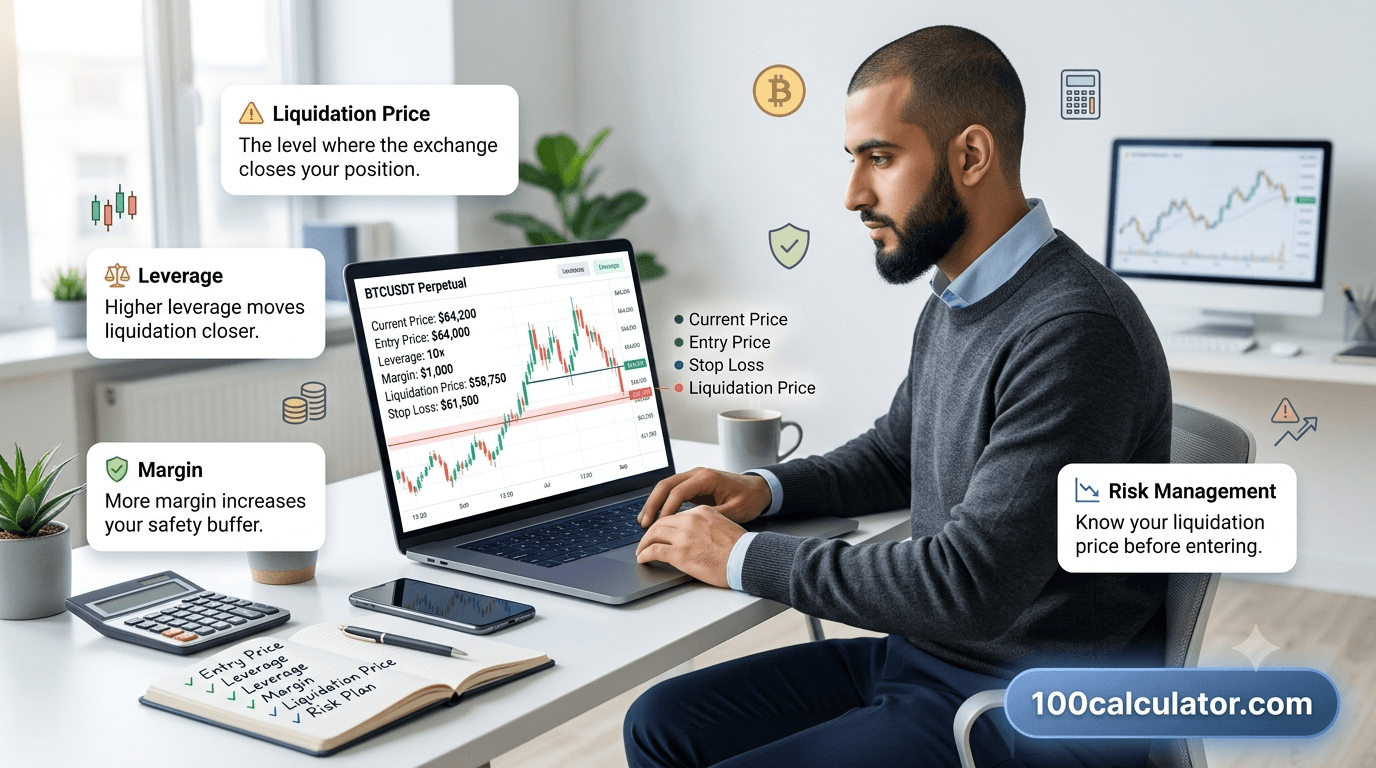
Liquidation price is the exact price at which a crypto exchange automatically closes your leveraged futures position, because your remaining margin can no longer absorb further losses. It's calculated from three things: your entry price, your leverage, and the maintenance margin rate your exchange requires you to keep in reserve. Once the market touches that price, the exchange closes your position with a market order, whether you're watching your screen or asleep.
The math behind it isn't complicated once it's laid out, and knowing your number before you open a trade is one of the simplest ways to avoid an unpleasant surprise. This guide walks through exactly how exchanges calculate liquidation price for both long and short positions, with worked examples you can follow along with a calculator in hand. If you'd rather skip the manual math, 100 Calculator's Crypto Liquidation Price Calculator runs the same calculation instantly, but understanding how it works underneath is what actually makes you a safer trader.
Every exchange handles fees and tiered margin rates a little differently, but the core formula is the same everywhere: it comes down to your leverage and the buffer built in by the maintenance margin rate. Once you see that relationship clearly, you can estimate your liquidation price on any platform, sanity-check the number an exchange shows you, and see exactly why higher leverage always means a thinner safety margin.
What Liquidation Price Actually Means
When you open a leveraged futures position, you're only putting up a fraction of the position's full value. The rest is exposure made possible through leverage. That works fine as long as the market moves in your favor, or even sideways. But if it moves against you enough, your margin, the money you actually put up, starts running out.
Liquidation price is the point where that margin can no longer cover your open losses. Instead of letting your losses grow past what you've deposited, the exchange forces the trade closed. It isn't a penalty and it isn't personal. It's a built-in safety mechanism that protects both you and the exchange from you owing more than you put in.
Why Exchanges Liquidate Positions Automatically
Futures exchanges lend you buying power through leverage, and that only works if losses stay contained within the margin you've posted. Without a liquidation mechanism, a large enough adverse move could leave your account with a negative balance, meaning you'd owe the exchange money beyond what you deposited.
By automatically closing your position once your margin drops to a set threshold, the exchange caps your maximum loss at roughly your margin balance instead of letting it grow indefinitely. This is also why exchanges maintain insurance funds and check liquidation against a smoothed "mark price" rather than the last trade, both of which we'll get to shortly.
Liquidation vs. a Stop-Loss: What's the Difference
A stop-loss is a voluntary order you set yourself, at a price of your choosing, to close a trade before it gets too painful. Liquidation is involuntary. It's set by the exchange's rules, not your preference, and it happens automatically once your margin runs out.
In practice, a well-placed stop-loss should trigger before your liquidation price is ever reached, closing the position on your terms with some margin still intact. If your stop-loss and your liquidation price sit close together, you're leaving very little room for the market's normal volatility before you're forced out at the worst possible level, often with a liquidation fee on top.
Key Terms to Understand Before You Calculate Anything
The liquidation price formula uses a handful of terms that are worth nailing down first. Once these click, the math itself is genuinely simple.
Margin and Leverage
Margin is the money you actually deposit to open a position. Leverage is the multiplier applied to that margin to determine your total position size. If you deposit $500 in margin and use 10x leverage, you're controlling a $5,000 position, ten times what you put up yourself.
Higher leverage means you need less of your own capital to open a given position size, but it also means a smaller price move wipes out your margin. Leverage doesn't necessarily change how much money you can lose in dollar terms; what it changes is how small a percentage move is needed to lose it. If you want to see how margin and leverage interact in a related market, our guide on how margin and leverage work together in forex walks through the same relationship outside of crypto.
Initial Margin vs. Maintenance Margin
Initial margin is the amount you need to open a position in the first place, and it's directly tied to your leverage: Initial Margin Rate = 1 ÷ Leverage. Maintenance margin is different. It's the minimum equity you need to keep the position open once it's already running.
Maintenance margin is almost always smaller than initial margin, and it's usually set as a percentage of the position's notional value, often tiered so that larger positions require a higher maintenance margin rate. This gap between the two is exactly why your liquidation price isn't simply "100% divided by leverage." The maintenance margin rate closes part of that gap, which is why it shows up in the formula later in this guide.
Mark Price vs. Last Traded Price
Most exchanges don't use the last traded price to decide when to liquidate you. Instead, they use a "mark price," typically a smoothed value built from an index of prices across several markets. This makes it much harder for one large order, or a brief wick on a single exchange, to trigger a liquidation that wouldn't have happened based on the broader market. When you're checking how much room you have before liquidation, compare against the mark price your exchange is showing, not just the last trade scrolling by on the chart.
The Core Liquidation Price Formula
For an isolated-margin position, ignoring trading fees and funding payments for now, the standard formula looks like this:
Long Position Formula
Liquidation Price = Entry Price × (1 − 1 ÷ Leverage + Maintenance Margin Rate)
Entry Price = the price you opened the position at
Leverage = your position size divided by your margin
Maintenance Margin Rate = the minimum equity percentage your exchange requires, set by them
Since a long position loses money as price falls, the formula subtracts most of your leverage-based cushion from the entry price, then adds back a small buffer for the maintenance margin rate. The bigger your leverage, the more of that cushion gets subtracted, and the closer your liquidation price sits to your entry.
Short Position Formula
Liquidation Price = Entry Price × (1 + 1 ÷ Leverage − Maintenance Margin Rate)
Entry Price, Leverage, and Maintenance Margin Rate mean the same thing as in the long formula above
Short positions lose money as price rises, so the formula flips: instead of subtracting, it adds the leverage-based buffer above your entry price, then subtracts a small amount for the maintenance margin rate. The higher your leverage, the closer this price sits above your entry.
| Position Type | Price Move That Hurts You | Liquidation Formula (Isolated Margin) |
|---|---|---|
| Long (Buy) | Price falls | Entry × (1 − 1/Leverage + MMR) |
| Short (Sell) | Price rises | Entry × (1 + 1/Leverage − MMR) |
Free Online Tool
Skip the manual math
100 Calculator's Crypto Liquidation Price Calculator takes your entry price, leverage, and margin, and returns your liquidation price for long or short positions instantly, with no signup required.
Step-by-Step: Calculating a Long Position's Liquidation Price
Let's work through a real example using round numbers. Say you're opening a long position on BTC/USDT perpetual futures.
Your starting numbers:
- Entry price: $60,000
- Leverage: 10x
- Margin you deposit: $500
- Maintenance margin rate: 0.5% (a commonly used illustrative rate; your exchange's actual rate may differ)
- Calculate position size. Margin × Leverage = $500 × 10 = $5,000. That's the total value of BTC you control.
- Calculate how much BTC that buys. $5,000 ÷ $60,000 = 0.08333 BTC.
- Calculate your initial margin rate. 1 ÷ Leverage = 1 ÷ 10 = 0.10, or 10%.
- Plug into the formula. Liquidation Price = $60,000 × (1 − 0.10 + 0.005) = $60,000 × 0.905 = $54,300.
- Check the distance. $60,000 − $54,300 = $5,700, which is a 9.5% drop from your entry price.
So if BTC falls to $54,300, your position gets liquidated. You can sanity-check this: your loss at that price would be 0.08333 BTC × $5,700 ≈ $475, leaving $25 of your original $500 margin, which matches 0.5% of your $5,000 position, exactly the maintenance margin your exchange requires you to keep.
Step-by-Step: Calculating a Short Position's Liquidation Price
The short version uses the same inputs, just with the formula flipped. Using the identical numbers, a $60,000 entry, 10x leverage, $500 margin, and a 0.5% maintenance margin rate:
Liquidation Price = $60,000 × (1 + 0.10 − 0.005) = $60,000 × 1.095 = $65,700.
If BTC rises to $65,700, a 9.5% move in the opposite direction, your short position gets liquidated. The same sanity check applies: your loss at that price is 0.08333 BTC × $5,700 ≈ $475, again leaving exactly $25, or 0.5% of your $5,000 position, as your remaining margin.
Notice that both liquidation prices sit the same percentage distance from your entry, just in opposite directions. That symmetry only holds when you compare a long and a short opened with identical leverage and margin. In practice, most traders aren't running mirror-image trades, so don't expect your own positions to line up this neatly.
Isolated Margin vs. Cross Margin
Every liquidation price calculation depends on which margin mode you're using, and the two modes protect you differently.
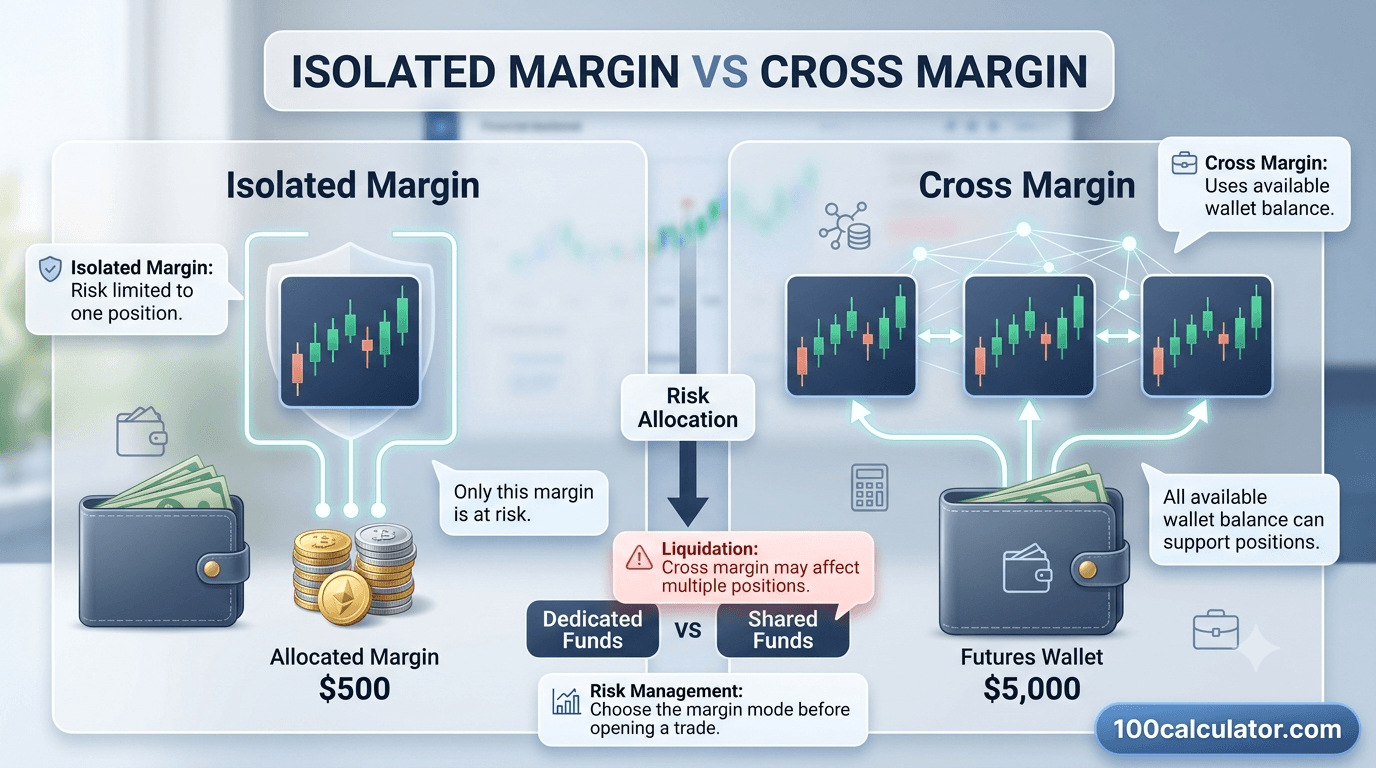
Isolated margin locks a specific amount of margin to one position. If that position gets liquidated, you lose the margin assigned to it, and only that. Your other positions and your remaining wallet balance stay untouched. This makes isolated margin easier to reason about, since the liquidation price depends only on that one position's own numbers, exactly like the examples above.
Cross margin pools your entire available futures balance as backup collateral for every open position. If one trade starts losing, funds from your broader balance can be pulled in to keep it open longer, which pushes the liquidation price further from your entry price. The tradeoff is that a bad move on one position can now draw down money you might have wanted for other trades.
| Aspect | Isolated Margin | Cross Margin |
|---|---|---|
| What backs the position | Only the margin you assign to that trade | Your entire available futures balance |
| Liquidation price | Fixed once set, based on assigned margin | Can shift as your balance and other positions change |
| Maximum loss | Limited to that position's margin | Can extend across your whole balance |
| Best for | Capping risk on a single trade | Giving a position more room using idle balance |
| Manual liquidation math | Easier, one position's numbers only | Harder, depends on all open positions |
Neither mode is universally better. Isolated margin gives you a hard cap on what one trade can cost you, while cross margin gives a position more breathing room using capital you're not actively using elsewhere. Many traders use isolated margin while testing a new setup, then move to cross margin only for positions they've already sized carefully.
What Actually Happens When You Get Liquidated
Liquidation isn't a single dramatic event so much as a mechanical process the exchange runs the moment your position crosses its threshold.
The Liquidation Engine and the Order Book
Once your position hits its liquidation price, the exchange's liquidation engine closes it with a market order in the opposite direction: a sell order for a long position, a buy order for a short one. Because this is a forced market order rather than a limit order at a price you'd have chosen, it can execute at a slightly worse price than your calculated liquidation level, especially during fast-moving markets.
This matters at a market-wide level too. When leverage is high across many traders at similar price levels, a string of liquidations firing in sequence can push price further in the same direction, triggering the next batch of liquidations behind them. This cascading effect is part of why crypto markets can move so sharply during high-leverage sell-offs.
Liquidation Fees and the Insurance Fund
Most exchanges charge a liquidation fee, deducted from whatever margin remains at the moment of closure. On top of that, many platforms maintain an insurance fund: a pool of assets built up from those very fees. It covers the gap when a position gets closed at a worse price than its calculated liquidation level during fast markets, so one trader's bad liquidation doesn't spill over as an unexpected loss to other traders on the platform.
Margin Call vs. Liquidation
Some trading platforms issue a margin call before liquidation: a warning that your margin is running low, giving you a chance to add funds or reduce your position. Many crypto exchanges skip this step entirely and move straight to liquidation once your maintenance margin threshold is crossed, so don't assume you'll get advance notice. If you want to see how a margin call plays out on a platform that does use one, our article on what happens when you get a margin call in forex covers the concept in more detail.
Factors That Move Your Liquidation Price Closer to Your Entry
Your liquidation price isn't fixed the moment you open a trade. Several things can shift it, usually in a direction you don't want.
Leverage Level
This is the biggest factor by far. The table below shows roughly how much room you have before liquidation at different leverage levels, using the same 0.5% maintenance margin rate as the earlier example, and ignoring fees for simplicity.
| Leverage | Initial Margin Rate | Approx. Move to Liquidation* |
|---|---|---|
| 2x | 50% | ~49.5% |
| 5x | 20% | ~19.5% |
| 10x | 10% | ~9.5% |
| 20x | 5% | ~4.5% |
| 50x | 2% | ~1.5% |
| 100x | 1% | ~0.5% |
*Assumes isolated margin, no fees, and a flat 0.5% maintenance margin rate for illustration. Your exchange's actual maintenance margin rate may be higher or lower depending on the asset and your position size tier.
Notice how quickly that buffer shrinks. Moving from 10x to 50x leverage doesn't just make things somewhat riskier. It cuts your safety margin down to roughly a sixth of what it was.
Funding Fees Slowly Eating Into Your Margin
Perpetual futures contracts use periodic funding payments, exchanged directly between long and short traders, to keep the contract's price tethered to the underlying spot market. If you're on the side paying funding, each payment is deducted from your margin. On a position held for weeks, this can nudge your liquidation price measurably closer to the market, even if the asset's price hasn't moved much at all. Our guide on what a funding rate is in crypto futures trading breaks down how these payments are calculated, and 100 Calculator's Crypto Futures Funding Fee Calculator can help you estimate the running cost on a position you're planning to hold.
Mark Price Movement and Volatility
Since liquidation is checked against mark price, sudden volatility in the underlying index, even briefly, can bring your liquidation price into range faster than the last traded price alone might suggest. This is especially relevant around major news events or during periods when an asset's typical daily range is unusually wide.
How to Protect Your Position From Liquidation
None of this math matters much if you don't use it to make safer decisions before you open a trade. A few habits go a long way:
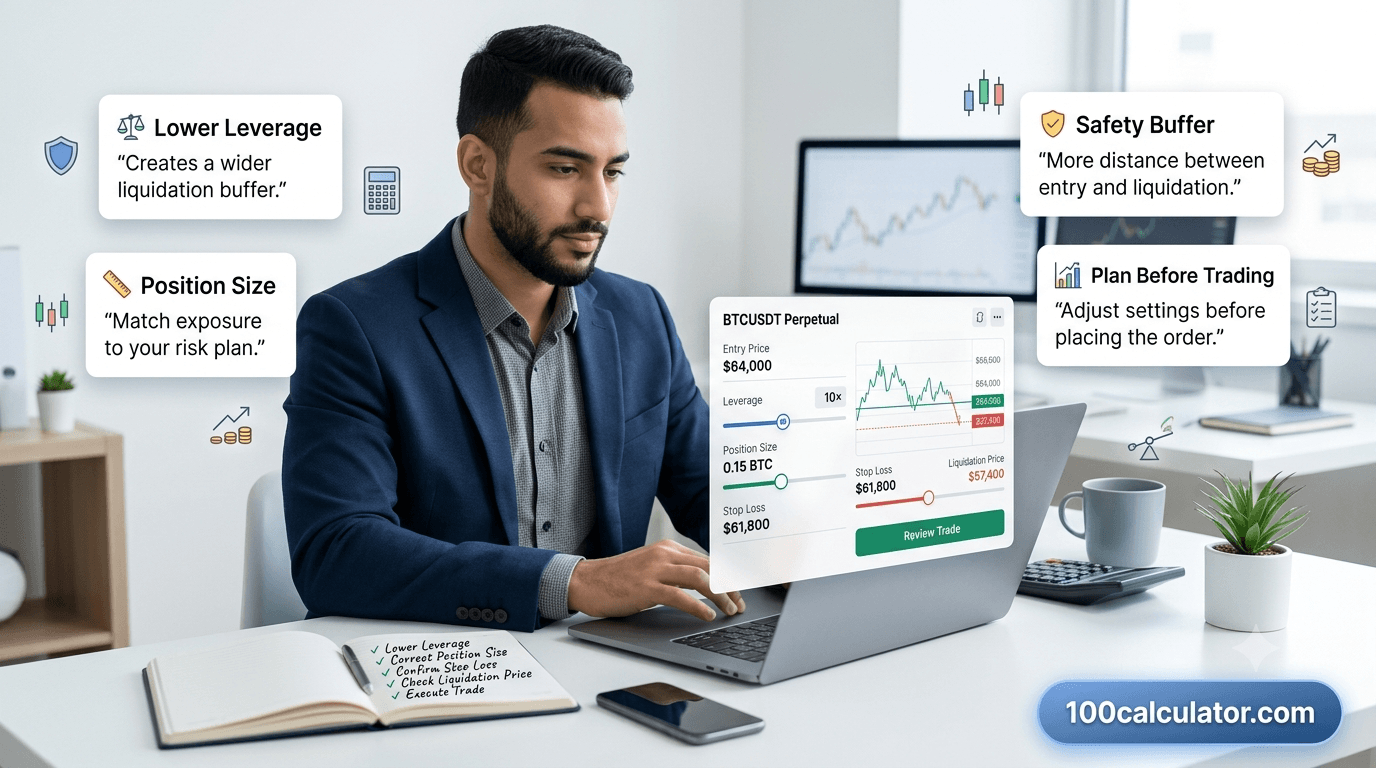
- Use less leverage than the maximum your exchange allows, not the maximum itself
- Size your position around your account balance, not around your maximum available margin
- Set your own stop-loss well above (or below) your liquidation price, not right next to it
- Watch mark price, not just the last traded price, when judging how close you are to danger
- Add margin proactively on isolated positions if a trade moves against you and you still believe in it
- Avoid stacking several correlated positions that could drain a shared cross-margin balance all at once
Position size matters just as much as leverage here. Even at moderate leverage, an oversized position relative to your account balance leaves you a thinner margin than the earlier math assumes. 100 Calculator's Crypto Position Size Calculator can help you work backward from how much you're willing to risk to a position size that fits it. Our guides on how to calculate position size for safer trading and how to avoid liquidation when trading with leverage both go deeper into the sizing side of this.
If you're weighing how much leverage feels appropriate for your own risk tolerance, 100 Calculator's Risk Reward Ratio Calculator is worth running before you enter a trade. It shows whether the potential reward actually justifies how close you're setting your liquidation price.
Common Liquidation Calculation Mistakes to Avoid
Even traders who understand the formula in theory tend to trip over the same handful of mistakes in practice.
- Confusing liquidation price with entry or breakeven price. These are three different numbers, and mixing them up leads to a false sense of how much room you actually have.
- Assuming the distance to liquidation is exactly 100% divided by leverage. That ignores the maintenance margin rate, which always shifts the real number slightly.
- Judging safety off the last traded price instead of the mark price. These can differ, sometimes by more than you'd expect during volatile periods.
- Forgetting that funding payments chip away at margin over time. This matters most on positions held for weeks rather than hours.
- Not knowing whether you're on isolated or cross margin. The formula and the risk to your other funds are genuinely different between the two.
- Treating liquidation price as fixed. It moves as your margin, funding payments, and other open positions change, so it's worth rechecking periodically rather than calculating it once and forgetting about it.
Any one of these on its own usually isn't catastrophic. But they tend to stack. Someone using cross margin without realizing it, judging distance off the last price instead of mark price, and ignoring weeks of funding payments, all at once, often ends up liquidated well before they expected to be. If a liquidation catches you off guard and wipes out more of your account than planned, 100 Calculator's Drawdown Recovery Calculator is worth a look. It shows how much of a return you'd need to get back to even, which is usually a bigger number than people expect. Our article on why large drawdowns are so hard to recover from explains that math in more depth.
Related Calculators
Put what you just read into practice, try these free tools instantly, no sign-up required.
Crypto Position Size Calculator
Calculate the right crypto position size for your risk level.
Crypto Liquidation Price Calculator
Find the price at which your leveraged crypto position liquidates.
Crypto Futures Funding Fee Calculator
Estimate funding fees paid or earned on crypto futures positions.
APY ↔ APR Crypto Yield Calculator
Convert between APY and APR to compare real crypto yields.
Impermanent Loss Calculator
Estimate impermanent loss when providing liquidity to a pool.
Liquidation Price Can Vary by Exchange
Everything in this guide describes the general logic nearly every exchange follows, but the exact numbers aren't identical everywhere. Maintenance margin rates are typically tiered by position size, meaning a larger position on the same asset can carry a higher rate than a smaller one. Fee structures, whether funding is folded into the live calculation, and even how mark price is derived can all differ from platform to platform.
Treat the formulas in this guide as a way to understand the mechanics and sanity-check what your exchange shows you, not as a substitute for the exact number your platform calculates in real time. Before trading with real funds, it's worth reading through your specific exchange's own documentation on margin and liquidation.
Using a Liquidation Price Calculator Instead of Doing It by Hand
Once you understand how the formula works, there's rarely a reason to keep recalculating it by hand every time you consider a trade.
Free Online Tool
Check your number before you trade
100 Calculator's Crypto Liquidation Price Calculator takes your entry price, leverage, margin, and position side, and returns your liquidation price instantly, letting you compare a handful of leverage levels side by side before you commit real funds.
Understanding the math in this guide is what lets you double-check that number and know exactly why it landed where it did, instead of treating it as a black box. That combination, a tool for speed and an understanding of the mechanics for confidence, is generally the safest way to approach leveraged trading.
Trading disclaimer: This article is for general educational purposes only and isn't financial or investment advice. Leveraged crypto futures trading carries a high risk of loss, including the potential loss of your entire margin balance, and isn't suitable for everyone. The formulas and examples here are simplified for teaching purposes and may not match your exchange's exact calculation once fees and tiered margin rates are included. Always confirm the specifics with your own exchange, and consider speaking with a licensed financial advisor about your personal risk tolerance before trading with leverage.
More From Our Crypto Calculator Guide
Still building your understanding of leverage, margin, and crypto futures math? These related guides dig deeper into the topics covered above.
Frequently Asked Questions
What is liquidation price in crypto futures trading?
Liquidation price is the exact price at which an exchange automatically closes your leveraged futures position because your remaining margin can no longer cover further losses. It's calculated from your entry price, leverage, and the exchange's maintenance margin rate. Once the market touches that price, the position is force-closed, whether you're watching the chart or not.
How do you calculate liquidation price for a long position?
For a long (buy) position on isolated margin, the standard formula is Liquidation Price = Entry Price × (1 − 1/Leverage + Maintenance Margin Rate). You subtract the portion of the position covered by your initial margin, then add back a small buffer for the maintenance margin rate your exchange requires. Higher leverage pushes this price closer to your entry.
How do you calculate liquidation price for a short position?
For a short (sell) position on isolated margin, the formula flips direction: Liquidation Price = Entry Price × (1 + 1/Leverage − Maintenance Margin Rate). Instead of subtracting, you add the leverage-based buffer, since a short position loses money as the price rises rather than falls. The higher your leverage, the closer this price sits above your entry.
What's the difference between isolated margin and cross margin liquidation?
Isolated margin limits your risk to only the margin you assigned to that specific position, and calculates liquidation price from that amount alone. Cross margin uses your entire available futures wallet balance as backup collateral, which usually pushes the liquidation price further away, but it also means a large loss on one position can draw down funds you were counting on for other trades.
What actually happens when your position gets liquidated?
When your position hits its liquidation price, the exchange automatically closes it with a market order in the opposite direction of your trade. Long positions are closed with a sell order, and shorts with a buy order. Most exchanges also apply a liquidation fee, and whatever margin remains after that fee is typically returned to you, though the exact handling can vary by platform.
Is a margin call the same thing as liquidation?
No. A margin call is a warning that your margin is running low and you may need to add funds or reduce your position, while liquidation is the actual forced closure that happens if you don't act in time. Many crypto exchanges skip the margin call stage entirely and move straight to liquidation once your maintenance margin threshold is breached, so don't assume you'll get advance notice.
Does liquidation use the mark price or the last traded price?
Most exchanges use mark price, not the last traded price, to decide when to liquidate a position. Mark price is typically a smoothed value based on an index of prices across multiple markets, which makes it harder for a single large order or a brief price wick on one exchange to trigger an unnecessary liquidation.
How does leverage affect your liquidation price?
Leverage directly sets how close your liquidation price sits to your entry price. At 10x leverage, a roughly 10% adverse move, minus a small maintenance margin buffer, is enough to wipe out your margin. At 50x, that buffer shrinks to around 2%. Lower leverage always means more room between your entry price and your liquidation price.
Can you do anything once your position is close to its liquidation price?
Yes, as long as the market hasn't reached your liquidation price yet. You can add more margin to your position on isolated margin, reduce your position size by partially closing it, or close the trade entirely to set the loss on your own terms instead of letting the exchange force it. Waiting until the price is already at your liquidation level leaves no time to act.
Do funding fees affect your liquidation price?
Yes. Funding payments on perpetual futures are exchanged between long and short traders at set intervals, and if you're on the paying side, each payment is deducted from your margin. Over many funding periods, especially on a long-held position, this can nudge your liquidation price slightly closer to the market price even if the underlying asset's price hasn't moved much.
Why is my liquidation price different from what I calculated manually?
The simplified formula in this guide leaves out fees, funding payments, and tiered maintenance margin rates that increase with larger position sizes, all of which most exchanges factor into their live liquidation price. Your exchange's number is almost always more accurate than a manual calculation, since it accounts for these details in real time.
How far should you keep your liquidation price from your entry price?
There's no universal safe distance, since it depends on the asset's typical volatility and your own risk tolerance, but many traders aim to keep their liquidation price further away than the asset's largest recent single-day move. For a volatile asset, that often means using noticeably lower leverage than the maximum an exchange allows.
Does adding more margin move your liquidation price?
Yes, if you're using isolated margin. Adding margin to an open position increases the buffer between your current equity and the maintenance margin requirement, which pushes your liquidation price further from the market price. On cross margin, your liquidation price already factors in your whole account balance, so adding funds to your wallet has a similar protective effect.
What happens if the market gaps past your liquidation price?
If the price gaps or moves so fast that the exchange can't close your position exactly at your calculated liquidation price, you can be closed out at a worse price than expected. This is one reason exchanges maintain an insurance fund: it covers the gap between your expected liquidation price and the price your position was actually closed at, so losses don't spill over to other traders except in extreme, rare conditions.
Is liquidation price calculated the same way on every exchange?
No. While the core logic is the same everywhere, maintenance margin rates, fee structures, and whether mark price or last price is used can all differ between exchanges, and even between different position sizes on the same exchange. Always check your specific platform's own documentation, or use its built-in liquidation price display, rather than assuming one formula applies universally.
Can a spot position get liquidated?
No. Liquidation is specific to leveraged and margin-based positions, including futures, perpetual contracts, and margin trading. A regular spot purchase, where you buy and fully own the asset with no borrowed funds, has no liquidation price at all, since there's no lender that needs to be protected from your losses.
About 100 Calculator
100 Calculator is a free hub of online calculators and educational guides covering health, finance, trading, crypto, education, and more. Every tool is built to be fast, accurate, and genuinely free, with no account or signup required.
We built this guide, and tools like the Crypto Liquidation Price Calculator referenced throughout it, to make leveraged trading concepts easier to understand before you put real money on the line. Head back to the 100 Calculator homepage to explore the full library of tools, or learn more about the team behind them on our About Us page.