How to Reduce Impermanent Loss When Providing Liquidity
A practical, beginner-friendly walkthrough of why impermanent loss happens in crypto liquidity pools and the concrete steps you can take to reduce it — from picking the right pool to running the numbers before you commit funds.
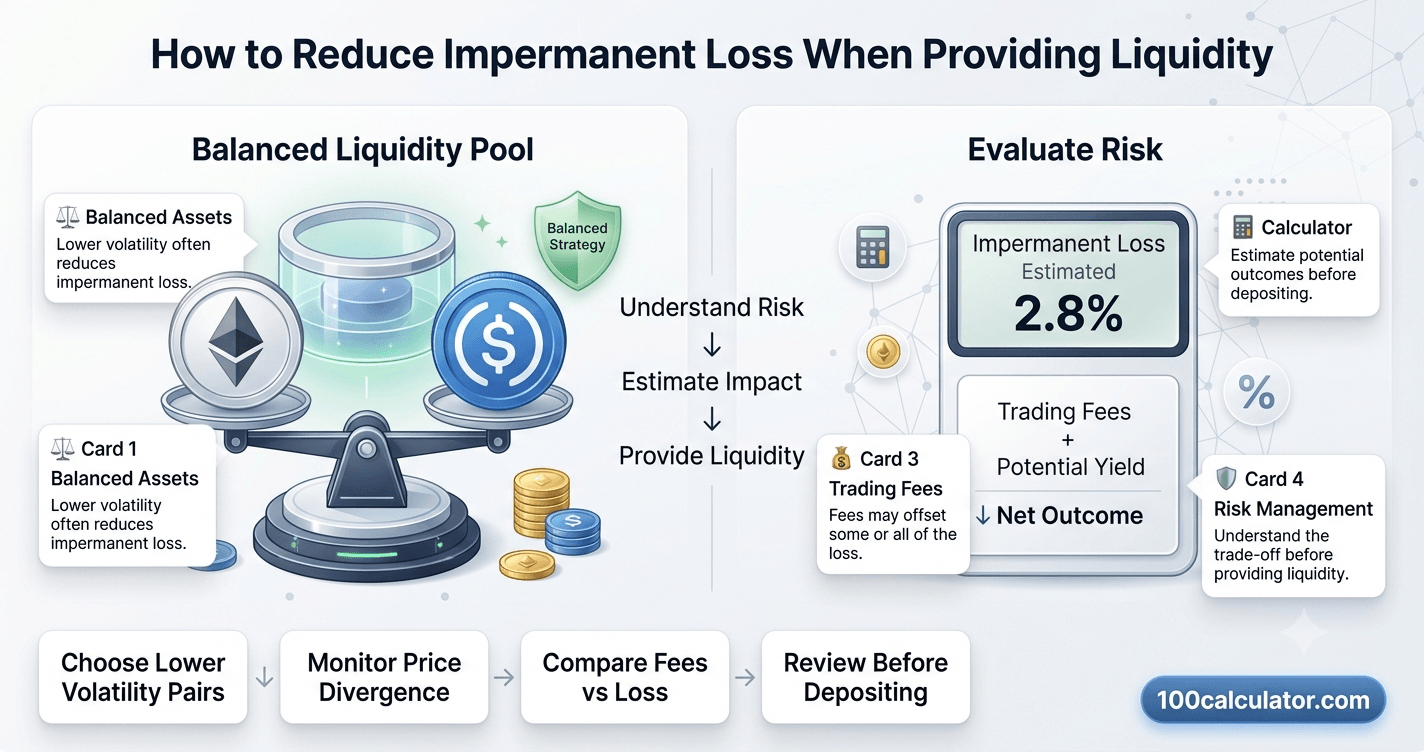
If you've looked into earning yield by supplying tokens to a decentralized exchange, you've probably run into a warning about impermanent loss. It sounds abstract until you realize it can quietly eat into returns that otherwise looked attractive on paper. The good news is that impermanent loss follows predictable math, and once you understand that math, there's a lot you can do to keep it small.
Impermanent loss is the gap between the value of your tokens sitting inside a liquidity pool and the value those same tokens would have if you'd simply held them in your wallet instead. It happens because automated market makers constantly rebalance the pool as prices move, so when one asset in the pair moves a lot relative to the other, your share of the pool ends up holding more of the asset that dropped and less of the one that rose.
You can't erase impermanent loss completely while providing liquidity to a standard two-asset pool — it's built into how these pools work. What you can do is choose pools, position sizes, and price ranges that keep it small enough that trading fees and rewards outweigh it. This guide walks through exactly how impermanent loss happens, the formula behind it, and the specific strategies liquidity providers use to manage it, including how to check your numbers with 100 Calculator's Impermanent Loss Calculator before you commit any funds.
Before getting into strategy, it helps to understand exactly what's happening inside the pool when prices shift — because that's what every mitigation tactic in this guide is built around.
What Is Impermanent Loss?
Impermanent loss shows up any time you deposit two different assets into a liquidity pool and their prices move apart from each other after you deposit. The pool automatically adjusts the ratio of the two tokens you're holding to keep its internal pricing formula balanced, and that automatic adjustment is what creates the gap between "pool value" and "just holding" value.
A Simple Definition
In plain terms, impermanent loss is the reduction in value a liquidity provider experiences compared to simply holding the same two tokens outside the pool, caused by price divergence between the paired assets. It's called "impermanent" because if prices move back to where they were when you deposited, the loss disappears. It only becomes a permanent, realized loss if you withdraw your liquidity while the prices are still diverged.
A Quick Example
Say you deposit $500 worth of ETH and $500 worth of USDC into a pool right when ETH is trading at $2,000. If ETH later climbs to $4,000 — a 2x move — simply holding your original ETH and USDC would leave you with $1,500 (your ETH doubled to $1,000, plus $500 in USDC).
Your liquidity position, on the other hand, would be worth about $1,414 instead of $1,500. Arbitrage traders bought ETH out of the pool as its price rose, leaving your share holding more USDC and less ETH than a straight hold would have. That roughly $86 gap is the impermanent loss — about 5.7% of what a simple hold would have been worth.
Why Impermanent Loss Happens in Liquidity Pools
Most liquidity pools don't use an order book the way a traditional exchange does. Instead, they rely on a formula that sets the exchange rate between the two tokens based on how much of each one sits in the pool. The most common version, popularized by Uniswap, is called the constant product formula: the amount of token A multiplied by the amount of token B always equals the same constant, often written as x × y = k. (Uniswap Docs)
How Automated Market Makers Set Prices
An automated market maker, or AMM, uses that formula to quote a price for every trade. When someone swaps token A for token B, they add token A to the pool and remove token B, which shifts the ratio and moves the price along a fixed curve. The pool never needs a buyer and seller to match up directly — the formula does that work automatically, which is exactly why AMMs can offer instant swaps for thousands of token pairs at once.
Arbitrage Traders and Rebalancing
The pool's internal price only reflects supply and demand within that specific pool, not the wider market. When the external market price of one token moves, the pool's price temporarily lags behind. Arbitrage traders exploit that gap: they buy the cheaper token from the pool and sell it elsewhere for a profit, and they keep doing this until the pool's price matches the broader market again.
Every one of those arbitrage trades changes the ratio of tokens sitting in the pool — and as a liquidity provider, your share of the pool changes right along with it. This is the mechanism that quietly shifts your holdings toward more of the asset that underperformed and less of the one that outperformed.
The Impermanent Loss Formula (and What the Numbers Mean)
For a standard two-asset constant product pool, impermanent loss can be calculated directly from how much the price of one asset has moved relative to the other, without needing to know the exact dollar amounts involved.
Impermanent Loss Formula
IL = [2 × √P / (1 + P)] − 1
P = the price ratio between the two assets — the new price of one asset divided by its price when you deposited
IL = impermanent loss, shown as a negative percentage of what simply holding the two assets would have been worth
The Formula Explained
Plug in a price ratio and the formula tells you the percentage difference between your pool position and a simple hold, at that price ratio, regardless of pool size. A price ratio of 1 means the price hasn't moved at all, so P = 1 gives IL = 0%. The further the ratio moves from 1 in either direction, the larger the loss becomes — and the formula is symmetric, so a token doubling in price and a token halving in price produce the exact same impermanent loss percentage.
Impermanent Loss by Price Change
Here's what that formula looks like in practice, using the price ratio directly:
| Price Change | Price Ratio | Impermanent Loss |
|---|---|---|
| 1.25x (or 0.8x) | 1.25 | ≈0.6% |
| 1.5x (or 0.67x) | 1.5 | ≈2.0% |
| 2x (or 0.5x) | 2.0 | ≈5.7% |
| 3x (or 0.33x) | 3.0 | ≈13.4% |
| 4x (or 0.25x) | 4.0 | ≈20.0% |
| 5x (or 0.2x) | 5.0 | ≈25.5% |
Notice how the loss grows faster than the price change itself for larger moves. A 2x price change costs roughly 5.7%, but a 5x change costs more than four times that at 25.5%. This is exactly why pairing two assets that rarely move far apart from each other — which we'll get to shortly — is one of the most effective ways to keep impermanent loss small.
Impermanent Loss vs. Trading Fees: Is It Really a Loss?
The numbers from the table above only tell half the story. Liquidity providers don't just sit there absorbing impermanent loss for free — they earn a cut of every trade that passes through the pool, plus sometimes extra token rewards from the protocol itself.
When Fees Cover the Loss
In pools with high trading volume relative to the amount of liquidity deposited, accumulated fees can outweigh impermanent loss entirely, especially in pairs that don't move far apart in price. This is exactly why stablecoin pools and busy, popular pairs tend to be more forgiving than quiet, low-volume pools paired with volatile tokens — there's simply more fee income flowing in to offset whatever divergence happens.
When They're Not Enough
Impermanent loss becomes a genuine problem when a pool sees a sharp, lasting price move with comparatively little trading volume to generate offsetting fees. This is common with newer tokens, low-liquidity pairs, or pools that briefly attracted a rush of deposits chasing a high advertised yield. If you withdraw during one of these divergences, the paper loss becomes a realized one — which is why it's worth checking your position with an impermanent loss calculator before adding liquidity, and again before withdrawing, rather than only at the start.
Comparing Pool Risk: Stablecoins vs. Correlated vs. Volatile Pairs
Not every pool carries the same amount of impermanent loss risk. The type of assets you pair together is the single biggest factor, so it's worth comparing the three broad categories before looking at specific strategies.
Lowest Risk
≈0–1% IL
Stablecoin-to-Stablecoin Pools
Pairing two coins pegged to the same value, like USDC and USDT, keeps price ratios nearly flat, so impermanent loss stays negligible even during volatile markets.
Moderate Risk
≈2–10% IL
Correlated Asset Pools
Pairs like ETH and a liquid staking token move together most of the time, which limits price divergence but doesn't eliminate it entirely.
Highest Risk
10%+ IL
Uncorrelated Volatile Pools
Pairing two independently priced assets, like ETH and a small-cap altcoin, creates the largest price swings and the deepest impermanent loss.
These categories aren't strict rules — a stablecoin can still de-peg, and two correlated assets can decouple during a market shock — but they give you a realistic starting point for judging how much price divergence, and therefore how much impermanent loss, a given pool is likely to produce. Before committing a large sum to any single pool, it's also worth checking how that deposit fits into your broader crypto holdings. 100 Calculator's Crypto Position Size Calculator can help you decide a reasonable allocation based on your overall risk tolerance.
Strategy 1: Choose Stablecoin and Pegged-Asset Pairs
The single most reliable way to minimize impermanent loss is to provide liquidity between two assets that are designed to hold the same value.
Best Pairs to Consider
Pairs like USDC/USDT, DAI/USDC, or a token and its wrapped or staked version (such as ETH and stETH) rarely diverge by more than a fraction of a percent under normal conditions, since both sides are anchored to the same reference value. Because the price ratio barely moves, the impermanent loss formula from earlier in this guide stays close to zero almost all the time.
The Yield Trade-Off
The catch is that these pools also tend to offer lower base yields, since there's less price risk for the protocol to compensate you for. Many liquidity providers treat stablecoin pools as the "low-risk baseline" of their portfolio and accept a smaller return in exchange for far more predictable outcomes — similar to how a savings account trades a lower rate for safety compared to a stock portfolio.
Strategy 2: Pick Correlated Assets Over Random Pairs
When a stablecoin pool doesn't fit what you're trying to do — maybe you want exposure to a specific token's price movement — the next best option is pairing assets that tend to move in the same direction and by similar amounts.
What Correlation Means in Practice
Correlation, here, just means how closely two assets' prices track each other over time. If token A and token B both tend to rise 10% and fall 8% around the same time, their price ratio barely changes even though both prices are moving. Since impermanent loss depends on the ratio between the two assets, not their individual price swings, high correlation keeps that ratio steady and keeps the loss small.
Examples of Correlated Pairs
Pairs like ETH and a liquid staking token such as stETH, or a token and its wrapped version across different chains, tend to move almost in lockstep. Two large-cap layer-1 tokens can also show meaningful correlation during broad market trends, though this is far less reliable than a pegged or staked-asset relationship. Platforms like Curve Finance were built specifically around pools of correlated or pegged assets, using a pricing curve designed to keep slippage and divergence low for exactly this kind of pair.
Strategy 3: Use Concentrated Liquidity Ranges Carefully
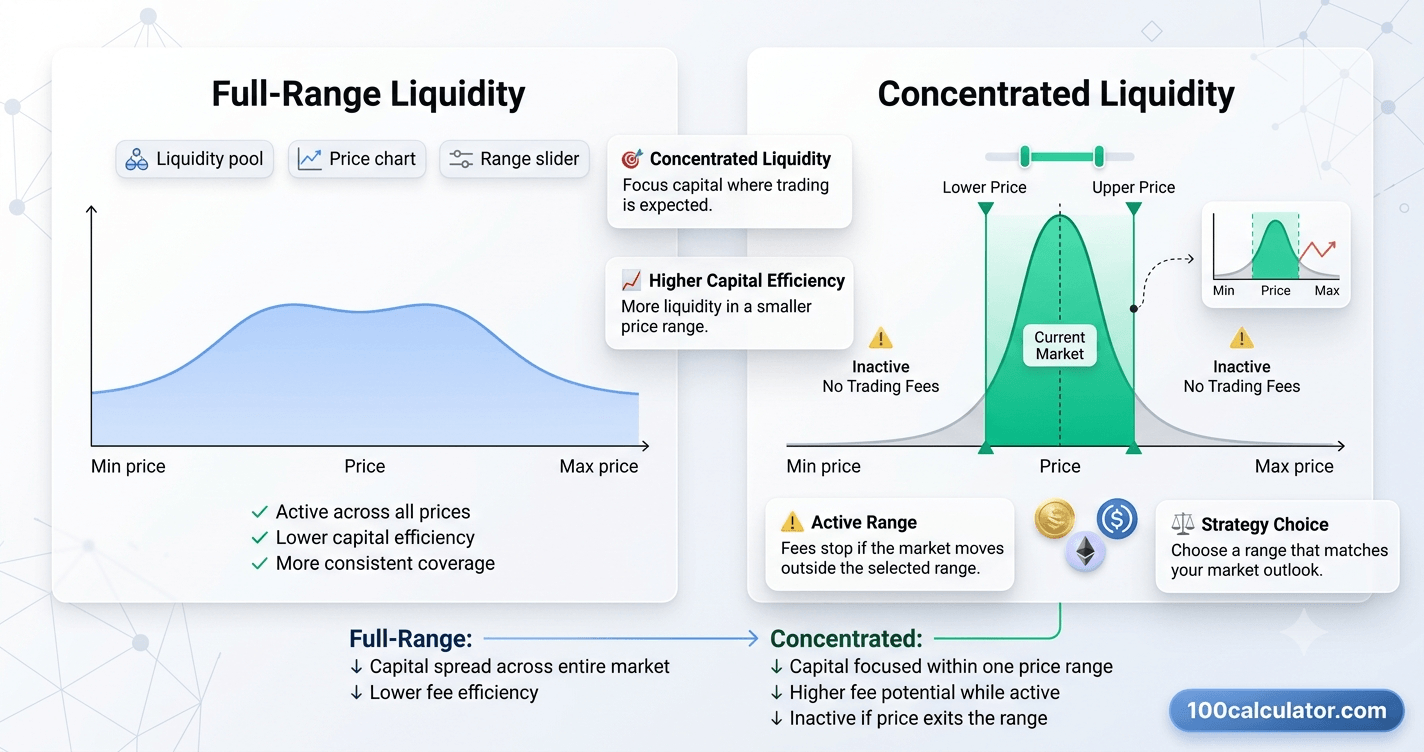
Newer AMM designs let you concentrate your liquidity within a specific price range instead of spreading it across every possible price, an approach popularized by Uniswap V3. (Uniswap Docs)
How Concentrated Liquidity Changes the Risk
Concentrating your capital into a narrower range means you earn a larger share of trading fees while the price stays inside that range, since your funds are doing more work per dollar deposited. The trade-off is that impermanent loss inside that range is amplified compared to a full-range position, and if the price moves outside your chosen range entirely, your position stops earning fees and effectively converts into just one of the two assets.
Setting a Realistic Price Range
A wider range behaves more like a traditional full-range pool: lower fee income, but less chance of drifting outside the range and lower effective impermanent loss for a given price move. A narrower range increases both potential fee income and potential impermanent loss. Many liquidity providers start with a wider range while they're still learning how a specific pair typically moves, then narrow it only once they have a clearer sense of that asset's normal trading range.
Strategy 4: Time Your Entries and Avoid Chasing Pumps
When you deposit liquidity matters almost as much as which pool you choose, since impermanent loss is calculated from the price at the moment you deposit, not from some long-term average.
Avoid Entering Right After a Pump
Adding liquidity immediately after one asset has already jumped sharply in price means you're depositing at a price ratio that's more likely to revert back down than to keep climbing — and if it does revert, you experience impermanent loss on the way back down as well as any further divergence upward. Waiting for a price to settle, or spreading your deposit out over time using an approach similar to what 100 Calculator's Crypto Dollar Cost Averaging (DCA) tool models for regular purchases, can smooth out this timing risk.
Rebalance After Big Price Moves
If you're using concentrated liquidity and the price has drifted well outside your set range, your position has effectively stopped acting as a liquidity position and is just sitting as a single asset. At that point, withdrawing, reassessing the current price ratio, and redepositing in a range centered on the new price is usually more effective than leaving funds parked outside an active range indefinitely.
Just remember that every withdrawal and redeposit costs gas, so weigh that cost — you can estimate it with 100 Calculator's Ethereum Gas Fee to USD Calculator — against how much fee income you're actually missing out on by staying put.
Strategy 5: Consider Impermanent Loss Protection and Hedging
A handful of protocols have experimented with features designed to offset impermanent loss directly, rather than asking liquidity providers to manage it through pool selection alone.
How IL Protection Mechanisms Work
These mechanisms typically work by drawing on a protocol-level insurance fund or by minting additional protocol tokens to compensate liquidity providers for a portion of their impermanent loss, usually scaling up the longer you keep your liquidity deposited. Availability and terms for these programs have shifted a lot over the years as protocols adjust to changing market conditions, so treat this as one option to research on a case-by-case basis rather than something to assume every pool offers.
Hedging with Options and Derivatives
More advanced liquidity providers sometimes hedge their impermanent loss exposure using options or perpetual futures on the same assets they've deposited, effectively betting against the price divergence that would hurt their LP position. This can reduce net impermanent loss significantly, but it adds its own costs and risks, including funding fees on perpetual positions and the chance of being liquidated on the hedge itself if the market moves quickly — something worth checking with a tool like 100 Calculator's Crypto Liquidation Price Calculator if you go this route. This approach generally makes more sense for larger positions where the cost of hedging is small relative to the impermanent loss it prevents, rather than for smaller, casual liquidity positions.
Common Mistakes That Make Impermanent Loss Worse
Even careful liquidity providers run into more impermanent loss than necessary because of a few avoidable habits:
- Chasing the highest advertised APY. A huge headline yield is often a sign of a volatile, low-volume pool where impermanent loss is likely to outrun the rewards.
- Depositing right after a sharp price spike. Prices that have already jumped are statistically more likely to pull back than to keep climbing, and pulling back creates impermanent loss too.
- Setting a concentrated range too narrow for the pair. A tight range earns more fees while the price stays inside it, but pushes your position out of range — and out of the running for those fees — the moment it moves.
- Ignoring gas costs when rebalancing often. Constant withdrawals and redeposits to "fix" a position can cost more in fees than the impermanent loss they're meant to prevent.
- Treating impermanent loss as a one-time number. It changes every time the price ratio moves, so a position that looked fine last week can look very different today.
- Withdrawing in a panic during a temporary dip. Impermanent loss only becomes permanent once you withdraw — selling into a short-term swing locks in a loss that might have reversed on its own.
Related Calculators
Put what you just read into practice, try these free tools instantly, no sign-up required.
Crypto Position Size Calculator
Calculate the right crypto position size for your risk level.
Crypto Liquidation Price Calculator
Find the price at which your leveraged crypto position liquidates.
Crypto Futures Funding Fee Calculator
Estimate funding fees paid or earned on crypto futures positions.
APY ↔ APR Crypto Yield Calculator
Convert between APY and APR to compare real crypto yields.
Impermanent Loss Calculator
Estimate impermanent loss when providing liquidity to a pool.
Using an Impermanent Loss Calculator Before You Provide Liquidity
Every strategy in this guide works best when you can put actual numbers to it instead of relying on gut feeling, which is exactly what a calculator is for.
Free Online Tool
Check your numbers before you deposit
100 Calculator's Impermanent Loss Calculator lets you enter your deposit amounts and a projected price change for one asset, then instantly shows you the resulting impermanent loss in both percentage and dollar terms — no wallet connection or account needed.
What to Enter Into the Calculator
Most versions ask for the price of each asset at the time you deposit, the price you expect (or fear) one of them might reach, and how much you're planning to deposit. Some also let you factor in an estimated APY from trading fees, so you can compare the projected impermanent loss directly against the yield you'd be earning over the same period.
How to Read Your Results
If the projected impermanent loss comes out well below the fee income a pool has been generating, that's a reasonable sign the pool is currently in "fees cover the risk" territory. If the numbers come out close together, or the loss is larger, treat that as a signal to either choose a more correlated pair, size your position more conservatively, or accept that you're taking on meaningfully more risk than a stablecoin pool for a comparable return.
Once you've been providing liquidity for a while, 100 Calculator's Crypto Average Cost Basis Calculator and Crypto Profit & Exchange Fee Calculator can help you track your real cost basis and net returns across deposits, withdrawals, and any rebalancing trades, so impermanent loss shows up as one line item in your overall numbers rather than a mystery gap you can't explain. Running the numbers before you deposit — and checking back in whenever prices move significantly — keeps impermanent loss a known, managed risk instead of a surprise.
Disclaimer: This article is for general educational purposes only and isn't financial or investment advice. Providing liquidity to crypto pools carries real risk, including impermanent loss, smart contract vulnerabilities, and the possibility of losing part or all of your deposited funds. Always do your own research and consider speaking with a qualified financial professional before providing liquidity or using leverage-based strategies.
More From Our Crypto Calculator Guide
Want to go deeper into crypto risk and yield calculations? These related guides cover the tools and concepts that pair naturally with impermanent loss.
Frequently Asked Questions
What is impermanent loss in simple terms?
Impermanent loss is the difference in value between holding two tokens in a liquidity pool versus simply holding them in your wallet. It happens because automated market makers automatically adjust the ratio of tokens you're holding as prices move, so if one asset in the pair rises or falls a lot more than the other, you end up with less total value than a simple hold would have given you. It's called "impermanent" because the loss disappears if prices return to where they were when you deposited.
How do you calculate impermanent loss?
Impermanent loss can be calculated using the price ratio between the two pooled assets — how many times the price of one has changed relative to the other since you deposited. The formula is 2 times the square root of that price ratio, divided by 1 plus the price ratio, minus 1. Plugging a price ratio into this formula gives you the percentage loss compared to simply holding, regardless of how much money you originally deposited. A free impermanent loss calculator can do this math for you instantly.
Can impermanent loss be avoided completely?
Not if you're providing liquidity to a standard two-asset pool where both prices can move independently — some amount of impermanent loss is built into how automated market makers work whenever prices diverge. You can get very close to zero by pairing two stablecoins or two assets pegged to the same value, since their price ratio barely changes. For any pool involving assets that move independently, the realistic goal is minimizing and managing impermanent loss rather than eliminating it outright.
Is impermanent loss a real loss or just "on paper"?
It starts as an unrealized, paper loss that only becomes a real, locked-in loss once you withdraw your liquidity while the two assets' prices are still diverged from where they were when you deposited. If prices move back toward their original ratio before you withdraw, the impermanent loss shrinks or disappears entirely. This is exactly why panic-withdrawing during a temporary price swing can turn a recoverable paper loss into a permanent one.
Do stablecoin pools have impermanent loss?
Stablecoin pools, like USDC paired with USDT, can still technically experience impermanent loss, but it's usually negligible because both assets are designed to hold the same value. Since impermanent loss depends on how much the price ratio between two assets moves, and a well-functioning stablecoin pair barely moves at all, the loss typically stays a small fraction of a percent. The main risk in these pools shifts from impermanent loss toward the smaller, but real, chance that one of the stablecoins loses its peg.
What's the safest way to provide liquidity without losing money?
No liquidity position is entirely risk-free, but pairing two stablecoins or pegged assets, sizing your position conservatively, and sticking to pools with strong, established trading volume are the most reliable ways to minimize impermanent loss specifically. It's also worth running your numbers through an impermanent loss calculator before depositing, so you know roughly what to expect if prices move, rather than finding out only after the fact.
Does impermanent loss go away if I wait long enough?
It goes away specifically if the price ratio between your two pooled assets returns to what it was when you deposited — not simply from the passage of time on its own. If prices keep drifting further apart, waiting longer only means the loss has more room to grow, not shrink. That said, accumulated trading fees over a longer holding period can offset or exceed a moderate impermanent loss, even if the underlying price ratio never fully reverts.
How much impermanent loss is considered normal?
There's no single "normal" number, since it depends entirely on how much the two pooled assets' prices move relative to each other. As a rough guide, a 2x price change between the two assets produces about 5.7% impermanent loss, while a 5x change produces about 25.5%. Pools built around correlated or pegged assets typically stay well under 1%, while pools pairing two independently priced, volatile tokens can see impermanent loss climb into double digits during a strong trend.
Do trading fees make up for impermanent loss?
Often, yes — especially in busy, high-volume pools where accumulated fees can outweigh a moderate amount of impermanent loss over time. It depends on the balance between how much trading volume a pool sees relative to its total liquidity and how far the two assets' prices actually diverge. Comparing a pool's realistic fee income against the impermanent loss estimated for a given price move is the clearest way to judge whether a specific pool is likely to be worth it.
What is concentrated liquidity, and does it reduce impermanent loss?
Concentrated liquidity lets you focus your deposited funds within a specific price range instead of spreading them across every possible price, which increases your share of trading fees while the price stays in that range. It doesn't reduce impermanent loss on its own — in fact, it amplifies the effective impermanent loss for a given price move compared to a full-range position. The benefit comes from earning more fees per dollar deposited, which can offset the larger loss if you choose your range carefully.
Are impermanent loss protection tools worth using?
They can be useful, but availability, terms, and reliability vary significantly between protocols and have changed over time as some programs were scaled back or discontinued during volatile markets. Before relying on one, check exactly how the protection is funded, whether it fully or only partially offsets impermanent loss, and how long you need to stay deposited to qualify. Treat any protection feature as a bonus on top of sound pool selection, not a replacement for it.
How does volatility affect impermanent loss?
Higher volatility increases the chances that the two pooled assets' prices will drift apart significantly, which directly increases impermanent loss, since the loss grows the further the price ratio moves from where it started. This is why pairs of highly volatile, uncorrelated tokens tend to produce far more impermanent loss than pairs of stablecoins or assets that move together, even if both types of pools see similar trading volume.
Should beginners avoid liquidity pools because of impermanent loss?
Not necessarily, but beginners are usually better off starting with lower-risk pools, like stablecoin pairs, while getting comfortable with how impermanent loss works in practice. Starting small, running potential scenarios through an impermanent loss calculator beforehand, and gradually moving toward correlated or more volatile pairs as you understand the mechanics gives you room to learn without risking a large amount on a pool you don't fully understand yet.
What's the difference between impermanent loss and just holding the coins?
Holding means keeping your tokens in your own wallet, where their combined value simply reflects each token's current price with no automatic rebalancing. Providing liquidity means depositing both tokens into a pool where an automated market maker adjusts your share of each token as trades happen and prices shift. Impermanent loss is specifically the gap between what your liquidity position is worth and what a simple hold of the same original tokens would have been worth at the same point in time.
How often should I check my liquidity position for impermanent loss?
It's worth checking whenever the price of either pooled asset moves significantly, rather than on a fixed schedule, since impermanent loss is driven by price movement, not by time. Many liquidity providers check in after major market moves, before deciding whether to withdraw, and periodically alongside reviewing accumulated fee income, so they can compare the two and confirm the pool is still working out in their favor.
Can impermanent loss happen in a two-stablecoin pool?
Yes, technically, though it's usually tiny under normal conditions since both stablecoins are meant to trade at the same value. It becomes meaningfully larger only if one of the two stablecoins loses its peg and its price diverges from the other, which is a real but comparatively rare event. In everyday conditions, impermanent loss in a well-chosen stablecoin pool is one of the smallest risk factors in the position, well below smart contract or de-pegging risk.
About 100 Calculator
100 Calculator is a free hub of online calculators and educational guides covering health, finance, trading, crypto, education, and more. Every tool is built to be fast, accurate, and genuinely free, with no account or signup required.
We built this guide, and tools like the Impermanent Loss Calculator referenced throughout it, to make DeFi concepts like liquidity pools and price divergence easier to understand before you commit real funds. Head back to the 100 Calculator homepage to explore the full library of tools, or learn more about the team behind them on our About Us page.