AP Calc BC vs AB: Which Exam Should You Take?
A clear, no-pressure comparison of AP Calculus AB and BC — what each course actually covers, how the exams are built and scored, and how to figure out which one matches where you are in math right now.
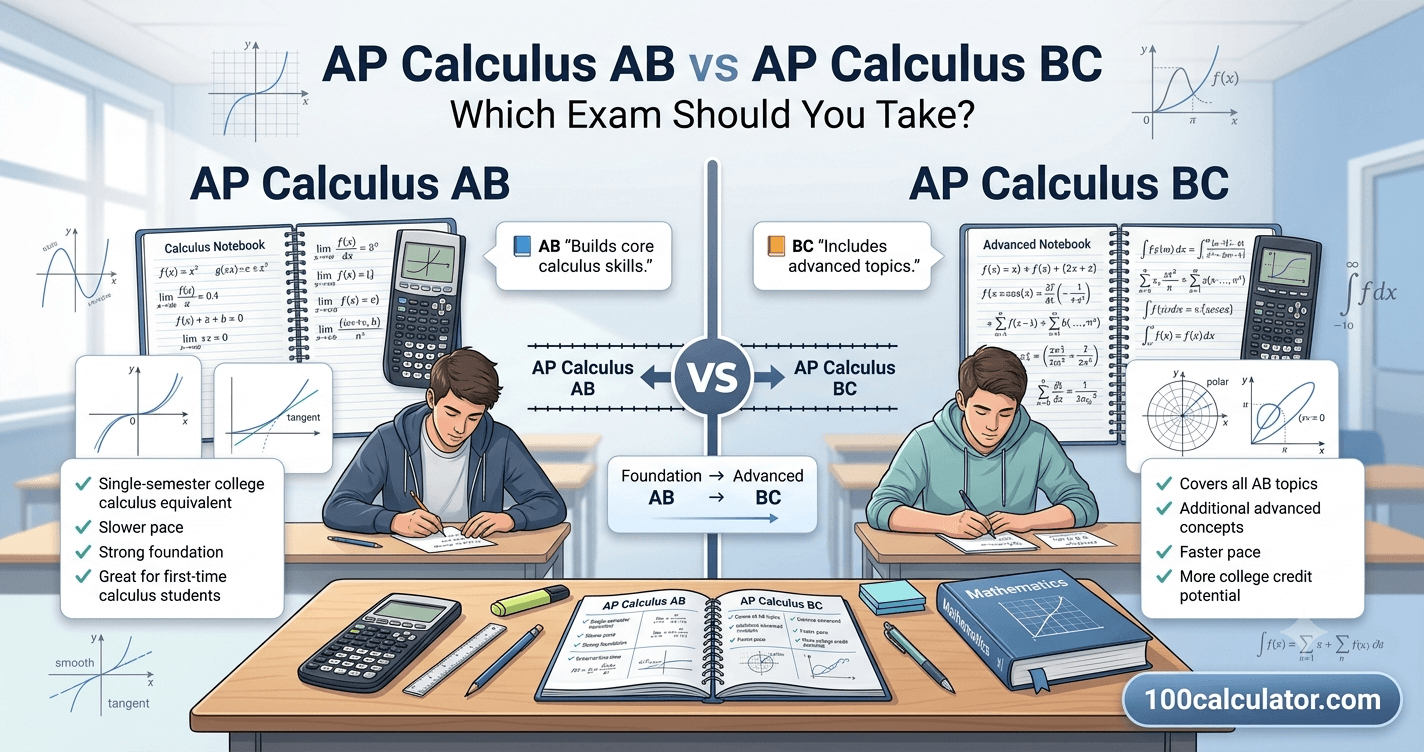
Picking between AP Calculus AB and AP Calculus BC is one of the bigger math decisions in a high schooler's course planning, and the two names make it sound like a smaller gap than it actually is.
AP Calculus AB is roughly equivalent to one semester of college calculus, while AP Calculus BC covers two semesters in the same one-year high school course — BC includes every topic in AB, then adds units on parametric, polar, and vector-valued functions and on infinite sequences and series. Both exams share the same format and the same 1-to-5 scoring scale, and the BC exam adds one more perk: a separate AB subscore, so a solid BC performance can effectively cover both courses at once.
Neither exam is the objectively "better" choice. The right one depends on how confident you feel in precalculus and trigonometry, how much time you have before test day, and what you actually want out of the credit. This guide walks through what each course covers, how the exams are built and scored, how the AB subscore works, and a practical way to decide which one fits you.
If you already have practice scores in hand, 100 Calculator's AP Calc BC Score Calculator converts your raw points into an estimated AP score in seconds. First, let's get clear on what these two courses actually cover.
Understanding AP Calculus AB and BC
The College Board's Advanced Placement program lets high schoolers take college-level courses in high school, then sit for a standardized exam at the end of the year. A qualifying score can earn college credit, placement into a higher course, or both, depending on the school. Calculus is one of the few AP subjects offered in two versions, AB and BC, built from the same framework but covering a different amount of ground.
What AP Calculus AB Covers
AP Calculus AB is built around 8 units that mirror a first-semester college calculus course: limits and continuity, differentiation rules, differentiating composite and implicit functions, contextual and analytical applications of derivatives, integration and accumulation of change, differential equations, and applications of integration. (College Board) By the end of the course, you should be comfortable finding and interpreting derivatives and integrals across graphs, tables, equations, and real-world descriptions.
What AP Calculus BC Covers
AP Calculus BC includes all 8 of those AB units, taught in the same amount of detail, then adds two more: parametric equations, polar coordinates, and vector-valued functions, plus infinite sequences and series. A few of the shared units go a little further in BC too, picking up extra integration techniques and a handful of additional applications. Altogether, BC is designed to be equivalent to two semesters of college calculus instead of one.
Why Two Versions of the Same Course Exist
AB and BC exist so schools can match the course to different math pathways, not to sort students into an "easy" version and a "smart" version. A student who's ready for a faster pace and a deeper course can take BC; a student who wants the same core skills with more room to build confidence can take AB. Plenty of strong math students take AB, and plenty of students who take BC could have handled AB just fine too. It comes down to pace and content coverage, not raw ability.
AB vs BC at a Glance
Before getting into the details, here's how the two courses stack up side by side.
| Category | AP Calculus AB | AP Calculus BC |
|---|---|---|
| College equivalent | One semester (Calculus I) | Two semesters (Calculus I and II) |
| Units covered | 8 units | 10 units (all 8 AB units, plus Units 9–10) |
| Unique content | — | Parametric, polar, and vector-valued functions; infinite sequences and series |
| Multiple-choice section | 45 questions, 1 hr 45 min | 45 questions, 1 hr 45 min |
| Free-response section | 6 questions, 1 hr 30 min | 6 questions, 1 hr 30 min |
| Score scale | 1–5 | 1–5, plus a separate AB subscore |
| Typical pace | Standard, one topic builds on the last | Faster, more content covered per week |
| Suggested background | Precalculus | Strong precalculus and trigonometry |
The exam format is identical, which is worth noting on its own: whichever course you take, test day feels the same. The real differences are all in what's taught during the year, not how it's tested.
What Makes BC Different: The Extra Content
BC's two extra units, and the deeper pass through a few shared ones, are what actually make it a two-semester course. Here's what that extra content looks like in practice.
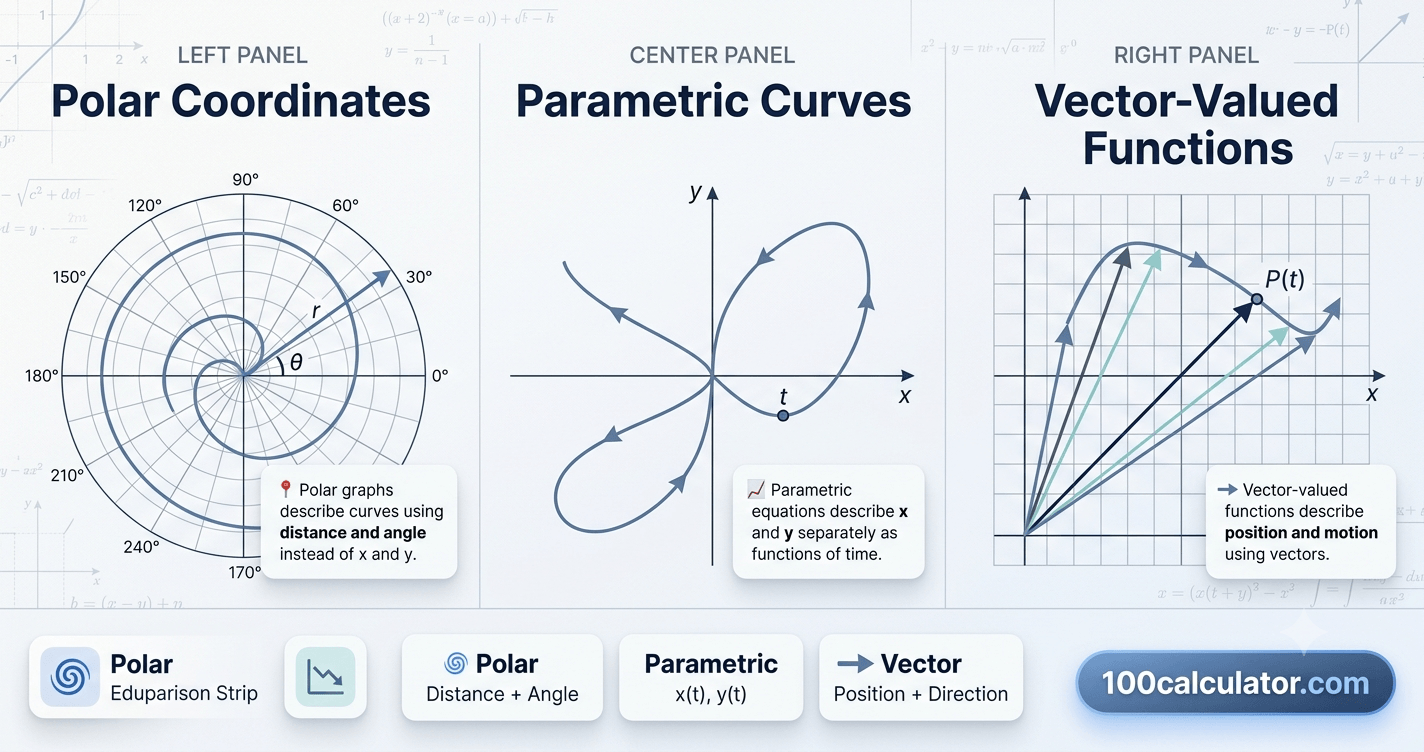
Parametric Equations, Polar Coordinates, and Vector-Valued Functions
These topics give you new ways to describe motion and curves that a standard x-y graph can't capture cleanly. Parametric equations describe a curve using a separate variable for time, which is useful for motion problems. Polar coordinates locate points using a distance and an angle instead of x and y, a natural fit for spirals and circular shapes. Vector-valued functions describe position, velocity, and acceleration in two dimensions at once. None of this appears on the AP Calculus AB exam.
Infinite Sequences and Series
This is usually the section BC students spend the most extra time on. You'll learn how to determine whether an infinite series converges or diverges using several different tests, then use polynomials, including Taylor and Maclaurin series, to approximate more complicated functions. It's a genuinely different way of thinking about functions compared to the rest of the course, which is exactly why it takes more repetition to feel natural.
A Few Deeper Topics Within the Shared Units
Beyond the two new units, BC also goes further inside a few of the units it shares with AB. That includes additional integration techniques, such as integration by parts and partial fractions, along with a few extra applications like arc length and logistic growth models. These additions are folded into the existing unit structure rather than taught as standalone topics.
How the AP Calculus AB and BC Exams Are Structured
Whichever course you take, the exam itself looks the same. Both AP Calculus AB and BC use a hybrid digital format: you answer multiple-choice questions in the College Board's Bluebook testing app, then handwrite your free-response answers in a paper booklet that gets returned for scoring. (College Board)
Multiple-Choice Section
Section I has 45 questions and runs 1 hour 45 minutes, worth 50% of your score. Part A is 30 questions in 60 minutes without a calculator. Part B is 15 questions in 45 minutes with a graphing calculator required. Questions cover algebraic, exponential, logarithmic, and trigonometric functions, presented graphically, numerically, analytically, and in words.
Free-Response Section
Section II has 6 questions and runs 1 hour 30 minutes, also worth 50% of your score. (College Board) Part A is 2 questions in 30 minutes with a calculator required. Part B is 4 questions in 60 minutes without a calculator. At least two questions bring in a real-world scenario, and partial credit is available for showing correct setup and reasoning, even without a fully correct final answer.
How AP Calculus Scores Are Calculated
Scoring works the same way for both exams, which makes it easy to compare practice results no matter which course you're in.
The 1-to-5 AP Scoring Scale
Your multiple-choice and free-response points combine into a single composite score, with no penalty for guessing on multiple choice. That composite is then converted to the familiar 1-to-5 AP score using a scale set for that specific exam, since raw-to-scaled conversions shift slightly from year to year. A 5 generally reflects extremely strong mastery, a 3 is usually described as "qualified," and it's the minimum many colleges will consider for credit, though plenty require a 4 or 5 instead.
Free Online Tool
Using an AP Calc BC Score Calculator to Check Your Progress
Once you've got practice exam results, 100 Calculator's AP Calc BC Score Calculator converts your raw multiple-choice and free-response points into an estimated 1-to-5 score, so you can see where you stand before test day without waiting on an official score report.
The AB Subscore on the BC Exam
Here's the part that makes BC feel lower-risk than it sounds. Every BC exam automatically generates a separate AB subscore, calculated only from the questions that align with AB-level content, and reported on the same 1-to-5 scale. Many colleges treat a qualifying AB subscore the same way they'd treat an actual AP Calculus AB score for Calculus I credit. That means a BC student who has a rough exam day can still walk away with a usable score, even if their overall BC composite lands lower than hoped. For the full breakdown of how raw points turn into your final score, see our guide on how AP Calculus BC exam scores are calculated each year.
Which Exam Should You Take? A Practical Way to Decide
There's no universal right answer here, but there is a practical way to think it through. Be honest with yourself about the questions below rather than going with whatever feels more impressive on paper.
Consider AB if
You want a steady first year with calculus
- Your precalculus and trig grades were solid but not effortless
- You'd rather master one semester of material deeply than move through two at a faster pace
- Your intended major doesn't require calculus beyond an introductory course
- Your school or counselor recommends starting with AB before BC
Consider BC if
You're ready to cover two semesters in one year
- You finished precalculus and trigonometry with real confidence, not just a passing grade
- You're aiming for a STEM major like engineering, physics, computer science, or math
- You want to maximize the amount of college credit one exam can earn you
- Your school allows you to enroll directly in BC without taking AB first
Can You Skip AP Calculus AB and Go Straight to BC?
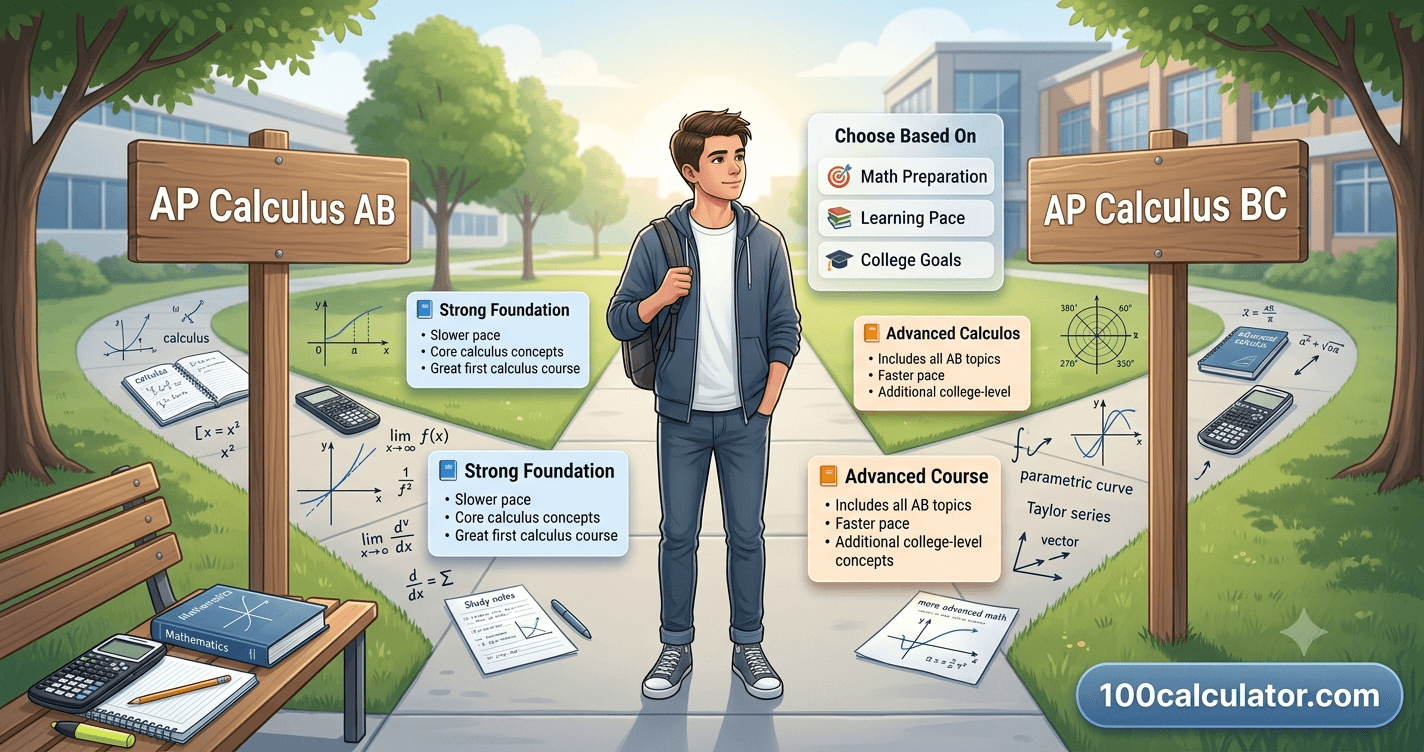
At many schools, yes. Because BC includes 100% of the AB curriculum, there's no content gap from skipping straight to BC, as long as your precalculus and trigonometry foundation is genuinely solid, not just a passing grade. Some schools require AB as a prerequisite or simply don't offer a direct-to-BC option, so this really is a "check your school" question rather than a universal rule.
Still Not Sure What to Do?
If you're torn, a short conversation with your current math teacher is usually the fastest way to get an honest answer, since they've watched you work through the material all year. It also helps to look up whether your top college choices actually award more credit for BC before assuming the extra workload is automatically worth it.
AB, BC, and Your Path to College Credit
For a lot of students, the credit question is what actually decides this.
How Colleges Typically Award Credit
Because AP Calculus AB is designed to match one semester of college calculus and BC is designed to match two, many colleges award a full year of introductory calculus credit for a qualifying BC score, while AB typically covers just the first semester. Some schools instead use AP scores for placement into a higher course without granting credit at all, and a few don't accept AP credit toward certain majors. Our guide to weighted vs unweighted GPA covers a related question worth checking too, since AP courses like Calculus BC are usually weighted differently on your transcript than a standard math class — you can see the exact effect using 100 Calculator's High School GPA Calculator.
Why the AB Subscore Matters for Credit
The AB subscore is worth factoring into this decision specifically because it lowers the downside of attempting BC. If BC ends up being more than you can handle and your overall composite score is disappointing, a solid AB subscore can still net you the same Calculus I credit an actual AB exam would have. That safety net is one of the more overlooked reasons BC is worth considering even for students who aren't fully certain they're ready for the full two-semester pace.
Common Mistakes Students Make When Choosing
A few habits quietly lead students to the wrong choice for their situation. Here's what to watch for:
- Choosing BC because it looks more impressive, without the precalculus foundation to back it up. A rushed BC year usually teaches less than a well-paced AB year.
- Assuming AB is automatically the "safe" choice. A strong student who finds AB's pace slow might actually enjoy BC more and handle it just as well.
- Not checking your target colleges' actual credit policy before deciding the extra BC workload is worth it. Some schools barely differentiate between the two.
- Overlooking the AB subscore entirely when weighing how risky BC feels. It's a real safety net, not a footnote.
- Picking a course because a friend is taking it, rather than basing the choice on your own math background.
- Waiting until the week before registration to ask a teacher or counselor for input, when that conversation is most useful early in the process.
If you're also juggling AP Chemistry this year, our guide to how the AP Chemistry exam is scored and 100 Calculator's AP Chem Score Calculator work the same way, which can help you keep both courses' scoring straight.
How to Prepare, Whichever Exam You Choose
Once you've picked a course, the prep work looks very similar for both exams.
- Start with an honest precalculus check. Function behavior, factoring, and trig identities aren't tested directly, but both exams assume you already have them down cold.
- Work through units in order, and don't rush the connection between derivatives and integrals. The Fundamental Theorem of Calculus trips up more students than topics that sound harder, like series.
- Practice with official released free-response questions rather than only multiple choice. Scoring rubrics reward showing your work and using correct notation, not just landing on the right number.
- If you're in BC, budget extra review time specifically for series convergence tests. It's the one topic most students say takes the most repetition before it clicks.
- Time yourself on practice sections early in the year, not the week before the exam, so the calculator and no-calculator pacing feels normal by test day.
- Track your practice scores as you go. Run them through 100 Calculator's AP Calc BC Score Calculator to see roughly where they'd land on the 1-to-5 scale, so you know whether you're on track or need to adjust your study plan.
Related Calculators
Put what you just read into practice, try these free tools instantly, no sign-up required.
High School GPA Calculator
Calculate your high school GPA from grades and credit hours.
GPA Calculator Middle School
Calculate your middle school GPA quickly and accurately.
AP Chem Score Calculator
Estimate your AP Chemistry exam score from practice results.
AP Calc BC Score Calculator
Estimate your AP Calculus BC exam score from raw points.
AP Gov Score Calculator
Estimate your AP Government exam score from practice results.
When to Talk to Your Teacher or Counselor
Most of this decision is something you can work through on your own, but a few situations are worth an outside opinion before you register.
- You're consistently lost in the first few weeks of precalculus review, before BC even reaches new material
- Your intended major doesn't require calculus at all, and you're mainly weighing this for transcript strength
- Your school offers both courses and you genuinely can't tell which pace fits you from the outside
- You're thinking about switching from BC to AB, or the other way around, partway through the year
- You want a straight answer on how a specific college treats the AB subscore versus a full AB score
A quick conversation early in the process almost always beats guessing. Your math teacher has watched you work through real material all year, which makes their read on your pace and readiness more useful than any single article, including this one. Use everything above as a starting point for that conversation, not a replacement for it.
A note on this guide: This article is for general educational purposes and reflects publicly available AP Calculus AB and BC course and exam information from the College Board. Course offerings, prerequisites, exam formats, and college credit policies can vary by school and change over time, so confirm current details with your math teacher, school counselor, and the admissions or registrar's office at any college you're considering.
More From Education Tools Guides
Still weighing your AP course load or planning ahead for next year? These related guides dig deeper into the topics covered above.
Frequently Asked Questions
What is the difference between AP Calculus AB and BC?
AP Calculus AB covers about one semester of college calculus, while AP Calculus BC covers two semesters. BC includes every topic taught in AB, then adds two more units on parametric, polar, and vector-valued functions and on infinite sequences and series. Both exams follow the same format and are scored on the same 1-5 scale, so the real difference is how much content is covered and how quickly the course moves, not the skills being tested.
Is AP Calculus BC harder than AP Calculus AB?
BC isn't necessarily harder question by question, but it covers more ground in the same one-year timeframe, which makes the pace more demanding. Students who found precalculus and trigonometry manageable, not just passable, tend to handle BC's speed well. If the faster pace worries you more than the material itself, AB gives you the same core skills with more time to build confidence.
Can I skip AP Calculus AB and go straight to BC?
In many schools, yes. Since BC includes 100% of the AB curriculum, there's no content gap from skipping AB, as long as your precalculus and trigonometry foundation is solid. Some schools require AB first or don't offer direct BC enrollment, so check your school's specific policy and talk with your math teacher before deciding to skip ahead.
What is the AB subscore on the AP Calculus BC exam?
When you take the BC exam, your score report also includes a separate AB subscore, based only on the questions that align with AB-level content. It's reported on the same 1-5 scale as a standalone AP Calculus AB score. Many colleges treat a qualifying AB subscore the same way they'd treat an actual AB exam score, which gives BC students a safety net even if their overall BC score isn't as high as they hoped.
Do colleges give more credit for AP Calculus BC than AB?
Often, yes, since BC covers two semesters of college calculus instead of one. Many colleges award one semester of credit for a qualifying AB score and up to two semesters for a qualifying BC score. This varies a lot by school and by major, so check the AP credit policy page for any college you're considering rather than assuming a specific credit amount.
What math should I take before AP Calculus AB or BC?
Both courses expect a similar foundation: algebra, geometry, trigonometry, analytic geometry, and familiarity with different families of functions, usually built through a precalculus course. The prerequisite expectations are nearly identical for AB and BC, which is part of why some students can go straight into BC without taking AB first, as long as that foundation is genuinely solid.
Can I take both AP Calculus AB and BC in the same school year?
No. College Board schedules the AP Calculus AB and BC exams at the same date and time each year, so you can only sit for one of them in a given testing year. Some students take AB one year and BC the following year, which is a valid path if you'd rather spread the content out.
What topics are on the BC exam that aren't on the AB exam?
BC-only content includes parametric equations, polar coordinates, and vector-valued functions, along with infinite sequences and series, including convergence tests and Taylor and Maclaurin polynomial approximations. BC also goes a bit further within a few AB units, covering additional integration techniques and more advanced applications. Everything tested on the AB exam also appears on the BC exam.
How is the AP Calculus exam scored?
Your multiple-choice and free-response sections are each worth 50% of your composite score, with no penalty for a wrong multiple-choice guess. That composite is then converted to the familiar 1-5 AP score using a scale set for that specific exam. You can estimate where your practice scores land using a tool like 100 Calculator's AP Calc BC Score Calculator.
What is a good score on the AP Calculus BC exam?
A 3 is generally considered "qualified" and is the minimum score many colleges will consider for credit, while a 4 or 5 gives you the best chance at maximum credit or placement. What counts as good enough really depends on the specific credit policy at the colleges you're applying to, since requirements vary from a 3 to a 5 depending on the school.
Does AP Calculus BC really cover two semesters of college calculus?
Yes, according to College Board, AP Calculus BC is designed to be equivalent to both the first and second semester of a typical college calculus sequence, usually called Calculus I and Calculus II. AP Calculus AB, by comparison, covers roughly the first semester only. That's the main reason BC can qualify for more college credit at many schools.
Should I take AP Calculus BC if I'm not majoring in a STEM field?
It depends on your goals. If you're comfortable with the pace and want to strengthen your transcript or earn extra college credit, BC can still be worthwhile even outside STEM. If calculus isn't required for your intended major and you're mainly taking it to fulfill a math requirement, AB usually offers the same benefit with a more manageable workload.
What happens if I don't pass the overall BC exam but do well on the AB portion?
You can still come away with a usable score. Because the BC exam automatically generates a separate AB subscore, a strong performance on the AB-level questions can earn you a qualifying AB subscore even if your overall BC composite lands lower than you wanted. Many colleges will accept that subscore for Calculus I credit, so a lower overall BC score doesn't necessarily mean the exam was wasted effort.
How long are the AP Calculus AB and BC exams?
Both exams run 3 hours and 15 minutes total. The multiple-choice section has 45 questions split into a 60-minute no-calculator part and a 45-minute calculator-required part. The free-response section has 6 questions, split into a 30-minute calculator-required part and a 60-minute no-calculator part. AB and BC share this exact same format and timing.
Is taking AP Calculus AB a bad idea if I might want BC later?
Not at all. Taking AB first is a completely normal path, and many students take AB one year and BC the next. Since BC includes all AB content, you won't repeat material you've already mastered so much as build on it at a faster pace. The only downside is spreading the coursework over two years instead of covering it in one.
What's the best way to decide between AP Calculus AB and BC?
Be honest about how confident you feel in precalculus and trigonometry, not just what grade you earned. Then factor in your intended major, how much time you realistically have to study, and whether your school lets you enroll directly in BC. If you're still unsure after that, a conversation with your current math teacher is usually the fastest way to get a clear answer.
About 100 Calculator
100 Calculator is a free hub of online calculators and educational guides covering health, finance, trading, crypto, education, and more. Every tool is built to be fast, accurate, and genuinely free, with no account or signup required.
We built this guide, and tools like the AP Calc BC Score Calculator referenced throughout it, to make exam prep and course planning a little easier to navigate. Head back to the 100 Calculator homepage to explore the full library of tools, or learn more about the team behind them on our About Us page.