How the AP Chemistry Exam Is Scored Each Year
A plain-English walkthrough of how the College Board turns your multiple-choice and free-response answers into a single 1–5 AP Chemistry score, including the most recently released score distribution.
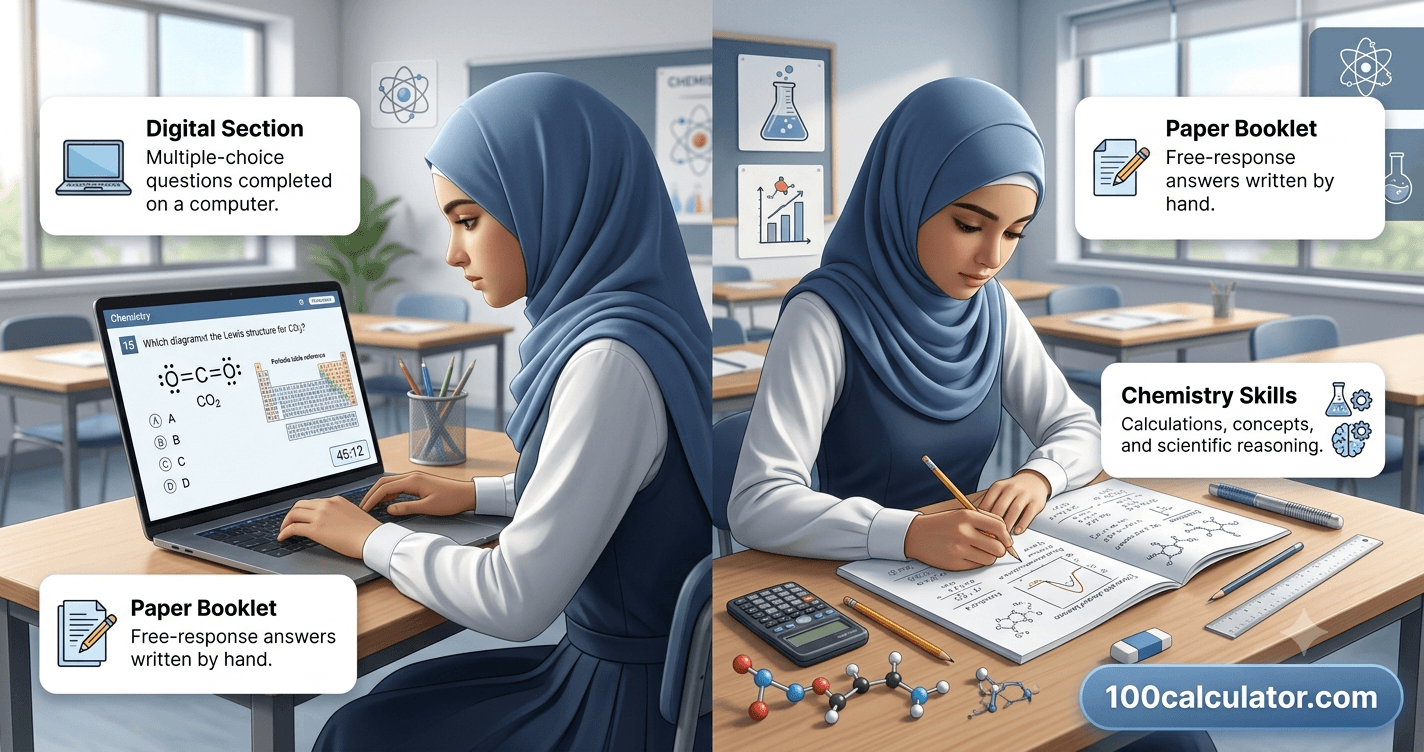
Every May, hundreds of thousands of students sit down for the AP Chemistry Exam. Every July, those same students log into their College Board account and wait for a single number between 1 and 5 to load. That number can feel like a mystery, since you spent three hours answering multiple-choice questions and writing out chemistry problems by hand, and now it's somehow just one digit.
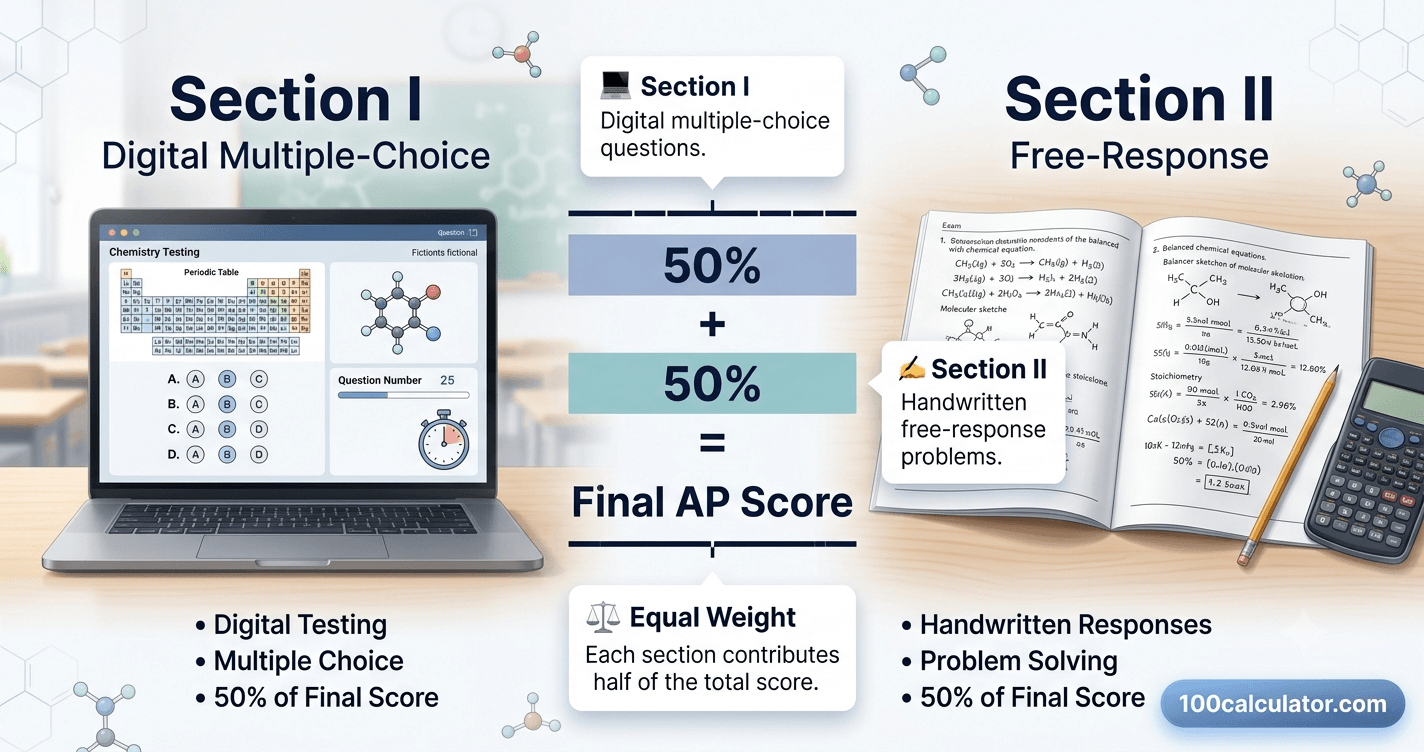
The AP Chemistry Exam is scored by combining your multiple-choice raw score with your free-response raw score, weighting each section to count for 50% of your total, and converting that combined "composite score" into a final score from 1 to 5 using cutoffs the College Board sets fresh after each year's exam. A 3 is generally labeled "qualified," while a 4 or 5 usually earns the strongest college credit.
In short, the process runs like this:
- You answer 60 multiple-choice questions and 7 free-response questions.
- Multiple choice is scored instantly by computer; free response is hand-scored by trained readers in June.
- Both raw scores are scaled so each section counts for 50% of your result.
- The two scaled scores combine into one composite score.
- The College Board converts that composite score into your final score of 1 to 5.
Some years the exam runs a little harder or a little easier than the year before, which is exactly why there's no fixed cutoff that applies every year. Below, we'll walk through each step in detail, look at what the most recently released scores actually looked like, and cover a few tips for getting the most out of your composite score. If you'd rather skip ahead and estimate your own score right now, 100 Calculator's AP Chem Score Calculator does the math the moment you enter your numbers.
What the AP Chemistry Exam Is Actually Measuring
The AP Chemistry Exam is the end-of-course test for the College Board's AP Chemistry class, a college-level introductory chemistry course typically taken by high school juniors and seniors. Questions are drawn from nine content units covering topics like atomic structure, chemical reactions, kinetics, thermodynamics, equilibrium, and acid-base chemistry.
The exam isn't graded like a normal school test, where 90% correct automatically means an A. Instead, everything you earn across both sections gets folded into a single composite score, and that composite score is converted into a scaled score from 1 to 5. It's that scaled score, not your raw percentage correct, that actually appears on your score report and that colleges look at for credit decisions.
What a "Passing" Score Actually Means
There's no official passing or failing grade on an AP exam. Instead, the College Board describes each score on the 1-to-5 scale as a recommendation about how ready you are for college credit, and a 3 is labeled "qualified." Many colleges award credit starting at that level, though plenty of selective schools only recognize a 4 or 5. It's worth checking your target college's specific AP credit policy directly, since it varies quite a bit from school to school.
How the AP Chemistry Exam Is Structured
Before the scoring makes sense, it helps to know exactly what you're being scored on. The AP Chemistry Exam runs 3 hours and 15 minutes total and is split into two sections that count equally toward your final score.
Section I: The Multiple-Choice Section
Section I has 60 multiple-choice questions and lasts 1 hour and 30 minutes. Some questions stand alone, while others are grouped around a shared chart, data table, or experimental setup. (College Board) This section counts for 50% of your total score and is completed digitally through the College Board's Bluebook testing app.
Section II: The Free-Response Section
Section II has 7 free-response questions and lasts 1 hour and 45 minutes, also worth 50% of your score. Three of those questions are long, multi-part problems worth 10 points each, and four are shorter, multi-part questions worth 4 points each, for 46 raw points available in total. You'll view these questions in Bluebook but write your actual answers by hand in a paper booklet that gets collected and scored separately.
| Section | Format | Time | Weight |
|---|---|---|---|
| I: Multiple Choice | 60 questions, digital | 1 hr 30 min | 50% |
| II: Free Response | 7 questions (3 long, 4 short), handwritten | 1 hr 45 min | 50% |
Calculators and Reference Tables: What's Allowed and When
This trips up a lot of students: a scientific or graphing calculator is allowed only on the free-response section. (College Board) Section I is calculator-free, so you'll want to be comfortable with quick mental math and estimation for the multiple-choice questions. Reference materials, a periodic table plus sheets of common equations and constants, are provided for both sections, so you never need to memorize every formula from scratch.
How Your Raw Score Is Calculated
Once your answer sheet and booklet are collected, two very different scoring processes kick in, one for each section.
Scoring the Multiple-Choice Section
Your multiple-choice raw score is simply the number of questions you answered correctly, out of 60. There's no penalty for a wrong answer, and a skipped question earns zero points in exactly the same way a wrong answer would. Because of that, there's genuinely no downside to answering every question, even one you have to guess on.
Scoring the Free-Response Section
Free-response answers are graded by college chemistry professors and experienced AP Chemistry teachers at the annual "AP Reading," typically held during the first two weeks of June. (College Board) Each question follows its own rubric that awards partial credit for specific steps, like setting up the right equation, using correct units, or reaching a defensible conclusion. A mostly-correct answer with one arithmetic slip usually still earns most of the points available for that question.
From Raw Points to Composite Score
Your multiple-choice raw score, out of 60, and your free-response raw score, out of 46, aren't simply added together, since they sit on two completely different scales. Instead, the College Board converts each raw score onto a shared scale so that each section ends up contributing exactly 50% of the final result, then adds those two scaled numbers together into a single composite score.
Composite Score = (MC Raw Score, scaled to 50%) + (FRQ Raw Score, scaled to 50%)
MC raw score: the number of the 60 multiple-choice questions you answered correctly
FRQ raw score: your total points earned across all 7 free-response questions, out of 46 possible
Scaling: because each section is designed to count for half the exam, both raw scores are converted onto a shared point scale before they're added together
Why the Two Sections Are Weighted Equally
Multiple choice and free response test overlapping but distinct skills. Multiple choice covers a wide range of content quickly, while free response tests deeper reasoning, calculation, and written scientific explanation. Weighting them 50/50 means you can't fully make up for a weak section with a strong one, so it's worth genuinely preparing for both formats rather than leaning heavily on just one.
How the Composite Score Becomes Your Final AP Score
This is the part that actually determines your 1-to-5 score, and it's also the part the College Board doesn't publish in exact detail ahead of time.
What Determines the Cut Scores Each Year
After every composite score is calculated, the College Board sets four score boundaries that separate a 1 from a 2, a 2 from a 3, and so on. These boundaries are based mainly on statistical equating to previous years' exams, a process designed so a 3 this year reflects roughly the same level of chemistry understanding as a 3 the year before, even if this year's exam happened to run a little harder or easier. (College Board) For brand-new or redesigned exams, the College Board also uses a research process called Evidence-Based Standard Setting, which draws on input from hundreds of college faculty and detailed student performance data, including studies that compare AP exam performance against grades earned in equivalent college chemistry courses.
What Each Score Actually Means
AP scores are reported as a single whole number from 1 to 5, with no decimals or plus and minus signs. Based on how past exams have generally converted, here's what each score tends to represent:
| AP Score | College Board Description | Roughly Comparable College Grade | Approx. Share of Composite Points* |
|---|---|---|---|
| 5 | Extremely well qualified | A+ / A | ~70–75%+ |
| 4 | Well qualified | A- / B+ / B | ~55–69% |
| 3 | Qualified | B- / C+ / C | ~40–54% |
| 2 | Possibly qualified | — | ~25–39% |
| 1 | No recommendation | — | Below ~25% |
*These percentages are a general pattern based on how past exams have converted, not an official published scale. The College Board sets the exact cutoff for each score after every exam is graded, so treat this as a guide rather than a guarantee. If you want an estimate based on your own numbers instead of a general range, 100 Calculator's AP Chem Score Calculator applies this same general pattern to whatever raw scores you enter. For a closer look at the specific point range that tends to separate a 4 from a 5, see our guide on what raw score you need for a 5 in AP Chemistry.
Recent AP Chemistry Score Distributions
Numbers make this a lot less abstract. According to the College Board's own released data, here's how AP Chemistry students have scored in recent years:
| Year | Score of 5 | Score of 4 | Score of 3 | Score of 2 | Score of 1 | Scored 3+ |
|---|---|---|---|---|---|---|
| 2026 | 15% | 31% | 30% | 18% | 6% | 76% |
| 2025 | 17.9% | 28.6% | 31.4% | 15.9% | 6.2% | 77.9% |
| 2024 | 17.9% | 27.4% | 30.3% | 16.9% | 7.5% | 75.6% |
| 2023 | 16.0% | 27.1% | 32.0% | 16.9% | 8.0% | 75.1% |
That 76% pass rate lines up closely with the previous three years, where the share of students scoring 3 or higher stayed in a fairly tight band between roughly 75% and 78%. (College Board) That kind of year-to-year consistency is exactly what the equating process described earlier is designed to produce. If you're also taking other AP exams this year, we've broken down the same process for how AP Calculus BC scores are calculated and for how the AP Government exam is scored.
Common Misconceptions About AP Chemistry Scoring
A few myths about AP Chemistry scoring circulate every spring. Here's what's actually true:
- Myth: guessing on multiple choice hurts your score. There's no penalty for a wrong or blank answer, so it's always worth choosing an answer rather than leaving a question empty.
- Myth: you need a flawless free-response answer to earn any points. Every free-response rubric awards partial credit for specific steps, so a mostly-correct answer with one mistake usually still earns most of the available points.
- Myth: a 5 means you answered every question perfectly. Because the cutoffs shift with each year's difficulty, a 5 in a harder year can require noticeably less than a perfect score.
- Myth: multiple choice and free response are graded the same way. Multiple choice is scored instantly by computer, while free response is hand-scored by college professors and AP teachers over about two weeks in June.
- Myth: your final score is just a straight percentage correct. Your percentage correct feeds into a composite score, which is then converted into the 1-to-5 scale through that year's specific cutoffs, not read directly as a percentage.
Tips to Maximize Your Composite Score
None of these tips are secret tricks. They're just the habits that consistently show up among students who score well:
- Answer every multiple-choice question, even a guess. Skipped and wrong answers are worth exactly the same: zero points.
- Show your work on every free-response question, clearly labeled, since rubric points are often awarded for specific steps, not just a final answer.
- Bring, and practice with, an approved calculator well before exam day, since it's only usable on Section II.
- Use the reference tables. They're provided for a reason, and re-deriving a formula from memory wastes time you don't have.
- Pace yourself deliberately on free response. With 105 minutes for 46 points, many students budget roughly 20 to 25 minutes per long question and 8 to 10 minutes per short one, leaving a little room to check work.
- Practice with official past free-response questions and their scoring guidelines, since they show you exactly what earns full credit.
How to Estimate Your Score Before It's Released
Official AP scores aren't released until early July, a long stretch of not knowing after a May exam. Plugging your practice exam results, or your best estimate of your real exam performance, into a dedicated score calculator won't be perfectly exact, since the final cutoffs for the current year aren't set until after grading, but it gives you a realistic range to plan around instead of pure guesswork.
Free Online Tool
Want a number instead of a percentage range?
100 Calculator's AP Chem Score Calculator applies the same weighting and general cutoff pattern covered in this guide to your own practice or real raw scores, so you can see roughly where a given performance would land on the 1-to-5 scale, right in your browser, with no signup required.
Related Calculators
Put what you just read into practice, try these free tools instantly, no sign-up required.
High School GPA Calculator
Calculate your high school GPA from grades and credit hours.
GPA Calculator Middle School
Calculate your middle school GPA quickly and accurately.
AP Chem Score Calculator
Estimate your AP Chemistry exam score from practice results.
AP Calc BC Score Calculator
Estimate your AP Calculus BC exam score from raw points.
AP Gov Score Calculator
Estimate your AP Government exam score from practice results.
What to Do After You Get Your Score
Once your score is in, a few practical next steps are worth knowing about:
- Send your score to colleges deliberately. Only scores you actively choose to send are visible to schools, so a lower score never has to appear on an application unless you send it.
- Check your target school's AP credit policy. Requirements for a 3 versus a 4 vary a lot from one college to the next, so it's worth confirming directly rather than assuming.
- Compare notes across your other AP exams. If you're also taking calculus or government this year, our guides on how AP Calculus BC exam scores are calculated and what score you need to pass AP Government walk through the same kind of process for those subjects.
- See how your AP work fits your GPA. Your AP Chemistry course grade and your exam score are two separate things, and depending on how your school weights AP classes, a strong course grade can matter just as much as the exam itself. Our High School GPA Calculator can help you see how an AP course factors into your overall GPA.
Educational disclaimer: This article is for general informational purposes and isn't affiliated with, endorsed by, or reviewed by the College Board. AP®, Advanced Placement®, and College Board® are trademarks of the College Board. Exact scoring cutoffs change every year and aren't published in advance, so always confirm current exam details on the official College Board website.
Sources & References
The scoring details, policies, and score distribution figures in this guide are drawn directly from the College Board's own published pages:
More From Our Education Tools Guide
Still working through GPA math or other AP exams? These related guides dig deeper into the topics that pair naturally with this one.
Frequently Asked Questions
How is the AP Chemistry Exam scored?
Your multiple-choice raw score, the number correct out of 60, and free-response raw score, the points earned out of 46, are each scaled so they count equally toward your final result, then added together into a composite score. The College Board converts that composite score into a final score from 1 to 5 using cutoffs it sets after each year's exam is graded.
Is there a penalty for guessing on AP Chemistry multiple choice?
No. Multiple-choice questions are scored purely on the number answered correctly, and incorrect or blank answers are worth the same zero points. Because of this, it's always better to answer every question, even if you have to guess, rather than leave it blank.
Can you use a calculator on the AP Chemistry multiple-choice section?
No. A scientific or graphing calculator is only allowed on the free-response section of the exam. The multiple-choice section is completed without a calculator, though a periodic table and reference sheet of common equations and constants are provided for both sections.
How many points is the AP Chemistry free-response section worth?
The free-response section has 7 questions worth 46 raw points combined: three long questions worth 10 points each and four short questions worth 4 points each. Those 46 points are then scaled so the whole section counts for 50% of your final score, matching the weight of the multiple-choice section.
What percentage do you need to get a 5 on AP Chemistry?
The College Board doesn't publish an exact cutoff in advance, but based on how past exams have converted, a 5 has generally required somewhere around 70% to 75% or more of the available composite points. The exact number shifts slightly every year depending on how difficult that year's exam turned out to be.
What score do you need to pass the AP Chemistry exam?
There's no official "pass" or "fail" on an AP exam, but a 3 is described by the College Board as "qualified," and many colleges begin awarding credit at that level. Based on recently released scores, roughly three-quarters of AP Chemistry students score a 3 or higher each year.
Does the AP Chemistry scoring curve change every year?
Yes. Because each year's exam has slightly different questions and difficulty, the College Board adjusts the exact composite-score cutoffs annually through a process called equating, so that a given AP score reflects a consistent level of understanding from one year to the next.
How is the free-response section graded?
Free-response answers are hand-scored by college chemistry professors and experienced AP teachers at an annual scoring event called the AP Reading, typically held during the first two weeks of June. Each question follows a detailed rubric that awards partial credit for specific steps, not just a correct final answer.
What's the difference between a raw score and a composite score?
A raw score is your unscaled result on one section, like the number of multiple-choice questions you answered correctly or the total points earned across all free-response questions. A composite score combines both sections after scaling them to their intended weights, and it's that composite score that gets converted into your final 1-to-5 AP score.
Do colleges accept a 3 on the AP Chemistry exam?
Many colleges do award credit or placement for a 3, though policies vary significantly by school, and some more selective institutions only grant credit starting at a 4 or 5. It's worth checking your specific college's AP credit policy directly rather than assuming a 3 will count everywhere.
When do AP Chemistry scores come out?
AP scores are typically released online through your College Board account in early July, a few weeks after the May exam date. Scores aren't released earlier for individual students; everyone taking a given AP exam generally receives their score around the same time each summer.
Can I see how many points I earned on each section?
Your official score report shows your final 1-to-5 AP score rather than a detailed point-by-point breakdown of your raw multiple-choice or free-response scores. Some additional score details are sometimes available through your College Board account, but the specific composite scoring formula for a given year isn't published.
Is AP Chemistry harder to score well on than other AP exams?
Historically, AP Chemistry has had a somewhat lower average score and a smaller share of 5s compared with some other popular AP subjects, though recent years have trended noticeably higher. That said, difficulty is relative to your own math and science background, and consistent practice with real free-response questions tends to matter more than the subject's general reputation.
What happens if I don't finish the free-response section?
Unanswered free-response questions simply earn zero points for any part left blank, with no additional penalty beyond the missed points themselves. Because partial credit is awarded step by step, it's usually worth attempting every question, even briefly, rather than skipping one entirely to spend more time elsewhere.
How can I estimate my AP Chemistry score before it's officially released?
You can apply the same general weighting and cutoff pattern described in this guide to your own multiple-choice and free-response raw scores using a tool like 100 Calculator's AP Chem Score Calculator. It won't be exact, since the current year's official cutoffs aren't set until after grading, but it gives you a realistic estimate to plan around.
Are AP Chemistry scores whole numbers only?
Yes. Every AP score is reported as a single whole number from 1 to 5, with no decimals, plus or minus signs, or partial scores. Your composite score is a more granular number behind the scenes, but only the final 1-to-5 result appears on your score report.
About 100 Calculator
100 Calculator is a free hub of online calculators and educational guides covering health, finance, trading, crypto, education, and more. Every tool is built to be fast, accurate, and genuinely free, with no account or signup required.
We built this guide, and tools like the AP Chem Score Calculator referenced throughout it, to make studying for AP exams a little less stressful. Head back to the 100 Calculator homepage to explore the full library of tools, or learn more about the team behind them on our About Us page.