What Score Do You Need to Pass AP Government?
A plain-English look at how the AP U.S. Government and Politics exam is scored, what score actually counts as "passing," and how to estimate your own result before official scores come out.
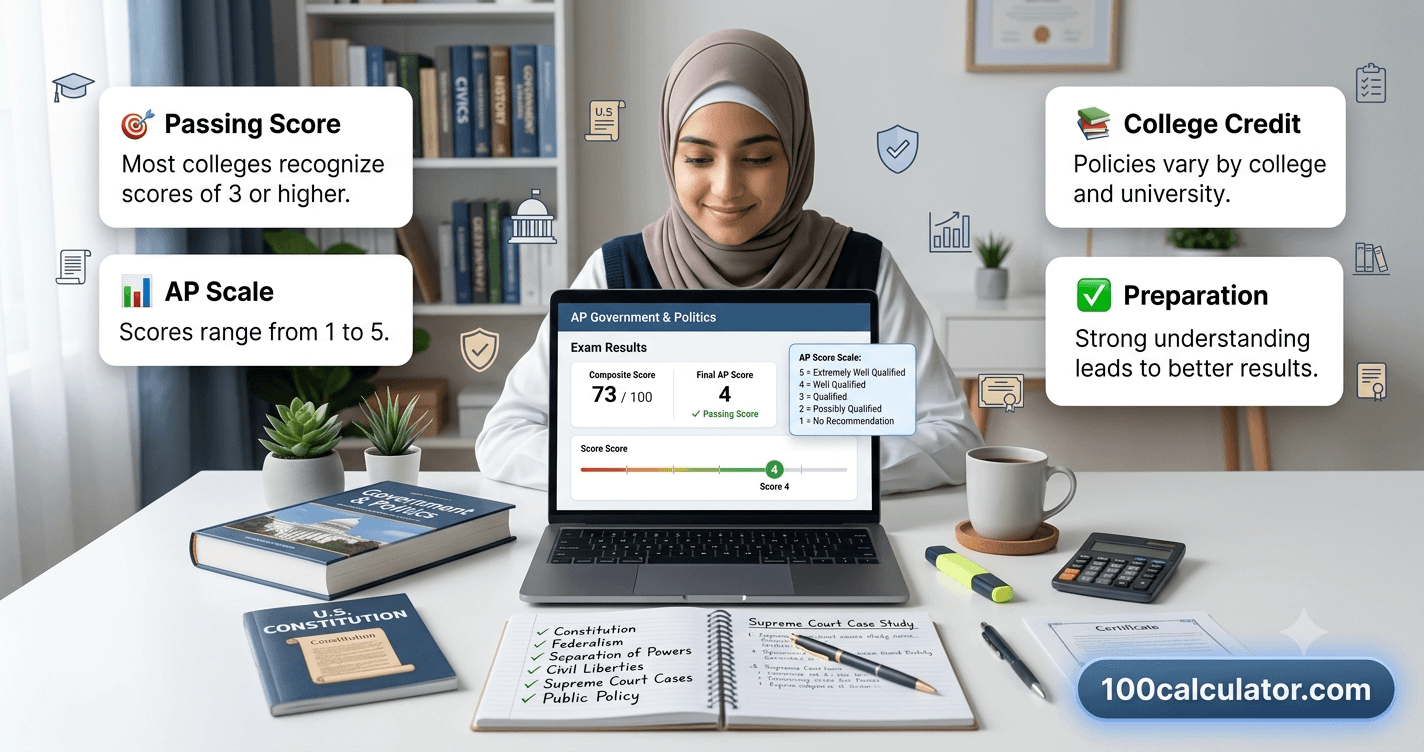
Every July, hundreds of thousands of students log into their College Board account and hold their breath before clicking on their AP Government score. The question on almost everyone's mind is the same: is this good enough?
College Board doesn't officially call any AP score "passing" or "failing." Scores run from 1 to 5, and a 3, labeled "qualified," is the number most students, teachers, and colleges informally treat as passing — it's also the threshold most schools use when deciding whether to grant credit for introductory coursework. A 4 or 5 clears the bar at more schools, including many selective ones, while a 1 or 2 rarely earns credit anywhere.
What makes this harder to pin down is that the exact cutoffs shift every single year, and College Board doesn't publish them in advance. If you want a faster way to see where you likely stand, 100 Calculator's AP Gov Score Calculator converts your practice or real exam performance into an estimated 1–5 score in seconds.
In this guide, we'll walk through exactly how the AP U.S. Government and Politics exam is scored, why the cutoff for a 3 keeps moving, what the last few years of score data actually show, and what your score really means once it lands on a college's desk.
Understanding the AP Government Exam
AP United States Government and Politics is a full-year course designed to mirror an introductory college political science class. The exam itself runs three hours and is administered fully online through College Board's Bluebook testing app, with both sections submitted automatically when time runs out. (College Board)
Exam Format at a Glance
The exam splits evenly into two sections, and each one counts for exactly half of your final score:
| Section | Format | Time | Weight |
|---|---|---|---|
| Section I | 55 multiple-choice questions | 1 hour 20 minutes | 50% |
| Section II | 4 free-response questions | 1 hour 40 minutes | 50% |
The multiple-choice section is graded by computer, and the free-response section is graded by trained human readers using official scoring rubrics each June. Since each section is worth exactly half your score, a weak showing on one side can't be fully offset by a strong showing on the other.
Required Supreme Court Cases and Foundational Documents
Unlike a lot of AP courses, AP Government asks you to know a specific, published list of source material cold: 15 required Supreme Court cases and 9 required foundational documents, including the Federalist Papers, the Constitution, and Dr. Martin Luther King Jr.'s "Letter from a Birmingham Jail." These show up directly in multiple-choice questions and are central to two of the four free-response questions, which we'll cover shortly. A future exam version is set to add several more required documents, so it's worth double-checking your class's current list rather than relying on an old study guide.
What Score Do You Need to Pass AP Government?
Here's the direct answer: there's no official "passing" score on any AP exam, including Government. Instead, College Board reports a 1–5 result and describes each number as a level of qualification for college credit, not a pass or fail grade. (College Board)
| Score | College Board Label | What It Generally Means |
|---|---|---|
| 5 | Extremely well qualified | Top-tier performance; credit is accepted almost everywhere it's offered |
| 4 | Well qualified | Strong performance; credit accepted at most schools, including many selective ones |
| 3 | Qualified | Solid, foundational performance; the score most commonly called "passing," though credit policies vary |
| 2 | Possibly qualified | Partial understanding; rarely earns college credit |
| 1 | No recommendation | Does not earn college credit |
In practice, "passing" boils down to two separate questions: did you hit a 3 (the informal bar most people mean), and does the specific college you care about actually grant something for a 3, or does it require a 4 or 5? We'll answer the second question in detail later in this guide.
How the AP Government Exam Is Scored
Your multiple-choice answers earn a raw point for every correct response, with no penalty for wrong or blank answers. Your free-response answers are scored by trained readers against an official rubric, question by question. Those two section results are then combined into a composite score, weighted 50/50, and College Board converts that composite into the final 1–5 scale you actually see on your score report.
That last step is the part most students don't realize: the raw-score-to-1–5 conversion isn't fixed. It's recalculated after every exam administration through a statistical process, so the exact number of points needed for a 3 in one year isn't guaranteed to match the number needed the year before or after. We cover exactly why that happens, and how much it has recently changed, in the next section. For a closer look at the raw point-by-point mechanics, our companion guide on how the AP Government exam score is calculated walks through the composite scoring process in more detail.
Free Online Tool
Want a quick estimate instead of doing the math yourself?
100 Calculator's AP Gov Score Calculator takes your multiple-choice and free-response performance and estimates where it likely lands on the 1–5 scale, based on how recent exams have been scored, right in your browser with no account needed.
The Multiple-Choice Section Explained
Section I gives you 80 minutes for 55 questions, each with four answer choices. Some questions stand alone, and others come in small sets built around a shared chart, map, cartoon, or short passage. Across the section, you'll be asked to:
- Describe, explain, and compare political concepts and processes
- Apply one of the required Supreme Court cases to a real-world scenario
- Read and interpret data in graphs, charts, tables, or maps
- Analyze foundational documents and other text-based or visual sources
This section is worth exactly 50% of your total score, the same as the free-response section, so it's not a section you can afford to rush through carelessly just to save time for Section II.
The Free-Response Section Explained
Section II gives you 100 minutes for four written questions. Unlike the multiple-choice section, each question here tests a distinct skill, and each one counts for an equal share of the free-response half of your score, regardless of how many raw points it's worth internally.
| Question | Task | Raw Points |
|---|---|---|
| FRQ 1 | Concept Application — apply a political concept to a described scenario | 3 |
| FRQ 2 | Quantitative Analysis — interpret data in a chart, graph, map, or table | 4 |
| FRQ 3 | SCOTUS Comparison — compare a new case to one of the 15 required Supreme Court cases | 4 |
| FRQ 4 | Argument Essay — build an argument using evidence from required foundational documents | 6 |
FRQ 1: Concept Application
You'll read a short scenario involving a political institution, behavior, or process, then describe and explain its effect and apply the underlying concept to a new situation. It's the most straightforward of the four questions, but it still expects precise use of course vocabulary rather than a general answer.
FRQ 2: Quantitative Analysis
Here you're given a data display, such as a bar chart, line graph, or table of survey results, and asked to describe a trend, draw a conclusion, and explain how it connects to a broader political concept. Reading the data correctly matters as much as knowing the underlying theory.
FRQ 3: SCOTUS Comparison
You'll be given a non-required Supreme Court case you likely haven't studied, described in enough detail to work with, and asked to connect it to one of the 15 required cases you do know. The goal isn't memorizing more cases; it's being able to identify the shared constitutional principle and explain the reasoning on both sides.
FRQ 4: Argument Essay
This is the highest-weighted single question on the exam. You'll build a defensible argument in response to a prompt, using at least one of the required foundational documents as evidence, plus one additional piece of evidence from your own course knowledge. Clear organization and a specific, arguable thesis matter more here than raw length.
Why Score Cutoffs Change Every Year
If you've ever heard someone say the AP Government exam "got easier," what actually changed is usually the scoring process, not the difficulty of the questions. College Board is explicit that it recalculates the raw-to-scaled conversion after each exam so that, for example, a 3 this year reflects roughly the same level of achievement as a 3 the year before. (College Board) That process, called equating, accounts for the fact that no two versions of the exam are exactly the same difficulty.
How Equating Works
Instead of publishing a fixed "you need 70 points for a 3" rule that applies every year, College Board looks at how the whole pool of test-takers performed on that year's specific questions, then sets cutoffs so scores stay comparable across different exam versions and different years. This is also why third-party AP score calculators, including ours, are described as estimates rather than guarantees: the exact cutoffs simply aren't published in advance.
The 2024 Recalibration
Starting around 2023 and 2024, College Board also began adjusting its standard-setting approach for several widely taken AP exams, including U.S. Government and Politics, U.S. History, and a handful of sciences. The stated goal was to bring success rates on those exams closer to the 60–80% range typically seen across most AP subjects, since Government's pass rate had been running notably lower than that for years.
This is exactly why the jump in scores between 2023 and 2024 looks so dramatic in the data below. Education researchers and reporters have documented the shift extensively, and it's generated real public discussion: some see it as a legitimate correction to previously miscalibrated cutoffs, while others have questioned whether comparing a 2024 score to a pre-2024 score is really an apples-to-apples comparison. Either way, if you're comparing your own results to an older sibling's or a friend's from a few years back, it's worth keeping that context in mind.
Recent AP Government Score Distributions
Seeing the actual numbers helps put your own score in context. Here's how AP Government scores have trended over the past several years, based on official College Board data. (College Board)
| Year | Mean Score | Scored 3 or Higher | Note |
|---|---|---|---|
| 2023 | 2.59 | 49.2% | Last year before recalibration |
| 2024 | 3.38 | ~73% | First year under the new approach |
| 2025 | 3.34 | 71.7% | 388,804 test-takers |
| 2026 | — | ~76% | ~430,000 test-takers |
The pattern is clear: pass rates have climbed steadily since 2023, and the exam that once had one of the lowest success rates of any AP subject now sits closer to the middle of the pack. That's genuinely useful context, but it doesn't change what matters for your own results this year, since your score is set against this year's cutoffs, not a prior year's.
How Colleges Interpret Your AP Government Score
Every college sets its own AP credit policy, and that policy, not the informal "3 is passing" rule, is what actually determines whether your score turns into college credit. A few general patterns hold across most schools:
- A 5 is accepted almost everywhere that grants AP credit at all, often for the strongest available placement
- A 4 clears the credit bar at most schools, including a large share of selective ones
- A 3 earns credit at many colleges, particularly large public universities, but some selective schools set their bar at a 4 for Government specifically
- A 1 or 2 almost never earns credit, regardless of the school
How to Check a College's AP Credit Policy
Search for the school's name plus "AP credit policy," or look for an AP credit chart on the registrar's or admissions office website. Policies are often listed subject by subject, and a school might require a 3 for one course but a 4 or 5 for another, so it's worth checking Government specifically rather than assuming the school's general AP policy applies evenly.
AP score reporting also works exam by exam, and it's your choice which scores to send to which schools. That means a lower score on Government doesn't have to affect how a stronger score in another AP subject, like chemistry or calculus, gets reported. If you're balancing multiple AP exams this season, our AP Chem Score Calculator and AP Calc BC Score Calculator work the same way as the Government version.
Common Mistakes That Lower Your Score
A lot of AP Government points get lost to avoidable habits rather than genuine gaps in knowledge. Here's what tends to cost students the most:
- Leaving multiple-choice questions blank. Since there's no guessing penalty, a blank answer and a wrong answer cost you the same number of points, so there's no reason to skip one.
- Writing a vague or missing thesis on the argument essay. FRQ 4 rewards a specific, defensible claim you can actually support, not a restatement of the prompt.
- Mixing up a required case with a similar-sounding one. FRQ 3 depends on correctly identifying the required case that shares a constitutional principle with the unfamiliar case in the prompt.
- Describing data instead of analyzing it. On the quantitative analysis question, simply restating what a chart shows earns fewer points than explaining what the trend means politically.
- Running out of time on Section II. With four questions in 100 minutes, spending too long perfecting the first FRQ often means rushing, or skipping, the last one.
How to Improve Your AP Government Score
Improving your score usually comes down to a handful of concrete habits rather than cramming more content in the final week.
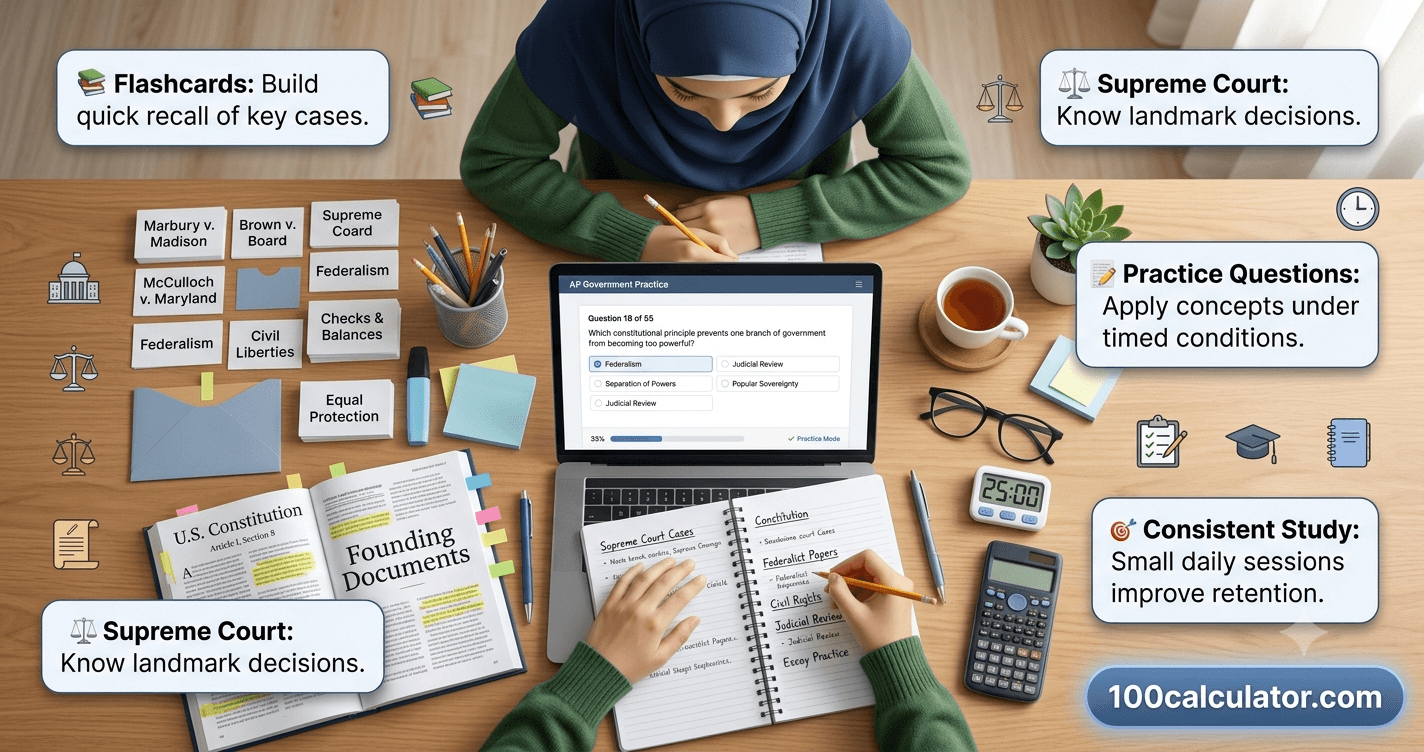
- Learn all 15 required Supreme Court cases and 9 foundational documents cold. Know the facts, the holding, and the constitutional reasoning for each one, since they appear throughout the exam, not just in one question.
- Practice with officially released FRQs. College Board publishes past free-response questions and scoring guidelines, which show you exactly what earns credit on each rubric line.
- Write under real timing conditions. Practicing all four free-response questions in 100 minutes builds the pacing instinct that's easy to underestimate until exam day.
- Drill data interpretation, not just vocabulary. FRQ 2 and a chunk of the multiple-choice section reward comfort reading charts, maps, and tables quickly.
- Review your weakest unit last. A quick self-check against the five course units usually reveals one or two areas worth extra review time before the exam.
If AP Government is one of several AP classes on your schedule, it's also worth thinking about how those scores and grades roll into your overall GPA. Our guide on weighted versus unweighted GPA explains how AP coursework is usually counted differently from a standard class.
Related Calculators
Put what you just read into practice, try these free tools instantly, no sign-up required.
High School GPA Calculator
Calculate your high school GPA from grades and credit hours.
GPA Calculator Middle School
Calculate your middle school GPA quickly and accurately.
AP Chem Score Calculator
Estimate your AP Chemistry exam score from practice results.
AP Calc BC Score Calculator
Estimate your AP Calculus BC exam score from raw points.
AP Gov Score Calculator
Estimate your AP Government exam score from practice results.
Using an AP Gov Score Calculator
Because College Board doesn't publish exact cutoffs in advance, a score calculator can't tell you your official result before it's released. What it can do is take your estimated raw performance and translate it into a realistic 1–5 range, based on patterns from recent, publicly released score data.
How to Use the Calculator
Grade a full practice exam, or your real exam once you have a sense of how it went, using an official answer key for the multiple-choice section and a released scoring rubric for the free-response section. Then enter your multiple-choice count and your estimated free-response points into 100 Calculator's AP Gov Score Calculator to see where that performance would likely land based on recent scoring patterns.
This is most useful in two situations: after a full-length practice exam, so you know which areas still need work before the real thing, and right after the actual exam, so you have a reasonable sense of what to expect while you wait the few weeks for official scores in July.
A note on accuracy: This article reflects publicly available AP Program information at the time of writing. AP score cutoffs, score distributions, required course content, and college credit policies can all change from year to year, so always confirm current details directly with College Board and with the admissions or registrar's office at any college you're considering.
More From Education Tools Guides
Still working through GPA, AP scoring, or exam strategy? These related guides dig deeper into the other education topics covered on 100 Calculator.
Frequently Asked Questions
What is considered a passing score on the AP Government exam?
College Board doesn't officially label any AP score as "failing" or "passing." Informally, though, a score of 3 or higher is what most students, teachers, and colleges mean by passing, since 3 is labeled "qualified" and is the threshold most schools use when deciding whether to award introductory course credit.
Does College Board define an official passing score for AP exams?
No. AP scores range from 1 to 5, and College Board describes them as levels of qualification rather than pass or fail. A 3 is labeled "qualified," which is why it's treated as the informal passing mark, but the actual credit decision always belongs to the college, not to College Board.
What percentage of students pass the AP Government exam?
It depends on the year, since cutoffs reset after each administration. In 2025, 71.7% of test-takers scored a 3 or higher, and in 2026 that number rose to roughly 76%. Both are well above the 49.2% pass rate recorded in 2023, before College Board adjusted its scoring approach.
Is AP Government a hard exam?
It has a reputation for being one of the more demanding AP exams, largely because it requires knowing 15 specific Supreme Court cases and 9 foundational documents in real detail. Recent score distributions show it's become more manageable than it was a few years ago, but it still rewards careful, consistent preparation on both sections.
How many multiple-choice questions are on the AP Government exam?
Section I has 55 multiple-choice questions, and you get 80 minutes to complete them. This section makes up half of your total score, and there's no penalty for guessing, so it's worth answering every question even when you're unsure.
How many free-response questions are on the AP Government exam?
Section II has 4 free-response questions, and you get 100 minutes to complete them. The four types are concept application, quantitative analysis, an SCOTUS comparison question, and an argument essay, and together they make up the other half of your score.
Do colleges give credit for a 3 on AP Government?
Many do, since 3 is the "qualified" threshold College Board associates with introductory college-level work. That said, credit policies vary widely, and some more selective schools only award credit starting at a 4 or 5, so it's worth checking your target school's specific AP credit policy for Government.
What's the difference between a 3 and a 4 on AP Government?
A 3 is labeled "qualified" and roughly compares to a C-range grade in the equivalent college course, while a 4 is "well qualified" and compares to a B-range grade. In practice, a 4 clears the credit bar at more colleges than a 3 does, including a number of selective schools.
Why did AP Government scores go up recently?
Starting around 2023 and 2024, College Board began adjusting how it sets score cutoffs for several popular AP exams, including Government and Politics, aiming to bring pass rates closer to the 60–80% range typically seen across AP subjects. That change is the main reason recent pass rates look noticeably higher than they did in 2022 and 2023.
How is the AP Government exam scored?
Your multiple-choice answers are scored by computer, and your free-response answers are scored by trained readers using official rubrics. Those two section scores are combined into a composite score, which College Board then converts into the final 1–5 scale using a statistical process that resets after every exam administration.
Can I use a raw score to predict my AP Government score?
You can get a reasonable estimate, but not an exact one. Tools like our AP Gov Score Calculator use patterns from past scoring data to translate your multiple-choice and free-response performance into a likely 1–5 range, though College Board doesn't publish exact cutoffs in advance, so any estimate carries some built-in uncertainty.
What Supreme Court cases do I need to know for AP Government?
The course requires familiarity with 15 specific Supreme Court cases, covering topics like judicial review, federalism, free speech, and civil rights. You'll need to know the facts, the holding, and the constitutional reasoning behind each one, since FRQ 3 specifically asks you to compare a new case to one of these required cases.
Is there a penalty for guessing on AP Government multiple-choice questions?
No. You earn one point for each correct answer, and incorrect or blank answers simply earn zero points. Since there's no downside to guessing, it's almost always worth selecting an answer rather than leaving a question blank.
How can I estimate my AP Government score before official results come out?
Compare your practice test performance against officially released scoring guidelines, or use an AP Gov score calculator to translate your practice raw scores into an estimated 1–5 range. Just remember that actual cutoffs are set after the real exam, so any estimate before scores are released is an educated guess, not a guarantee.
What happens if I get a 1 or 2 on AP Government?
A 1 or 2 rarely earns college credit, since they're labeled "no recommendation" and "possibly qualified." The score still appears on your official AP record, but most students in this range simply choose not to send that particular score to colleges, since AP score reporting is optional and handled exam by exam.
Should I report a low AP Government score to colleges?
That's a personal decision, since AP score reporting isn't automatic and you choose which scores to send. Some students skip sending a 1 or 2 since it's unlikely to help an application, while others still value the AP course itself for the rigor it shows on a transcript, separate from the exam score.
About 100 Calculator
100 Calculator is a free hub of online calculators and educational guides covering health, finance, trading, crypto, education, and more. Every tool is built to be fast, accurate, and genuinely free, with no account or signup required.
We built this guide, and tools like the AP Gov Score Calculator referenced throughout it, to make studying for AP exams a little less stressful and a lot more predictable. Head back to the 100 Calculator homepage to explore the full library of tools, or learn more about the team behind them on our About Us page.