What Raw Score Do You Need for a 5 in AP Chemistry?
A clear breakdown of how the AP Chemistry composite score works, what raw score has historically been enough for a 5, and how to estimate your own score before results arrive.
You just finished your AP Chemistry exam, or you're deep in practice tests, and one question keeps looping through your head: how many points do you actually need for a 5?
Here's the direct answer. Based on recent AP Chemistry exams, a composite score of roughly 70 to 75 out of 100 available points has typically been enough to earn a 5. That works out to answering somewhere around 70% to 75% of the exam correctly across the multiple-choice and free-response sections combined. The exact cutoff shifts a little every year, since the College Board adjusts the scale to keep scores fair across different versions of the test, but that range gives you a realistic target to aim for while you study.
This guide breaks down exactly how that composite score gets built, section by section, so you can see where you stand and where to improve. You'll learn how multiple-choice and free-response points combine into one composite score, what recent AP Chemistry score distributions actually look like, which mistakes quietly cost students the most points, and how to use 100 Calculator's free AP Chem Score Calculator to turn your practice test results into an honest estimate of your final AP score.
Understanding How AP Chemistry Scoring Actually Works
Before you can figure out what raw score gets you a 5, it helps to know what "raw score" and "composite score" actually mean on the AP Chemistry exam. These aren't the same number, and mixing them up is one of the most common sources of confusion for students checking their practice test results.
Your raw score is simply how many points you earned before any scaling happens: the number of multiple-choice questions you got right, plus the number of points a scorer awarded you on the free-response questions. Your composite score is what you get after both raw scores are weighted and combined into a single number out of 100. That composite number is what actually gets converted into your final AP score of 1 through 5.
For a fuller walkthrough of how the College Board builds that conversion each year, our guide on how the AP Chemistry exam is scored each year goes into more detail on the process itself. Here, we'll focus specifically on what composite score history suggests you need for each AP score, and how to estimate your own.
The Two Sections of the AP Chemistry Exam
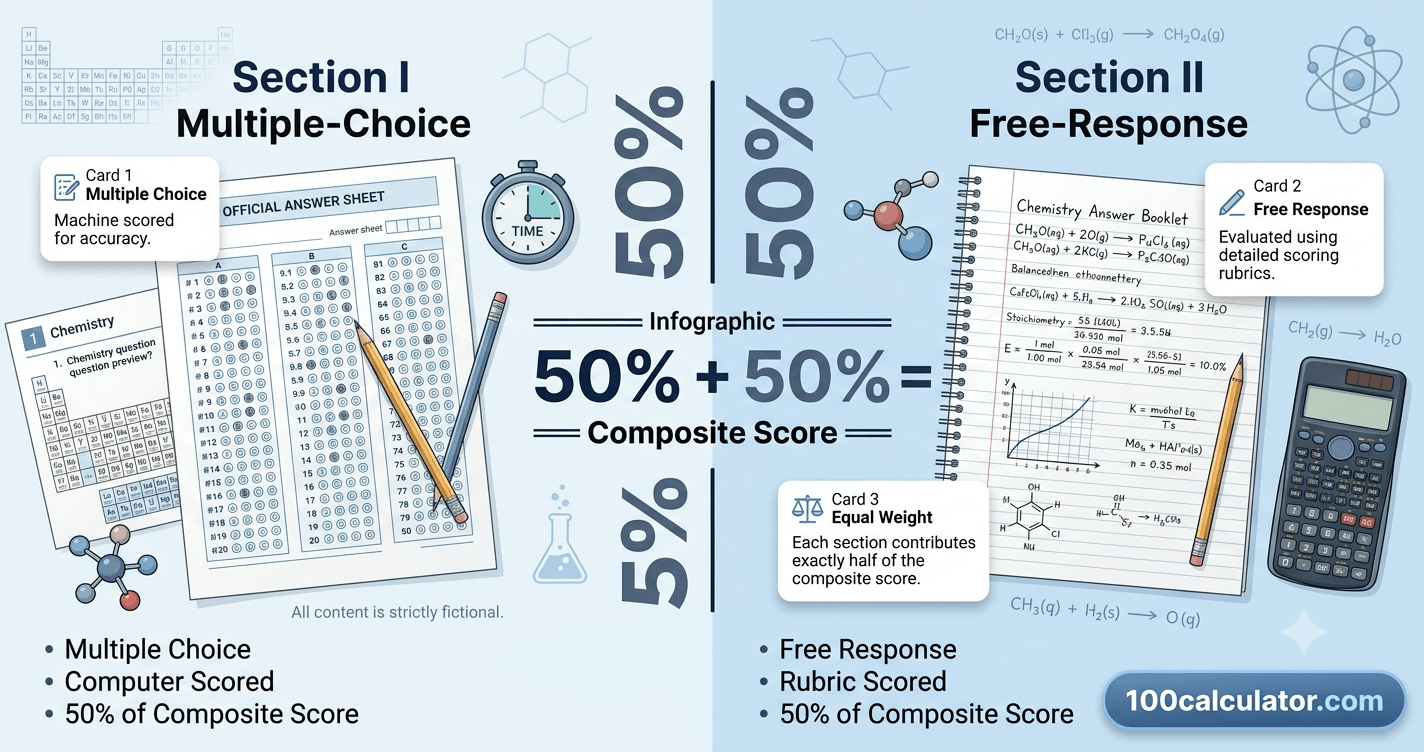
The AP Chemistry exam has two sections, and each one counts for exactly half of your final composite score.
Section I is multiple choice. It has 60 questions, and you get 90 minutes to complete it. Every question you answer correctly adds one point to your raw MCQ score, out of a possible 60 points.
Section II is free response. It has 7 questions total, split into 3 long-answer questions and 4 short-answer questions, and you get 105 minutes to complete it. Each question is scored by trained AP readers using an official rubric, and the points from all 7 questions add up to a raw FRQ score out of 46.
That's just over three hours of total testing time, split roughly evenly between the two sections.
From Raw Points to a Composite Score
Once both raw scores are in, they get converted using the same math every year, even though the cutoffs that follow can shift.
Your raw MCQ score out of 60 is scaled to a maximum of 50 composite points. Your raw FRQ score out of 46 is also scaled to a maximum of 50 composite points. Add the two together, and you get a composite score somewhere between 0 and 100.
This is the number that matters most. A student who does slightly better on free response and slightly worse on multiple choice can end up with the exact same composite score, and therefore the exact same AP score, as a student whose strengths run the other way.
What Raw Score Do You Actually Need for a 5?
To translate that into raw points, a composite around 72 might come from getting roughly 45 of 60 multiple-choice questions right and about 30 of 46 free-response points, or from a slightly different mix, since the two sections trade off against each other. Here's how that composite range breaks down across all five AP scores.
| AP Score | Approx. Composite (out of 100) | Roughly Equivalent To |
|---|---|---|
| 5 | About 70–75 | 70%–75% of total points |
| 4 | About 55–64 | 55%–64% of total points |
| 3 | About 45–54 | 45%–54% of total points |
| 2 | About 30–44 | 30%–44% of total points |
| 1 | Below about 30 | Below 30% of total points |
Why the Cutoff Isn't the Same Every Year
The College Board doesn't publish next year's exact composite-to-score table in advance. Instead, after each exam is administered, a committee of chemistry faculty and assessment specialists reviews how that particular version of the test performed compared to previous years, using a statistical process often called equating.
If that year's exam turned out to be a little harder overall, the composite needed for each AP score typically drops slightly. If it turned out easier, the cutoffs usually rise a bit. This keeps a 5 meaning roughly the same level of chemistry mastery no matter which year, or which specific version of the exam, a student happened to take.
In practice, this means the 70–75 range above is a genuinely useful planning target, but not a number you should treat as exact down to the point.
A Realistic Study Target
If you're using practice exams to gauge where you stand, aim to consistently score above 75 out of 100 on full-length, timed practice tests using official College Board materials or your class's practice resources. That gives you a buffer above the historical 5 range, so a slightly harder real exam, or a rough patch on one free-response question, doesn't knock you into 4 territory.
If you're consistently landing in the 55 to 65 range on practice tests, you're in solid shape for a 4, and targeting specific weak spots, often the free-response section, is usually the fastest way to close the gap to a 5.
AP Chemistry Score Distribution: How Many Students Get Each Score
Knowing the target composite score is useful, but it also helps to see how actual test-takers have scored recently, since that context shows you exactly how competitive a 5 really is.
| AP Score | 2025 | 2026 |
|---|---|---|
| 5 | 17% | 15% |
| 4 | 29% | 31% |
| 3 | 32% | 30% |
| 2 | 16% | 18% |
| 1 | 6% | 6% |
| Score of 3 or higher | 77.9% | ≈76% |
| Average score | 3.36 | ≈3.31* |
*The 2026 average is calculated directly from the distribution above; the College Board had not separately published a rounded average score at the time of writing.
Both years land in a similar range: roughly three out of four students who take AP Chemistry each year score a 3 or higher, and the 5 rate has held fairly steady at around 15% to 17%. (College Board) That 5 rate is genuinely useful context. It means a 5 puts you in a minority of test-takers, even though it's far from a rare, one-in-a-hundred outcome.
Breaking Down the Multiple-Choice Section
Section I is often where students feel the most immediate pressure, since every question either counts or it doesn't. Understanding exactly how it's scored can take some of that pressure off.
How Multiple-Choice Points Are Scored
Multiple-choice scoring on AP Chemistry is refreshingly simple. Every question you answer correctly earns exactly one raw point, out of 60 possible. There's no penalty for a wrong answer, and there's no penalty for leaving a question blank, aside from missing out on the point you would have earned.
That means guessing is never a bad idea if you're running out of time or genuinely unsure. A random guess has a chance of earning you a point; an empty bubble guarantees it earns you nothing.
Some multiple-choice questions stand alone, and others are grouped into short sets built around a shared chart, graph, or lab scenario. Both types are worth exactly the same one point each.
How Many MCQs Should You Aim to Get Right?
If you're aiming for a composite in the 70 to 75 range and expect to perform similarly on both sections, that generally works out to somewhere around 42 to 46 correct answers out of 60 on multiple choice, paired with a comparably strong free-response performance.
That said, the two sections don't have to match evenly. A student who's stronger on free response can afford a slightly lower multiple-choice raw score, and vice versa, since it's the combined composite that determines your final AP score, not either section on its own.
Breaking Down the Free-Response Section
Section II asks you to show your work, and it's where understanding partial credit becomes especially important.
Long vs. Short Free-Response Questions
The free-response section has 7 questions total: 3 long-answer questions worth 10 points each, and 4 short-answer questions worth 4 points each. That adds up to a maximum raw FRQ score of 46 points.
Long questions typically ask you to work through a multi-step problem, often involving calculations, graphing, or connecting several chemistry concepts within a single scenario. Short questions are more focused, usually asking you to explain a single concept, interpret one piece of data, or perform a shorter calculation.
How Partial Credit Works
Every free-response question is scored using an official rubric that breaks the question into individual scoring points. A long question worth 10 points, for example, might award one point for a correct calculation, another for correct units, and additional points for explaining your reasoning, rather than requiring one single all-or-nothing answer.
This is genuinely good news for your composite score. Showing your work, labeling your reasoning clearly, and attempting every part of a question, even if you're unsure of the full answer, gives you a real chance at partial credit. Leaving a free-response question blank guarantees zero points, while a partial attempt often earns at least something.
| Section | Questions | Time | Weight | Raw Points Possible |
|---|---|---|---|---|
| I: Multiple Choice | 60 questions | 90 minutes | 50% | 60 |
| II: Free Response | 7 questions (3 long, 4 short) | 105 minutes | 50% | 46 |
How to Calculate Your Own Estimated AP Chemistry Score
Once you know roughly how the scoring works, the most useful next step is estimating your own score using real practice test results. Here's how to do that by hand, followed by an easier way using our free tool.
Step-by-Step: Calculating Your Composite Score
- Score your multiple-choice section. Count how many of the 60 questions you answered correctly. That number, out of 60, is your raw MCQ score.
- Score your free-response section using an official rubric. If you're working from a released exam, award yourself points question by question using the official scoring guidelines, rather than guessing at a percentage. Add up your points across all 7 questions for a raw FRQ score out of 46.
- Scale each section to 50 points. Divide your raw MCQ score by 60, then multiply by 50. Do the same for your FRQ score, dividing by 46 and multiplying by 50.
- Add the two scaled scores together. The result is your composite score out of 100.
- Compare your composite to the historical ranges above to see which AP score it would likely correspond to.
MCQ Scaled = (Raw MCQ ÷ 60) × 50 FRQ Scaled = (Raw FRQ ÷ 46) × 50 Composite Score = MCQ Scaled + FRQ Scaled
Raw MCQ — number of multiple-choice questions answered correctly, out of 60.
Raw FRQ — total points earned across all 7 free-response questions, out of 46.
Composite Score — your combined score out of 100, which converts into your final AP score of 1 to 5.
For example, a student who answers 48 of 60 multiple-choice questions correctly, and earns 32 of 46 points on free response, would calculate their composite like this:
MCQ Scaled: (48 ÷ 60) × 50 = 40
FRQ Scaled: (32 ÷ 46) × 50 ≈ 34.8
Composite Score: 40 + 34.8 ≈ 74.8
Based on the historical ranges covered earlier, a composite around 75 sits right at the upper end of what's typically needed for a 5, making this a strong, though not guaranteed, result.
Using the AP Chem Score Calculator Tool
Free Online Tool
Skip the manual math
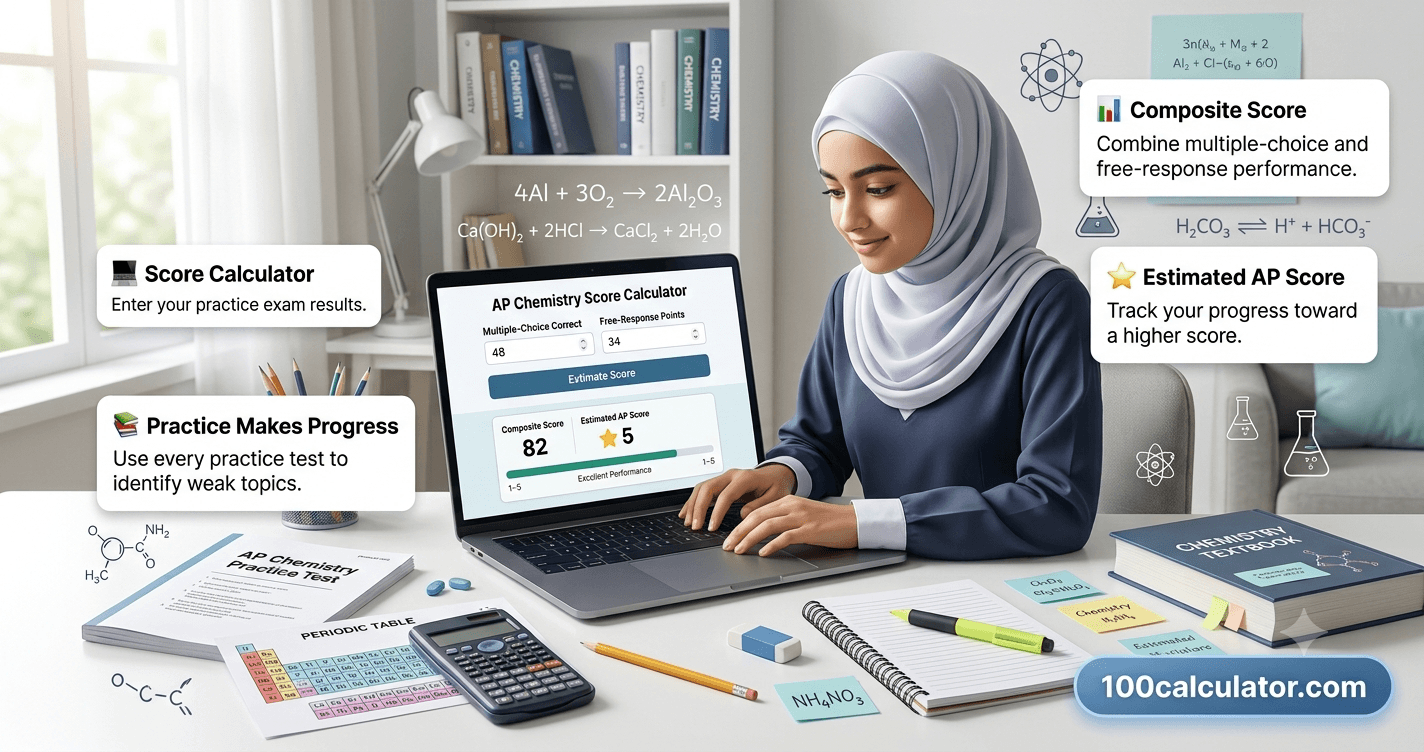
100 Calculator's AP Chem Score Calculator does this conversion for you. Enter your multiple-choice and free-response results, and it estimates your composite score and likely AP score instantly, based on recent historical scoring patterns, with no sign-up required.
What Does Each AP Chemistry Score Actually Mean?
A composite score is only useful once you know what to do with the resulting AP score. Here's what scores of 5 down to 1 typically mean in practice.
| AP Score | General Meaning | Typical College Credit Outlook |
|---|---|---|
| 5 | Extremely well qualified | Very often accepted for credit or placement, including at selective and pre-med-focused programs |
| 4 | Well qualified | Frequently accepted for credit at most colleges |
| 3 | Qualified | Often accepted for credit, though more selective schools and certain majors may require a 4 or 5 |
| 2 | Possibly qualified | Rarely accepted for credit |
| 1 | No recommendation | Not accepted for credit |
The College Board describes a 3 as "qualified," meaning you've demonstrated the level of understanding expected of a passing introductory college chemistry student. Many colleges do award credit or placement for a 3, though this varies enormously by institution and even by specific department within the same school.
If you're planning to use your AP Chemistry score toward a pre-med track, an engineering program, or another chemistry-heavy major, it's worth checking your target school's AP credit policy directly rather than assuming a 3 will automatically satisfy a requirement. Some competitive programs specifically require a 4 or 5, or only grant elective credit rather than satisfying a specific course requirement, for anything below a 5.
A strong AP score can also affect your weighted GPA, depending on how your high school calculates it. Our guide to weighted vs. unweighted GPA walks through exactly how AP coursework factors in, and our High School GPA Calculator can show you the difference it makes.
Common Mistakes That Quietly Lower Your Composite Score
Even strong chemistry students lose composite points in predictable, avoidable ways. Here's what to watch for:
- Leaving free-response questions blank. A blank answer guarantees zero points, while even a partial, uncertain attempt has a real chance at partial credit.
- Skipping units and significant figures. Many FRQ rubrics award separate points for correct units and appropriate significant figures, independent of whether your final number is right.
- Running out of time on Section II. With 105 minutes across 7 questions, roughly 15 minutes each, students who spend too long perfecting one long question often shortchange the short questions that follow.
- Second-guessing multiple-choice answers. Since there's no penalty for a wrong answer, changing a reasoned answer to an uncertain one late in the section can cost points rather than protect them.
- Ignoring released free-response questions. Practicing exclusively with multiple-choice questions builds one skill while leaving the half of your composite score tied to free response underdeveloped.
- Forgetting that both sections count equally. Some students focus heavily on memorizing facts for multiple choice while under-practicing the multi-step, written format of Section II, even though it's worth exactly the same 50% of the composite.
Study Strategies That Actually Raise Your Raw Score
A few consistent habits tend to move students from a 3 or 4 into 5 territory more reliably than last-minute cramming.
- Practice with officially released AP Chemistry free-response questions and score yourself using the real rubrics, not just an answer key
- Time yourself on full-length practice sections so pacing becomes automatic before exam day
- Review your weakest content unit specifically, rather than re-studying material you've already mastered
- Practice showing complete work on every calculation, including units and significant figures, since that's exactly what FRQ rubrics reward
- Track your composite score across several practice tests using a tool like our AP Chem Score Calculator, so you can see whether you're trending toward your target
- Treat every multiple-choice question as worth answering, even as a guess, since there's no penalty for getting it wrong
Is AP Chemistry Curved? Separating Myths From Facts
AP Chemistry has a reputation as one of the toughest AP sciences, and part of that reputation comes from confusion about how the scoring curve actually works.
Myth: AP Chemistry limits how many
students can score a 5 each year.
Fact: The scoring process adjusts for how
difficult that year's specific exam turned out to be; it
doesn't cap the number of 4s or 5s awarded. In years when
more students perform well, more students receive high
scores.
Myth: The raw score requirement stays
exactly the same every year.
Fact: The composite needed for each AP
score shifts slightly year to year, which is exactly why
this guide gives a range instead of one fixed number.
Myth: Getting less than half the
multiple-choice questions right means you've already
failed.
Fact: Because both sections combine into
one composite, a mediocre multiple-choice performance
paired with a strong free-response showing can still add
up to a 4 or even a 5.
Myth: AP Chemistry scores have stayed
flat for years.
Fact: Recent data shows the opposite.
Average scores and the share of students earning a 3 or
higher have both trended upward over the past several
years, even as the number of students taking the exam has
grown.
Related Calculators
Put what you just read into practice, try these free tools instantly, no sign-up required.
High School GPA Calculator
Calculate your high school GPA from grades and credit hours.
GPA Calculator Middle School
Calculate your middle school GPA quickly and accurately.
AP Chem Score Calculator
Estimate your AP Chemistry exam score from practice results.
AP Calc BC Score Calculator
Estimate your AP Calculus BC exam score from raw points.
AP Gov Score Calculator
Estimate your AP Government exam score from practice results.
When (and How) to Use an AP Chem Score Calculator
An AP Chem Score Calculator is most useful as a planning tool, not a guarantee. Here's how to get the most accurate estimate out of one, and where its limits are.
What a Score Calculator Can (and Can't) Tell You
A good score calculator applies the same weighting the College Board uses, 50% multiple choice and 50% free response, and compares your resulting composite against recent historical cutoffs. That gives you a genuinely useful estimate of where you stand.
What it can't do is tell you your exact, guaranteed AP score. Since the real cutoffs for your specific exam administration aren't set until after everyone has taken it, any calculator, including ours, is working from historical patterns rather than that year's finalized numbers.
Getting the Most Accurate Estimate
Score yourself as honestly as possible on free response, ideally using an official scoring rubric rather than a gut-feel percentage, since FRQ scoring is rarely a simple right-or-wrong process. Recheck your estimate after each full-length practice test rather than relying on a single data point, and pay attention to whether your composite is trending up, flat, or down as you continue studying. A calculator is most valuable when you use it consistently over time, not as a single one-time check.
If AP Chemistry is one of several AP exams on your plate this year, the same composite-and-cutoff logic applies to most other AP subjects, just with different section weights and formats. Our AP Calc BC Score Calculator and AP Gov Score Calculator work the same way for those exams.
A note on accuracy: 100 Calculator's AP Chem Score Calculator and the estimates in this guide are independent tools built from historical AP Chemistry scoring patterns and publicly released College Board data. They are not produced, reviewed, or endorsed by the College Board or the AP Program, and they cannot predict your exact, official AP score. Composite score cutoffs are set by the College Board after each exam administration and may differ from the historical ranges discussed here. Your official AP score report is always the final word.
Sources & References
This guide draws on the College Board's own published AP Chemistry data. For the most current, official figures, see:
More From Our Education Tools Guide
Studying for more than one AP exam, or keeping an eye on your overall GPA? These related guides dig deeper into the topics covered above.
Frequently Asked Questions
What raw score do I need for a 5 on the AP Chemistry exam?
Based on recent AP Chemistry exams, a composite score of roughly 70 to 75 out of 100 available points has typically been enough to earn a 5. That works out to about 70% to 75% of all points across the multiple-choice and free-response sections combined. The exact cutoff shifts slightly every year based on that year's exam difficulty, so treat this as a strong planning target rather than a fixed number.
How is the AP Chemistry exam scored?
The exam has two sections, each worth 50% of your final score. Multiple choice (60 questions) is scored one point per correct answer, out of 60. Free response (7 questions) is scored using official rubrics, out of 46 total points. Both raw scores are scaled to 50 points each and added together for a composite score out of 100, which then converts to your final AP score of 1 to 5.
What percentage of students get a 5 on AP Chemistry?
In recent years, roughly 15% to 17% of AP Chemistry test-takers have earned a 5, based on College Board score distributions. That's held fairly steady even as the total number of students taking the exam has grown, reaching around 185,000 test-takers in 2026.
Is AP Chemistry one of the harder AP exams?
AP Chemistry has a reputation for being demanding, largely because of its math-heavy problem-solving and dense content. That said, recent score data tells a more encouraging story: the overall pass rate, a score of 3 or higher, has climbed to around 76% to 78% in the most recent exam years, up from lower rates several years earlier.
What composite score do I need to pass AP Chemistry with a 3?
Historically, a composite score somewhere in the mid-40s to mid-50s out of 100 has been enough to earn a 3, which the College Board describes as "qualified." Many colleges award credit for a 3, though this varies by school, so it's worth confirming your target college's specific AP credit policy.
Does AP Chemistry have a curve that limits how many students can score a 5?
No. The scoring process adjusts for how difficult a specific year's exam turned out to be, a process called equating, but it doesn't cap the number of 4s or 5s available. In years when more students perform strongly, more students receive high scores; there's no fixed quota.
How many multiple-choice questions are on the AP Chemistry exam?
There are 60 multiple-choice questions in Section I, worth one raw point each for a total of 60 possible points. You get 90 minutes to complete this section, and it accounts for 50% of your final composite score.
How many free-response questions are on the AP Chemistry exam?
Section II has 7 free-response questions: 3 long-answer questions worth 10 points each and 4 short-answer questions worth 4 points each, for a total of 46 raw points. You get 105 minutes for this section, which also makes up 50% of your composite score.
Can I use a calculator on the AP Chemistry exam?
Yes, a scientific or graphing calculator is generally permitted on the AP Chemistry exam. Exact rules around calculator models and features can be updated by the College Board from year to year, so it's worth double-checking the current policy on the official AP Chemistry exam page before test day.
Does guessing hurt my score on AP Chemistry multiple choice?
No. AP Chemistry multiple-choice scoring awards one point for each correct answer, with no penalty for an incorrect one. That means it's always worth answering every question, even as an educated guess, since a blank answer and a wrong answer earn you the exact same zero points.
How much is each AP Chemistry free-response question worth?
The three long free-response questions are typically worth 10 points each, and the four short free-response questions are typically worth 4 points each, adding up to 46 total raw points for Section II. Each question is broken into smaller rubric points, so partial credit is available throughout.
What AP Chemistry score do most colleges require for credit?
Policies vary widely by school. Many colleges award credit or placement for a score of 3 or higher, while some more selective programs, particularly for pre-med or engineering tracks, require a 4 or 5. Always check your specific target college's published AP credit policy rather than assuming a general rule applies.
How accurate is an AP Chem score calculator?
A well-built AP Chem score calculator applies the same 50/50 section weighting the College Board uses and compares your composite to recent historical cutoffs, which makes it a genuinely useful planning tool. It can't guarantee your exact official score, though, since real cutoffs aren't finalized until after each year's exam is administered.
When are AP Chemistry scores released?
AP scores, including AP Chemistry, are typically released in early July following the May exam administration. Exact release dates can shift slightly year to year, so check the College Board's AP Students site for the current year's specific release schedule.
Is a 4 on AP Chemistry a good score?
Yes. A 4 is described by the College Board as "well qualified" and is frequently accepted for college credit or placement. Roughly 29% to 31% of AP Chemistry test-takers earned a 4 in recent years, making it a strong, solidly above-average result even though it falls just short of the top score.
How can I improve my raw score before the exam?
Practice with officially released free-response questions and score yourself using real rubrics, not just an answer key. Time full-length practice sections so pacing feels automatic, review your weakest content areas specifically, and always show complete work, including units, since that's exactly what earns partial credit on Section II.
About 100 Calculator
100 Calculator is a free hub of online calculators and educational guides covering health, finance, trading, crypto, education, and more. Every tool is built to be fast, accurate, and genuinely free, with no account or signup required.
We built this guide, and tools like the AP Chem Score Calculator referenced throughout it, to make exam prep a little less stressful and a lot more concrete. Head back to the 100 Calculator homepage to explore the full library of tools, or learn more about the team behind them on our About Us page.