How AP Calculus BC Exam Scores Are Calculated Each Year
A plain-English breakdown of how your raw multiple-choice and free-response points turn into your final AP Calculus BC score, including the AB subscore and why the cutoffs shift a little every year.
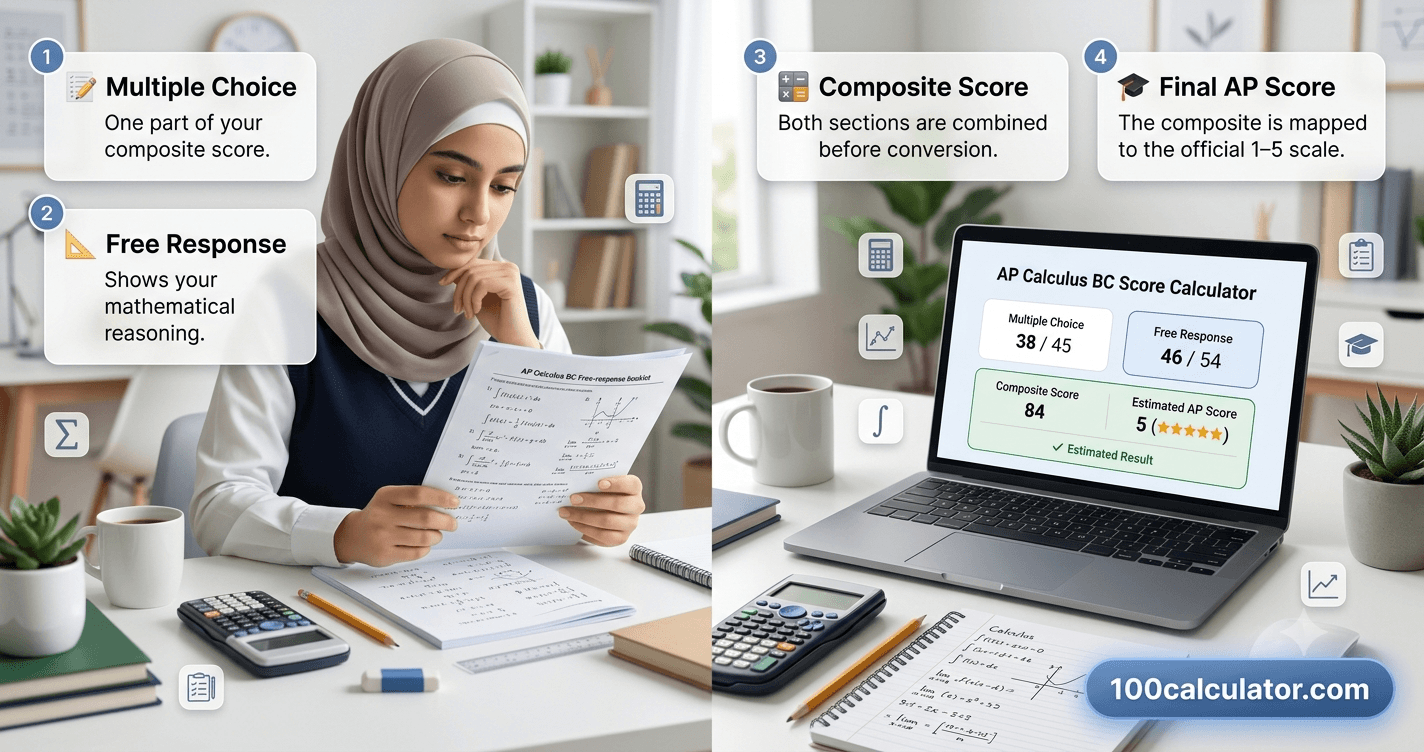
Your AP Calculus BC score isn't just a percentage of questions you answered correctly. It comes from two separate sections, multiple choice and free response, that get weighted, added together into a composite score, and then converted onto the familiar 1-to-5 scale using cutoffs that College Board finalizes after each exam.
That last detail is what throws off most self-graded estimates. You can't just count your multiple-choice hits and assume you know your grade, because the free-response section carries equal weight, and the exact composite score needed for a 5 shifts slightly from year to year.
This guide walks through exactly how raw answers become a final AP score: how the two sections are weighted, what the composite score formula looks like, what the separate AB subscore means, and why nobody, not even your teacher, can hand you a guaranteed cutoff before your specific exam has gone through scoring. If you'd rather skip straight to the numbers, 100 Calculator's AP Calc BC Score Calculator does this math the moment you enter your raw scores.
We'll also cover the mistakes that throw off most score estimates, and a few realistic ways to raise your composite score before test day.
What Is the AP Calculus BC Exam?
AP Calculus BC is a College Board Advanced Placement course that covers roughly two semesters of college-level calculus in a single high school year. It builds directly on AP Calculus AB, then adds several units of its own: parametric equations, polar coordinates, vector-valued functions, and infinite sequences and series.
Students usually choose BC because they're aiming for a STEM-heavy major, want a head start on college math requirements, or simply want the fuller version of calculus rather than stopping at AB. The exam is administered nationwide on a single date each May; the 2026 administration was held on May 11.
Here's something that catches a few students off guard: the current AP Calculus BC exam is a hybrid digital exam. You complete the multiple-choice section and view the free-response prompts inside College Board's Bluebook testing app, but you still handwrite your free-response answers in a paper booklet that's collected and scored by hand. (College Board)
Once those five terms are clear, the rest of the scoring process is much easier to follow, so let's look at the exam itself before getting into the math.
AP Calculus BC Exam Format: Multiple Choice and Free Response
The exam runs 3 hours and 15 minutes total and is split into two sections that each count for exactly half of your final score. Knowing the shape of each section matters, because it explains why the scoring formula later in this guide looks the way it does.
Section I: Multiple Choice (45 Questions)
Section I has 45 multiple-choice questions worth 50% of your exam score. It's split into two parts based on calculator use: Part A gives you 30 questions in 60 minutes with no calculator allowed, and Part B gives you 15 questions in 45 minutes where a graphing calculator is required. There's no penalty for a wrong answer, so it's always worth answering every single question.
Section II: Free Response (6 Questions)
Section II has 6 free-response questions, also worth 50% of your score. Part A gives you 2 questions in 30 minutes with a graphing calculator required, and Part B gives you 4 questions in 60 minutes with no calculator. Each question is scored out of 9 points by trained AP Readers using a detailed rubric, so full credit isn't all-or-nothing. You can earn points for correct setup and reasoning even when your final answer is wrong.
| Section | Format | Questions | Time | Calculator |
|---|---|---|---|---|
| Section I, Part A | Multiple Choice | 30 questions | 60 minutes | Not permitted |
| Section I, Part B | Multiple Choice | 15 questions | 45 minutes | Required |
| Section II, Part A | Free Response | 2 questions | 30 minutes | Required |
| Section II, Part B | Free Response | 4 questions | 60 minutes | Not permitted |
How Raw Scores Are Calculated
Before any weighting happens, you have two raw scores, one per section. Your multiple-choice raw score is simply the number of questions you answered correctly, from 0 to 45. Since there's no penalty for a wrong answer, your raw score can never go down for guessing.
Your free-response raw score is the sum of your six individual FRQ scores, each ranging from 0 to 9 points, for a raw total between 0 and 54. This is where the exam's rubrics matter most. A reader awards points for specific pieces of correct work, like setting up the right integral, applying the correct rule, or interpreting a result correctly in context, rather than grading the question as simply right or wrong.
Neither raw score is your AP score, and neither one is even your composite score yet. They're just the starting point for the next step: turning two very differently sized numbers, 45 and 54, into a single, fairly weighted composite.
Turning Raw Scores Into a Composite Score
Multiple choice and free response are each worth 50% of your grade, but their raw point totals aren't equal, 45 points versus 54 points. To make the two sections carry truly equal weight, your multiple-choice raw score gets scaled up before it's added to your free-response score.
Specifically, your multiple-choice raw score is multiplied by 1.2, which brings a maximum of 45 up to a maximum of 54, matching the free-response section exactly. Your free-response raw score needs no scaling at all, since it's already out of 54. Add the two weighted scores together and you get your composite score, out of a maximum of 108.
Composite Score Formula
Weighted MC Score = (MC Raw Score ÷ 45) × 54 Weighted FRQ Score = Sum of all 6 FRQ scores (0–9 each) Composite Score = Weighted MC Score + Weighted FRQ Score
Composite Score runs from 0 to 108 and is rounded to the nearest whole number before it's matched to an AP score.
Here's a quick example. Say you answered 36 of the 45 multiple-choice questions correctly and earned 40 out of 54 possible free-response points. Your weighted MC score would be (36 ÷ 45) × 54 = 43.2, and your weighted FRQ score stays at 40 since no scaling is needed. Add those together and your composite score is 83.2, which rounds to 83 out of 108.
From Composite Score to Your Final AP Score
Your composite score alone isn't what appears on your score report. College Board converts it into the 1-to-5 scale using cutoffs that are finalized for that specific year's exam, through a process called Evidence-Based Standard Setting.
To see what this looks like in practice: on one past international administration of the exam, a composite score of about 70 or higher out of 108 corresponded to a 5, scores from roughly 59 to 69 corresponded to a 4, 45 to 58 corresponded to a 3, and 28 to 44 corresponded to a 2, with anything below that earning a 1. Those exact numbers belong to that specific exam and won't match any other year exactly, but they give you a realistic sense of where the bands tend to fall.
Because College Board designs a new version of the exam every year, and no two versions land at precisely the same difficulty, these boundaries move slightly each time so that, as College Board puts it, a given score reflects the same level of achievement whether you took the exam this year or several years ago. (College Board)
What Each AP Score Actually Means
AP scores are reported on a whole-number scale from 1 to 5. These aren't percentages or letter grades; they're College Board's official recommendation about how ready you are for credit or placement in an introductory college course.
| AP Score | Official Description | Roughly Equivalent College Grade |
|---|---|---|
| 5 | Extremely well qualified | A |
| 4 | Well qualified | A-, B+, B |
| 3 | Qualified | B-, C+, C |
| 2 | Possibly qualified | Not typically credit-earning |
| 1 | No recommendation | Not credit-earning |
Most colleges that award credit treat a 3 as the minimum passing score, though plenty of selective schools set their bar at a 4 or reserve credit for a 5 only. Since credit and placement policies vary school by school, it's worth checking your specific college's AP credit policy rather than assuming any score guarantees credit everywhere.
Understanding the AP Calculus AB Subscore
Because AP Calculus BC covers everything in AP Calculus AB plus several additional units, every BC student also receives a second, separate score: the AB subscore. It's reported right alongside your main BC score, and it's also on the same 1-to-5 scale.
The AB subscore is calculated from only the portion of your answers that align with AB-level content. College Board identifies which multiple-choice questions and which parts of your free-response work sit within the AB curriculum, then rescales just that portion into its own composite and its own AP score, separate from your full BC composite.
In practice, the AB subscore estimates how you likely would have scored had you taken the AB exam instead of BC. That's useful information for a couple of reasons: some colleges grant different credit for AB versus BC, and the subscore gives them a way to evaluate BC students against their AB-specific credit policy. If you're still weighing whether BC or AB is the better fit for you in the first place, our guide on AP Calc BC vs AB: Which Exam Should You Take? walks through that decision in more detail.
Why Score Cutoffs Change Every Year
This is the single most common source of confusion around AP scoring, so it's worth spelling out clearly: there is no permanent, published table that says "composite score X always equals AP score Y." The cutoffs are set fresh for every administration.
Here's why. Every year's exam uses new questions, and even with careful design, no two exams end up exactly as difficult as each other. If College Board used a fixed cutoff regardless of difficulty, a harder year would unfairly produce lower scores for equally well-prepared students. Instead, statisticians compare performance data across years, including on repeated "anchor" questions used for equating, and adjust that year's cutoffs so a 3 this year reflects the same level of mastery as a 3 in any other year.
This is also exactly why an AP Calc BC score calculator can only ever give you an estimate. No calculator, including ours, has access to cutoffs that haven't been set yet.
Common Mistakes When Estimating Your Score
A handful of habits quietly throw off most self-graded score estimates. Here's what to watch for:
- Judging your grade from multiple choice alone. Free response carries the exact same weight, so a rough MC section doesn't automatically mean a low final score, and a strong one doesn't guarantee a 5 either.
- Grading free response as all-or-nothing. Real AP Readers award partial credit for correct setup and reasoning. Self-graders who only count "fully correct" answers tend to underestimate their own score.
- Using AB cutoffs to estimate a BC score. AB and BC are scored on entirely separate scales with their own composite ranges, so borrowing one exam's cutoffs for the other gives a misleading estimate.
- Treating one past year's table as this year's guarantee. Cutoffs shift with each exam's difficulty, so last year's numbers are a reference point, not a promise.
- Skipping BC-only content in your prep, like series and parametric or polar functions, since these show up across both sections and can't be avoided on exam day.
Tips to Raise Your Composite Score
Once you understand how the composite score is built, a few practical habits make a real difference in how high it climbs.
- Answer every multiple-choice question. There's no penalty for a wrong answer, so an educated guess is always better than leaving a bubble blank.
- Show complete work on every free-response question. Partial credit needs something to grade, so a partial setup earns more than a blank page.
- Give BC-only units real study time. Series, parametric equations, and polar functions often feel newer and get under-practiced, even though they appear throughout the exam.
- Practice each part under its real time limit. Timing pressure changes how a problem feels, so untimed practice alone can be misleading.
- Practice the no-calculator sections by hand. Reaching for a calculator out of habit costs time you won't have on Part A of Section I or Part B of Section II.
Using 100 Calculator's AP Calc BC Score Calculator
Once you have a raw multiple-choice score and six free-response scores, whether from an official exam, a practice test, or released free-response questions, you can plug them straight into a calculator instead of doing the weighting by hand.
Free Online Tool
See your estimated composite and AP score instantly
100 Calculator's AP Calc BC Score Calculator takes your multiple-choice raw score and your six free-response scores, applies the same weighting covered in this guide, and gives you an estimated composite score and AP score, based on historical scoring patterns, right in your browser.
Since official cutoffs for the current year aren't published until after that year's exam is scored, treat any calculator's result, including ours, as a well-informed estimate rather than a guaranteed final score. If you're prepping for other AP exams alongside Calculus BC, 100 Calculator also offers an AP Chem Score Calculator and an AP Gov Score Calculator built the same way.
Related Calculators
Put what you just read into practice, try these free tools instantly, no sign-up required.
High School GPA Calculator
Calculate your high school GPA from grades and credit hours.
GPA Calculator Middle School
Calculate your middle school GPA quickly and accurately.
AP Chem Score Calculator
Estimate your AP Chemistry exam score from practice results.
AP Calc BC Score Calculator
Estimate your AP Calculus BC exam score from raw points.
AP Gov Score Calculator
Estimate your AP Government exam score from practice results.
When AP Scores Are Released
AP scores are typically released in stages beginning in early July, a couple of months after the May exam date. For the 2026 administration, scores began appearing in students' College Board accounts starting July 6, 2026. Exact release timing can shift slightly from year to year, so your College Board account is always the most reliable place to check your own status.
Only your final AP score and your AB subscore appear on your official score report. College Board doesn't publish your individual raw scores or your composite score alongside it, which is exactly why the math in this guide, and tools like our AP Calc BC Score Calculator, are useful for understanding your result rather than replacing it. If you're also tracking how this score fits into your overall transcript, our guide to calculating your high school GPA is a natural next stop.
Disclaimer: This article and 100 Calculator's AP Calc BC Score Calculator are for informational and self-assessment purposes only. Any composite-to-AP-score ranges mentioned here, including the historical example, are estimates based on past exam data and are not official College Board cutoffs for the current exam year. Your official AP score, sent only through your College Board account, is the only score that colleges and universities recognize.
More From Education Tools Guides
Studying for more than one AP exam, or trying to see how this score fits into the bigger academic picture? These related guides dig deeper into the topics covered above.
Frequently Asked Questions
How is the AP Calculus BC exam scored?
Your score comes from two sections weighted equally. Your multiple-choice raw score (out of 45) is scaled up to 54 points, and your six free-response scores (each out of 9) are added together for up to 54 points. Those two weighted scores combine into a composite score out of 108, which College Board then converts to the 1-to-5 AP score using cutoffs set for that year's exam.
What is a good score on the AP Calculus BC exam?
A 4 or 5 is generally considered a strong result, since colleges that grant credit for Calculus BC often require at least a 4, and some require a 5. A 3 is officially "qualified" and earns credit at many schools, though selective colleges tend to set the bar higher.
How many multiple-choice questions are on the AP Calculus BC exam?
There are 45 multiple-choice questions, split into a 30-question section without a calculator (60 minutes) and a 15-question section that requires a graphing calculator (45 minutes). Together they run 105 minutes and make up half of your total exam score.
Is there a penalty for guessing on AP Calculus BC multiple choice?
No. Wrong answers aren't penalized, so it's always in your favor to answer every question, even if you're only narrowing it down to one or two choices before guessing. A blank answer and an incorrect one earn exactly the same number of points: zero.
How much is each free-response question worth on AP Calculus BC?
Each of the six free-response questions is scored out of 9 points by trained AP Readers using a detailed rubric, for a raw section total of up to 54 points. Partial credit is awarded for correct setup, reasoning, and intermediate steps, even if your final numeric answer ends up wrong.
What is the AB subscore on the AP Calculus BC exam?
The AB subscore is a second, separate 1-to-5 score that every BC student receives alongside their main BC score. It's calculated from only the portion of your answers that align with AB-level content, and it estimates how you likely would have scored had you taken the AB exam instead.
Do colleges see my AB subscore if I already have a BC score?
Yes, both scores appear on the same score report. Some colleges use the AB subscore for placement decisions if they don't offer the same credit for BC as they do for AB, so it's worth understanding even if your main BC score is what most schools focus on.
What composite score do you need for a 5 on AP Calculus BC?
There's no fixed number, since composite-to-AP score cutoffs are set fresh for each year's exam based on that year's difficulty. Historically, a composite score somewhere in the high 50s to low 70s out of 108 has often lined up with a 5, but that range can shift depending on the year.
Why do AP score cutoffs change every year?
College Board designs a new version of the exam every year, and no two versions are exactly the same difficulty. To keep a given AP score meaning the same level of achievement year after year, statisticians adjust where each cutoff falls through Evidence-Based Standard Setting, using data gathered from hundreds of college faculty.
When do AP Calculus BC scores come out?
AP scores are typically released in stages starting in early July. For the 2026 administration, scores began appearing in students' College Board accounts on July 6, 2026. Exact release timing can shift slightly year to year, so check your College Board account directly for your own status.
Can I see my raw multiple-choice and free-response scores after the exam?
No. College Board doesn't release your individual raw scores or your composite score alongside your official AP score. You only receive the final 1-to-5 score plus your AB subscore, so any composite number you calculate yourself is an estimate, not an official figure.
Does a low multiple-choice score always mean a low final AP score?
Not necessarily. Since free response makes up the other half of your composite, a strong free-response performance can offset a weaker multiple-choice section, and the reverse is true as well. It's the combined composite score that matters, not either section by itself.
How accurate is an AP Calc BC score calculator?
A score calculator gives a solid estimate based on historical scoring patterns, but it can't be exact, because official cutoffs for the current year aren't published until after that year's exam has gone through scoring. Use it to get a realistic range for your performance rather than a guaranteed final number.
What happens if I leave a free-response question blank?
A blank response earns zero points for that question, the same as a fully incorrect answer. Since FRQs are scored with partial credit, it's almost always better to write down a setup, a relevant formula, or a partial attempt than to leave the space empty.
Do colleges see my composite score, or just my final 1-to-5 AP score?
Colleges only ever see your final 1-to-5 AP score and your AB subscore. The composite score is an internal step in the scoring process that never appears on your official score report, which is exactly why estimating it yourself only gets you an approximation.
About 100 Calculator
100 Calculator is a free hub of online calculators and educational guides covering health, finance, trading, crypto, education, and more. Every tool is built to be fast, accurate, and genuinely free, with no account or signup required.
We built this guide, and tools like the AP Calc BC Score Calculator referenced throughout it, to make exam-season questions a little easier to answer. Head back to the 100 Calculator homepage to explore the full library of tools, or learn more about the team behind them on our About Us page.