Weighted vs Unweighted GPA: What Is the Difference?
A plain-English breakdown of how weighted and unweighted GPA are calculated, why they can tell two different stories about the same report card, and which one actually matters most for college applications.
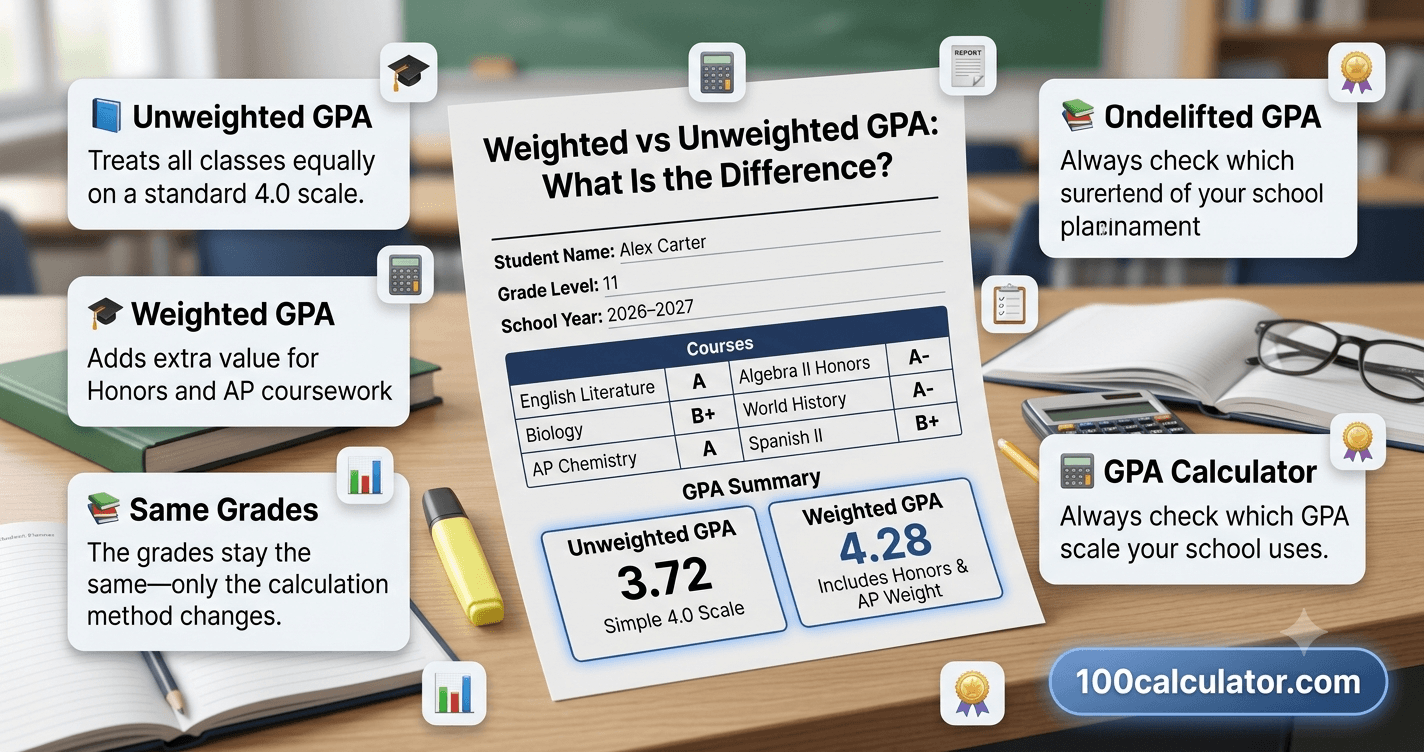
Check your report card and you might see two different GPA numbers sitting right next to each other, and they're rarely the same. One might read 3.6, the other 4.1, and both are describing the exact same set of grades. That's not a mistake. It's the difference between an unweighted GPA and a weighted GPA.
An unweighted GPA scores every class the same way, on a scale that usually tops out at 4.0, no matter how hard the class was. A weighted GPA gives extra credit for harder classes, like Honors, AP, or dual enrollment courses, so it can climb above 4.0, often up to 4.5 or 5.0. Neither number is "wrong." They're just answering different questions: one tells you how well you did, the other tells you how well you did relative to how difficult your schedule was.
Once you know which is which, a lot of confusing moments start to make sense, like why a classmate's 3.9 GPA might actually reflect an easier course load than your 3.7, or why a college application asks for both numbers instead of just one. This guide walks through how each GPA is calculated, with real number examples, which one colleges actually pay attention to, and how to use 100 Calculator's High School GPA Calculator to check your own numbers instead of doing the math by hand.
What Is a GPA, and Why Are There Two Types?
A GPA, or grade point average, turns your letter grades into a single number that sums up how you're doing overall. Instead of listing out every A, B, and C separately, a GPA condenses a whole transcript into one figure that's easy to compare across semesters, students, and schools.
The idea sounds simple until you realize schools don't all treat classes the same way. An A in a standard English class and an A in an AP Chemistry class look identical on a transcript, but most people would agree the AP class asked more of the student. That gap is exactly why two GPA systems exist side by side.
An unweighted GPA ignores course difficulty entirely. Every A is worth the same 4.0, whether it came from a standard class or the hardest AP course a school offers. A weighted GPA tries to account for that difficulty by adding bonus points to harder classes, so a student who took on a heavier academic load gets some credit for it in their GPA, not just in a transcript's list of course names.
This system, and the terms "weighted" and "unweighted," are most common in United States high schools, with similar versions used in parts of Canada. If you're comparing grades from a different country's school system, the specific scales will likely look different, though the core idea, giving more credit for harder coursework, shows up in various forms worldwide.
Most U.S. high schools calculate both an unweighted and a weighted GPA and list them side by side on report cards and transcripts, so it's worth understanding both since they show up in different places throughout high school and the college admissions process. If you want an even deeper walkthrough of the exact math involved, our companion guide on how high school GPA is calculated step by step covers the full process from start to finish.
What Is an Unweighted GPA?
An unweighted GPA measures your grades on a flat scale that typically tops out at 4.0. Every class counts equally, so an A is always a 4.0, whether you earned it in a standard class, an elective, or the hardest AP course your school offers.
The Standard 4.0 Scale
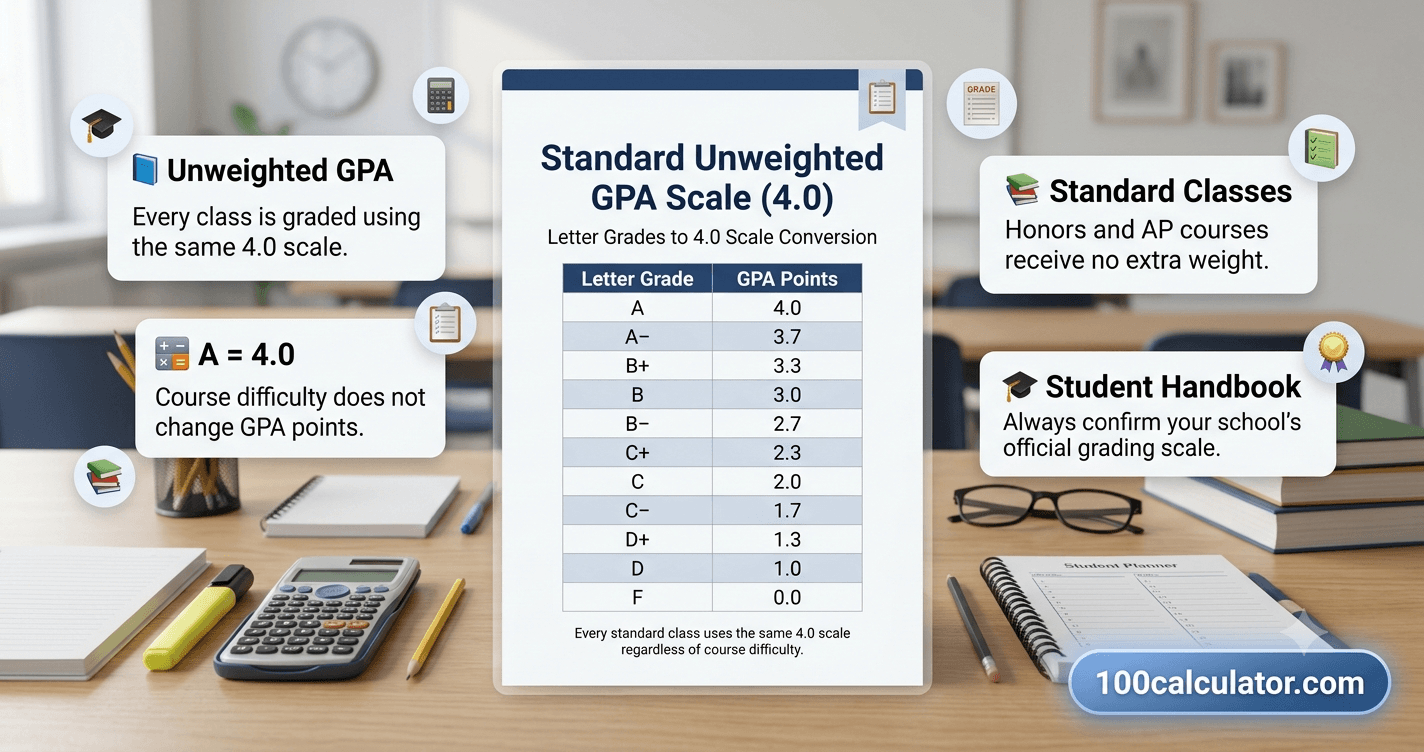
Most U.S. high schools convert letter grades to unweighted GPA points using something close to this scale:
| Letter Grade | Typical Percentage | Unweighted GPA Points |
|---|---|---|
| A | 90–100% | 4.0 |
| B | 80–89% | 3.0 |
| C | 70–79% | 2.0 |
| D | 60–69% | 1.0 |
| F | Below 60% | 0.0 |
Some schools use a plus/minus version instead, where an A- might be worth 3.7 and a B+ worth 3.3. Since the exact breakdown varies, it's worth checking your own school's grading policy rather than assuming the flat whole-number version applies everywhere.
Where Unweighted GPA Falls Short
The flat 4.0 scale makes unweighted GPA simple and easy to compare, but it has a real blind spot. It can't tell the difference between a student who filled their schedule with the easiest electives available and one who took on four AP classes in the same year. Both students could land on an identical 3.8 unweighted GPA despite very different workloads, which is exactly the gap weighted GPA was designed to close.
What Is a Weighted GPA?
How Extra Points Get Added for Harder Classes
A weighted GPA starts from the same letter grades, but gives extra credit for classes generally considered more rigorous, like Honors, AP, IB, and dual enrollment or college-credit courses. The exact bonus varies by school, but a very common approach adds:
- +0.5 points for an Honors class
- +1.0 point for an AP, IB, or dual enrollment class
Using that common scale, an A in a standard class still comes out to 4.0, but an A in an Honors class becomes 4.5, and an A in an AP class becomes a full 5.0. Here's how that plays out for the exact same "A" grade across different class types:
Common Weighted GPA Scales (4.5 vs 5.0)
Not every school weights classes the same way. Some cap weighted GPA at 4.5, using a smaller +0.5 bump for advanced classes across the board. Others use a full 5.0 scale, reserving the largest bonus for AP, IB, or college-level classes and a smaller one for Honors.
Because there's no single national standard, two students with technically the same course load and the same grades could end up with different weighted GPAs, simply because their schools use different formulas.
Taking an AP class affects two separate numbers: your weighted GPA, which comes from your semester grade, and your AP exam score, which comes from the College Board exam each May. These aren't the same thing, and a class can move one number without touching the other much at all. Our guide on how the AP Chemistry exam is scored walks through how that separate exam score works, and the matching AP Chem Score Calculator can estimate your score from practice results.
Weighted vs Unweighted GPA: Key Differences at a Glance
If you only remember one comparison from this guide, make it this one:
| Factor | Unweighted GPA | Weighted GPA |
|---|---|---|
| Typical maximum | 4.0 | 4.5 or 5.0 |
| Course difficulty | Not factored in | Extra points for Honors, AP, IB, dual enrollment |
| Same grade, every class | Always equal value | Value depends on the class level |
| Best for comparing across schools | Yes, since the scale is standard | Not always, since formulas vary |
| Most often used for | A simple performance snapshot | Reflecting course rigor, sometimes rank |
How to Calculate Your Weighted GPA
Calculating a weighted GPA uses the same basic math as an unweighted one, just with bonus points folded in before you average everything together.
Weighted GPA Formula
Weighted GPA = (Sum of weighted grade points) ÷ (Number of classes)
Weighted grade points: base grade value (0–4) plus any course bonus — commonly +0.5 for Honors and +1.0 for AP, IB, or dual enrollment classes
Number of classes: only classes that received a final grade for that term or year
Weighted GPA Example Walkthrough
Say a student takes five classes in one semester:
- English (standard): A → 4.0
- Biology (Honors): A → 4.0 + 0.5 = 4.5
- Algebra II (standard): B → 3.0
- AP World History: B → 3.0 + 1.0 = 4.0
- Spanish II (standard): A → 4.0
Add up those weighted points: 4.0 + 4.5 + 3.0 + 4.0 + 4.0 = 19.5. Divide by 5 classes, and the weighted GPA for that semester comes out to 3.9.
How to Calculate Your Unweighted GPA
The unweighted version skips the bonus points entirely and just averages the base grade values.
Unweighted GPA Example Walkthrough
Using the exact same five classes from the example above, but ignoring class difficulty:
- English: A → 4.0
- Biology (Honors): A → 4.0 (no bonus applied)
- Algebra II: B → 3.0
- AP World History: B → 3.0 (no bonus applied)
- Spanish II: A → 4.0
Add those up: 4.0 + 4.0 + 3.0 + 3.0 + 4.0 = 18.0. Divide by 5 classes, for an unweighted GPA of 3.6.
Notice the Honors and AP classes don't get any extra credit here, which is exactly why the same set of grades produced a 3.9 weighted GPA but only a 3.6 unweighted one. Neither number is inflated or wrong. They're both accurate, just built on different rules.
Free Online Tool
Skip the manual math
100 Calculator's High School GPA Calculator works out both your weighted and unweighted GPA the moment you enter your classes and grades, using whichever weighting scale your school follows.
Which GPA Do Colleges Actually Look At?
Why Some Colleges Recalculate Your GPA
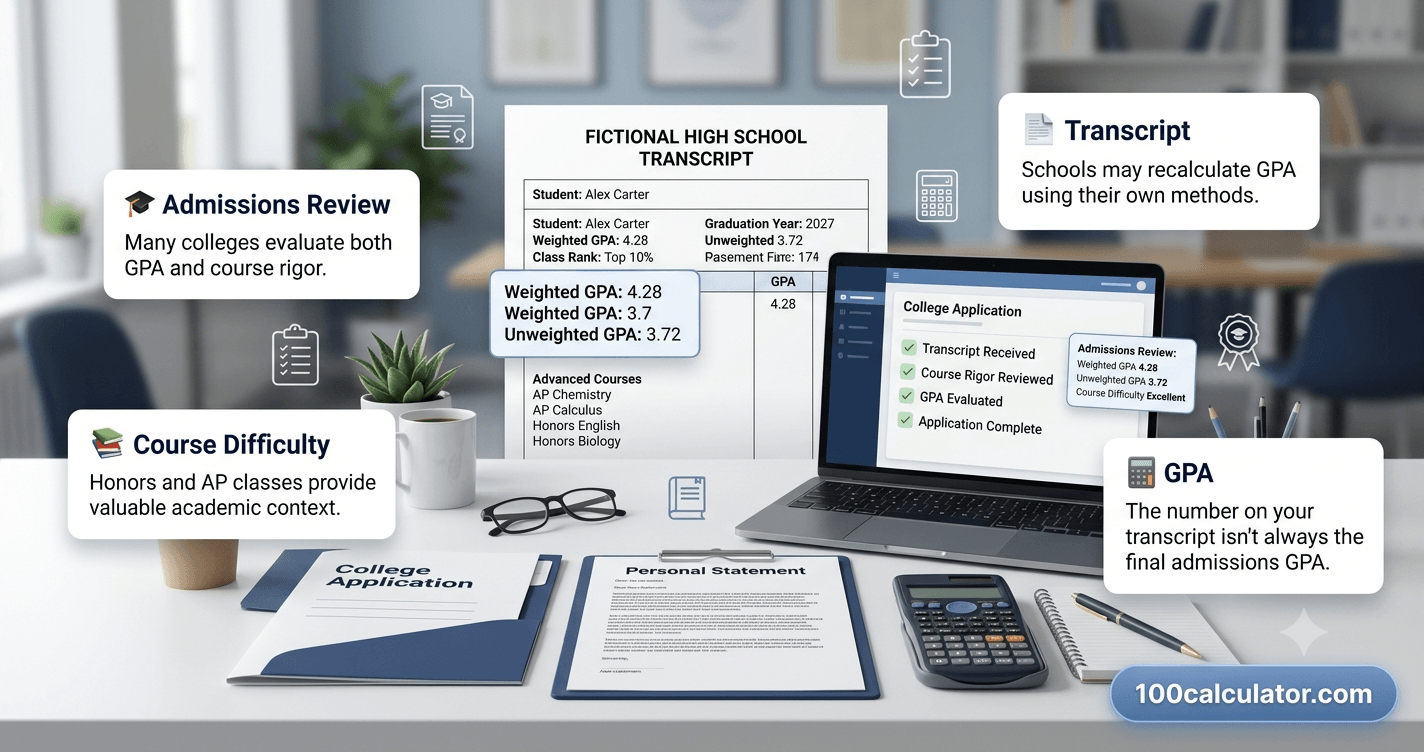
Most colleges see both your weighted and unweighted GPA on your transcript, often alongside a school profile that explains how your high school weights its classes. But because weighting formulas vary so much from school to school, many colleges don't take either number completely at face value.
Instead, a lot of admissions offices recalculate applicants' GPA using their own standardized formula, often based only on core academic classes like English, math, science, social studies, and world language, sometimes ignoring weighting altogether or applying their own consistent bonus for AP or IB classes. That way, a 4.3 weighted GPA from a school with generous weighting and a 4.1 from a school with a stricter scale can be compared more evenly.
This means your weighted GPA on your own transcript isn't necessarily the exact number a college uses to evaluate you, and it's one of the reasons course rigor, meaning which classes you chose to take, often matters just as much to admissions officers as the GPA number itself.
Class Rank vs GPA
Some high schools also calculate class rank, usually based on weighted GPA, to show where a student falls compared to their graduating class. A growing number of schools have moved away from ranking altogether, partly because it can create intense competition over small decimal-point GPA differences that don't reflect much real difference in preparation.
If your school does report a class rank, it's worth asking your counselor whether it's based on weighted or unweighted GPA, since that changes how much your AP and Honors classes affect where you land.
Common GPA Mistakes to Avoid
A few small misunderstandings can throw off how you think about your own GPA. Here's what trips students up most often:
- Assuming a higher weighted GPA always means stronger performance. It might just reflect a heavier course load.
- Forgetting that some schools cap weighted GPA at 4.5 instead of 5.0, which changes how "high" a number can even go.
- Assuming every elective or non-listed class is weighted the same as an official Honors or AP course. Always check your school's list of weighted classes.
- Only checking GPA once a year instead of each semester, which makes it easy to miss a dip before it affects your overall average.
- Panicking over one rough semester. Cumulative GPA averages every term together, so a single low semester rarely defines your overall number.
Weighted vs Unweighted GPA by Grade Level
Freshman and Sophomore Year
Early in high school, most students are taking a mix of standard classes and maybe one or two Honors classes, so the gap between weighted and unweighted GPA tends to be small. This is also a good stretch to get familiar with how your own school's system works, well before college applications are anywhere close.
If you're coming from middle school, our guide on whether middle school GPA actually matters later on covers how much those earlier grades carry forward.
Still building study habits before high school weighting kicks in? Our GPA Calculator Middle School and our guide on how to calculate GPA in middle school correctly can help you check your current numbers.
Junior and Senior Year
By junior and senior year, course loads often shift toward more AP, IB, or dual enrollment classes, especially for students building a college application. That's usually when the gap between weighted and unweighted GPA grows the most, since these are the years with the heaviest concentration of weighted classes.
This is also when it's worth checking GPA trends most closely, since junior year grades in particular carry significant weight in college applications submitted the following fall.
Finding Out Which GPA Scale Your School Uses
Since weighting formulas differ so much from school to school, the fastest way to know your exact numbers is to check your school's own policy rather than assume a national standard.
A few reliable places to look:
- Your school's student handbook or course catalog, which usually lists the exact GPA scale and weighting bonus for Honors, AP, IB, or dual enrollment classes
- Your school counselor, who can walk you through exactly how your transcript GPA is calculated
- Your official transcript itself, which sometimes lists both GPA numbers along with a short note about the scale used
Once you know your school's exact formula, plugging your classes and grades into 100 Calculator's High School GPA Calculator gives you both your weighted and unweighted totals instantly, without redoing the addition by hand every semester.
Related Calculators
Put what you just read into practice, try these free tools instantly, no sign-up required.
High School GPA Calculator
Calculate your high school GPA from grades and credit hours.
GPA Calculator Middle School
Calculate your middle school GPA quickly and accurately.
AP Chem Score Calculator
Estimate your AP Chemistry exam score from practice results.
AP Calc BC Score Calculator
Estimate your AP Calculus BC exam score from raw points.
AP Gov Score Calculator
Estimate your AP Government exam score from practice results.
Tips to Raise Your GPA, Weighted or Unweighted
A handful of habits tend to move both numbers in the right direction:
- Prioritize consistency over cramming. GPA rewards steady performance across a full semester, not just one strong final exam.
- Talk to your teacher early if a grade starts slipping, rather than waiting until progress reports come out.
- Choose Honors or AP classes you're genuinely prepared for. A low grade in a weighted class can hurt your GPA more than a strong grade in a standard class helps it.
- Check your cumulative GPA each semester instead of only once a year, so small dips don't go unnoticed.
- Use a GPA calculator before registering for next semester's classes, so you can see roughly how a new schedule might shift your numbers before you commit to it.
Sources & References
This guide reflects GPA weighting practices commonly used across U.S. high schools. For official details on Advanced Placement courses and exams, and how AP can affect your transcript, see the College Board's AP Students site. GPA scales and weighting formulas are set individually by each school and district, so always confirm the exact policy with your own school's counselor or student handbook before comparing numbers.
More From Our Education Tools Guide
Still thinking through GPA, AP scores, or how your grades stack up? These related guides dig into a few of the topics we touched on above.
Frequently Asked Questions
What is the difference between a weighted and unweighted GPA?
An unweighted GPA scores every class on the same 4.0 scale, no matter how difficult the class was. A weighted GPA adds extra points for harder classes like Honors, AP, IB, or dual enrollment courses, so it can go above 4.0, often up to 4.5 or 5.0. Both numbers come from the same grades — they just apply different rules for how much credit a hard class earns.
Which GPA is higher, weighted or unweighted?
A weighted GPA is usually equal to or higher than an unweighted GPA for the same student, since it adds bonus points for advanced classes and never subtracts anything. If a student hasn't taken any Honors, AP, IB, or dual enrollment classes, their weighted and unweighted GPA will typically be identical, since there are no bonus points to add.
Do colleges look at weighted GPA or unweighted GPA?
Most colleges see both numbers on your transcript, but many admissions offices also recalculate your GPA using their own formula, since weighting scales vary so much between high schools. That recalculated number, often based on core academic classes, is frequently what actually gets compared across applicants, rather than either the weighted or unweighted GPA your school reports.
How do you calculate a weighted GPA?
Add up the grade points for every class, including any bonus points for Honors, AP, IB, or dual enrollment courses (commonly +0.5 or +1.0 depending on the class), then divide the total by the number of classes. For example, four classes with weighted points of 4.0, 4.5, 3.0, and 4.0 add up to 15.5, divided by 4 classes, for a weighted GPA of 3.9.
How do you calculate an unweighted GPA?
Convert each letter grade to its point value on a flat 4.0 scale (A = 4.0, B = 3.0, C = 2.0, and so on), add those points together, and divide by the number of classes. No bonus points are added for Honors or AP classes, so every class counts exactly the same, regardless of how difficult it was.
Can a weighted GPA go above 5.0?
It's uncommon, but possible at some schools, especially if a student takes an unusually heavy load of AP or IB classes and a school's formula allows for it. Most schools cap weighted GPA at either 4.5 or 5.0, so anything meaningfully above that is rare and usually specific to that school's own grading policy.
Do all AP and Honors classes add the same number of points?
No, and this is one of the most common misunderstandings about weighted GPA. Some schools add +0.5 for Honors and +1.0 for AP, IB, or dual enrollment classes, but other schools use different values entirely, or weight AP and Honors classes the same. Always check your own school's official grading policy instead of assuming a standard formula.
Does every high school use a weighted GPA scale?
No. Some high schools only report an unweighted GPA and don't weight classes at all, while others weight only specific class types like AP or IB but not Honors. There's no single national requirement, so it's worth checking your school's student handbook or asking a counselor to see exactly which system your school follows.
Why is my weighted GPA higher than my unweighted GPA?
This happens whenever you've taken at least one Honors, AP, IB, or dual enrollment class and earned a grade in it, since weighted GPA adds bonus points for those classes while unweighted GPA doesn't. The more advanced classes you're taking, and the better you're doing in them, the larger that gap between your two GPA numbers tends to be.
Will taking an AP class hurt my unweighted GPA?
It can, if you earn a lower grade in the AP class than you would have in a standard version of the same subject, since unweighted GPA doesn't give any credit for the class being harder. That's exactly why weighted GPA exists, to help balance out the fact that a B in an AP class often reflects more effort than an A in an easier one.
Does class rank use weighted or unweighted GPA?
When a school calculates class rank, it typically uses weighted GPA, since the goal is usually to reflect course rigor alongside grades. That said, not every school ranks students at all anymore, and the ones that do don't always use the same formula, so it's worth asking your counselor exactly how your school's rank is calculated.
How do I find out if my school uses a weighted GPA scale?
Check your school's student handbook or course catalog, which usually spells out the exact GPA scale and any bonus points for Honors, AP, IB, or dual enrollment classes. Your school counselor can also explain exactly how your own transcript GPA is calculated, and your official transcript sometimes lists the scale directly.
Do colleges recalculate your GPA?
Many do. Because weighting formulas differ so much between high schools, a lot of college admissions offices convert every applicant's grades into their own standardized GPA, often based only on core academic classes, so they can compare students fairly regardless of which school they attended or how that school weighted its classes.
Is a 3.5 unweighted GPA considered good?
A 3.5 unweighted GPA generally reflects a solid B+ to A- average and is considered strong by most standards. Whether it's competitive for a specific college depends heavily on that school's typical admitted GPA range and how rigorous your course load was, so it's worth comparing your number against the admissions data a school publishes rather than a single universal benchmark.
About 100 Calculator
100 Calculator is a free hub of online calculators and educational guides covering health, finance, trading, crypto, education, and more. Every tool is built to be fast, accurate, and genuinely free, with no account or signup required.
We built this guide, along with tools like the High School GPA Calculator referenced throughout it, to make everyday school questions easier to work through. Head back to the 100 Calculator homepage to explore the full library of tools, or learn more about the team behind them on our About Us page.