How the AP Government Exam Score Is Calculated
A section-by-section walkthrough of how the College Board turns your multiple-choice and free-response points into the final 1-to-5 score colleges see, plus what actually moves the needle on exam day.
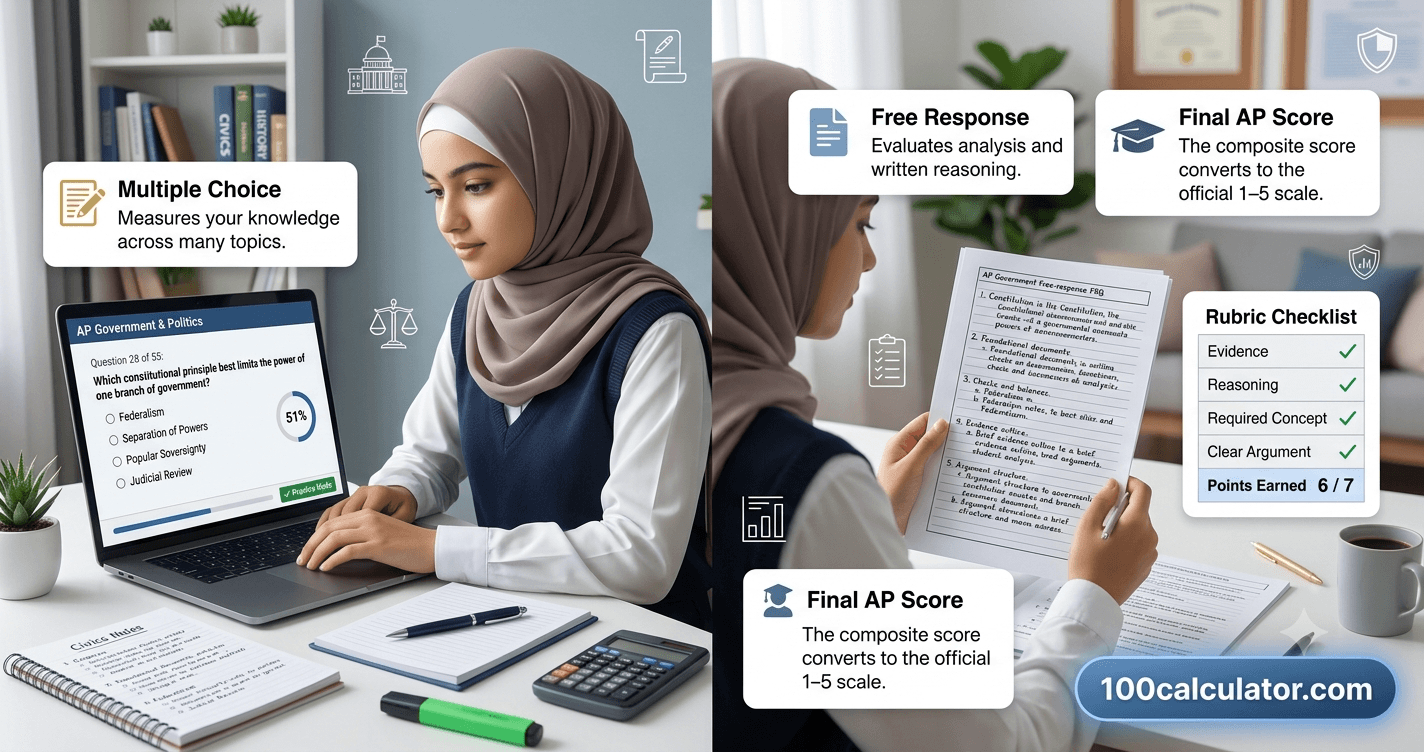
If you've ever stared at your AP Government multiple-choice results and tried to guess your final score, the math probably didn't add up in any obvious way. That's because your AP score isn't a simple percentage. It's built from two separately scored sections that get combined, weighted, and then converted onto the 1-to-5 scale colleges actually see.
Your AP United States Government and Politics score comes from combining two numbers: how many multiple-choice questions you answered correctly, and how many points trained readers awarded across four free-response questions. Those two numbers form what the College Board calls your composite score, and that composite score is then converted into the familiar 1-5 AP score through a process that shifts slightly every year.
None of this is meant to stay a mystery, even though the College Board doesn't spell it out in plain language on any single page. In this guide, we'll walk through exactly how each section is scored, how the two combine into one composite number, why the cutoffs for a 3, 4, or 5 move around from year to year, and what you can actually do to push your score higher. If you'd rather skip ahead and estimate your own score right now, our AP Gov Score Calculator does the math the moment you enter your numbers.
- Total exam time: 3 hours, split into two sections
- Section I (Multiple Choice): 55 questions, worth 50% of your score
- Section II (Free Response): 4 questions, worth 50% of your score
- Final score scale: 1 to 5, with 3 or higher generally treated as passing
- Score cutoffs: not fixed — they're set after each exam, and shift slightly year to year
Understanding the AP Government and Politics Exam Format
Before the scoring makes sense, it helps to know what you're actually being scored on. The AP U.S. Government and Politics Exam is a fully digital, three-hour test taken through the College Board's Bluebook app, usually in May of your junior or senior year. (College Board) It's split into two sections, and — unlike a lot of classroom tests — those two sections are weighted exactly the same.
What's Tested in Each Section
Section I is the multiple-choice section: 55 questions in 80 minutes. Some are standalone questions, and others are grouped into small sets built around a shared source, like a chart, a political cartoon, a map, or a short text excerpt. You're asked to recall terms, apply Supreme Court rulings to new scenarios, and read data the way a political scientist would.
Section II is the free-response section: 4 questions in 100 minutes, each requiring a written answer instead of a multiple-choice pick. These four questions test a different skill each — applying a concept, reading a data set, comparing court cases, and building an argument — which is exactly why they're graded so differently from Section I.
| Section | Format | Time | Weight |
|---|---|---|---|
| Section I | 55 multiple-choice questions | 80 minutes | 50% |
| Section II | 4 free-response questions | 100 minutes | 50% |
Key Terms Worth Knowing
A few terms show up constantly once you start digging into how the exam is built. The course requires familiarity with 9 foundational documents — things like the Declaration of Independence, the Constitution, and selected Federalist Papers — along with 15 required Supreme Court cases such as Marbury v. Madison, McCulloch v. Maryland, Brown v. Board of Education, and Citizens United v. FEC. Both show up throughout the multiple-choice section and are essential for two of the four free-response questions.
You'll also see the word "composite" a lot. A composite score simply means your Section I and Section II results combined into a single number, before that number gets converted into your final 1-5 AP score. We'll break down exactly how that conversion works later in this guide.
Why Your AP Gov Score Isn't Just "Percent Correct"
It's tempting to think about your AP score the way you'd think about a class test — get 90% of the points, get an A. AP scoring doesn't work that way, and it trips up a lot of students who assume a rough percentage of points earned maps directly onto a 1-5 score.
That conversion step is the part most students never see, and it's the reason two students who earned the exact same composite score in different years could technically end up with different final scores. We'll walk through why that happens in the sections ahead — starting with how each section is scored on its own.
How the Multiple-Choice Section Is Scored
Section I scoring is the simplest part of the whole process. Every correct answer earns 1 point, for a maximum of 55 raw points. A computer grades this section instantly once you submit your exam in Bluebook.
There's no penalty for a wrong answer, and no penalty for leaving a question blank — both are simply worth zero points. That single rule matters more than it sounds like it should, and we'll come back to it in the mistakes section below.
- 1 point per correct answer, 55 points max
- No points deducted for wrong answers
- No points deducted for blank answers
- Graded by computer, with results instant
How the Free-Response Section Is Scored
Section II is where things get more interesting. Each of the four free-response questions (FRQs) tests a different skill, and each one is worth a different number of raw points, adding up to 17 points total across the section.
The Four FRQ Types
| FRQ Type | Points | What It Asks |
|---|---|---|
| 1. Concept Application | 3 | Describe and explain the effects of a political institution, behavior, or process, then apply the concept to a new scenario |
| 2. Quantitative Analysis | 4 | Interpret a chart, graph, or data table and connect it to a course concept |
| 3. SCOTUS Comparison | 4 | Compare a non-required Supreme Court case to one of the 15 required cases |
| 4. Argument Essay | 6 | Build a defensible argument using at least one required foundational document as evidence |
Notice that the argument essay is worth double the points of the concept application question. That's a useful thing to know when you're deciding how to budget your 100 minutes in Section II — we'll get into pacing strategy in the tips section further down.
Who Grades the FRQs and How
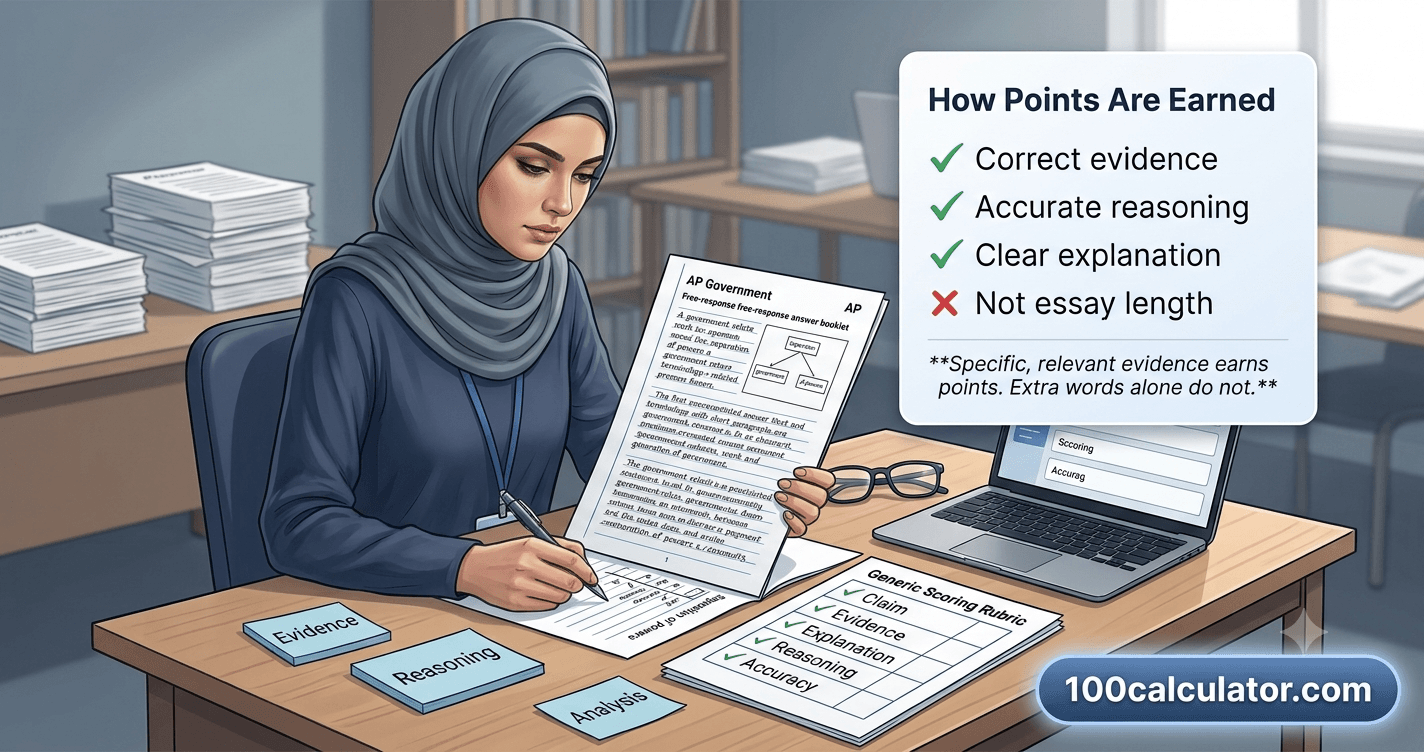
Unlike Section I, free-response answers are graded by real people: trained AP Readers, many of them college professors and experienced AP teachers, who gather each summer to score exams using rubrics the College Board releases publicly after the exam.
Each rubric breaks a question into specific, checkable criteria. A grader isn't judging how well-written your answer sounds. They're checking whether you hit each required element — naming the right concept, citing the right document by name, or drawing the correct comparison — and awarding points accordingly. That's why precision usually beats length on the free-response section.
How Your Composite Score Is Calculated
Once both sections are scored, the College Board combines them into a single composite score. Because Section I and Section II are each worth 50% of your final grade — regardless of the fact that one is scored out of 55 and the other out of 17 — each section's raw score first gets converted to a share of that 50%, and the two shares are added together.
Composite (%) = (MC correct ÷ 55 × 50) + (FRQ points earned ÷ 17 × 50)
MC correct — number of multiple-choice questions answered correctly, out of 55.
FRQ points earned — total points awarded across all four free-response questions, out of 17 (3 + 4 + 4 + 6).
Composite (%) — your combined score on a 0-100 scale, before it's converted into the final 1-5 AP score.
Here's what that looks like with real numbers. Say a student answers 40 of the 55 multiple-choice questions correctly and earns 12 of the 17 possible free-response points:
- Multiple-choice share: 40 ÷ 55 × 50 ≈ 36.4
- Free-response share: 12 ÷ 17 × 50 ≈ 35.3
- Composite score: 36.4 + 35.3 ≈ 71.7%
That composite percentage still isn't the final AP score. It's the number that gets fed into the next step: converting it onto the 1-5 scale. If you'd rather skip the arithmetic, plug your own numbers into our AP Government Score Calculator and it will run this exact formula for you.
How the College Board Converts Your Composite Score to a 1-5
This is the step that confuses most students, mainly because the College Board doesn't publish it in advance. Your composite score gets mapped onto the 1-5 scale through a process rather than a fixed formula, and that process is finalized only after each year's exam has already been administered.
Why Cutoffs Change Every Year
Every AP exam is a little different from the one before it — a slightly harder data set here, an easier argument prompt there. To keep a 4 meaning roughly the same thing year over year despite those differences, the College Board adjusts, or "equates," that year's composite scale before deciding where the cut points for each score fall. (College Board)
Equating and Standard Setting, Explained Simply
Separately, the College Board runs studies comparing how AP students perform against college students taking an equivalent introductory course. Panels of college faculty review that data and help decide what composite score should count as "qualified" (a 3), "well qualified" (a 4), and so on. This is sometimes called a standard-setting process, and it's why cut points can shift by a few points in either direction from one year to the next.
What Each AP Government Score Actually Means
Once the cut points are set, your composite score lands in one of five bands. Each band comes with an official description from the College Board that roughly translates to a level of college readiness in the subject.
| Score | Official Description | Roughly Comparable to |
|---|---|---|
| 5 | Extremely well qualified | A in the college course |
| 4 | Well qualified | A-, B+, or B |
| 3 | Qualified | B-, C+, or C |
| 2 | Possibly qualified | Rarely earns college credit |
| 1 | No recommendation | Not comparable to a passing grade |
These labels describe how "qualified" the College Board considers you for credit in an equivalent college course — they aren't a percentage, and they aren't your class grade. Your AP exam score also has no effect on your high school GPA, though the AP course grade on your transcript often does, which is worth keeping in mind when you're using a High School GPA Calculator to plan out your semester.
What Counts as a Good or Passing AP Gov Score
Is a 3 Good Enough?
The College Board's own label for a 3 is "qualified," and most U.S. colleges do treat a 3 as a passing score for general credit purposes. That said, "passing" on an AP exam works differently than passing a class — there's no universal cutoff every college honors the same way.
Selective colleges frequently set their bar higher, requiring a 4 or 5 before they'll grant credit or let you skip an introductory course. Less selective schools often accept a 3, and some accept a 2 for limited placement purposes, though that's uncommon. Our guide on what score you need to pass AP Government goes deeper into how to check a specific school's policy before you assume anything.
Common Mistakes That Lower Your AP Gov Score
A few habits quietly cost students points every year, independent of how well they actually know the material.
- Leaving multiple-choice questions blank. Since there's no penalty for a wrong answer, an educated guess can only help your score, never hurt it.
- Answering only part of a free-response prompt. Rubrics award points part by part, so skipping one component of a multi-part FRQ means losing those points automatically, even if the rest of the answer is strong.
- Restating the prompt instead of making a claim. The argument essay rewards a clear, defensible thesis, not a summary of the question.
- Describing a document or case without naming it. Readers are checking for specific, named evidence. "A founding document talked about factions" earns far less than naming Federalist No. 10 directly.
- Misjudging FRQ pacing. Spending too long on the 3-point concept application question often leaves too little time for the 6-point argument essay, which carries the most weight of any single question on the exam.
- Cramming the required cases and documents at the last minute. Two of the four FRQs depend directly on naming a required Supreme Court case or foundational document correctly, so this isn't material you can skim the night before.
Tips to Maximize Your AP Government Score
Multiple-Choice Strategy
- Answer every question — an educated guess costs nothing
- Eliminate obviously wrong choices first, then compare what's left
- For chart or cartoon questions, answer only from what the source actually shows
- Flag uncertain questions and return to them if time allows, rather than freezing on one item
Free-Response Strategy
- Address every part of the prompt, in the order it's asked
- Name the specific required case or document rather than describing it vaguely
- Open the argument essay with one clear, defensible claim before adding evidence
- Budget more of your 100 minutes toward the 6-point essay than the 3-point concept question
- Write in short, direct paragraphs organized around each rubric point instead of one long block of prose
Free Online Tool
Check your practice score in seconds
After a practice exam, enter your multiple-choice count and your four FRQ scores into 100 Calculator's AP Gov Score Calculator to see an estimated composite and likely score band instantly, with no signup required.
Related Calculators
Put what you just read into practice, try these free tools instantly, no sign-up required.
High School GPA Calculator
Calculate your high school GPA from grades and credit hours.
GPA Calculator Middle School
Calculate your middle school GPA quickly and accurately.
AP Chem Score Calculator
Estimate your AP Chemistry exam score from practice results.
AP Calc BC Score Calculator
Estimate your AP Calculus BC exam score from raw points.
AP Gov Score Calculator
Estimate your AP Government exam score from practice results.
How AP Gov Scoring Compares to Other AP Exams
A 50/50 split between multiple-choice and free-response is common across AP exams, but it isn't universal, and the exact point values behind that split vary by subject. Comparing formats can help you plan your study time if you're taking more than one AP exam this year.
AP Chemistry, for example, uses a similar two-section structure but with different question counts and lab-based free-response prompts — our guide on how the AP Chemistry exam is scored breaks that down, and the AP Chem Score Calculator works the same way as the tool referenced throughout this guide. AP Calculus BC follows yet another structure built around free-response problems that allow partial credit for correct methods, which we cover in our piece on how AP Calculus BC exam scores are calculated, alongside the AP Calc BC Score Calculator.
If you're stacking AP courses on your transcript and trying to see how they'll affect your GPA alongside your exam scores, our article on weighted versus unweighted GPA is a useful next stop.
A note on accuracy: This article explains how the AP U.S. Government and Politics exam is generally scored, based on published College Board information and consistent historical scoring patterns. Exact weighting details, question formats, and score cutoffs are set independently by the College Board each year and can change. For the most current, official information, check AP Central or ask your AP Government teacher.
Sources & References
More From Education Tools Guide
Still working through GPA math or other AP exams? These related guides dig deeper into the topics that connect to AP Government scoring.
Frequently Asked Questions
How is the AP Government exam scored?
Your score comes from two sections weighted 50/50: a 55-question multiple-choice section graded by computer, and a 4-question free-response section graded by trained AP Readers. The results from both sections combine into a composite score, which the College Board then converts into your final 1-5 AP score using that year's scoring guidelines.
What is a composite score on the AP Government exam?
A composite score is your multiple-choice and free-response results combined into a single number, calculated by weighting each section at 50%. It's an intermediate step, not your final grade — the College Board converts the composite into the 1-5 AP score afterward, using cut points that are set after the exam is administered.
How many multiple-choice questions are on the AP Gov exam?
There are 55 multiple-choice questions in Section I, worth 1 point each for a maximum of 55 raw points. You get 80 minutes to complete them, and they include both standalone questions and small sets built around a shared chart, map, cartoon, or text excerpt.
How many free-response questions are on the AP Gov exam, and what are they called?
There are four free-response questions in Section II: Concept Application, Quantitative Analysis, SCOTUS Comparison, and Argument Essay. Together they're worth 17 raw points and count for 50% of your final score, and you get 100 minutes total to complete all four.
How many points is each AP Gov free-response question worth?
Concept Application is worth 3 points, Quantitative Analysis is worth 4, SCOTUS Comparison is worth 4, and the Argument Essay is worth 6, adding up to 17 points total. The argument essay carries the most weight of any single question on the exam, which is worth remembering when you're budgeting your time.
Does guessing hurt your score on the AP Gov multiple-choice section?
No. There's no point deduction for a wrong answer on the AP Government multiple-choice section, and a blank answer scores exactly the same as a wrong one: zero points. Because of that, answering every question, even with an educated guess, can only help your raw score.
Who grades the AP Government free-response questions?
Free-response answers are graded by trained AP Readers, typically college professors and experienced AP teachers, using rubrics the College Board publishes after the exam. Each rubric checks for specific, named evidence and required components rather than judging general writing quality.
Why doesn't the College Board publish AP Gov score cutoffs in advance?
Cutoffs depend on that specific year's exam difficulty and on standard-setting studies that compare AP student performance to college student performance in an equivalent course. Both of those can only be measured after the exam has actually been given, which is why cut points are finalized afterward rather than announced ahead of time.
What composite score do you need to get a 5 on AP Government?
There's no single fixed answer, since the exact composite needed for a 5 shifts slightly from year to year based on that year's scoring guidelines. As a general pattern, a 5 usually requires strong, consistent performance across both the multiple-choice and free-response sections rather than excelling in just one. Our AP Gov Score Calculator can give you a reasonable estimate based on typical historical ranges.
What is considered a passing score on the AP Government exam?
The College Board describes a 3 as "qualified," and most U.S. colleges treat 3 or higher as passing for general credit purposes. That said, selective schools often require a 4 or 5 for credit or placement, so "passing" really depends on the specific college's own AP credit policy.
How many Supreme Court cases do I need to know for AP Government?
The course requires familiarity with 15 specific Supreme Court cases, along with 9 required foundational documents. Both appear throughout the multiple-choice section, and two of the four free-response questions — SCOTUS Comparison and the Argument Essay — depend directly on naming one correctly.
What's the difference between a raw score and an AP score?
Your raw score is simply the points you earned in each section — up to 55 on multiple-choice and up to 17 on free-response. Those raw points are weighted into a composite score, and the composite score is then converted into your AP score, the familiar 1-to-5 number that gets reported to colleges.
When are AP Government exam scores released?
AP scores are typically released in the first half of July through your College Board online account. The exact release date shifts by a few days each year, so it's worth checking your College Board account directly around that time rather than relying on a fixed date.
Is AP Government one of the easier AP exams?
AP Government is often described as one of the more approachable AP exams, partly because it doesn't require prior coursework the way exams like AP Calculus BC do. That said, "easier" still means memorizing 15 required Supreme Court cases and 9 foundational documents in real detail, so it isn't a light lift.
Does an AP Government score affect my high school GPA?
No. Your AP exam score is separate from your GPA and is reported only to your College Board account and any colleges you send it to. The letter grade you earn in the AP Government course is what factors into your GPA, and many schools weight that course grade more heavily than a standard class because of its AP status.
About 100 Calculator
100 Calculator is a free hub of online calculators and educational guides covering health, finance, trading, crypto, education, and more. Every tool is built to be fast, accurate, and genuinely free, with no account or signup required.
We built this guide, and tools like the AP Gov Score Calculator referenced throughout it, to make exam scoring a little less mysterious and a lot more transparent. Head back to the 100 Calculator homepage to explore the full library of tools, or learn more about the team behind them on our About Us page.