How High School GPA Is Calculated Step by Step
A clear, beginner-friendly walkthrough of exactly how your GPA is calculated — from converting letter grades into points to combining every class into one final number — so your report card stops feeling like a mystery.
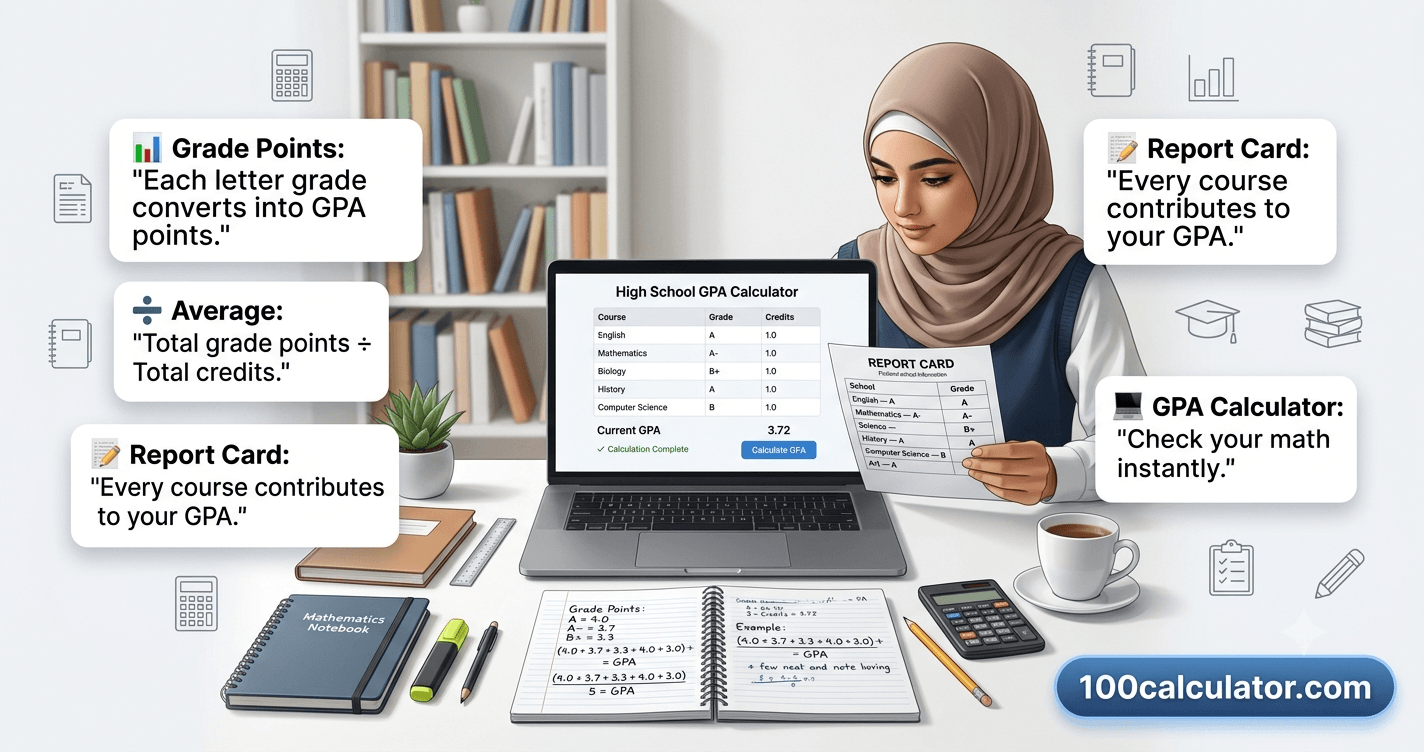
Report cards are easy to read one class at a time, but the single number at the bottom — your GPA — can feel like it comes out of nowhere. It doesn't. Every GPA is built from the same handful of steps, repeated once for each class, and once you see the math laid out, a report card stops looking mysterious.
Your GPA, or grade point average, is calculated by converting each letter grade into a point value, multiplying that value by the class's credit hours to get grade points, adding up the grade points from every class, and dividing the total by your overall credit hours. Most U.S. high schools use a 4.0 scale, where an A is worth 4.0 points and an F is worth 0.0. Add in weighted classes like Honors or AP, and a few extra points get layered on top of that same basic formula.
This guide walks through that formula step by step, with a full worked example using a real sample report card. You'll also find the standard grade-to-point conversion chart, the difference between weighted and unweighted GPA, and the most common mistakes that throw off a GPA calculation.
If you'd rather skip the manual math, 100 Calculator's High School GPA Calculator runs every step below automatically. But understanding how it works makes the number on your own report card a lot easier to trust.
What Is GPA and Why Schools Use It
GPA stands for grade point average. It takes every grade you've earned across every class and compresses them into one number, typically somewhere between 0.0 and 4.0, that's meant to summarize your overall academic performance at a glance.
The Standard 4.0 GPA Scale
On the most common version of this scale, an A is worth 4.0 points, a B is worth 3.0, a C is worth 2.0, a D is worth 1.0, and an F is worth 0.0. Plus and minus grades sit in between — a B+ is worth 3.3, for example, and a B- is worth 2.7. We'll cover the full chart, including every plus and minus value, in the next section.
Why Schools Compress Everything Into One Number
A transcript with fifteen or twenty individual grades is hard to compare at a glance, especially across thousands of applicants with different course loads. GPA gives schools, colleges, and scholarship committees one consistent number to sort by, track over time, and use as an early filter, even though it's always meant to be read alongside the actual classes and grades behind it.
Why Calculating Your GPA Accurately Matters
It's tempting to eyeball your GPA or round it to a number that sounds about right. The trouble is, GPA gets used for more than just curiosity, so a small miscalculation can affect real decisions.
College Admissions and Scholarships
Many scholarships list a minimum GPA cutoff, and some colleges use GPA as an early filter before an admissions officer ever reads the rest of an application. Colleges also frequently recalculate applicants' GPAs using their own formula rather than accepting the number a school reports, which is worth knowing before you assume your transcript GPA is the exact number a college will see.
Eligibility for Programs and Activities
Honor societies, some AP or Honors course registrations, and athletic eligibility rules often depend on hitting a specific GPA threshold each term. A GPA that's off by even a tenth of a point can be the difference between qualifying and not.
A few reasons it's worth double-checking your GPA rather than estimating it:
- Scholarship cutoffs are exact, and rounding in your favor can cost you an opportunity you'd otherwise qualify for
- Some colleges use GPA as an early screening step before reading the rest of an application
- Honor societies and athletic eligibility often depend on hitting a specific threshold each term
- An accurate number makes it easier to notice when one low grade is dragging your average down more than you realized
The Letter Grade to GPA Point Conversion Chart
Before you can calculate anything, you need to know how your school converts letter grades into points. The chart below shows the standard unweighted 4.0 scale used by most U.S. high schools, including the plus and minus values.
| Letter Grade | GPA Points | Letter Grade | GPA Points |
|---|---|---|---|
| A | 4.0 | C | 2.0 |
| A- | 3.7 | C- | 1.7 |
| B+ | 3.3 | D+ | 1.3 |
| B | 3.0 | D | 1.0 |
| B- | 2.7 | D- | 0.7 |
| C+ | 2.3 | F | 0.0 |
Step 1: Calculate Grade Points for a Single Class
Every GPA calculation starts at the class level. Before you can add anything together, you need to know how many "grade points" a single class contributed, which depends on two things: the letter grade you earned, and how many credit hours the class is worth.
Most full-year classes are worth 1.0 credit, and most single-semester classes are worth 0.5 credit, though this varies by school and by course. This system traces back to the Carnegie Unit, a measure developed in 1906 that ties roughly one credit to a year of regular classroom instruction. Your school's course catalog or transcript key will list the exact credit value for each class.
The Grade Points Formula
Grade Points = Credit Hours × Grade Value
Credit Hours: How much weight the class carries — typically 1.0 for a full-year class, 0.5 for a single semester.
Grade Value: The point value of your letter grade on your school's scale, using the chart above.
Here's what that looks like with real numbers. A B+ in a full-credit class is worth 3.3 points on the standard scale, so:
Grade Points = 1.0 × 3.3 = 3.3
A half-credit class only contributes half as many grade points for the same letter grade. An A in a 0.5-credit class works out to:
Grade Points = 0.5 × 4.0 = 2.0
That second example matters more than it might seem — forgetting that half-credit classes count for less is one of the most common GPA mistakes, which we'll come back to later in this guide.
Step 2: Calculate Your Semester GPA
Once you know the grade points for each individual class, finding your GPA for a single semester is just a matter of combining them. Add up the grade points from every class you took that term, add up the credit hours from those same classes, and divide the first total by the second.
Say you took five classes in one semester and earned a combined 16.5 grade points across 5.0 total credit hours. Your semester GPA would be 16.5 ÷ 5.0 = 3.3. The same two-step process — add up the points, add up the credits, then divide — works no matter how many classes you're combining.
Step 3: Calculate Your Cumulative GPA
Your cumulative GPA covers every semester you've completed, not just the current one. The formula is the same as before, but the totals now span your entire academic record instead of a single term.
The Cumulative GPA Formula
Cumulative GPA = Total Grade Points ÷ Total Credit Hours
Total Grade Points: The sum of grade points from every class you've completed, across every term.
Total Credit Hours: The sum of credit hours from those same classes.
Here's the part that trips people up: you can't just average your semester GPAs together, because that treats every semester as equally important even when your credit loads were different. Instead, you have to combine the raw totals first, then divide once.
Say Semester 1 earned you 17.5 grade points across 5.0 credit hours (a 3.5 GPA), and Semester 2 earned you 21.0 grade points across a heavier 7.0 credit hours (a 3.0 GPA). Simply averaging 3.5 and 3.0 gives you 3.25 — but that's not your real cumulative GPA. Combining the totals correctly gives:
Cumulative GPA = (17.5 + 21.0) ÷ (5.0 + 7.0) = 38.5 ÷ 12.0 ≈ 3.21
The difference between 3.25 and 3.21 looks small, but it's the difference between an estimate and your actual GPA — and it grows larger the more your credit loads vary from term to term.
Free Online Tool
Let the calculator handle the totals
100 Calculator's High School GPA Calculator adds up your grade points and credit hours automatically, so you can enter your classes once and get an accurate semester or cumulative GPA without doing the addition by hand.
Weighted vs. Unweighted GPA: What Changes
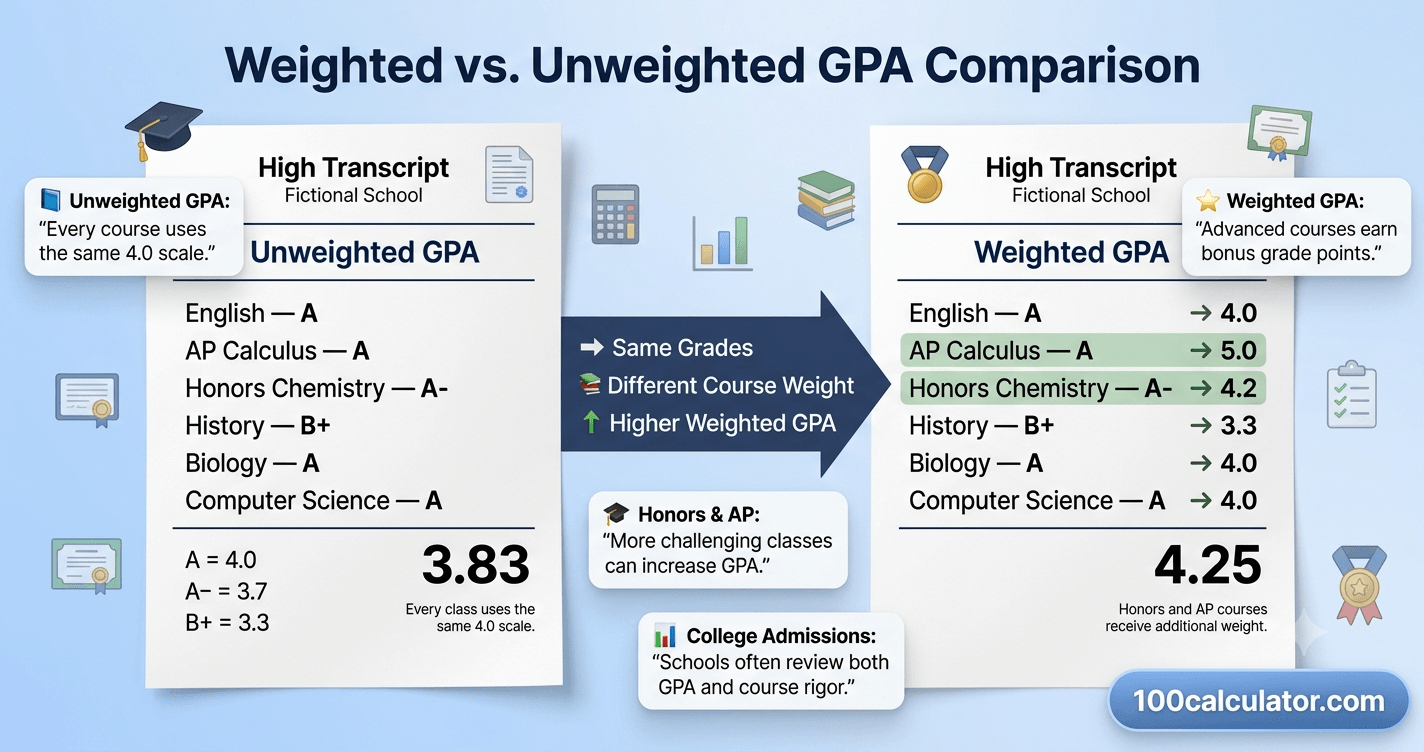
Everything above describes an unweighted GPA, where every class is capped at 4.0 no matter how difficult it was. A weighted GPA uses the same basic formula but adds extra points for tougher classes, which is why weighted GPAs can climb above 4.0.
How Weighted Points Are Added for Honors, AP, and IB Classes
A common convention adds an extra 0.5 points for Honors classes and an extra 1.0 point for AP or IB classes, though the exact amount varies by school and some schools weight only certain grade thresholds. The table below shows how the same letter grade can translate into two different GPA values.
| Course Type | Letter Grade | Unweighted Value | Weighted Value |
|---|---|---|---|
| Regular | A | 4.0 | 4.0 |
| Honors | A | 4.0 | 4.5 |
| AP / IB | A | 4.0 | 5.0 |
| Regular | B | 3.0 | 3.0 |
| Honors | B | 3.0 | 3.5 |
| AP / IB | B | 3.0 | 4.0 |
It's worth keeping your AP exam score and your AP class grade separate in your head. Your semester grade in an AP class is what feeds into your GPA — the 1 to 5 score you get on the AP exam itself is a separate number colleges use mainly for course credit. If you want to check a projected exam score, 100 Calculator has calculators for the AP Chem Score Calculator, the AP Calc BC Score Calculator, and the AP Gov Score Calculator, alongside our guides on how the AP Chemistry exam is scored, how AP Calculus BC scores are calculated, and how the AP Government exam is scored.
Colleges are also well aware that weighting rules differ from school to school. Many recalculate applicants' GPAs on their own standardized scale — sometimes removing weighting, sometimes focusing only on core academic classes — specifically so they can compare students fairly across different high schools. (College Board) For more on how the two scales compare, our weighted vs. unweighted GPA guide breaks down the differences in more depth.
A Full Worked Example: Calculating a Real Report Card
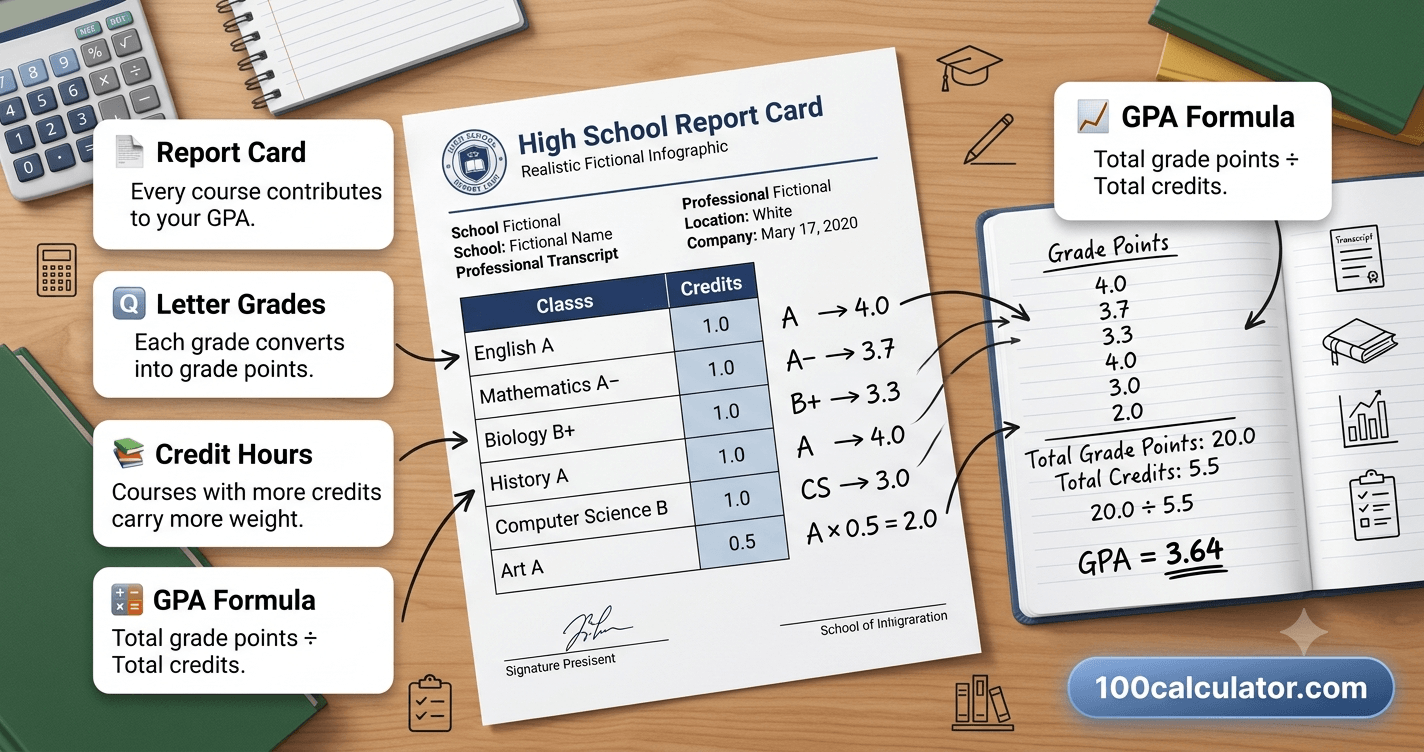
Seeing the formula applied to a full schedule makes the process click faster than any explanation on its own. Here's a sample semester with six classes, calculated one row at a time.
| Class | Credit Hours | Letter Grade | Grade Points |
|---|---|---|---|
| English 10 | 1.0 | B+ | 3.3 |
| Geometry | 1.0 | A- | 3.7 |
| Biology | 1.0 | B | 3.0 |
| World History | 1.0 | A | 4.0 |
| Spanish II | 1.0 | B- | 2.7 |
| Physical Education | 0.5 | A | 2.0 |
| Total | 5.5 | — | 18.7 |
Add up the grade points column: 3.3 + 3.7 + 3.0 + 4.0 + 2.7 + 2.0 = 18.7. Add up the credit hours column: 1.0 + 1.0 + 1.0 + 1.0 + 1.0 + 0.5 = 5.5. Then divide the two totals:
GPA = 18.7 ÷ 5.5 = 3.4
That's a 3.4 GPA for the semester, built entirely from six ordinary classes and the same formula from Step 1. A cumulative GPA works exactly the same way — it just combines totals from every semester instead of one.
Common GPA Calculation Mistakes to Avoid
Even with the right formula, a few habits can quietly throw off your number. Here's what to watch for:
- Averaging semester GPAs instead of combining totals. As shown in Step 3, this shortcut gives a slightly inaccurate result whenever your credit loads differ between terms.
- Forgetting that half-credit classes count for less. A 0.5-credit class contributes half as many grade points as a 1.0-credit class with the same letter grade.
- Mixing up weighted and unweighted numbers. Comparing a weighted GPA to a scholarship cutoff that's asking for an unweighted number (or the reverse) can make your GPA look higher or lower than it actually is for that purpose.
- Assuming every school uses identical point values. Some schools skip plus and minus grades entirely, so a B+ might be worth a flat 3.0 instead of 3.3 depending on where you go.
- Leaving out a low grade or a repeated class. Your official GPA usually still counts classes you'd rather forget about, even if a retake replaced the grade later.
- Including a class your school actually excludes. Pass/Fail classes and some non-graded courses often don't count toward GPA at all, even though they still appear on your transcript.
Tips to Protect or Improve Your GPA
Understanding the formula is half the battle. These habits make it easier to keep your GPA accurate — and moving in the direction you want — going forward.
- Know exactly which classes count and how much credit weight each one carries before you calculate anything by hand.
- Ask your counselor about grade replacement policy before assuming a retake will fully erase a lower grade from your GPA, since schools handle this differently.
- Balance course difficulty realistically. A heavier load of AP or Honors classes only helps a weighted GPA if you can still earn strong grades in them.
- Check your official transcript every term for data-entry errors, since one wrong credit-hour value can throw off your entire GPA.
- Model your options before you commit. 100 Calculator's High School GPA Calculator lets you test how a specific class or grade would move your number before next semester's schedule is finalized.
GPA Scales That Aren't the Standard 4.0
The 4.0 scale is the most common system in the United States, but it isn't the only one you'll run into, especially if you're comparing schools or countries.
Percentage and 100-Point Scales
Some schools skip the 4.0 conversion for day-to-day grading and report scores directly as percentages, like 87 or 94, converting to a letter grade and GPA point only at the end of the term. Colleges that want a 4.0 comparison typically convert these percentages themselves, using a standard chart similar to the one earlier in this guide.
Weighted Scales That Go Beyond 4.0
As covered in the weighted GPA section above, schools that add points for Honors and AP classes often cap their weighted scale at 5.0 rather than 4.0. A small number of schools use other weighting systems entirely, so a 4.3 or 4.6 GPA at one school isn't automatically comparable to the same number somewhere else.
GPA Outside the United States
Many countries don't use a 4.0 GPA scale at all. Some rely on percentage marks, some use numeric scales where a lower number actually means a better grade, and some report standing as a class rank instead of a single averaged score. If you're comparing academic records across different countries, a direct number-to-number comparison usually doesn't work, and a conversion or explanation from the school is typically needed.
| Scale Type | Typical Range | Where It's Common |
|---|---|---|
| Standard unweighted | 0.0 – 4.0 | Most U.S. high schools |
| Weighted | 0.0 – 5.0 (or higher) | U.S. schools that add points for Honors, AP, or IB classes |
| Percentage / 100-point | 0 – 100 | Some U.S. schools, and many countries outside the U.S. |
Related Calculators
Put what you just read into practice, try these free tools instantly, no sign-up required.
High School GPA Calculator
Calculate your high school GPA from grades and credit hours.
GPA Calculator Middle School
Calculate your middle school GPA quickly and accurately.
AP Chem Score Calculator
Estimate your AP Chemistry exam score from practice results.
AP Calc BC Score Calculator
Estimate your AP Calculus BC exam score from raw points.
AP Gov Score Calculator
Estimate your AP Government exam score from practice results.
When You Might Need to Recalculate Your GPA
Most of the time, recalculating your GPA is simply a matter of adding a new semester's grades to your running totals. A few situations call for a closer look than usual.
- Transferring schools, since credit hours, grading scales, and weighting rules can all differ from your previous school.
- Retaking a class, especially if your school replaces the old grade rather than averaging the two together.
- Dropping a class before versus after your school's official drop deadline, which can change whether it still counts toward your GPA.
- The end of every semester, simply because you've added new grades and credit hours to your total.
If you're wondering whether grades from before ninth grade carry into your high school GPA at all, that's worth checking directly — our guides on whether middle school GPA actually matters later on and how to calculate GPA in middle school correctly cover that transition in detail, and 100 Calculator's GPA Calculator Middle School tool handles that earlier stage separately.
A quick note on accuracy: This guide explains the standard method most U.S. high schools use to calculate GPA. Some schools apply different point values, weighting rules, or course inclusion policies. For your official GPA and exactly how it's calculated at your school, check your transcript or ask your school counselor or registrar.
More From Our Education Tools Guide
Still building out your understanding of grades, GPA, and AP scoring? These related guides dig deeper into the topics covered above.
Frequently Asked Questions
What is a GPA and how is it calculated?
GPA stands for grade point average. It's calculated by converting each of your letter grades into a point value (usually on a 4.0 scale), multiplying that value by the class's credit hours, adding up the grade points from every class, and dividing by your total credit hours. The result is a single number that summarizes your overall academic performance across every class you've taken.
What is the formula for calculating GPA?
The basic formula is GPA equals total grade points divided by total credit hours. To get total grade points, multiply each class's credit hours by its grade value (A equals 4.0, B equals 3.0, and so on), then add those numbers together across all your classes. Divide that sum by your total credit hours, and you get your GPA. The same formula works whether you're calculating one semester or your full cumulative GPA.
How do I calculate my GPA by hand?
List every class along with its credit hours and letter grade. Convert each letter grade to its point value using a standard 4.0 scale, then multiply that value by the class's credit hours to get grade points for that class. Add up the grade points from all your classes, add up all the credit hours separately, then divide total grade points by total credit hours. That final number is your GPA.
What does a 4.0 GPA mean?
A 4.0 GPA means you've earned straight A's in every class on the standard unweighted scale, where an A is worth 4.0 points. It's the highest possible score on most unweighted GPA scales. Some schools use weighted scales that go above 4.0 for students taking Honors, AP, or IB classes, so a 4.0 on one school's scale isn't always directly comparable to a 4.0 somewhere else.
What's the difference between weighted and unweighted GPA?
Unweighted GPA treats every class the same, capping each grade at 4.0 no matter how difficult the course was. Weighted GPA adds extra points for tougher classes, commonly an extra 0.5 for Honors and an extra 1.0 for AP or IB courses, which is why weighted GPAs can climb above 4.0. Both numbers can appear on the same transcript, and colleges often recalculate one or the other for consistency.
Do all high schools use the same GPA scale?
No. Most U.S. high schools use some version of the 4.0 scale, but the exact point values for grades like A- or B+ can vary, and some schools skip plus and minus grades entirely. Other schools use a 100-point percentage scale, or a weighted scale that goes up to 5.0 or higher. Because of this variation, colleges often recalculate applicants' GPAs onto one standardized scale to compare students fairly.
How many credit hours is a typical high school class worth?
Most full-year classes are worth 1.0 credit, and most single-semester classes are worth 0.5 credit, though this can vary by school and by course. This system traces back to the Carnegie Unit, a standard developed in 1906 that ties one credit to roughly a year of regular classroom instruction. Check your school's official credit chart if you're not sure how many credits a specific class counts for.
Does GPA include electives and PE classes?
Usually yes — most high schools include every graded class on your transcript in your GPA, including electives and PE. Some schools exclude Pass/Fail classes or certain non-academic courses from the calculation entirely. Colleges sometimes recalculate your GPA using only core academic subjects like math, science, English, social studies, and world languages, which can change your number for admissions purposes even if your school's version includes everything.
What GPA is considered good for college admissions?
It depends heavily on the college. Competitive schools often admit students with GPAs above 3.7 on an unweighted scale, while many colleges accept a much wider range. GPA is also just one part of an application alongside test scores, essays, and extracurriculars. Rather than aiming for one universal number, it's more useful to compare your GPA to the range typically admitted at the specific schools you're interested in.
Do you average semester GPAs to get your cumulative GPA?
No, and this is one of the most common GPA mistakes. Averaging your semester GPAs together gives a slightly inaccurate result whenever your semesters had different total credit hours. The correct method is to add up the total grade points from every semester, add up the total credit hours from every semester, and divide those two combined totals once. This gives you an accurate cumulative GPA instead of an average of averages.
Does retaking a class improve your GPA?
It depends on your school's policy. Some schools replace the original grade with the new one in your GPA calculation, some average the two grades together, and some keep both grades on your transcript permanently. Ask your school counselor or registrar exactly how grade replacement works at your school before assuming a retake will fully erase a lower grade from your GPA.
Do AP and Honors classes always add extra GPA points?
Only if your school uses a weighted GPA scale. On an unweighted scale, an A in an AP class and an A in a regular class are both worth exactly 4.0 points. On a weighted scale, the AP class typically earns extra points, often bringing that same A up to 5.0. Check with your school to see whether it reports a weighted GPA, an unweighted GPA, or both.
Is a GPA above 4.0 possible?
Yes, but only on a weighted GPA scale. Weighted scales add extra points for Honors, AP, or IB classes, which can push a student's GPA to 4.3, 4.5, or higher depending on how many advanced classes they've taken and how their school weights them. On a standard unweighted scale, 4.0 is always the maximum, since even the hardest classes cap out at 4.0 points for an A.
How do I convert a percentage grade to GPA?
Most schools use a conversion chart that maps percentage ranges to letter grades first, then converts those letter grades to GPA points — for example, 93 to 100 percent might equal an A worth 4.0, while 90 to 92 percent equals an A- worth 3.7. The exact percentage cutoffs vary by school, so check your school's official grading scale before converting your own percentage grades to make sure you're using the right ranges.
Can I calculate my GPA without knowing my exact credit hours?
Not accurately. Credit hours are what make the GPA formula weighted correctly, since a 1.0-credit class should count more than a 0.5-credit class. If you're not sure how many credits a class is worth, check your school's course catalog, your report card, or ask your counselor. Assuming every class is worth the same number of credits can throw off your final GPA calculation.
About 100 Calculator
100 Calculator is a free hub of online calculators and educational guides covering health, finance, trading, crypto, education, and more. Every tool is built to be fast, accurate, and genuinely free, with no account or signup required.
We built this guide, and tools like the High School GPA Calculator referenced throughout it, to make everyday academic questions a little easier to answer. Head back to the 100 Calculator homepage to explore the full library of tools, or learn more about the team behind them on our About Us page.