Does Middle School GPA Actually Matter Later On?
A straightforward look at what actually happens to your middle school grades once high school starts — and the few situations where they genuinely do stick around.
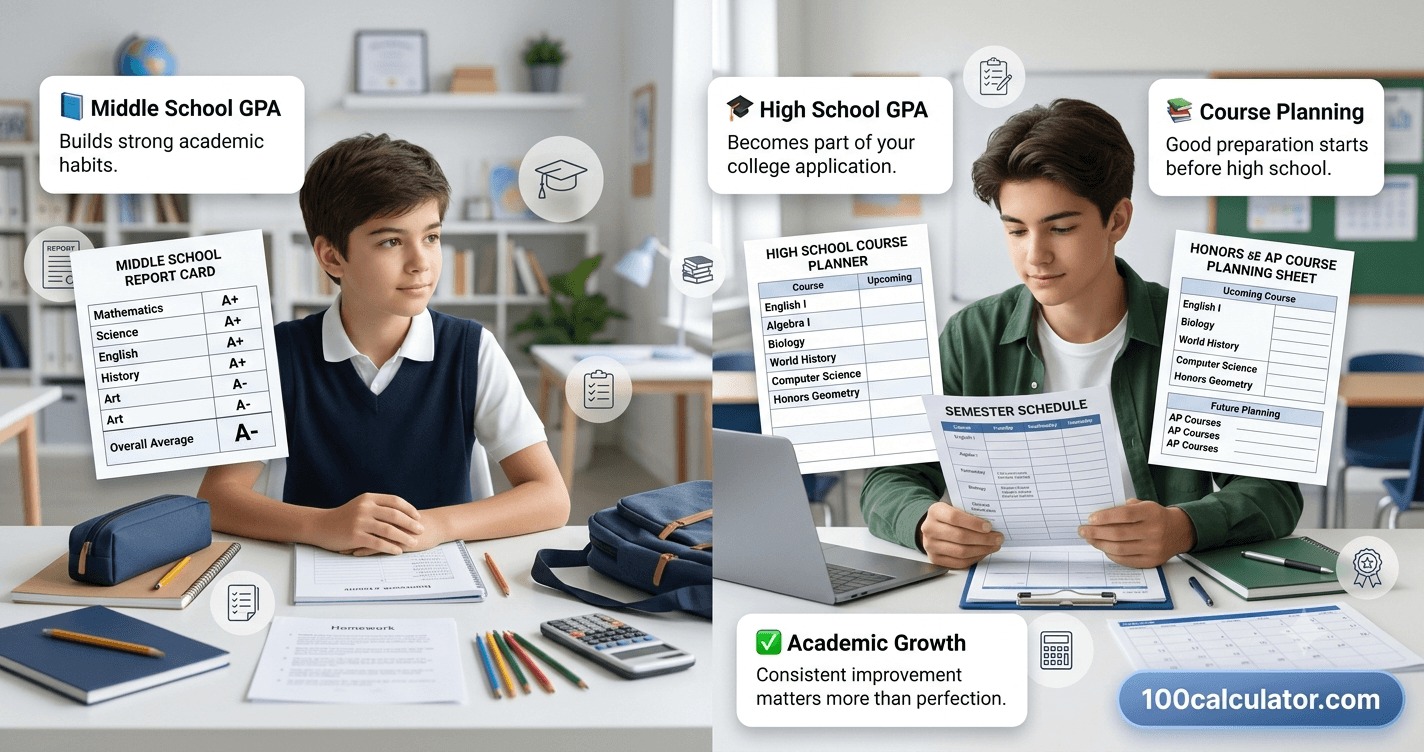
A rough report card in 7th grade can feel like the end of the world, especially once a teacher or older sibling warns that "this goes on your permanent record." For almost every student, that's simply not true.
Middle school GPA generally does not appear on your official high school transcript, and it is not something colleges or scholarship committees ever review. Most high school transcripts start recording grades from 9th grade onward, which means the number on a 6th, 7th, or 8th grade report card typically stays inside your middle school's own files.
That doesn't mean middle school grades are pointless. They shape which classes you're placed into as a freshman, whether you get access to honors or advanced programs, and — for students applying to selective or magnet high schools — they can be part of a real admissions decision. The study habits you build now also tend to follow you, even when the number itself doesn't.
This guide breaks down exactly what middle school GPA does and doesn't affect, how it's calculated, and what actually deserves your attention before high school starts. If you'd like to check your own numbers while you read, our free GPA Calculator Middle School tool can do the math for you in a few seconds.
What Is a Middle School GPA, Exactly?
Grade point average, or GPA, is a single number that summarizes your grades across every class you're taking. Instead of looking at five or six separate letter grades one at a time, a GPA condenses all of them into one figure, usually somewhere between 0.0 and 4.0.
How Middle School GPA Is Measured
Most middle schools calculate GPA on an unweighted 4.0 scale. Every class counts the same, whether it's math, art, or physical education, and there's no bonus for taking a harder class. Here's the standard conversion:
| Letter Grade | Typical Percentage | GPA Points |
|---|---|---|
| A | 90–100 | 4.0 |
| B | 80–89 | 3.0 |
| C | 70–79 | 2.0 |
| D | 60–69 | 1.0 |
| F | Below 60 | 0.0 |
Some schools also use plus and minus grades (A-, B+, and so on), which shift the GPA up or down by roughly a third of a point. A handful of districts weight certain accelerated classes even in middle school, though that's far less common than it becomes in high school. Check your school's grading policy or report card key if you're not sure which version applies to you.
Why Schools Track GPA in Middle School at All
If middle school GPA doesn't follow you to college, it's fair to ask why schools bother calculating it at all. The honest answer is that it's mostly an internal planning tool. Teachers and counselors use it to spot students who might need extra support, to help decide who qualifies for honors or advanced programs, and to figure out which math or language track makes sense as a student heads into high school. It's a planning number, not a permanent record.
Why So Many Students and Parents Worry About Middle School Grades
The anxiety around middle school GPA usually comes from somewhere reasonable: high school and college rules genuinely are strict, so it's natural to assume middle school works the same way. Older siblings, teachers, and well-meaning relatives sometimes repeat advice that was true for high school without clarifying that middle school and high school records are handled very differently.
Middle schools also issue real report cards, real GPAs, and sometimes even honor roll recognition, which makes the number feel just as official as anything in high school. It looks the same on paper, even though what happens to it afterward is completely different.
The short version: the worry is understandable, but it's usually based on mixing up two systems that only start overlapping once high school actually begins.
Does Middle School GPA Appear on a High School Transcript?
For the overwhelming majority of students, no. Your official high school transcript — the document your school eventually sends to colleges, scholarship programs, and sometimes employers — typically starts recording grades from 9th grade onward. Sixth, seventh, and eighth grade report cards generally stay in your middle school's own files and are never forwarded as part of your high school record.
What a High School Transcript Actually Includes
A standard high school transcript lists every course you've taken since freshman year, the grade you earned in each one, your credits, and your cumulative GPA. Colleges rely on this document, along with a school profile from your counselor, to understand your academic record. Your freshman and sophomore grades already count toward that cumulative GPA once high school begins, and your junior year transcript is often the version admissions officers look at most closely. (College Board)
The One Real Exception: High-School-Credit Courses Taken Early
There's one situation where a middle school grade genuinely can show up later: if you took a high-school-credit course while still in middle school. This is most common with Algebra I, Geometry, or a first-year foreign language like Spanish I. Because these are technically high school courses, many districts place them directly on the high school transcript, and depending on local policy, the grade may even count toward the high school GPA.
If you're in one of these classes right now, it's worth asking your counselor two direct questions: does this grade appear on my high school transcript, and does it count toward my GPA? The answer varies by state and district, so it's worth confirming rather than assuming.
What Middle School Grades Actually Affect
Even though the GPA number usually resets, middle school performance still shapes your path in a few concrete ways.
Course Placement and Track Decisions
The clearest impact is on which classes you're placed into as a freshman. Strong grades in math, for example, often open the door to Algebra I or Geometry in 7th or 8th grade, which can put you on track to reach Calculus by senior year — a course selective colleges tend to notice. (College Board) A rougher stretch of grades, on the other hand, might mean starting high school math one level below a classmate who did well in middle school.

Access to Honors, Gifted, or Selective Programs
Many schools use middle school grades, along with test scores and teacher recommendations, to decide who's invited into honors or advanced classes once high school starts. Even where there's no formal "gifted" label, teachers often base early high school recommendations on how a student performed the year before.
Building the Study Habits That Carry Forward
This one doesn't show up on paper, but it matters just as much. Students who build a habit of organizing homework, studying before tests, and asking for help in middle school tend to carry that habit straight into high school. Students who coast because "it doesn't count" often end up building those same habits from scratch during freshman year, right as everything else gets harder.
How to Calculate Your Middle School GPA
Knowing your current GPA is still useful, even though it won't follow you to college. It gives you an honest snapshot of how you're doing and makes it easier to set a realistic goal for the next report card.
Step-by-Step: Manual Calculation
- List every class and the letter grade you earned in it.
- Convert each letter grade to points using the 4.0 scale (A = 4, B = 3, C = 2, D = 1, F = 0).
- Add up all the points from every class.
- Divide the total by the number of classes you took.
For example, imagine a report card with an A in math (4.0), a B in English (3.0), an A in science (4.0), a C in social studies (2.0), and a B in PE (3.0). Adding those five numbers together gives 16.0, and dividing by five classes gives a 3.2 GPA.
Using an Online Middle School GPA Calculator
Free Online Tool
Skip the manual math
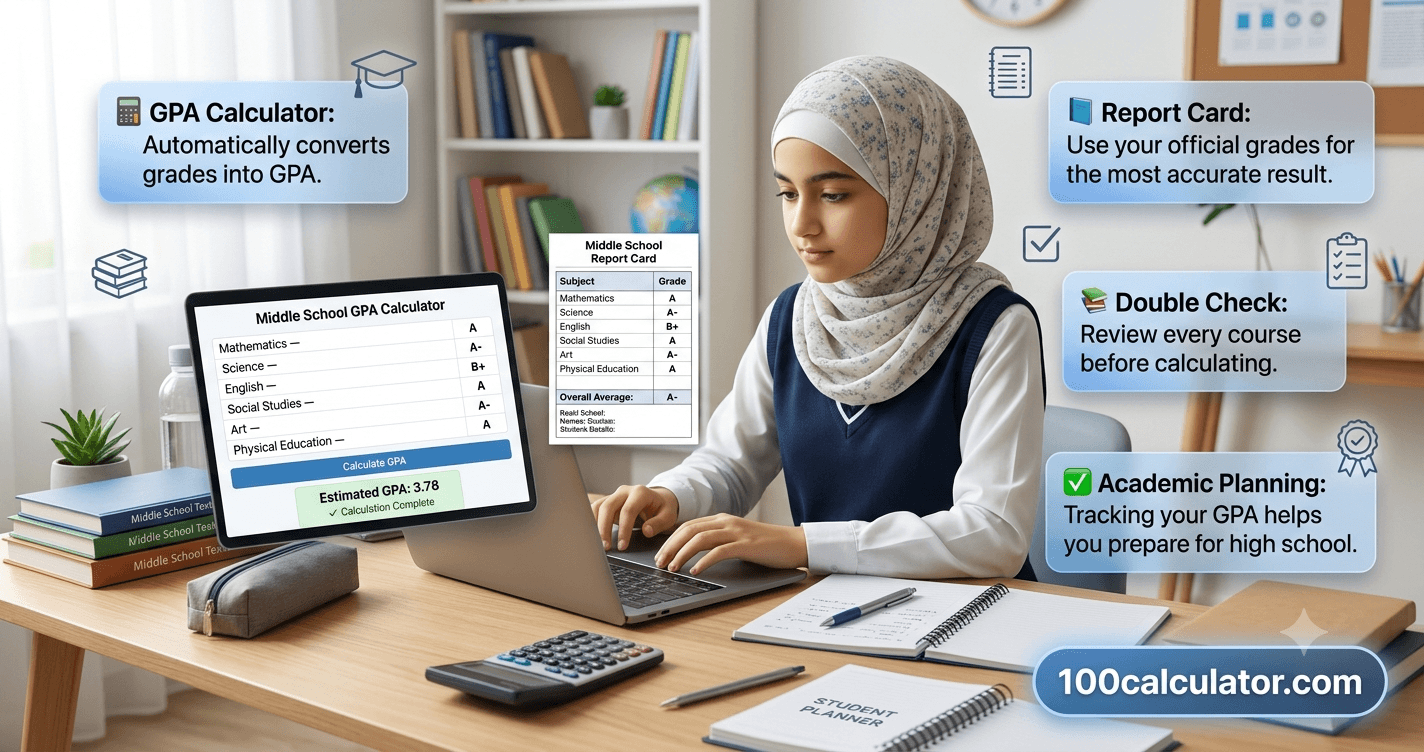
100 Calculator's GPA Calculator Middle School tool does this instantly. Enter your classes and grades, and it calculates your GPA on the standard 4.0 scale in seconds — a fast way to check your numbers before a parent-teacher conference or before setting a goal for next quarter. Once high school starts, our High School GPA Calculator picks up where this one leaves off, including support for weighted grades.
Middle School GPA vs. High School GPA: What's Different
Middle school and high school GPA look similar on a report card, but they work differently in almost every way that matters. Here's a side-by-side comparison:
| Feature | Middle School GPA | High School GPA |
|---|---|---|
| On the official transcript | Usually no | Yes |
| Weighted for honors/AP | Rarely | Often, yes |
| Reviewed by colleges | No | Yes |
| Affects course placement | Yes | Yes |
| Resets or carries forward | Resets in 9th grade | Carries through all four years |
| Can include high-school-credit courses | Yes, if taken early | Not applicable |
The biggest shift happens the moment 9th grade starts. That's when your official academic record — the one colleges and scholarship committees might eventually see — begins. For a full breakdown of how that number is actually built, see our guide on how high school GPA is calculated step by step.
Common Mistakes That Make Middle School GPA Feel Bigger Than It Is
A handful of habits tend to make middle school grades feel more stressful than they need to be:
- Assuming nothing matters at all, so skipping homework or coasting through easy classes.
- Panicking over a single bad grade as if it were permanent, instead of looking at the pattern over a full quarter.
- Not asking a counselor which classes carry high school credit, like Algebra I or a foreign language.
- Turning down an accelerated math or language class out of nerves without checking what it opens up later.
- Waiting until high school to build any kind of homework or study routine.
- Comparing your GPA to a friend's instead of tracking your own progress over time.
Most of these come from treating middle school like a smaller version of high school, when it actually runs by a different set of rules.
Middle School GPA: Myths vs. Facts
Here's a quick reference for the claims that come up most often:
| Myth | Fact |
|---|---|
| "My middle school grades follow me forever." | For most students, they don't appear on the official high school transcript at all. |
| "A bad grade in 7th grade ruins my chances at a good college." | Colleges only see your high school transcript, which starts in 9th grade. |
| "Grades don't matter at all in middle school." | They shape course placement, study habits, and sometimes selective high school admission. |
| "Every school treats middle school grades the same way." | Policies vary by school, district, and even country. |
| "High-school-credit classes taken early never count." | They often do appear on your high school transcript and may count toward your GPA. |
If you only remember one row from this table, make it the first one — it's the belief that causes the most unnecessary stress.
When Middle School Performance Really Does Follow You
For most students, the story ends with course placement and study habits. But there are two situations where middle school grades become part of an actual decision, not just a planning tool.
Selective-Enrollment and Magnet High Schools
In cities with competitive selective-enrollment or magnet high schools, admission is often based on a mix of test scores, attendance, and yes, middle school grades, sometimes going back to 6th or 7th grade. If you're applying to one of these programs, ask the school directly which grades and which years factor into their admissions formula, since this varies significantly from district to district.
Private School Admissions
Private high schools that require an application typically ask for middle school report cards as part of that application. Because private schools set their own admissions criteria, a strong, or weak, middle school record can genuinely influence whether you're accepted, even though the same grades would be invisible to a public high school or a college.
Building Habits Now That Actually Help Later
Since the GPA number itself mostly resets, the more useful question is which habits are worth building before that reset happens. A few things make a real difference:
- Keep a simple record of your grades each quarter, so you notice patterns instead of being surprised
- Ask a teacher or counselor what "high school ready" looks like for math and reading at your school
- Build a consistent homework and study routine now, before the workload increases
- Talk to your counselor about advanced options like Algebra I if you're doing well in math
- Practice tracking your own assignments and deadlines instead of relying only on reminders from a parent
- Treat one bad grade as information, not a verdict — look at the pattern over a full quarter
None of this is about chasing a perfect GPA. It's about walking into high school with habits that make the actual, permanent record easier to build.
When to Start Taking GPA Seriously
If middle school GPA doesn't carry over, the natural question is: when does it start counting for real?
The 9th Grade Reset
The moment you start 9th grade, your GPA calculation starts from zero, and this time, it's the number that actually gets reported to colleges and scholarship programs. Every class from freshman year forward becomes part of your permanent academic record. This is also usually when weighted GPA options, extra points for honors or AP classes, become available, which our guide on weighted vs. unweighted GPA explains in more detail.
Why Freshman Year Sets the Tone
Freshman year grades count just as much toward your cumulative GPA as senior year grades do, which surprises a lot of students who assume only the "important" later years matter. A strong start in 9th grade makes the rest of high school easier, both because the habits are already in place and because there's less ground to make up later. As you move further into high school, tools like our High School GPA Calculator, and eventually subject-specific tools like the AP Chem Score Calculator or AP Calc BC Score Calculator or AP Gov Score Calculator, become useful for tracking exactly where you stand.
A note on accuracy: This article explains how GPA and high school transcripts commonly work in the United States and in systems that follow similar grading practices. Specific rules about grade weighting, transcripts, and high-school-credit courses vary by school, district, and country. For details that apply to your own situation, check with your school counselor, registrar, or admissions office.
Related Calculators
Put what you just read into practice, try these free tools instantly, no sign-up required.
High School GPA Calculator
Calculate your high school GPA from grades and credit hours.
GPA Calculator Middle School
Calculate your middle school GPA quickly and accurately.
AP Chem Score Calculator
Estimate your AP Chemistry exam score from practice results.
AP Calc BC Score Calculator
Estimate your AP Calculus BC exam score from raw points.
AP Gov Score Calculator
Estimate your AP Government exam score from practice results.
More From Our Education Tools Guide
Ready to keep learning about GPA and how it's scored through high school? These related guides dig deeper into the topics covered above.
Frequently Asked Questions
Does middle school GPA matter for high school?
Middle school GPA itself usually doesn't carry over as a number, since most high school transcripts start fresh in 9th grade. What does matter is what your middle school grades lead to — the math and reading level you're placed into, and sometimes access to honors or advanced programs as a freshman.
Do colleges look at middle school grades?
No. Colleges review your official high school transcript, which your counselor sends directly to them, and that document generally only includes classes taken from 9th grade onward. Middle school report cards stay in your middle school's own records.
Does 7th or 8th grade GPA affect college admissions?
Not directly. The one exception is if you took a high-school-credit course, like Algebra I, in 7th or 8th grade. That grade can appear on your official high school transcript and may factor into your GPA, depending on your district's policy.
What's considered a good GPA in middle school?
Most schools consider a 3.0 or higher, a B average, solid, and 3.5 or above strong, on the standard unweighted 4.0 scale. There's no single "required" number, since middle school GPA isn't formally reviewed by colleges or most high schools.
Do middle school grades appear on a high school transcript?
Generally, no, unless the class was a high-school-credit course taken early, such as Algebra I, Geometry, or a first-year foreign language. Those specific courses often do appear, since they're technically high school coursework regardless of when they were completed.
Why do schools calculate a GPA in middle school if it doesn't count later?
Middle school GPA is mainly an internal planning tool. Teachers and counselors use it to identify students who need extra support, decide who qualifies for honors or advanced tracks, and figure out an appropriate starting point for high school classes.
Can a bad grade in middle school affect high school course placement?
It can, especially in subjects like math that build on each other year to year. A rough grade in 7th grade pre-algebra, for example, might mean starting high school in a standard math track instead of an accelerated one, though this varies by school.
Do private high schools look at middle school report cards?
Often, yes. Private schools that require an application typically ask for middle school transcripts as part of the admissions process, since they set their own criteria independent of public school rules.
Does middle school GPA affect scholarships?
Almost never directly. Scholarship applications, like college applications, are built around your high school record. The exception would be a small number of middle-school-specific academic awards, which are separate from the scholarships you'd apply for in high school.
What's the difference between middle school GPA and high school GPA?
Middle school GPA is usually unweighted, resets when you move on, and stays internal to the school. High school GPA is often weighted for honors or AP classes, becomes part of your official transcript, and is the number colleges and scholarship programs actually review.
When does GPA start counting toward college applications?
Starting in 9th grade. Your freshman year grades already count toward the cumulative GPA that most colleges consider, and that record continues building through your senior year.
Do high-school-credit classes taken in middle school, like Algebra I, count toward GPA?
Often, yes, though it depends on your school district's specific policy. Since these are high school courses taken early, many districts include the grade on your high school transcript and factor it into your GPA. Ask your counselor to confirm how your school handles it.
Should middle schoolers worry about their GPA?
Not in the sense of stressing over the exact number. It's more useful to focus on the habits behind the grade, like consistent homework and studying, since those habits matter more for high school success than the middle school GPA itself.
How can I calculate my middle school GPA?
Convert each letter grade to points on the 4.0 scale (A = 4, B = 3, C = 2, D = 1, F = 0), add the points together, and divide by the number of classes. Our free GPA Calculator Middle School tool does this automatically if you'd rather skip the manual math.
Does one bad semester in middle school ruin my chances later?
No. A single rough semester in middle school leaves no lasting record once you reach high school, aside from any effect on course placement. What matters far more is how you perform once your official high school transcript begins in 9th grade.
About 100 Calculator
100 Calculator is a free hub of online calculators and educational guides covering health, finance, trading, crypto, education, and more. Every tool is built to be fast, accurate, and genuinely free, with no account or signup required.
We built this guide, and tools like the GPA Calculator Middle School referenced throughout it, to make everyday school questions a little easier to answer. Head back to the 100 Calculator homepage to explore the full library of tools, or learn more about the team behind them on our About Us page.