How to Calculate GPA in Middle School Correctly
A clear, step-by-step walkthrough of how middle school GPA actually works — the 4.0 scale, a worked example you can follow along with, and an honest answer on how much it matters once high school starts.
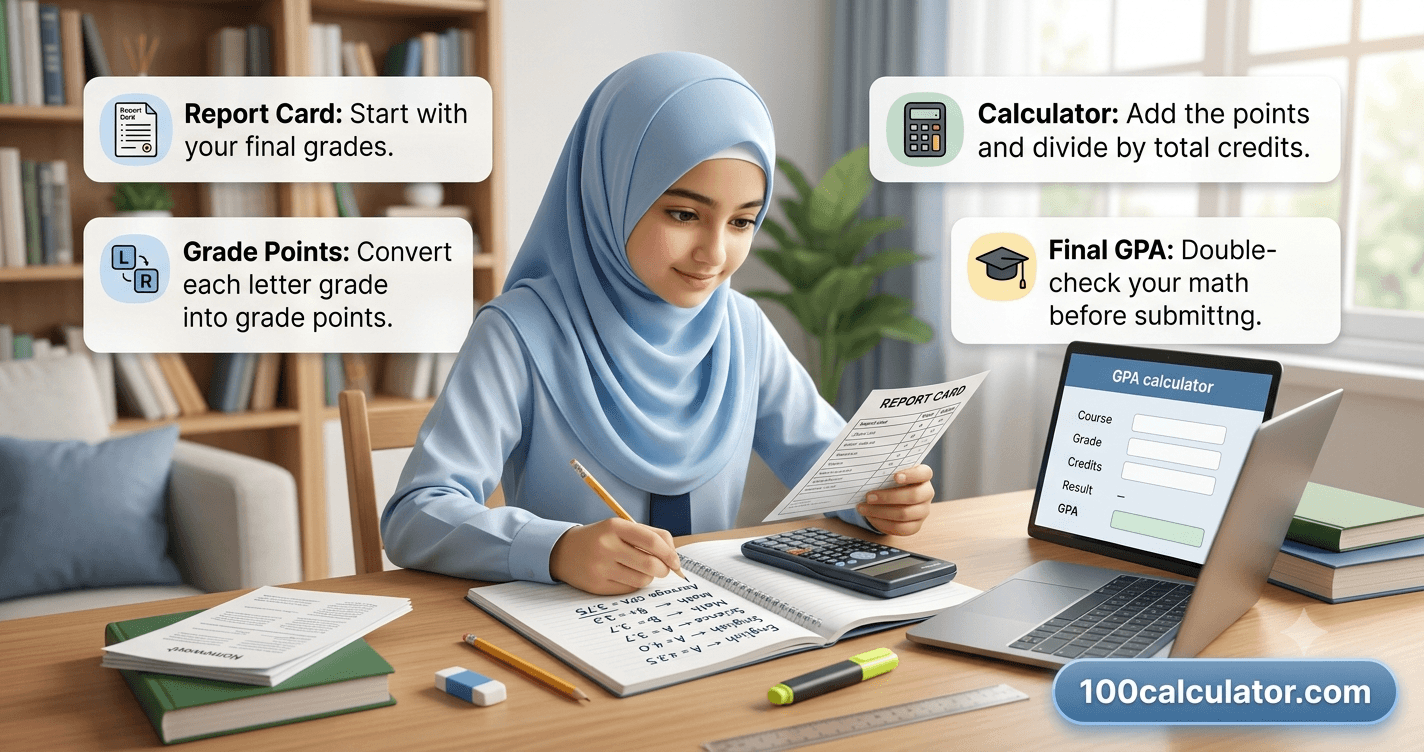
Report cards come home, and suddenly there's a single number attached to how you're doing across every class: your GPA. If nobody has actually walked you through the math, that number can feel like it shows up out of nowhere.
Your middle school GPA is calculated by converting each letter grade into points on a scale (typically 4.0 for an A, 3.0 for a B, 2.0 for a C, and so on), adding those points together, then dividing by the number of classes. That's the whole formula. Plus and minus grades, semester averages, and weighted classes are all just small variations on those same three steps.
Not every middle school issues a formal GPA the way high schools do — some report cards stick to plain letter grades or percentages. Plenty of schools do calculate one, though, whether it's for honor roll, class placement, or simply to get students used to how high school transcripts work. Either way, knowing the math behind the number means you're never stuck guessing at what your grades add up to.
This guide walks through the standard GPA formula step by step, works through a full example with real numbers, and covers the small habits that throw a GPA calculation off. Toward the end, we'll also point you to a free GPA Calculator Middle School tool that does the same math instantly, in case you'd rather skip the arithmetic and just check the number.
What Is a Middle School GPA?
GPA stands for grade point average. It takes every letter grade on a report card, turns each one into a number, and averages those numbers into a single score, usually somewhere between 0.0 and 4.0. Instead of looking at six or seven separate letter grades, a GPA compresses all of them into one number that's easy to compare over time.
Why Schools Track GPA Instead of Just Letter Grades
A transcript full of individual letter grades is useful, but it doesn't summarize easily. GPA solves that by giving schools, teachers, and students a quick way to answer questions like whether someone qualifies for honor roll, whether their grades are trending up or down, or whether they meet the cutoff for an advanced class. It's a summary number, not a replacement for the actual grades underneath it.
Does Every Middle School Calculate GPA?
Not always. Some middle schools report progress using only letter grades or percentages on the report card and never formally calculate a GPA at all. Others calculate GPA every term, often starting somewhere around 6th or 7th grade. If you're not sure which category your school falls into, check your report card or your school's online grade portal — if there's a number next to your grades that isn't a percentage, that's usually your GPA.
The Basic GPA Formula, Step by Step
Every GPA, no matter how complicated a transcript looks, comes down to the same three steps.
GPA Formula
GPA = Total Grade Points ÷ Number of Classes
Total Grade Points — the sum of the point value for every class, based on the letter grade earned in each one
Number of Classes — how many classes are included in the average, usually every class on that report card
Step 1: Convert Each Letter Grade Into Points
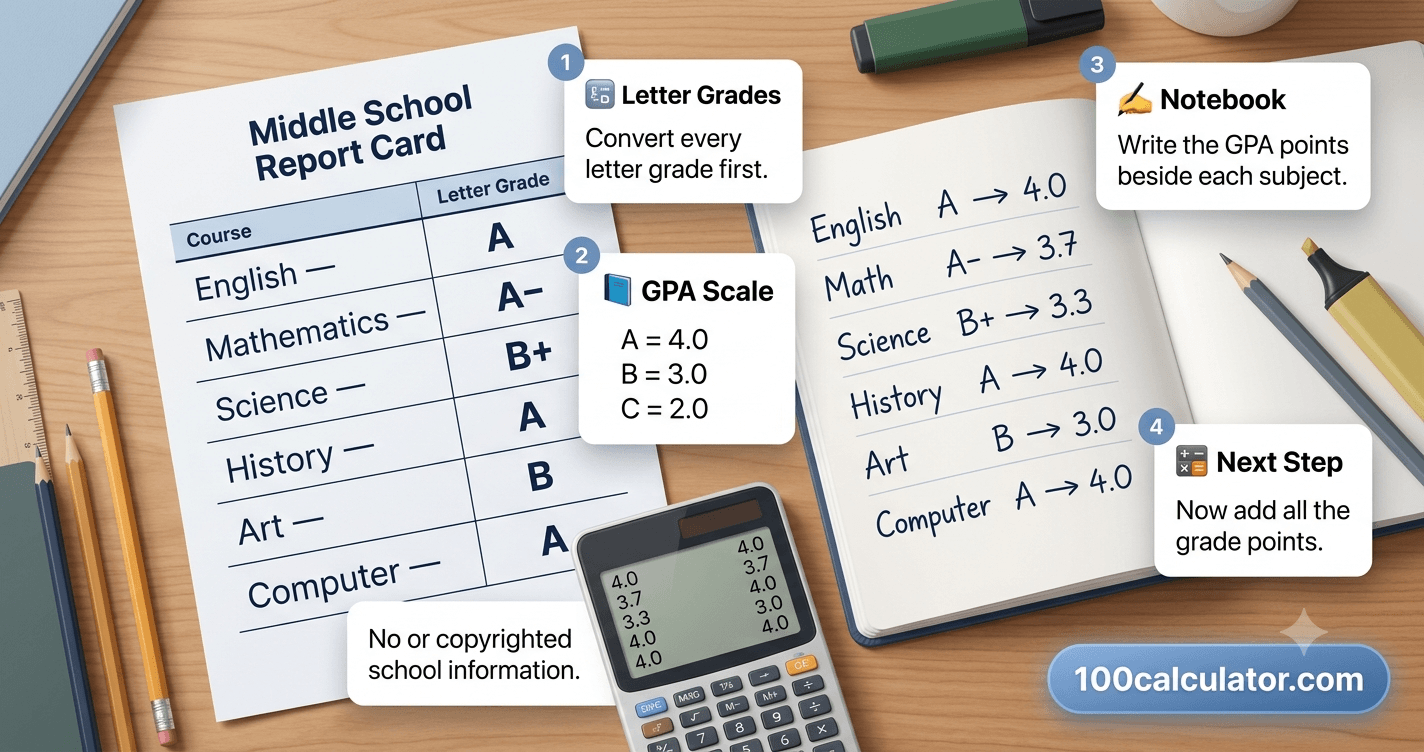
Start with your report card and turn every letter grade into its point value using your school's scale. On the standard version, an A is worth 4.0 points, a B is worth 3.0, a C is worth 2.0, a D is worth 1.0, and an F is worth 0.0. Write the point value next to each class so you have a clean list to work from.
Step 2: Add All the Grade Points Together
Once every class has a point value next to it, add them all up into one total. This total by itself isn't your GPA yet — it's just the sum of every class's points, and it naturally gets larger the more classes you include.
Step 3: Divide by the Number of Classes
Take that total and divide it by how many classes you included. The result is your GPA. Dividing is what turns the raw total into an average that stays on the same 0.0–4.0 scale, no matter how many classes you're averaging.
The 4.0 GPA Scale for Middle School
The most common scale for converting letter grades into GPA points runs from 0.0 to 4.0. Here's the standard version most schools start from:
| Letter Grade | Percentage (Typical) | GPA Points (4.0 Scale) |
|---|---|---|
| A | 90–100% | 4.0 |
| B | 80–89% | 3.0 |
| C | 70–79% | 2.0 |
| D | 60–69% | 1.0 |
| F | Below 60% | 0.0 |
The Plus/Minus Version of the Scale
Some schools break each letter grade into finer plus and minus categories, which changes the point values slightly:
| Letter Grade | GPA Points |
|---|---|
| A | 4.0 |
| A- | 3.7 |
| B+ | 3.3 |
| B | 3.0 |
| B- | 2.7 |
| C+ | 2.3 |
| C | 2.0 |
| C- | 1.7 |
| D+ | 1.3 |
| D | 1.0 |
| D- | 0.7 |
| F | 0.0 |
Both versions use the exact same formula from the last section. The only difference is how finely each letter grade gets broken down before you add the points together.
A Full Middle School GPA Calculation Example
Numbers are easier to follow with an actual example, so here's one full walkthrough using six typical middle school classes.
| Subject | Letter Grade | GPA Points |
|---|---|---|
| Math | A | 4.0 |
| Science | B | 3.0 |
| English | A | 4.0 |
| Social Studies | B | 3.0 |
| Physical Education | A | 4.0 |
| Art | C | 2.0 |
| Total | — | 20.0 |
Adding up the points column gives a total of 20.0. Dividing that total by six classes gives a GPA of 3.33 (20 ÷ 6 = 3.33).
How the Same Example Changes on a Plus/Minus Scale
If those same grades were actually A, B+, A-, B, A, and C+, the plus/minus version of the scale would give slightly different points: 4.0, 3.3, 3.7, 3.0, 4.0, and 2.3. Added together, that's 20.3, and dividing by six gives a GPA of 3.38 — close to the simple version, but not identical. This is exactly why it matters to know which scale your own school uses before comparing your GPA to a friend's.
When Grades Are Percentages or Numbers Instead of Letters
Plenty of schools skip letter grades on the report card entirely and give a straight percentage or a number out of 100 instead. The GPA math still works the same way — it just adds one extra step.
Converting a Percentage Grade to GPA
First, match the percentage to its typical letter grade range, then convert that letter grade to points using the same scale from earlier in this guide.
| Percentage | Typical Letter Grade | GPA Points |
|---|---|---|
| 90–100 | A | 4.0 |
| 80–89 | B | 3.0 |
| 70–79 | C | 2.0 |
| 60–69 | D | 1.0 |
| Below 60 | F | 0.0 |
A student with an 84% in one class, for example, would treat that as a B, worth 3.0 points, using exactly the same formula as before.
Why the Exact Percentage Cutoffs Can Shift
Some schools use 93% and above for an A instead of 90%, or set the passing cutoff at 65% instead of 60%. These small shifts don't change the formula, but they can change which letter grade, and which point value, a specific percentage lands on. Your school's student handbook or grade portal is the most reliable place to confirm your exact cutoffs.
Semester GPA vs. Year GPA vs. Cumulative GPA
The word "GPA" gets used for a few different things depending on how much time it covers, and mixing these up is a common source of confusion.
- Semester GPA — averages only the grades earned in one semester, using the formula from earlier in this guide.
- Year, or annual, GPA — combines both semesters, either by averaging the two semester GPAs together or by using a single end-of-year grade per class, depending on how your school reports grades.
- Cumulative GPA — averages every semester or year completed so far, which is the version most often used for honor roll and, later, for high school transcripts.
All three use the exact same three-step formula. The only thing that changes is how many grades get included before you divide. If your report card shows both a semester GPA and a cumulative GPA and they look noticeably different, that's usually a sign that an earlier semester pulled the average up or down, not a sign that something was calculated incorrectly.
Common Middle School GPA Mistakes to Avoid
Even with the right formula, a few habits quietly throw off a GPA calculation. Here's what to watch for:
- Mixing up letter grades and percentages. Converting an 84% directly into 84 grade points, instead of first turning it into a B worth 3.0, is one of the most common errors.
- Forgetting to include every class. Leaving out a single elective or PE grade changes both the total points and the number of classes you're dividing by.
- Using the wrong scale. Plugging plus/minus grades into the simple 4.0 scale, or the other way around, gives a GPA that looks close to correct but isn't quite right.
- Rounding too early. Rounding each grade's points before adding them up, instead of rounding only the final GPA, can shift the result by a few hundredths.
- Assuming semester GPA and cumulative GPA are the same number. They answer different questions, and it's normal for them to differ.
Does Weighted GPA Apply in Middle School?
Weighted GPA gives extra points for harder classes, so an A in an advanced course might count as 4.5 or 5.0 instead of the standard 4.0. It's worth understanding the concept, but it rarely applies in middle school the way it does in high school.
Why Weighting Usually Starts in High School
Weighted scales exist to reward students for taking more difficult coursework, like honors or Advanced Placement (AP) classes, which mostly don't exist yet at the middle school level. Most middle school GPAs, when they're calculated at all, use the simple unweighted version covered throughout this guide.
The Exception: High-School-Level Classes Taken Early
Some middle schoolers take a class that's officially considered high-school level, most commonly Algebra I, Geometry, or a world language. When that happens, many districts record the grade directly on the student's future high school transcript, which means it can eventually be included in a weighted high school GPA even though it was earned in 7th or 8th grade. Whether this applies to a specific class depends entirely on district policy, so it's worth asking a school counselor directly if this describes your situation.
For a full breakdown of how weighting works once you reach that point, our guide on weighted vs unweighted GPA covers the difference in more detail, and our guide to how high school GPA is calculated walks through the weighted formula step by step.
Does Middle School GPA Actually Matter?
This is usually the real question behind "how do I calculate my GPA," so it's worth answering directly.
What Middle School GPA Does Not Do
In most school systems, a middle school GPA does not carry over into an official high school GPA, and colleges do not see it directly, since college applications ask for a high school transcript, not a middle school one. A rough semester in 7th grade, on its own, is not something that follows a student into high school admissions or college applications.
What It Actually Affects
Where middle school grades genuinely matter is in what they lead to. Strong, consistent grades often determine which classes, including honors or accelerated tracks, a student gets placed into once high school starts, and that placement is what eventually shows up on a transcript colleges do review. Grades can also affect honor roll recognition and, in some districts, eligibility for specific programs or classes.
We cover this question in a lot more depth, including which situations carry forward and which don't, in our guide on whether middle school GPA actually matters later on.
Tips to Improve or Maintain a Strong GPA
A GPA calculation only reflects grades that already exist. Improving the number itself comes down to a handful of habits that are easy to describe, and, admittedly, not always easy to stick with.
- Turn in every assignment, even small ones — missing work often costs more than one difficult test grade.
- Check your grade portal regularly instead of waiting for the report card to find out something slipped.
- Ask teachers directly about extra credit, retake policies, or how a specific assignment is weighted.
- Focus extra study time on the class pulling your GPA down the most, not the one you already do well in.
- Keep a simple running list of your grades so you always know roughly where your GPA stands.
Using a GPA Calculator for Middle School
The formula in this guide is simple enough to do with a pen and paper, but it gets tedious once you're averaging six, seven, or eight classes, especially if you're checking it more than once a term.
Free Online Tool
Skip the manual math
100 Calculator's GPA Calculator Middle School tool lets you enter your grades directly and get your GPA instantly, on either the simple or plus/minus scale. It runs right in your browser, with no account or signup required.
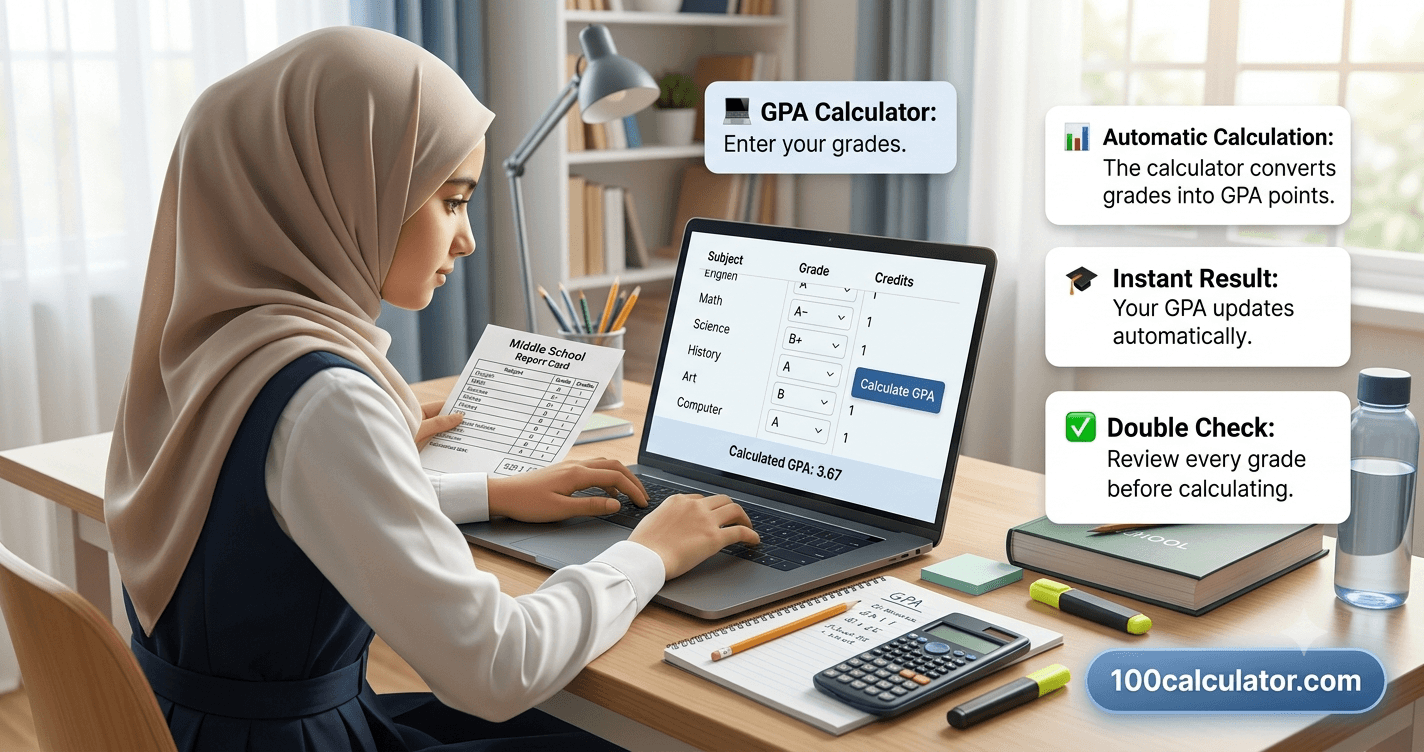
If you're a few years away from high school, it's worth knowing that the same idea applies once weighted classes and AP courses enter the picture. Our High School GPA Calculator handles that version for whenever you're ready for it, and knowing the formula now means it'll already feel familiar.
Related Calculators
Put what you just read into practice, try these free tools instantly, no sign-up required.
High School GPA Calculator
Calculate your high school GPA from grades and credit hours.
GPA Calculator Middle School
Calculate your middle school GPA quickly and accurately.
AP Chem Score Calculator
Estimate your AP Chemistry exam score from practice results.
AP Calc BC Score Calculator
Estimate your AP Calculus BC exam score from raw points.
AP Gov Score Calculator
Estimate your AP Government exam score from practice results.
More From Our Education Tools Guide
Still working out how grades, exams, or GPA scales fit together? These related guides dig deeper into the topics mentioned above.
Frequently Asked Questions
What is a good GPA in middle school?
A GPA of 3.0 or higher, a B average, is generally considered solid in middle school, and anything above 3.5 is considered strong. That said, "good" depends on your school's grading scale and your own goals. A 3.0 built on steady effort across all your classes is often more meaningful than a slightly higher number in only your easiest subjects. If you're aiming for advanced or honors classes in high school, ask a school counselor what range those placements typically expect.
How do you calculate GPA in middle school?
Convert each letter grade into points using your school's scale, commonly A=4.0, B=3.0, C=2.0, D=1.0, and F=0.0. Add up the points from every class, then divide that total by the number of classes you took. Four classes worth 4, 3, 4, and 3 points add up to 14, and 14 divided by 4 equals a 3.5 GPA. The process stays the same whether you're averaging one semester or a full school year.
Is middle school GPA on a 4.0 scale?
Most schools that calculate a middle school GPA use the standard 4.0 unweighted scale, where an A equals 4.0 and a B equals 3.0, down to an F at 0.0. Some schools use a plus/minus version with values like 3.7 for an A- or 3.3 for a B+. A smaller number of schools use a 100-point or letter-only system without converting to a 4.0 scale at all, so it's worth checking your own school's grading policy to be sure.
Does middle school GPA affect high school?
In most school systems, middle school grades don't carry into an official high school GPA, since high school GPA typically starts fresh in 9th grade. The common exception is a high-school-level course taken early, like Algebra I, which often appears on the high school transcript and counts toward GPA once a student enrolls. Policies vary by district, so it's worth confirming with a school counselor.
Does middle school GPA matter for college?
Colleges almost never see middle school grades directly, since college applications ask for a high school transcript, not a middle school one. Where middle school performance matters is in what it leads to: strong grades and habits built in 6th through 8th grade often determine which classes, including honors tracks, a student is placed into once high school starts, and that placement does eventually show up on the transcript colleges review.
How do you convert a percentage grade into GPA?
Most schools map percentage ranges to letter grades first, then convert the letter grade to GPA points. A common version is 90–100% as an A (4.0), 80–89% as a B (3.0), 70–79% as a C (2.0), 60–69% as a D (1.0), and below 60% as an F (0.0). Exact cutoffs can shift by a few points between schools, so check your student handbook if your school's ranges look different.
What's the difference between weighted and unweighted GPA?
An unweighted GPA treats every class the same, so an A is always worth 4.0 regardless of how difficult the class is. A weighted GPA adds extra points for advanced classes, like honors or AP courses, so an A in a harder class might count as a 4.5 or 5.0 instead of 4.0. Weighted GPA is almost entirely a high school concept; middle schools typically stick with the simpler unweighted version.
Do all middle schools calculate an official GPA?
No. Many middle schools report progress using only letter grades or percentages and don't formally calculate a GPA, since GPA becomes more relevant once high school transcripts and college applications enter the picture. Other middle schools do calculate GPA, often to determine honor roll status or track eligibility for advanced classes. Your report card or school's grade portal is the fastest way to check which applies to you.
What happens to your GPA if you get an F?
An F is worth 0.0 grade points on the standard 4.0 scale, which pulls your overall GPA down more than any other grade, since it contributes nothing to the total while still counting as one of your classes. Four classes with an A, A, B, and F average out to a 2.75 GPA, even though three of the four grades are strong. This is exactly why catching a struggling class early matters more than fixing the average after the fact.
How many classes do you need to calculate a GPA?
There's no minimum number of classes required mathematically, since a GPA is still just points divided by classes. In practice, most middle school GPAs are calculated across all the core and elective classes on a report card for that semester or year, typically somewhere between five and eight classes, so the average reflects overall performance rather than just one subject.
Is there a difference between semester GPA and year-end GPA?
Yes. A semester GPA only averages the grades from that specific semester, while a year-end GPA typically combines both semesters, either by averaging the two semester GPAs or by using a single final grade per class. A cumulative GPA goes a step further and averages every semester or year completed so far. All three use the same basic formula; they just cover different stretches of time.
Do electives and PE count toward GPA?
In most schools, yes. Electives like art, music, and PE are graded the same way as core classes and count toward GPA using the same point scale. A few schools handle certain classes differently, such as giving pass/fail grades for PE that don't factor into GPA at all. Check your report card or student handbook, since this is one of the details that varies most between schools.
Can advanced middle school classes like Algebra I affect your high school GPA?
Yes, often. When a middle schooler takes a course considered high-school level, like Algebra I, Geometry, or a world language, many districts record that grade directly on the future high school transcript. That means the grade can count toward high school GPA even though it was earned in 7th or 8th grade. This depends entirely on district policy, so ask a counselor if you're taking any accelerated classes.
How can I raise my GPA in middle school?
The most reliable way to raise a GPA is to focus on the classes pulling it down the most, since a low grade often has more room for improvement than pushing an already-strong grade even higher. Turning in every assignment, asking teachers about extra credit or retake policies, and checking your grade portal regularly instead of waiting for report cards all help catch problems while there's still time to fix them.
Can I calculate my GPA without doing the math by hand?
Yes. 100 Calculator's GPA Calculator Middle School tool lets you enter your grades and instantly get your GPA without doing the arithmetic yourself, which is especially useful if you're juggling several classes with different grades. It's free, works right in your browser, and doesn't require creating an account.
About 100 Calculator
100 Calculator is a free hub of online calculators and educational guides covering health, finance, trading, crypto, education, and more. Every tool is built to be fast, accurate, and genuinely free, with no account or signup required.
We built this guide, and tools like the GPA Calculator Middle School referenced throughout it, to make everyday school questions a little easier to answer. Head back to the 100 Calculator homepage to explore the full library of tools, or learn more about the team behind them on our About Us page.