How to Calculate the Volume of a Sphere Correctly
A clear, step-by-step walkthrough of the sphere volume formula, complete with worked examples, common mistakes to avoid, and a free calculator so you can check your answer instantly.
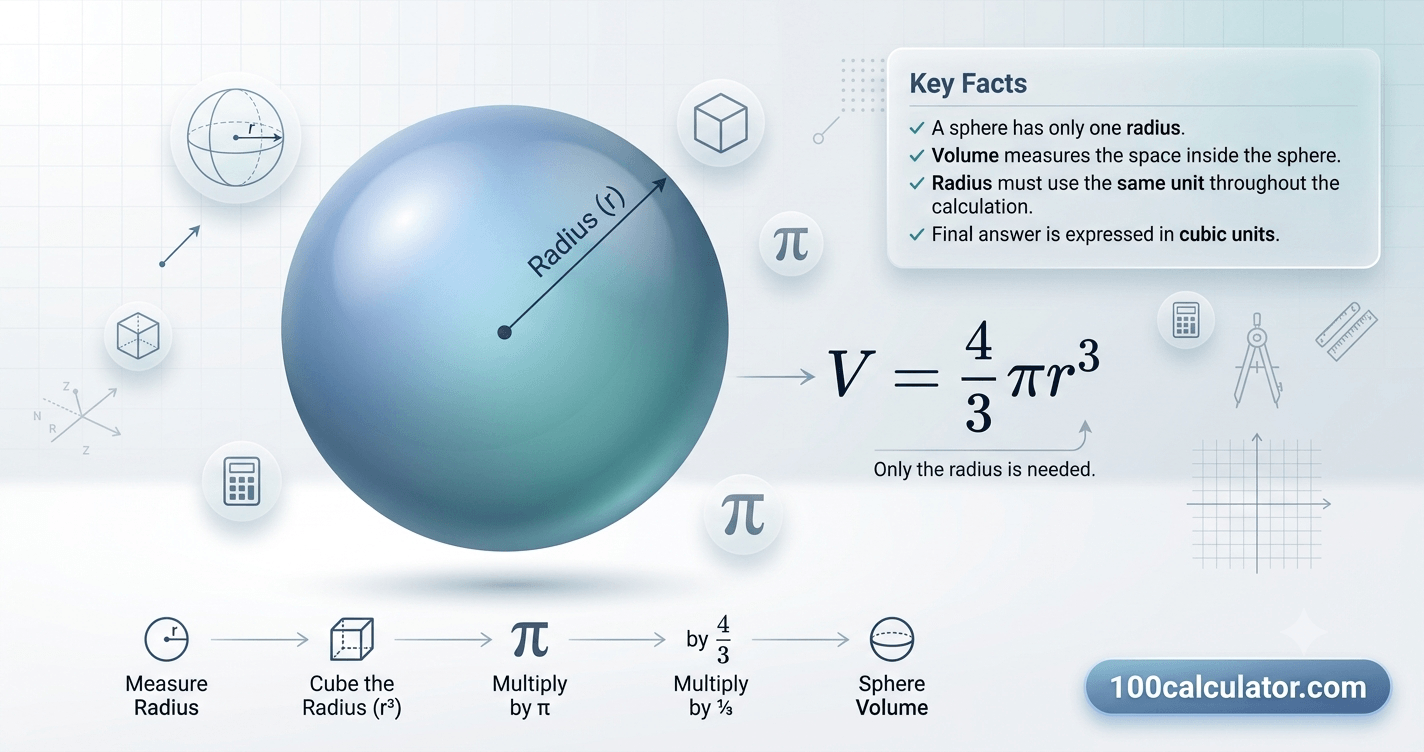
If you need the volume of a sphere fast, here's the formula: V = (4/3) × π × r³, where r is the radius. Cube the radius, multiply by pi, then multiply the result by four-thirds. That gives you the volume, expressed in cubic units.
The volume of a sphere is the total amount of three-dimensional space it takes up, calculated with the formula V = (4/3)πr³, where r is the sphere's radius. This one formula works for any sphere, from a marble to a water tank, as long as you know the radius.
Getting the right answer depends on a few details that trip people up: whether you were given the radius or the diameter, which units you're working in, and how much you round pi along the way. Miss any one of those and your final number can be off by a lot, even when the formula itself was applied correctly.
This guide breaks the formula down piece by piece, walks through several worked examples, and covers the mistakes that throw off sphere volume calculations most often. We'll also look at how volume compares to surface area and where this math actually shows up outside a classroom. If you'd rather skip the manual steps, 100 Calculator's Volume of a Sphere Calculator gives you the answer the moment you enter a radius or diameter. Understanding the process behind it just makes it easier to catch a mistake if a number ever looks off.
What Is the Volume of a Sphere?
A sphere is a perfectly round three-dimensional shape, like a ball, a marble, or a globe. Every point on its surface sits exactly the same distance from its center. That distance is the radius, and it's the only measurement you need to describe a sphere completely.
Volume measures how much space a three-dimensional object takes up, expressed in cubic units like cubic centimeters, cubic inches, or cubic meters. The volume of a sphere specifically tells you how much space is enclosed inside its round surface, whether that space ends up filled with air, water, metal, or nothing at all.
What Makes a Sphere Different From a Circle
A circle is flat. It's a two-dimensional shape with an area, not a volume. A sphere is what you get when that same circle is spun in three dimensions around its diameter. Because a sphere exists in three dimensions, it has both volume, how much space it fills, and surface area, how much its outer skin covers, but no flat "area" the way a circle does.
Why Sphere Volume Matters
Calculating sphere volume shows up more often than most people expect. Engineers use it to figure out how much material fits inside a tank or a pressure vessel. Manufacturers use it to work out how much a ball bearing or a molded part weighs. Students run into it constantly in geometry class, and scientists use it to estimate everything from the size of a cell to the volume of a planet. Once you understand the formula, you can apply it to any round object you can measure.
The Sphere Volume Formula
Every sphere, no matter how big or small, follows the same formula:
Sphere Volume Formula
V = (4/3) × π × r³
V = volume, in cubic units
r = radius of the sphere
π (pi) = a constant, approximately 3.14159
4/3 = a fixed multiplier that comes from the sphere's geometry
Breaking Down Each Part of the Formula
r³ means the radius multiplied by itself three times (r × r × r), not the radius multiplied by 3. This is the step people get wrong most often, so it's worth double-checking every time. Pi (π) is a constant that shows up anywhere circles or spheres are involved; most calculations use 3.14159, or the π key on a calculator for more precision. The 4/3 comes directly from the math used to derive the formula, and it never changes, regardless of the sphere's size.
Where the Formula Comes From
The Greek mathematician Archimedes worked out the relationship between a sphere and a surrounding cylinder more than 2,000 years ago, long before calculus existed in any formal sense. He proved that a sphere's volume is always exactly two-thirds the volume of the smallest cylinder that can contain it (NYU Math). He considered this his greatest achievement and requested that a sphere and cylinder be carved on his tombstone. We'll come back to this relationship later in the guide, since it's a handy way to sanity-check a sphere volume answer.
How to Calculate the Volume of a Sphere Step by Step
Once you have the radius, calculating sphere volume is a short, repeatable process.
- Confirm you have the radius, not the diameter. If you were only given the diameter, divide it by 2 first.
- Cube the radius. Multiply the radius by itself three times: r × r × r.
- Multiply by pi. Use 3.14159 for a close approximation, or the π key on a calculator for more precision.
- Multiply by 4/3. You can multiply by 4 and then divide by 3, or multiply by the decimal 1.3333.
- Label your answer in cubic units. Volume is always cubic, such as cm³, in³, or m³, since you're measuring three-dimensional space.
Worked Examples With Real Numbers
Numbers are easier to follow than formulas alone. Here are three examples at different scales, so you can see the same steps applied each time.
Example 1: A Small Sphere
Say you're holding a marble with a radius of 0.5 cm. Plugging that into the formula looks like this:
- V = (4/3) × π × (0.5)³
- V = (4/3) × π × 0.125
- V ≈ 0.52 cm³
A marble that size holds about half a cubic centimeter of space, roughly the volume of a small pea.
Example 2: A Medium Sphere
Now try a ball with a radius of 12 cm.
- V = (4/3) × π × (12)³
- V = (4/3) × π × 1,728
- V ≈ 7,238.23 cm³
That's a little over 7.2 liters, roughly the volume of a large mixing bowl.
Example 3: A Large Sphere
Finally, a spherical water tank with a radius of 3 meters.
- V = (4/3) × π × (3)³
- V = (4/3) × π × 27
- V ≈ 113.10 m³
At 1,000 liters per cubic meter, that tank holds roughly 113,000 liters, enough to fill more than 100,000 one-liter bottles.
Finding Volume From Diameter Instead of Radius
Not every problem hands you the radius directly. Diameter, the distance all the way across a sphere through its center, shows up just as often, especially on product labels and spec sheets.
The relationship between the two is simple: radius is always half of diameter (r = d ÷ 2). Divide the diameter by 2 first, then use the standard formula, or skip that step entirely with a version of the formula built for diameter:
Sphere Volume From Diameter
V = (1/6) × π × d³
V = volume, in cubic units
d = diameter of the sphere
This works because r = d ÷ 2, so r³ becomes (d ÷ 2)³, which simplifies to d³ ÷ 8
Diameter Formula Explained
Both formulas always return the same answer for the same sphere. V = (1/6)πd³ is simply V = (4/3)πr³ rewritten in terms of diameter instead of radius. Use whichever version matches the measurement you already have, so you don't need an extra conversion step.
For example, a sphere with a 24 cm diameter: V = (1/6) × π × (24)³ = (1/6) × π × 13,824 ≈ 7,238.23 cm³ — the exact same answer as the 12 cm-radius ball from the previous section, since 24 ÷ 2 = 12.
Volume of a Sphere in Different Units
Your answer is only as useful as its units. If your radius is in centimeters, your volume comes out in cubic centimeters, not centimeters, and definitely not square centimeters. Mixing units partway through a calculation is one of the fastest ways to end up with a wrong answer, even when every other step was correct.
Converting Between Cubic Units
Sometimes you calculate volume in one unit but need the answer in another, like converting cubic centimeters to liters for a container, or cubic inches to cubic feet for a construction project. These conversions aren't linear the way length conversions are; because you're dealing with three dimensions, the conversion factor gets cubed too.
| Converting From | Converting To | Multiply By |
|---|---|---|
| Cubic centimeters (cm³) | Cubic meters (m³) | Divide by 1,000,000 |
| Cubic meters (m³) | Cubic centimeters (cm³) | Multiply by 1,000,000 |
| Cubic inches (in³) | Cubic feet (ft³) | Divide by 1,728 |
| Cubic feet (ft³) | Cubic inches (in³) | Multiply by 1,728 |
| Cubic centimeters (cm³) | Liters (L) | Divide by 1,000 |
| Cubic inches (in³) | US gallons (gal) | Divide by 231 |
Common Mistakes to Avoid
A handful of small errors account for most wrong answers in sphere volume problems. Here's what to watch for.
- Using the diameter where the radius belongs. Always confirm which one you were given before you start.
- Multiplying the radius by 3 instead of cubing it. r³ means r × r × r, not r × 3.
- Rounding pi too early. Round only your final answer, not the value of pi itself, to avoid compounding small errors.
- Forgetting the 4/3. Skipping it gives you the volume of something else entirely, not a sphere.
- Leaving off cubic units, or worse, labeling the answer in square units left over from an area calculation.
- Mixing units mid-calculation, like using a radius in inches with a formula meant for centimeters.
Volume vs Surface Area of a Sphere
Volume and surface area both describe a sphere, but they answer different questions. Volume tells you how much space is inside the sphere. Surface area tells you how much material it would take to cover its outside.
| Measurement | Formula | What It Tells You |
|---|---|---|
| Volume | V = (4/3)πr³ | Space enclosed inside the sphere, in cubic units |
| Surface Area | SA = 4πr² | Area covering the sphere's outside, in square units |
Both formulas start with 4πr², but volume adds an extra factor of r, making it r³, and multiplies by an additional third. That's not a coincidence. Increasing a sphere's volume formula by a small change in radius produces the exact surface area formula, which is part of why the two are so closely linked mathematically.
Sphere Volume Compared to Other Shapes
It helps to see how the sphere formula stacks up against other common three-dimensional shapes. Here's a quick reference:
| Shape | Volume Formula | Variables |
|---|---|---|
| Sphere | V = (4/3)πr³ | r = radius |
| Cylinder | V = πr²h | r = radius, h = height |
| Cone | V = (1/3)πr²h | r = radius, h = height |
| Cube | V = s³ | s = side length |
| Rectangular prism | V = l × w × h | l = length, w = width, h = height |
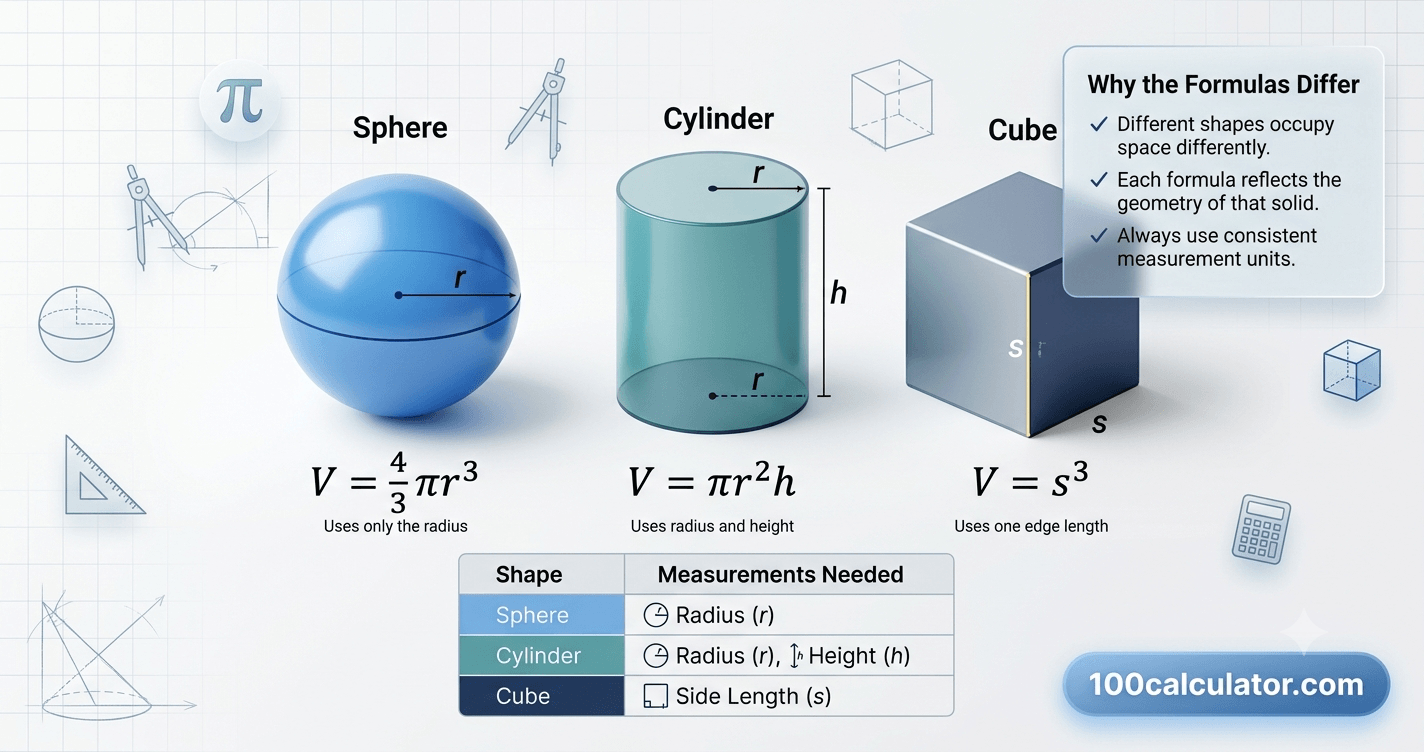
For a deeper look at how sphere and cylinder formulas relate, see our guide on volume of a sphere vs cylinder.
Real-World Uses for Sphere Volume
Sphere volume calculations show up in more places than a typical geometry worksheet.
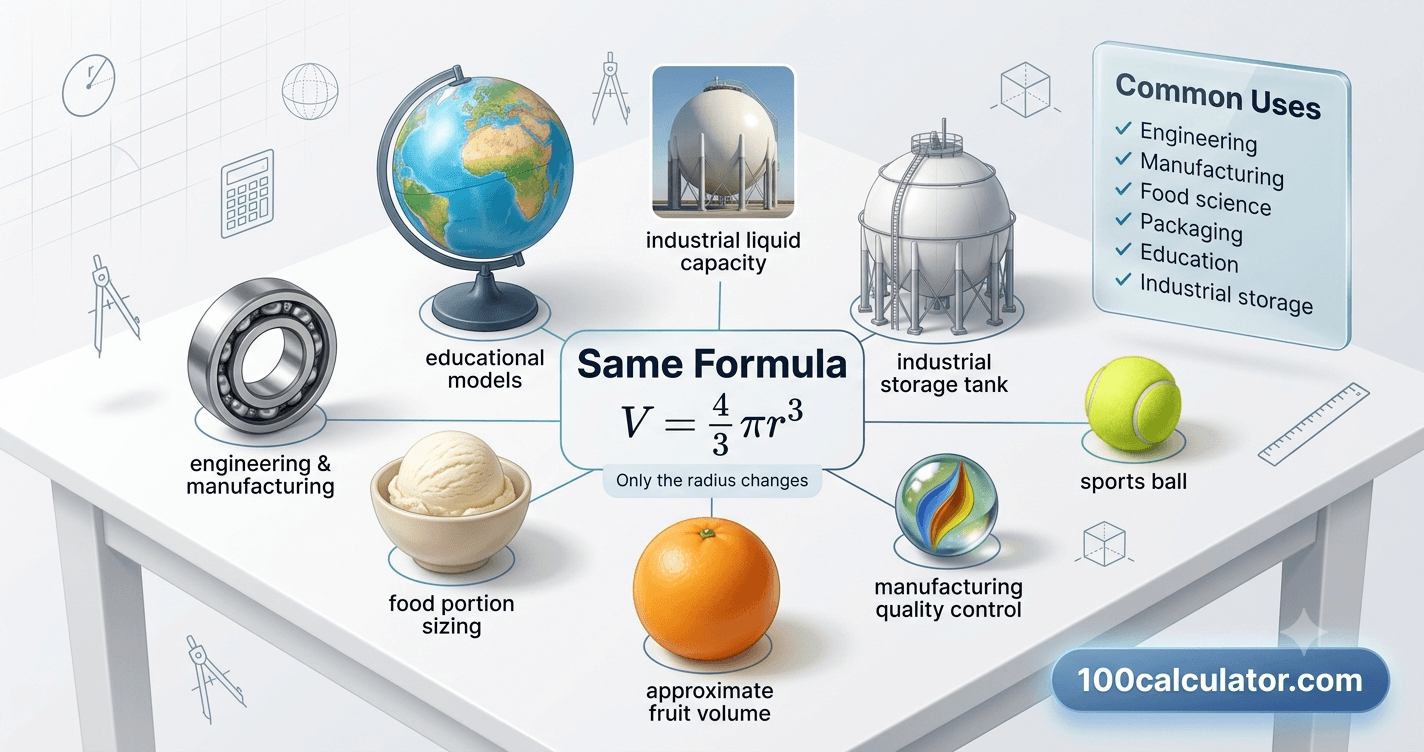
- Manufacturing: calculating how much steel or plastic goes into ball bearings, valves, and molded parts
- Packaging and shipping: figuring out how much product fits inside a round container or estimating weight from material density
- Storage and construction: sizing spherical tanks, silos, and pressure vessels
- Science: estimating the volume of cells, droplets, planets, and other round objects in biology, chemistry, and astronomy
- 3D printing and design: calculating material use for spherical or rounded models
- Everyday cooking: estimating how much filling fits inside a round scoop or a spherical mold
Practice Problems to Test Yourself
Try these on your own before checking the answers. Round to two decimal places unless noted otherwise, and feel free to check any answer against 100 Calculator's Volume of a Sphere Calculator once you've worked it out by hand.
- A sphere has a radius of 4 cm. What is its volume?
- A sphere has a diameter of 6 inches. What is its volume?
- A sphere has a radius of 10 meters. What is its volume, rounded to the nearest whole number?
- A sphere has a volume of 33.51 cm³. What is its radius, rounded to one decimal place?
Check your answers
1. V = (4/3) × π × (4)³ = (4/3) × π × 64 ≈ 268.08 cm³
2. Radius = 3 in. V = (4/3) × π × (3)³ = 36π ≈ 113.10 in³
3. V = (4/3) × π × (10)³ = (4/3) × π × 1,000 ≈ 4,189 m³
4. r³ = (33.51 × 3) ÷ (4 × π) ≈ 8.00, so r ≈ 2.0 cm
Using an Online Volume of a Sphere Calculator
Working through the formula by hand is a great way to understand what's happening, but it isn't always the fastest option, especially if you need several calculations done quickly or want to double-check your own math.
Free Online Tool
Skip the manual math
100 Calculator's Volume of a Sphere Calculator handles the entire formula for you. Enter a radius or a diameter, in whichever unit you're working with, and it returns the volume instantly. It's free, runs right in your browser, and doesn't require an account.
This is especially useful for checking homework, running several "what if" scenarios for a project, like comparing tank sizes, or confirming a hand calculation before you commit to it. A calculator won't teach you the formula, but pairing one with the steps in this guide gives you both speed and understanding.
Related Calculators
Put what you just read into practice, try these free tools instantly, no sign-up required.
Interval of Convergence Calculator
Find the interval of convergence for any power series.
Mean Absolute Deviation Calculator
Calculate the mean absolute deviation for any data set.
P Value Calculator
Calculate the p-value for your hypothesis test statistic.
Volume of a Sphere Calculator
Calculate the volume of a sphere from its radius or diameter.
Z Score Calculator
Calculate the z-score for a value within a normal distribution.
More From Math & Statistics
Still building your math toolkit? These related guides dig into other formulas and concepts from the same category.
Frequently Asked Questions
What is the formula for the volume of a sphere?
The formula for the volume of a sphere is V = (4/3) × π × r³, where V is the volume and r is the radius. To use it, cube the radius (multiply it by itself three times), multiply that result by pi (about 3.14159), then multiply by four-thirds. The answer comes out in cubic units, matching whatever unit you used for the radius.
How do you find the volume of a sphere if you only know the diameter?
Divide the diameter by 2 to get the radius, then use the standard formula, V = (4/3)πr³. Or use the diameter version directly: V = (1/6)πd³. Both give the same result. For example, a sphere with a 10 cm diameter has a 5 cm radius, and either formula returns a volume of about 523.60 cm³.
What is the volume of a sphere with a radius of 5 cm?
A sphere with a 5 cm radius has a volume of about 523.60 cubic centimeters. Using the formula: V = (4/3) × π × (5)³ = (4/3) × π × 125 ≈ 523.60 cm³. This is one of the most common example values used in geometry classes, so it's a handy one to remember as a reference point.
How is the sphere volume formula different from the surface area formula?
Volume, V = (4/3)πr³, tells you how much space is inside a sphere, measured in cubic units. Surface area, SA = 4πr², tells you how much area covers its outside, measured in square units. Volume includes an extra factor of the radius and a one-third multiplier compared to surface area, which is why the two numbers grow at different rates as a sphere gets bigger.
Why is the volume of a sphere four-thirds pi r cubed?
The 4/3 and the cubed radius both come from adding up the area of infinitely thin circular slices stacked across the sphere, a calculus technique. Long before calculus was formalized, Archimedes reached the same result by comparing a sphere to a cylinder and cone that shared its radius, showing the sphere always equals exactly two-thirds of the cylinder's volume.
What is the difference between a sphere's radius and diameter?
The radius is the distance from the center of the sphere to any point on its surface. The diameter is the full distance across the sphere, passing through the center, and it's always exactly twice the radius (d = 2r). Mixing these two up is one of the most common reasons sphere volume calculations come out wrong.
How do you convert sphere volume from cubic centimeters to liters?
Divide the volume in cubic centimeters by 1,000, since 1 liter equals exactly 1,000 cubic centimeters. For example, a sphere with a volume of 4,500 cm³ holds 4.5 liters. This conversion is exact and doesn't require rounding, since it's built into the definition of the liter.
Can you find the volume of a hemisphere using the sphere formula?
Yes. A hemisphere is exactly half of a sphere, so its volume is half the full sphere formula: V = (2/3)πr³. Calculate the full sphere's volume first using V = (4/3)πr³, then divide by 2, or use the hemisphere formula directly once you know the radius.
What is a real-world example of calculating sphere volume?
Sizing a spherical storage tank is a common real-world example. If a tank has a radius of 3 meters, its volume is V = (4/3)π(3)³ ≈ 113.10 cubic meters, or roughly 113,000 liters. Engineers use this same calculation for pressure vessels, propane tanks, and any other round container where capacity matters.
Is the volume of a sphere always smaller than its circumscribing cylinder?
Yes, always. A sphere's volume is exactly two-thirds the volume of the smallest cylinder that can contain it, a relationship first proven by Archimedes. This holds true no matter how large or small the sphere is, since both volumes scale together with the radius.
How accurate do I need to be when rounding pi in sphere volume calculations?
For most everyday and classroom purposes, 3.14159 is precise enough and keeps your final answer accurate to within a fraction of a percent. For engineering or manufacturing work where tight tolerances matter, use the π key on a calculator, which carries far more decimal places. Either way, round only your final answer, not pi itself, partway through the calculation.
What units should I use for sphere volume?
Use whatever cubic unit matches your radius measurement: cubic centimeters (cm³) for a radius in centimeters, cubic inches (in³) for a radius in inches, and so on. Volume is always expressed in cubic units because it measures three-dimensional space, never in plain linear units like centimeters or inches by themselves.
How do I find the radius if I already know the volume of a sphere?
Rearrange the formula to solve for r: r equals the cube root of (3V ÷ 4π). Multiply the volume by 3, divide by 4π, and then take the cube root of the result. For example, a sphere with a volume of 33.51 cm³ has a radius of about 2 cm.
What's the easiest way to calculate sphere volume without doing the math by hand?
100 Calculator's free Volume of a Sphere Calculator does the entire calculation for you. Enter a radius or diameter, and it returns the volume instantly, with no manual multiplication or rounding required. It's a quick way to double-check homework or confirm a hand calculation before you rely on it.
Does the volume of a sphere formula work for any size sphere?
Yes. V = (4/3)πr³ applies to every sphere, from a grain of sand to a planet, as long as you have an accurate radius measurement. The formula itself never changes based on size; only the numbers you plug into it do, which is what makes it worth memorizing once and reusing everywhere.
What is the volume of a sphere with a diameter of 10 inches?
A 10-inch diameter sphere has a 5-inch radius, giving a volume of about 523.60 cubic inches. That works out to roughly 2.27 US gallons, using the conversion that 1 gallon equals exactly 231 cubic inches. The same two-step process, dividing the diameter by 2 and applying the standard formula, works for any diameter you're given.
How many liters are in a sphere with a 1-meter radius?
A sphere with a 1-meter radius has a volume of about 4.19 cubic meters, which converts to roughly 4,189 liters, since 1 cubic meter equals 1,000 liters. That's a handy number to remember, since a 1-meter radius is a common reference size in engineering.
About 100 Calculator
100 Calculator is a free hub of online calculators and educational guides covering health, finance, trading, crypto, education, math, and more. Every tool is built to be fast, accurate, and genuinely free, with no account or signup required.
We built this guide, and the Volume of a Sphere Calculator referenced throughout it, to make geometry problems easier to work through, from classroom homework to real-world measuring jobs. Head back to the 100 Calculator homepage to explore the full library of tools, or learn more about the team behind them on our About Us page.