Radius vs Interval of Convergence: What Is the Difference?
A clear, beginner-friendly walkthrough of how the radius of convergence and the interval of convergence relate to each other, including the ratio test, why endpoints need their own check, and a full worked example.
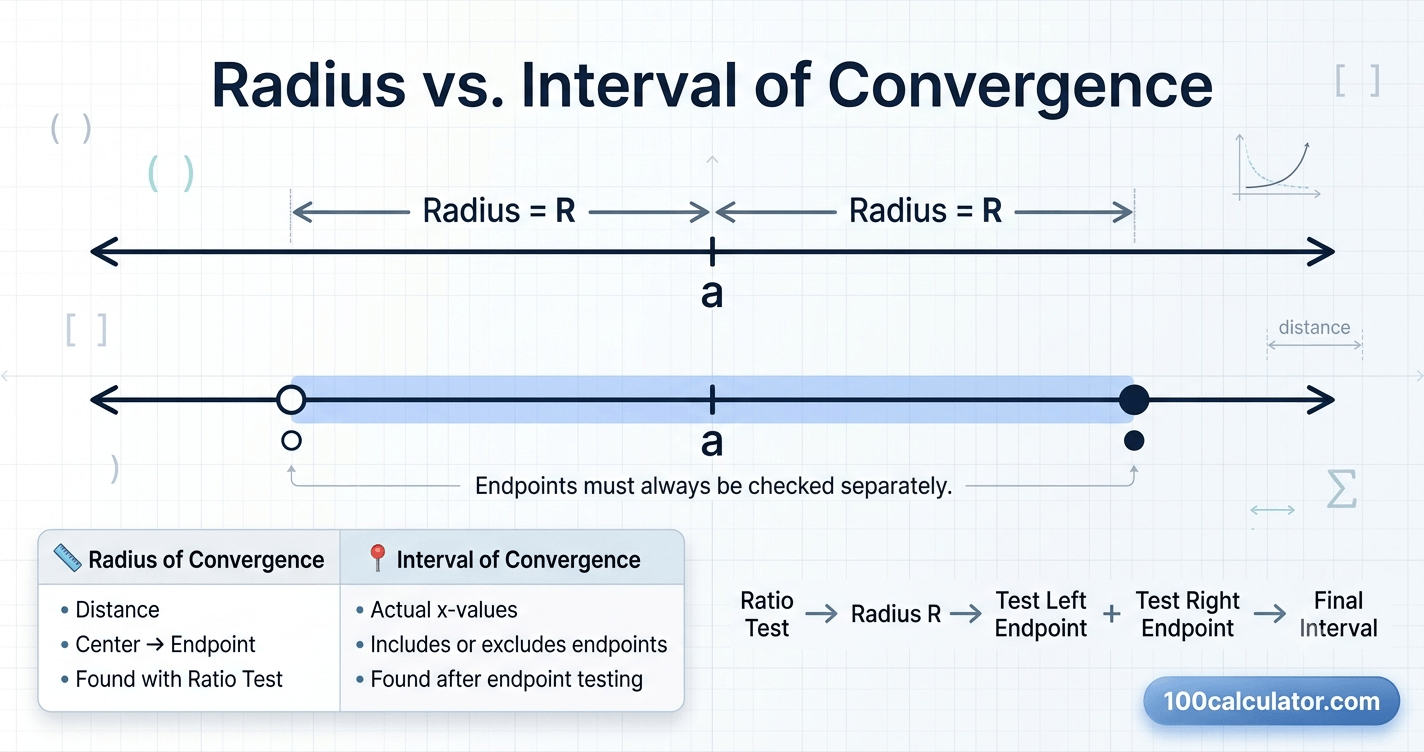
"Radius of convergence" and "interval of convergence" get used together so often in calculus that it's easy to assume they mean the same thing. They don't, and mixing them up is one of the easiest ways to lose points on an otherwise correct problem.
The radius of convergence is a single number that tells you how far a power series reaches from its center before it stops converging. The interval of convergence is the actual set of x-values where the series converges — you find it by taking that radius and then checking each endpoint separately. The radius answers "how far?" The interval answers "exactly which values?"
If you'd rather skip the algebra and check your own work, 100 Calculator's Interval of Convergence Calculator works out both numbers the moment you enter a series' coefficients.
This guide walks through what a power series actually is, how the ratio test gives you the radius, why the two endpoints each need their own separate check, and a complete worked example so you can see the whole process from start to finish. If you'd like the ratio-test steps broken down on their own first, our guide on how to find the interval of convergence for a series covers that in more depth. By the end of this one, you'll be able to look at almost any power series and know exactly which x-values make it work.
What Is a Power Series?
Before comparing the radius and the interval, it helps to be clear on what a power series actually is, since both terms describe a different aspect of the same underlying object.
The General Form of a Power Series
A power series is a sum that looks a lot like a polynomial, except it never stops. Written out in general form, it looks like this:
General Form of a Power Series
f(x) = c₀ + c₁(x − a) + c₂(x − a)² + c₃(x − a)³ + … = Σ cₙ(x − a)ⁿ
a — the center of the series, the value x is measured from
cₙ — the coefficients, one for every power of (x − a)
x — the variable; which value you plug in decides whether the series converges or diverges
When a = 0, the series simplifies to Σ cₙxⁿ, which is the version you'll see most often in an introductory course. The center only shifts where the series is "measured from" — the underlying behavior works the same way either way.
What "Convergence" Actually Means Here
A series converges when adding up more and more of its terms settles on one finite number. It diverges when that never happens, whether the terms grow without bound, alternate forever without settling, or simply don't shrink fast enough.
Plug a specific number in for x, and a power series turns into an ordinary infinite series, one that either converges or diverges for that particular value. The whole point of the radius and interval of convergence is to answer, in one shot, which values of x make that happen and which don't — instead of testing every possible x one at a time.
What Is the Radius of Convergence?
Once you have a power series, the first useful question is how far from the center it actually converges. That distance is the radius of convergence, usually written as R.
Finding R With the Ratio Test
The most common way to find R is the ratio test. (Paul's Online Math Notes) You take the limit of the ratio between consecutive terms, multiply by the distance from the center, and set the result less than 1. Solving that inequality for x tells you exactly how far x can wander from a before the series stops converging.
Ratio Test Shortcut for the Radius
R = lim (n → ∞) | cₙ / cₙ₊₁ |
If the limit is a positive, finite number, that number is R.
If the limit is 0, the series only converges at the center (R = 0).
If the limit is ∞, the series converges for every real number (R = ∞).
This shortcut works well whenever the coefficients follow a clean pattern. When they don't, applying the ratio test directly to the full term, including the (x − a) part, gets you to the same place. We'll do exactly that in the worked example further down.
The Three Possible Values of R
Every power series has exactly one radius of convergence, and it always falls into one of three categories:
- R = 0 — the series only converges at its own center
- 0 < R < ∞ — the series converges within a finite distance of the center and diverges beyond it
- R = ∞ — the series converges no matter what value you plug in for x
We'll come back to the R = 0 and R = ∞ cases in more detail later, since they behave a little differently from the typical finite-radius case.
What Is the Interval of Convergence?
Once you know R, the interval of convergence is the natural next step: the complete, actual set of x-values where the series converges, written as an interval rather than a single number.
Why the Endpoints Need Separate Testing
The ratio test guarantees convergence for |x − a| < R and divergence for |x − a| > R. Right at the boundary — where x = a − R or x = a + R — the ratio test always comes out to exactly 1, which means it can't tell you anything one way or the other.
That inconclusive result is exactly where the radius and the interval genuinely part ways. The radius doesn't need to know what happens at the boundary; the interval can't be complete without knowing it. So each endpoint gets substituted back into the original series and tested on its own, usually with the alternating series test, a comparison test, or the p-series test, covered in more detail further down.
Writing the Interval in Proper Notation
The interval of convergence is written using standard interval notation. (MIT OpenCourseWare) A parenthesis means that endpoint is excluded (the series diverges there), while a square bracket means it's included (the series converges there).
Radius vs Interval of Convergence: The Key Differences
With both terms defined, the difference is easier to see side by side.
Single Number
Radius of Convergence (R)
Tells you how far from the center the series is guaranteed to converge. It's just a distance, so it says nothing about what happens at either boundary point.
Full Range
Interval of Convergence
The actual set of x-values where the series converges, written in interval notation. Built from the radius, plus a separate check of each endpoint.
| Aspect | Radius of Convergence | Interval of Convergence |
|---|---|---|
| What it is | A single number, or ∞ | A set of x-values, written as an interval |
| What it measures | Distance from the center where convergence is guaranteed | The complete range of x-values that actually converge |
| How you find it | Ratio test (or root test) on the terms | Radius, then a separate test at each endpoint |
| Endpoints | Not part of what it describes | Decide whether each bracket is open or closed |
| Possible values | 0, a positive number, or ∞ | A single point, a bounded interval, or all real numbers |
Every power series has exactly one radius of convergence, but that same radius can lead to four different possible intervals, depending on how the two endpoints behave. The next section walks through finding both, from scratch, on an actual series.
How to Find the Radius and Interval of Convergence, Step by Step
With the definitions in place, here's the process you'll use on almost any power series problem.
The 4-Step Method
- Identify the general term. Write the series in the form Σ cₙ(x − a)ⁿ and pin down the center a and the coefficients cₙ.
- Apply the ratio test. Compute lim |aₙ₊₁ / aₙ| for the full term (including the (x − a) part), then set the result less than 1 and solve for x. This gives you the radius R and the open interval (a − R, a + R).
- Test the left endpoint. Substitute x = a − R back into the original series and check whether that specific series converges or diverges.
- Test the right endpoint. Substitute x = a + R back into the original series and check it the same way. Combine both results into the final interval of convergence.
Worked Example: Σ (x − 3)ⁿ / n
Let's find the radius and interval of convergence for Σ (x − 3)ⁿ / n, summed from n = 1 to infinity.
Step 1 — Identify the general term. The center is a = 3, and the general term is aₙ = (x − 3)ⁿ / n.
Step 2 — Apply the ratio test. Dividing consecutive terms:
Applying the Ratio Test
|aₙ₊₁ / aₙ| = |x − 3| · n / (n + 1) → |x − 3| as n → ∞
Setting |x − 3| < 1 gives 2 < x < 4, so R = 1.
The open interval (2, 4) is guaranteed to converge — the two endpoints, x = 2 and x = 4, still need to be checked individually.
Step 3 — Test x = 2. Substituting x = 2 gives Σ (−1)ⁿ / n, the alternating harmonic series. The terms shrink toward zero and alternate in sign, so by the alternating series test, this converges (conditionally, since Σ 1/n itself diverges).
Step 4 — Test x = 4. Substituting x = 4 gives Σ 1/n, the plain harmonic series, which diverges. So x = 4 is excluded.
Putting it together: the radius of convergence is 1, and the interval of convergence is [2, 4) — closed at the left endpoint, open at the right one. Notice that R alone would only tell you "1"; it's the interval that captures the full, slightly asymmetric answer.
Free Online Tool
Want to check a series of your own?
100 Calculator's Interval of Convergence Calculator runs right in your browser. Enter your series' coefficients and it estimates the radius and interval instantly, so you can confirm your by-hand work in seconds.
Testing the Endpoints: Which Tools to Use
Once you substitute an endpoint back into the original series, you're left with an ordinary infinite series that no longer involves x. Which test applies depends on what that series looks like.
The Alternating Series Test
If the substituted series alternates in sign and its terms shrink steadily toward zero, the alternating series test (sometimes called the Leibniz test) usually confirms convergence. This is exactly what happened at x = 2 in the worked example above, and it's one of the most common outcomes at a "converging" endpoint.
The p-Series and Divergence Tests
If the endpoint simplifies to a series shaped like Σ 1/nᵖ, the p-series test settles it immediately: it converges when p > 1 and diverges when p ≤ 1 (the plain harmonic series, Σ 1/n, is the p = 1 case, and it diverges). If the individual terms don't shrink to zero at all, the divergence test (also called the nth-term test) rules out convergence right away, without any further work.
The Four Possible Interval Shapes
Once both endpoints are tested, there are exactly four possible outcomes for the interval of convergence:
| Left Endpoint (a − R) | Right Endpoint (a + R) | Interval of Convergence |
|---|---|---|
| Diverges | Diverges | (a − R, a + R) |
| Converges | Diverges | [a − R, a + R) |
| Diverges | Converges | (a − R, a + R] |
| Converges | Converges | [a − R, a + R] |
Special Cases: When R Is Zero or Infinite
Two situations skip the endpoint-testing step entirely, since there's no finite boundary to check.
R = 0: Convergence at a Single Point
Take Σ n! xⁿ. Applying the ratio test to the general term gives |aₙ₊₁ / aₙ| = (n + 1)|x|, which grows toward infinity for any x other than zero. That means the series only converges at x = 0, so R = 0 and the interval of convergence is just the single point {0}. There's no open interval and no endpoints to test here at all.
R = ∞: Convergence Everywhere
Now take Σ xⁿ / n!. The ratio test gives |aₙ₊₁ / aₙ| = |x| / (n + 1), and as n grows, that ratio shrinks toward 0 no matter which x you picked. Since the limit is always below 1, the series converges for every real number. R = ∞, and the interval of convergence is all of (−∞, ∞).
Common Mistakes to Avoid
A handful of small habits explain most of the lost points on radius and interval of convergence problems:
- Skipping the endpoints entirely. Reporting (a − R, a + R) as the final answer without testing either boundary point is the single most common mistake.
- Reusing the ratio test at the endpoints. The ratio test always equals exactly 1 there, so it can never resolve an endpoint on its own — a different test is required.
- Assuming both endpoints match. One endpoint converging doesn't guarantee the other one does; each needs its own separate check.
- Mixing up the radius with the interval. R is a distance, not an answer to "for which x-values does this converge?" — that's what the interval is for.
- Flipping the bracket convention. A closed bracket means the series converges there; an open parenthesis means it diverges there, not the other way around.
Related Calculators
Put what you just read into practice, try these free tools instantly, no sign-up required.
Interval of Convergence Calculator
Find the interval of convergence for any power series.
Mean Absolute Deviation Calculator
Calculate the mean absolute deviation for any data set.
P Value Calculator
Calculate the p-value for your hypothesis test statistic.
Volume of a Sphere Calculator
Calculate the volume of a sphere from its radius or diameter.
Z Score Calculator
Calculate the z-score for a value within a normal distribution.
Why This Topic Matters
Radius and interval of convergence aren't just an exercise in algebra. Power series, including Taylor and Maclaurin series, are how calculators, computers, and textbooks approximate functions like eˣ, sin(x), and ln(1 + x) using an infinite sum of simpler terms — but only within the interval where that series actually converges. Outside of it, the approximation simply isn't valid, no matter how many terms you add.
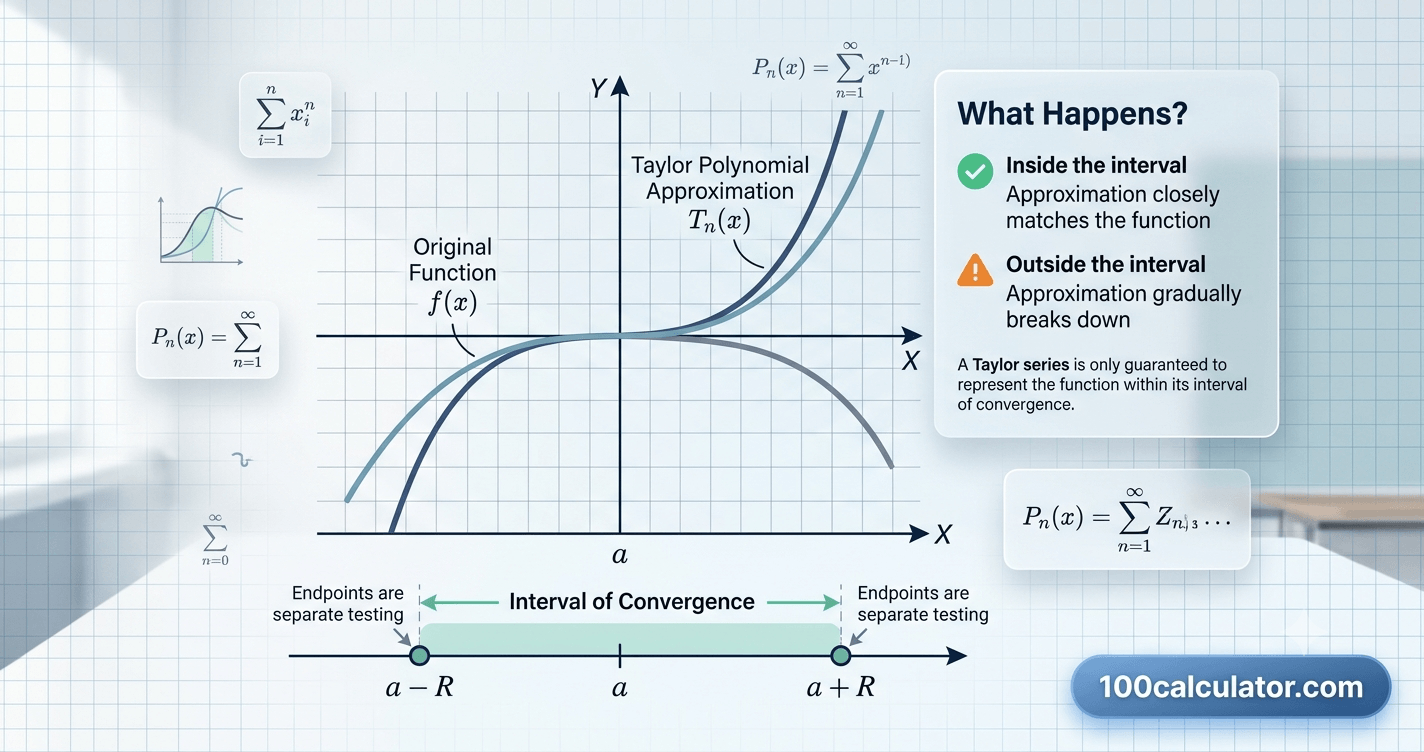
This is exactly why the topic shows up so consistently in Calculus II and AP Calculus BC, and again later in differential equations courses, where power series help solve equations that don't have a tidy closed-form answer. Anywhere an infinite sum is standing in for a function, knowing exactly where that sum is valid matters as much as finding the sum itself. If you're working through problems like these regularly, 100 Calculator's Interval of Convergence Calculator is a quick way to check your radius and interval before moving on to the next step of a longer problem.
Sources & References
This guide draws on standard calculus references for the definitions, the ratio test, and the convergence behavior discussed above:
More From Math & Statistics Guides
Still working through series, spread, or significance? These related guides dig deeper into other Math & Statistics topics covered on 100 Calculator.
Frequently Asked Questions
What is the main difference between radius and interval of convergence?
The radius of convergence is a single number that tells you how far from the center a power series converges. The interval of convergence is the actual set of x-values where the series converges, written as an interval. You get the interval by taking the radius and then checking whether each endpoint should be included.
What is a power series in simple terms?
A power series is an infinite sum of terms that each contain a power of (x − a), where a is a fixed center point and each term has its own coefficient. You can think of it as a very long polynomial that never stops. Depending on the value you plug in for x, that infinite sum either settles on a finite value (converges) or grows without bound (diverges).
How do you find the radius of convergence?
The most common method is the ratio test. Take the limit as n approaches infinity of |cₙ₊₁ / cₙ|, multiply by |x − a|, and set the result less than 1. Solving that inequality for x tells you how far x can be from the center before the series stops converging — that distance is the radius, R.
What is the ratio test?
The ratio test is a method for checking whether an infinite series converges by looking at the limit of the ratio between consecutive terms. If that limit is less than 1, the series converges absolutely. If it's greater than 1, or infinite, the series diverges. If it equals exactly 1, the test can't tell you anything, and you need a different method.
Do I always need to check both endpoints?
Yes, whenever the radius of convergence is a positive, finite number. The ratio test always gives exactly 1 at both endpoints, which means it can't tell you whether the series converges there. You have to substitute each endpoint back into the original series and test it separately, often with the alternating series test or a comparison test. The only exceptions are when R = 0 or R = ∞, since there are no finite endpoints to check.
What test should I use to check an endpoint?
It depends on what the series looks like once you substitute the endpoint value in. If the result alternates in sign and the terms shrink to zero, the alternating series test usually works. If it simplifies to a series like Σ 1/nᵖ, the p-series test tells you whether it converges. If the terms don't approach zero at all, the series diverges automatically by the divergence test.
What happens if the ratio test gives exactly 1?
A ratio test result of exactly 1 means the test is inconclusive — it simply can't tell you whether the series converges or diverges at that point. This is exactly what happens at both endpoints of the interval of convergence, which is why those two points always need to be checked using a different test instead of relying on the ratio test again.
Can the radius of convergence be zero?
Yes. A radius of convergence of zero means the power series only converges at its center point, x = a, and diverges everywhere else. This happens when the coefficients grow so quickly that no value of x other than the center keeps the series from blowing up. In this case, the interval of convergence is just the single point x = a.
Can the radius of convergence be infinite?
Yes. An infinite radius of convergence means the series converges for every real number, with no boundary to worry about. Many familiar series, like the ones representing eˣ, sin(x), and cos(x), have an infinite radius of convergence, so their interval of convergence is simply all real numbers, often written as (−∞, ∞).
Is the interval of convergence always centered on the same point as the series?
Yes. The interval of convergence is always centered on a, the same center point used in the power series itself. The radius of convergence measures how far the interval extends in each direction from that center, so the midpoint of the interval always matches the center of the series, even if the two endpoints behave differently.
What's the difference between absolute and conditional convergence at an endpoint?
A series converges absolutely if it still converges after you take the absolute value of every term. It converges conditionally if the original series converges, but taking absolute values would make it diverge. This distinction often comes up at the endpoints of an interval of convergence, where a series can converge conditionally, such as through the alternating series test, even though the same series without alternating signs would diverge.
Can the interval of convergence be just a single point?
Yes, this happens whenever the radius of convergence equals zero. In that case, the series only converges when x equals the center, a, and diverges for every other value of x. It's technically still called the "interval" of convergence in this situation, even though it contains just one point rather than a range.
What's the difference between the ratio test and the root test?
Both tests can find the radius of convergence, and they always agree when both apply. The ratio test looks at the limit of the ratio between consecutive coefficients, while the root test looks at the limit of the nth root of the coefficients. The ratio test is usually simpler to compute by hand, but the root test (formalized as the Cauchy-Hadamard theorem) works in some cases where the ratio test's limit doesn't exist.
How do I write the interval of convergence correctly?
Use standard interval notation, with a parenthesis for an excluded (open) endpoint and a bracket for an included (closed) endpoint. For example, [2, 4) means the series converges at x = 2 but not at x = 4, while everything strictly between the two values converges as well. Always base the notation on what your endpoint tests actually showed, rather than assuming both sides behave the same way.
Where does this topic come up in real math courses?
Radius and interval of convergence are core topics in Calculus II and AP Calculus BC, usually taught alongside Taylor and Maclaurin series. They also show up in differential equations courses, where power series are used to solve equations that don't have simple closed-form solutions, and in any math or engineering course that relies on approximating functions with infinite sums.
Can I check my answer with a calculator?
Yes. 100 Calculator's free Interval of Convergence Calculator lets you enter your series' coefficients and quickly see the radius and a suggested interval, which is a fast way to double-check your by-hand work. It's still worth understanding the ratio test and endpoint checks yourself, since a calculator can confirm an answer but won't teach you why a particular endpoint converges or diverges.
About 100 Calculator
100 Calculator is a free hub of online calculators and educational guides covering math, statistics, finance, trading, crypto, health, and more. Every tool is built to be fast, accurate, and genuinely free, with no account or signup required.
We built this guide, and tools like the Interval of Convergence Calculator referenced throughout it, to make calculus topics a little less intimidating to work through. Head back to the 100 Calculator homepage to explore the full library of tools, or learn more about the team behind them on our About Us page.