How to Find the Interval of Convergence for a Series
A step-by-step walkthrough of the ratio test, endpoint checks, and worked examples, so you can find the interval of convergence for any power series with confidence.
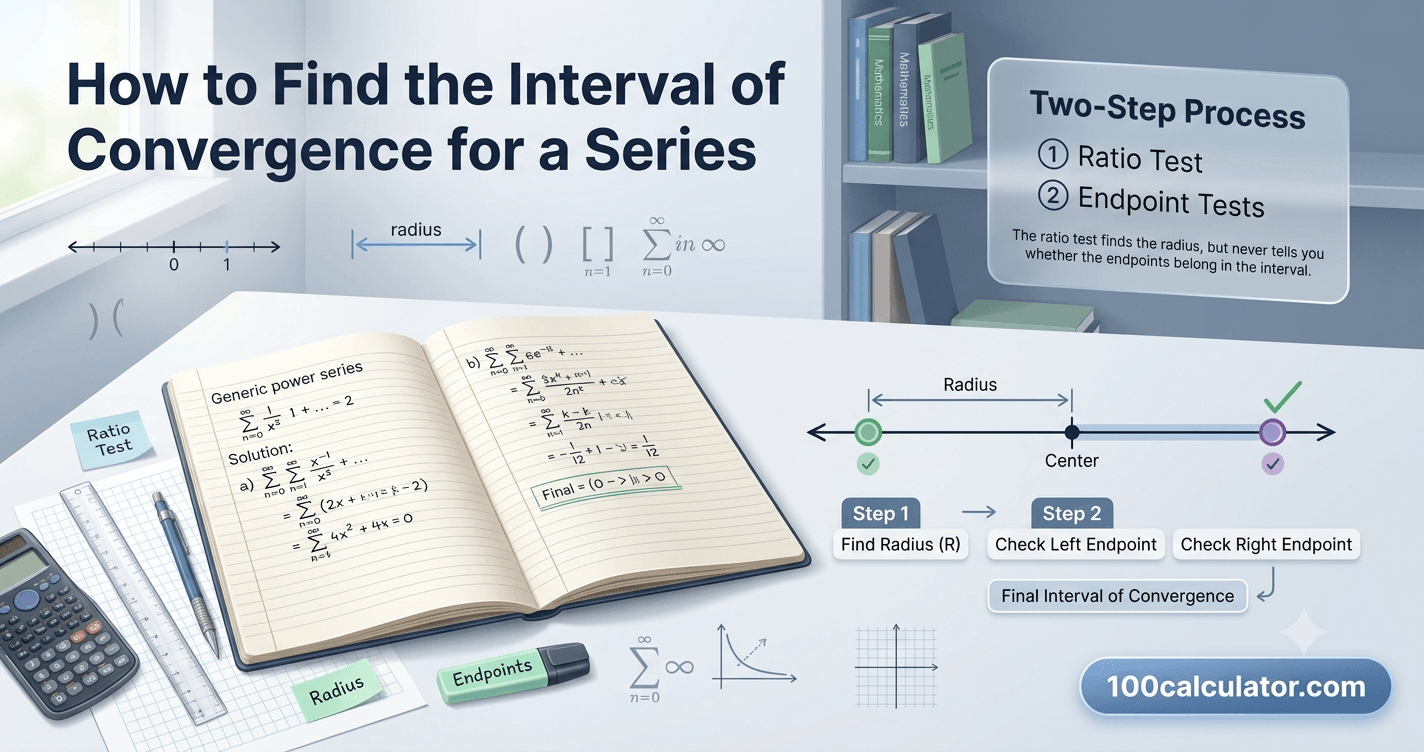
Power series show up all over calculus, from approximating functions like eˣ and sin(x) to solving differential equations. But a power series doesn't behave the same way for every value of x you plug in. For some values, the infinite sum settles down to a real number. For others, it grows without bound and never settles at all.
The interval of convergence is the range of x-values for which a power series adds up to a finite sum. It's built from the radius of convergence, a single number describing how far the series extends from its center in each direction, plus a separate check of the two endpoint values, since the test used to find the radius can't tell you what happens exactly at the edges.
Most students find the radius using the ratio test, then plug each endpoint back into the original series to see whether it still converges there. If you'd rather check your work instead of grinding through it by hand every time, 100 Calculator's Interval of Convergence Calculator handles both steps automatically and shows you the full interval in seconds.
This guide walks through the whole process: what a power series actually is, how the ratio test finds your radius, how to handle the endpoints correctly, and several worked examples so you can see the method from start to finish.
What Is a Power Series?
A power series is an infinite sum of terms, where each term is a coefficient multiplied by (x minus some center point) raised to an increasing whole-number power. You can picture it as a polynomial that never stops adding terms.
General Form of a Power Series
Σ (n = 0 to ∞) cn(x − a)n
=
c0 + c1(x − a) + c2(x −
a)2 + c3(x − a)3
+ …
Here, cₙ is the coefficient of the nth term, x is the variable, and a is the center of the series. When a series is centered at zero, this simplifies to Σ cₙxⁿ.
The coefficients cₙ can come from almost anywhere: a simple pattern like 1/n!, a recursive rule, or the derivatives of a function if you're building a Taylor series. What matters for this guide is what happens once you plug in a specific number for x.
Why Convergence Matters for a Series
Plug one value of x into a power series, and the infinite sum might settle down to a specific number as you add more and more terms. That's convergence. Plug in a different value, and the terms might keep growing forever without ever settling down. That's divergence. Since every power series is centered at some point a, values of x close to that center are more likely to converge, and values far away are more likely to diverge. The interval of convergence is simply where that boundary falls.
The General Form of a Power Series
Every power series has three moving pieces: the coefficients cₙ, the center a, and the variable x. When a = 0, the series is centered at the origin and often looks simpler, written as Σ cₙxⁿ. When a is any other number, the series is shifted, and you'll see (x − a) raised to each power instead of just x.
What Is the Radius of Convergence?
The radius of convergence, always written as R, is the distance from the center a to the edge of the region where the series converges. If R = 3 and the series is centered at a = 0, the series converges for every x between −3 and 3, at least before you worry about the endpoints.
R can be any non-negative number, or infinity. A radius of 0 means the series only converges at its center point. A radius of infinity means the series converges for every real number, no matter how large or small x gets.
Picturing the Radius on a Number Line
It helps to picture the radius as a literal distance on a number line. Mark the center point a, then measure R units to the left and R units to the right. Everything strictly between those two marks converges, and everything outside them diverges. The two marks themselves, a − R and a + R, are the endpoints, and they each need their own separate test.
What Is the Interval of Convergence?
The interval of convergence turns the radius into an actual set of numbers, written in standard interval notation. It always has the form (a − R, a + R) at minimum, and then each endpoint gets added back in with a square bracket if the series converges there, or left out with a parenthesis if it diverges there.
Open, Closed, and Half-Open Intervals
Once you check both endpoints, there are four possible outcomes:
- Both endpoints converge → closed interval [a − R, a + R]
- Neither endpoint converges → open interval (a − R, a + R)
- Only the left endpoint converges → half-open interval [a − R, a + R)
- Only the right endpoint converges → half-open interval (a − R, a + R]
The Ratio Test: Step by Step
The ratio test is the standard tool calculus courses use to find the radius of convergence. (Paul's Online Math Notes) It compares the size of one term in the series to the size of the term right before it, then asks what happens to that ratio as you go further and further out in the series.
The Ratio Test
L = lim (n → ∞) |an+1 / an|
If L < 1, the series converges. If L > 1, the series diverges. If L = 1, the test can't tell you anything, and you'll need to check that x-value separately.
Applying the Ratio Test Step by Step
- Set up the ratio. Write out an+1 divided by an, then take the absolute value of the whole expression.
- Simplify. Cancel matching factors, simplify any exponents, and reduce factorials where possible. Most of the n-dependent parts should cancel down to a much simpler expression.
- Take the limit as n approaches infinity. What's left should be an expression in terms of x alone, since the n-dependent pieces usually simplify to a constant or disappear entirely.
- Set the result less than 1 and solve for x. Whatever inequality you land on, written in the form |x − a| < R, hands you the center and the radius at the same time.
Reading Your Result
Once you've simplified the limit, here's what each outcome tells you:
| Result | What It Means |
|---|---|
| L < 1 | The series converges (absolutely) at that x |
| L > 1 | The series diverges at that x |
| L = 1 | The test is inconclusive; check that x-value separately |
How to Test the Endpoints
Once you have your radius and a candidate interval, the ratio test's job is finished. It genuinely can't tell you anything about the two exact endpoint values, since that's precisely where its limit equals 1. You have to go back to the original series, plug in each endpoint number for x, and test the resulting series on its own.
How to Check Each Endpoint
- Substitute the left endpoint (a − R) for x in the original series and simplify.
- Identify the resulting series. Once x is replaced by a number, you're usually left with a p-series, a geometric series, or an alternating series.
- Apply the matching test — the alternating series test, a p-series comparison, or the direct comparison test all work well here, since the ratio test itself won't help at this exact value.
- Repeat the same process for the right endpoint (a + R), since the two endpoints can behave completely differently from each other.
Absolute vs Conditional Convergence at Endpoints
A series converges absolutely if it still converges after every term is made positive. It converges conditionally if it only converges with its original positive and negative signs intact, and would diverge if every term were forced positive. Endpoints of an interval of convergence often turn out to converge conditionally, especially once you're dealing with an alternating series.
Worked Examples From Start to Finish
The steps make a lot more sense once you see them applied to real series. Here are four examples that cover the situations you're most likely to run into, from a straightforward finite radius to the two extreme cases of R = 0 and R = ∞.
Example 1 – A Series Centered at Zero
The Series
Σ (n = 1 to ∞) xn / n
Applying the ratio test gives |x| · n/(n + 1), which approaches |x| as n grows large. Setting |x| < 1 gives a radius of R = 1, centered at a = 0, for a candidate interval of (−1, 1).
At x = 1, the series becomes Σ 1/n, the harmonic series, which diverges. At x = −1, it becomes Σ (−1)ⁿ/n, the alternating harmonic series, which converges conditionally. That makes the final interval of convergence [−1, 1).
Example 2 – A Series Centered at a Nonzero Value
The Series
Σ (n = 1 to ∞) (x − 3)n / (n · 4n)
This one looks more intimidating, but it follows the same pattern as Example 1, just shifted and scaled. The ratio test simplifies to |x − 3|/4, so setting that less than 1 gives R = 4, centered at a = 3, for a candidate interval of (−1, 7).
At x = 7, the series becomes Σ 1/n, which diverges. At x = −1, it becomes the alternating harmonic series again, Σ (−1)ⁿ/n, which converges conditionally. The final interval of convergence is [−1, 7).
Example 3 – A Series With an Infinite Radius
The Series
Σ (n = 0 to ∞) xn / n!
This is the power series for eˣ. Applying the ratio test gives |x|/(n + 1), and since that limit heads to 0 as n grows, no matter what x is, the inequality L < 1 is always true. That means the series converges for every real number, so R = ∞ and the interval of convergence is (−∞, ∞). There are no endpoints to check, since the interval never ends.
Example 4 – A Series That Converges at Only One Point
The Series
Σ (n = 0 to ∞) n! xn
Here, the ratio test gives (n + 1)|x|, which grows toward infinity for any x other than 0. Since that means L > 1 for every nonzero x, the series only converges at its center. So R = 0, and the interval of convergence is a single point: {0}. Every power series is guaranteed to converge at its own center, even when it converges nowhere else.
Special Cases You Should Know
Most series you'll work with land somewhere in the middle, with a finite, nonzero radius. But it's worth recognizing the two extremes so you're not thrown off when they show up.
| Radius (R) | What It Means | Interval of Convergence |
|---|---|---|
| R = 0 | Series converges only at its center | A single point: {a} |
| 0 < R < ∞ | Series converges within a finite distance of the center | A finite interval; endpoints vary |
| R = ∞ | Series converges for every real number | All real numbers: (−∞, ∞) |
When the Radius Is Zero
A radius of zero usually shows up when the coefficients grow extremely fast, like when a factorial sits in the numerator instead of the denominator. Example 4 above shows exactly this pattern.
When the Radius Is Infinite
An infinite radius usually shows up when the coefficients shrink fast enough to overpower any growth from x, most commonly when a factorial sits in the denominator. This is exactly how the power series for eˣ, sin(x), and cos(x) all behave.
Common Mistakes to Avoid
Even once you understand the method, a few small habits can throw off an otherwise correct answer. Here's what to watch for:
- Forgetting to test the endpoints at all and reporting the open interval as your final answer
- Assuming both endpoints behave the same way, when one can converge while the other diverges
- Mixing up the radius with the interval when writing the final answer on a test or homework set
- Losing track of absolute value signs while simplifying the ratio, especially with negative coefficients
- Treating L = 1 as automatic convergence or divergence instead of testing that value separately
- Forgetting that the center always converges, even in the R = 0 case
Using an Interval of Convergence Calculator
Working through the ratio test and endpoint checks by hand is the best way to actually learn the method, but it's also easy to make a small slip, especially with factorials, negative signs, or a shifted center. Once you've solved a problem yourself, checking it against a calculator is a fast way to catch mistakes before they show up on a homework set or exam.
Free Online Tool
Check your work in seconds
100 Calculator's Interval of Convergence Calculator takes your series, walks through the ratio test, and tells you the radius, the full interval, and how each endpoint behaves, with no download or account required.
What a Good Calculator Should Show You
- The radius of convergence, clearly labeled
- The candidate interval before endpoints are checked
- Whether each endpoint converges or diverges, and why
- The final interval, written in correct interval notation
Interval of Convergence vs. Radius of Convergence
These two terms describe the same underlying idea from different angles, and it's easy to mix them up when you're writing a final answer. Our guide to radius vs. interval of convergence goes deeper into the distinction, but here's the short version.
| Aspect | Radius of Convergence | Interval of Convergence |
|---|---|---|
| What it is | A single number (a distance) | A range of x-values |
| Symbol | R | Written as (a − R, a + R), adjusted for endpoints |
| Includes endpoints? | Not applicable; it's just a distance | Sometimes, depending on the endpoint tests |
| Found using | The ratio test (or root test) | The radius, plus separate endpoint tests |
| Example | R = 4 | [−1, 7) |
Related Calculators
Put what you just read into practice, try these free tools instantly, no sign-up required.
Interval of Convergence Calculator
Find the interval of convergence for any power series.
Mean Absolute Deviation Calculator
Calculate the mean absolute deviation for any data set.
P Value Calculator
Calculate the p-value for your hypothesis test statistic.
Volume of a Sphere Calculator
Calculate the volume of a sphere from its radius or diameter.
Z Score Calculator
Calculate the z-score for a value within a normal distribution.
Where This Shows Up: Calculus II and AP Calculus BC
Radius and interval of convergence are core parts of the infinite series unit in AP Calculus BC, and questions on this topic appear regularly across both the multiple-choice and free-response sections of the exam. (College Board) Outside of AP Calculus, the same material typically shows up in the Series and Sequences chapter of a college Calculus II course.
Taylor and Maclaurin Series Connections
Once you're comfortable with the interval of convergence, the next step in most courses is Taylor and Maclaurin series, which use power series to approximate functions like eˣ, sin(x), and ln(1 + x). If you're studying for the exam itself, 100 Calculator's AP Calc BC Score Calculator can help you translate your practice results into an estimated score.
If you're brushing up on other statistics topics alongside calculus, our Z Score Calculator and P Value Calculator cover two other concepts that show up often in intro statistics courses.
More From Math & Statistics
Still building your comfort with series, statistics, or geometry formulas? These related guides dig deeper into the topics that pair naturally with this one.
Frequently Asked Questions
What is the interval of convergence?
The interval of convergence is the set of every x-value for which a power series adds up to a finite number. It's usually written as an interval, such as (a − R, a + R), and may include one, both, or neither endpoint depending on the series. Any x-value outside this interval causes the series to diverge instead of settling on a finite sum.
What is the radius of convergence?
The radius of convergence, written as R, is the distance from a power series' center to the edge of the region where it converges. If a series is centered at x = a, it converges for every x within R units of a, meaning any x that satisfies |x − a| < R. R can be zero, a positive number, or infinite.
How do you find the radius of convergence?
Most students find the radius of convergence with the ratio test. You divide one term of the series by the term before it, take the absolute value, and find the limit as n approaches infinity. Setting that limit less than 1 and solving for x gives you an inequality in the form |x − a| < R, which hands you the radius directly.
What is the difference between radius and interval of convergence?
The radius of convergence is a single number that measures how far the series extends from its center before it starts to diverge. The interval of convergence is the actual list of x-values that work, built from that radius plus a separate check of both endpoints. In short, the radius gives you the size, and the interval gives you the exact boundaries.
Why do you need to test the endpoints separately?
The ratio test only describes what happens strictly inside the radius of convergence. Right at the two endpoints, the ratio test's limit equals exactly 1, which means the test can't tell you anything at that point. You have to substitute each endpoint back into the original series and check it with a different tool, such as the alternating series test or a direct comparison.
What happens when the ratio test gives exactly 1?
A limit of exactly 1 means the ratio test is inconclusive at that value of x, which is almost always exactly what happens at the two endpoints of your interval. The test simply can't decide convergence or divergence there. You'll need to plug that specific x-value into the original series and test the resulting numerical series on its own.
Can the interval of convergence be infinite?
Yes. Some power series converge no matter what value you plug in for x, which means the radius of convergence is infinite and the interval of convergence is every real number. This usually happens when the coefficients include a factorial in the denominator, since factorials grow fast enough to force the ratio test's limit to zero regardless of x.
Can the radius of convergence be zero?
Yes. A radius of convergence of zero means the power series only converges at its own center point and diverges everywhere else. This typically happens when the coefficients grow extremely quickly, such as when a factorial shows up in the numerator instead of the denominator.
Is the interval of convergence always symmetric around the center?
The radius itself is always the same distance in both directions from the center, but the finished interval can look asymmetric once you factor in the endpoints. It's entirely possible for a series to converge at the left endpoint while diverging at the right one, or the other way around.
What's the difference between the ratio test and the root test?
Both tests produce a limit, L, that you compare against 1 to judge convergence. The ratio test compares each term to the one before it, while the root test takes the nth root of the absolute value of the nth term. The root test tends to be easier when every term in the series is already raised to the nth power.
Do all power series have a radius of convergence?
Yes, every power series has a radius of convergence, even if that radius turns out to be zero or infinite. This is a guaranteed property of power series, unlike general infinite series, which don't always follow such a clean, predictable pattern.
What does absolute versus conditional convergence mean at an endpoint?
A series converges absolutely if it still converges after every term is made positive. It converges conditionally if it only converges because of its original mix of positive and negative terms, and would diverge if every term were made positive. Endpoints of an interval of convergence often turn out to converge conditionally, especially with alternating series.
Is interval of convergence tested on the AP Calculus BC exam?
Yes. Radius and interval of convergence are core parts of the infinite series unit in AP Calculus BC, and questions on this topic appear regularly in both the multiple-choice and free-response sections of the exam. Students are expected to apply the ratio test by hand and justify how they checked each endpoint.
What's a fast way to check my interval of convergence answer?
After working through a problem by hand, entering your series into 100 Calculator's Interval of Convergence Calculator is a quick way to confirm your radius, your candidate interval, and how each endpoint behaves. It's especially useful for catching small mistakes in endpoint testing, which tends to be the step students get wrong most often.
Why does my series sometimes converge at only one point?
If your radius of convergence works out to zero, the series only converges exactly at its center and diverges for every other value of x. This is a valid result, and it usually shows up when the coefficients in the series grow too quickly for the sum to settle down anywhere else.
What is a power series, in simple terms?
A power series is an infinite sum of terms where each term is a number multiplied by (x minus a center point) raised to a whole-number power that keeps increasing. You can think of it as a polynomial that never stops adding terms, and depending on which number you plug in for x, that endless sum either settles on a finite value or grows without any limit.
Can I use the ratio test on any series?
The ratio test works for the vast majority of power series you'll come across in a typical course, but it isn't completely foolproof. If the limit comes out to exactly 1, the test simply won't give you an answer, and for a handful of unusual series, the limit may not simplify cleanly at all. In those situations, the root test or a direct comparison test often works better.
About 100 Calculator
100 Calculator is a free hub of online calculators and educational guides covering math, statistics, finance, health, and more. Every tool is built to be fast, accurate, and genuinely free, with no account or signup required.
We built this guide, along with the Interval of Convergence Calculator referenced throughout it, to make calculus topics like series convergence easier to work through on your own. Head back to the 100 Calculator homepage to explore the full library of tools, or learn more about the team behind them on our About Us page.