Volume of a Sphere vs Cylinder: Formulas Compared
A clear, side-by-side breakdown of the sphere and cylinder volume formulas, with worked examples, a step-by-step derivation, and the surprising 2/3 relationship that connects the two shapes.
A basketball and a soup can are both "round," but working out how much space is inside each one takes two completely different formulas. That's the part about volume that trips people up: shape changes everything, even when two objects seem to belong to the same family.
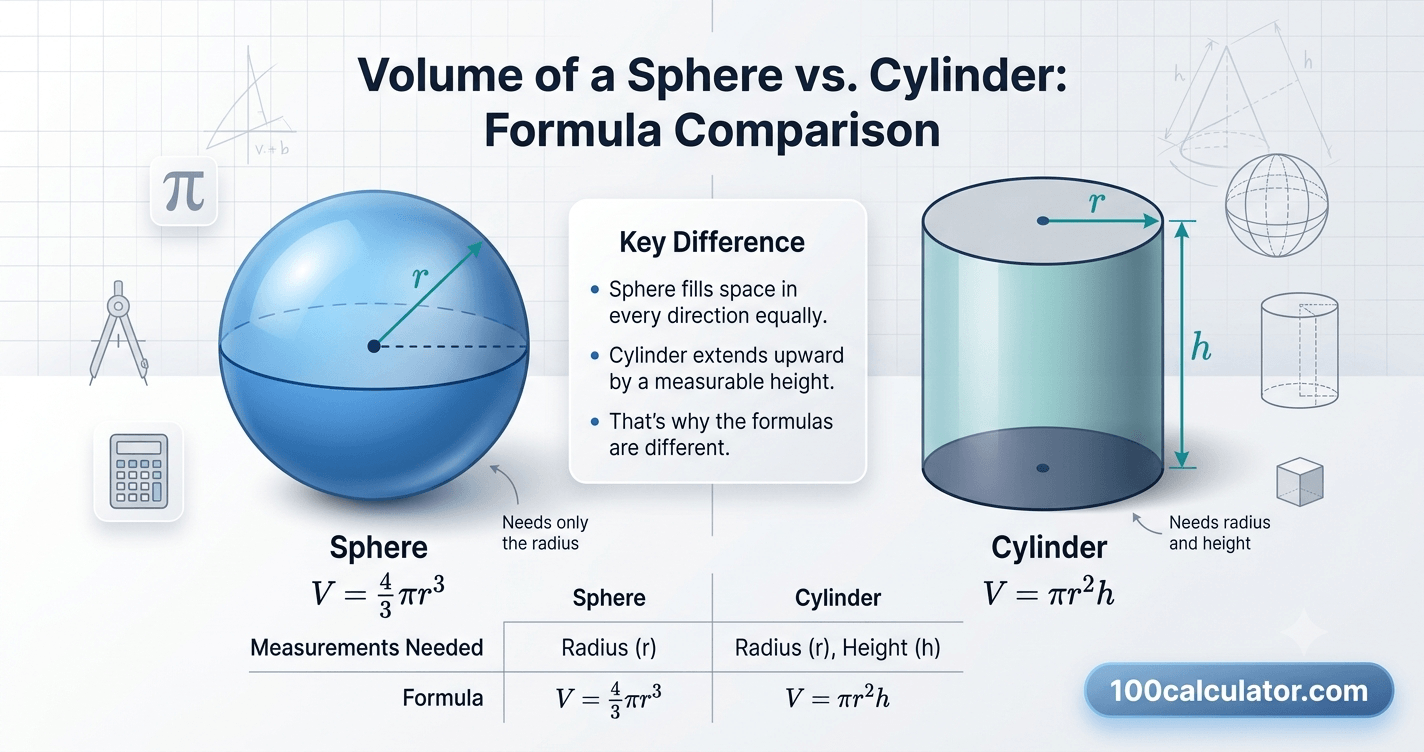
The volume of a sphere is V = (4/3)πr³, and the volume of a cylinder is V = πr²h. The sphere formula only needs the radius, while the cylinder formula needs the radius and the height, because a cylinder can be short and wide or tall and narrow, while a sphere's entire shape is fixed the moment you pick a radius.
Once you see why the formulas are built the way they are, the math stops feeling like something to memorize and starts feeling like something you actually understand. This guide breaks down both formulas from the ground up, shows you exactly where each one comes from, and walks through worked examples so you can check your own numbers. We'll also cover one of the most famous relationships in classical geometry: the exact 2/3 connection between a sphere and the cylinder that encloses it, a discovery its inventor considered so important that he had it carved on his own tombstone.
If you'd rather skip the manual math, 100 Calculator's Volume of a Sphere Calculator does the work instantly — enter a radius or diameter and get an exact answer with the steps shown.
What Is Volume, and Why the Shapes Differ
Volume is simply the amount of three-dimensional space something takes up, measured in cubic units like cubic centimeters (cm³), cubic inches (in³), or liters. If you could pack a shape completely full of tiny unit cubes, volume tells you how many of those cubes it would take.
A sphere and a cylinder are both curved, three-dimensional solids, and that's usually where the similarity ends. A sphere is perfectly round in every direction — think of a ball, a marble, or a planet. A cylinder has two flat, parallel circular ends connected by a curved side — think of a soup can, a pipe, or a roll of paper towels.
That structural difference is exactly why the two volume formulas don't look alike. A sphere's entire shape is locked in by a single measurement, its radius. Once you know the radius, there's only one possible sphere. A cylinder needs two independent measurements: how wide it is (the radius) and how tall it is (the height). Two cylinders can share the same radius and still hold very different amounts depending on height — something that simply isn't possible with a sphere.
Key Terms: Radius, Diameter, and Height
A few terms come up constantly in both formulas, so it helps to nail them down before going further:
| Term | Symbol | What It Means |
|---|---|---|
| Radius | r | The distance from the center of a sphere or circle to its outer edge |
| Diameter | d | The distance straight across a sphere or circle through the center — always twice the radius |
| Height | h | The distance between a cylinder's two circular bases; spheres don't use this measurement at all |
| Pi | π | A constant close to 3.14159 that relates a circle's circumference to its diameter |
Why Shape Changes the Formula
Every volume formula, no matter the shape, comes down to the same basic idea: stack up thin, flat slices of the solid and add up their areas across its height. A cylinder's slices are all identical circles, so multiplying one circle's area by the height gets you the answer directly. A sphere's slices are circles too, but they change size continuously — small near the top and bottom, largest at the middle — which is why the sphere formula needs more mathematical work behind it to arrive at 4/3πr³ instead of a single, simple multiplication.
Why Compare These Two Formulas?
Spheres and cylinders show up together constantly, in packaging, engineering, plumbing, and classroom geometry problems, so it's natural to want to compare them directly. Putting the formulas side by side also makes each one easier to remember, because you can see exactly which parts overlap and which parts don't.
Both formulas share the same two ingredients: π and the radius. The difference is what happens next. The cylinder formula multiplies the circular base's area by a height you choose. The sphere formula raises the radius to the third power and multiplies by a fixed constant, 4/3, because a sphere's shape repeats the radius in every direction at once rather than adding a separate, independent dimension. Seeing that connection is usually what finally makes both formulas click.
The Sphere Volume Formula Explained
The volume of a sphere is calculated with one formula, and it only requires one piece of information: the radius.
Sphere Volume Formula
V = (4/3) × π × r³
V is the volume, π (pi) is approximately 3.14159, and r is the radius. The radius is cubed, meaning it's multiplied by itself three times.
Where the Formula Comes From
Archimedes worked out the sphere volume formula around 225 BCE by comparing a sphere to shapes he already understood: a cylinder and a cone. (Wolfram MathWorld) Using a comparison method that closely resembles modern integral calculus, nearly 2,000 years before calculus was formally developed, he showed that a sphere's volume always works out to exactly 4/3 times π times the radius cubed. We'll look at that relationship in more detail later in this guide, since it's genuinely one of the more elegant results in classical geometry.
What Each Variable Means
Cubing the radius (r³) accounts for the fact that volume grows in three dimensions at once. Double a sphere's radius, and its volume doesn't just double — it multiplies by eight (2³), a detail that surprises a lot of people the first time they calculate it. For a closer look at this formula on its own, with additional worked examples, see our guide on how to calculate the volume of a sphere correctly.
The Cylinder Volume Formula Explained
The cylinder volume formula is more straightforward, because a cylinder is really just a circle "extruded" upward into a third dimension.
Cylinder Volume Formula
V = π × r² × h
V is the volume, π is approximately 3.14159, r is the radius of the circular base, and h is the height between the two bases.
Where the Formula Comes From
A cylinder's volume comes from a much simpler idea than a sphere's. The area of one circular base is πr², a formula most people learn long before they ever touch a cylinder. Stack that circle straight up for a distance of h, without its size changing at any point, and you get πr² × h. Because every cross-section of a cylinder is an identical circle, there's no extra math required beyond multiplying area by height.
What Each Variable Means
Height plays a much bigger role here than it does for a sphere. Doubling a cylinder's height exactly doubles its volume, since height only affects one of the three dimensions. Doubling the radius, on the other hand, quadruples the volume (2²), since radius affects the circular base in two directions at once.
Sphere vs Cylinder: Formulas Side by Side
Putting both formulas next to each other makes the differences easy to spot at a glance.
Sphere
V = 4/3 × π × r³
Needs only the radius (r)
Cylinder
V = π × r² × h
Needs the radius (r) and height (h)
A more detailed comparison shows a few more differences worth knowing, especially if you're studying for a geometry exam. The last two rows assume the shape's other measurement stays fixed while the radius doubles:
| Property | Sphere | Cylinder |
|---|---|---|
| Volume formula | V = 4/3 πr³ | V = πr²h |
| Surface area formula | 4πr² | 2πr² + 2πrh |
| Measurements needed | Radius only (1 value) | Radius and height (2 values) |
| Cross-section shape | Circle, size varies by slice position | Circle, identical at every slice |
| Doubling the radius | Volume multiplies by 8 | Volume multiplies by 4 |
| Doubling the height | Not applicable — spheres have no height | Volume multiplies by 2 |
The Surprising 2/3 Relationship Between a Sphere and Its Cylinder
Here's where the sphere and cylinder formulas connect in a way that surprises most people the first time they see it. Picture a sphere that fits perfectly inside a cylinder, touching the top, the bottom, and the entire way around the sides. That's called an "inscribed" sphere, and its cylinder always has a radius equal to the sphere's radius, with a height equal to the sphere's diameter (2r).
Plug those numbers into both formulas, and something remarkable happens every single time: the sphere's volume is exactly two-thirds of the cylinder's volume, no matter how big or small the sphere is.
Archimedes and the Sphere-in-a-Cylinder Proof
This isn't a coincidence, and it isn't a modern discovery. The Greek mathematician Archimedes proved this exact relationship around 225 BCE in a work called "On the Sphere and Cylinder," and he considered it the finest result of his career. (Britannica) According to historical accounts, he was so proud of the discovery that he asked for a sphere inscribed in a cylinder to be carved into his tombstone. More than a century after his death, the Roman writer Cicero reportedly located Archimedes' overgrown, forgotten grave in Syracuse by recognizing that exact carving.
Why This Still Matters Today
Beyond the history, the 2/3 relationship is a genuinely useful way to sanity-check your own math. If you calculate the volume of a sphere and the volume of its exactly-fitting cylinder, dividing one by the other should always land on roughly 0.6667. If it doesn't, one of your two calculations has an error worth tracking down.
Step-by-Step: How to Calculate the Volume of a Sphere
Here's exactly how to work through the sphere volume formula by hand, whether you're starting from a radius or a diameter.
Sphere Volume From Radius
- Cube the radius. Multiply the radius by itself three times (r × r × r).
- Multiply by π. Use 3.14159 for a precise answer, or 3.14 for a quick estimate.
- Multiply by 4/3. This is the same as multiplying by 4 and then dividing by 3, in either order.
- Add cubic units. The result is in cubic units — cm³, in³, m³, or whatever unit the radius was measured in.
For example, a sphere with a 3 cm radius: 3³ = 27, then 27 × π ≈ 84.82, then 84.82 × 4/3 ≈ 113.10 cm³.
Sphere Volume From Diameter
If you only have the diameter, divide it by 2 first to get the radius, then follow the same steps above. There's also a direct formula that skips that step: V = πd³/6, which comes from substituting r = d/2 into the standard formula.
Step-by-Step: How to Calculate the Volume of a Cylinder
The cylinder formula involves one extra measurement, but the steps are just as mechanical once you know them.
Cylinder Volume From Radius and Height
- Square the radius. Multiply the radius by itself once (r × r).
- Multiply by π. This gives you the area of the circular base.
- Multiply by the height. This "stacks" the base's area upward for the full height of the cylinder.
For example, a cylinder with a 3 cm radius and a 10 cm height: 3² = 9, then 9 × π ≈ 28.27, then 28.27 × 10 ≈ 282.74 cm³.
Cylinder Volume From Diameter and Height
If you're working from a diameter instead of a radius, either divide the diameter by 2 first, or use the direct formula V = πd²h/4, which comes from the same r = d/2 substitution used for the sphere.
Worked Examples: Sphere vs Cylinder Volume in Practice
Seeing the formulas applied to a few different scenarios side by side is often the fastest way to make them stick.
Example 1: A Small Ball vs a Tall Can
Say you have a ball-shaped object with a 5 cm radius, and a can-shaped object with the same 5 cm radius but a 12 cm height.
Sphere: 4/3 × π × 5³ = 4/3 × π × 125 ≈ 523.60 cm³
Cylinder: π × 5² × 12 = π × 25 × 12 ≈ 942.48 cm³
Even with the exact same radius, the cylinder holds close to 80% more than the sphere, simply because its height adds a dimension of size that the sphere doesn't have in the same way.
Example 2: Quick Reference Table by Radius
The table below shows both volumes for several common radius values, using a cylinder height equal to the sphere's diameter (h = 2r) so the two shapes stay directly comparable — the same "inscribed" relationship covered earlier in this guide.
| Radius (r) | Sphere Volume | Cylinder Volume |
|---|---|---|
| 1 cm | ≈ 4.19 cm³ | ≈ 6.28 cm³ |
| 2 cm | ≈ 33.51 cm³ | ≈ 50.27 cm³ |
| 3 cm | ≈ 113.10 cm³ | ≈ 169.65 cm³ |
| 4 cm | ≈ 268.08 cm³ | ≈ 402.12 cm³ |
| 5 cm | ≈ 523.60 cm³ | ≈ 785.40 cm³ |
Notice that every sphere volume in that table is exactly two-thirds of the cylinder volume next to it — the same relationship Archimedes proved more than 2,000 years ago.
Example 3: Working From a Diameter
Say a water storage tank is described as a cylinder with a 6-meter diameter and a 4-meter height. First, convert the diameter to a radius: 6 ÷ 2 = 3 meters. Then apply the cylinder formula: π × 3² × 4 = π × 9 × 4 ≈ 113.10 cubic meters.
Common Mistakes When Calculating Sphere or Cylinder Volume
A handful of small errors account for most of the wrong answers people get with these two formulas.
- Using the diameter instead of the radius. Both formulas call for the radius. Plugging in the diameter by mistake makes the sphere's answer eight times too large and the cylinder's answer four times too large.
- Forgetting to cube the radius for a sphere. Squaring it instead of cubing it is one of the most common sphere-volume errors, since squaring is the more familiar operation from circle area problems.
- Mixing units. A radius in centimeters and a height in meters need to be converted to the same unit before multiplying, or the result won't mean anything.
- Rounding pi too early. Rounding π to 3 or 3.1 partway through a multi-step calculation can throw off the final answer more than expected. Keep at least four decimal places (3.1416) until the very last step.
- Reporting the answer without cubic units. A volume of "113.10" means nothing on its own — it needs to be 113.10 cm³, in³, or whatever unit applies.
- Assuming a cylinder's height equals its radius. Unlike a sphere, a cylinder's height is independent of its radius and has to be measured or given separately.
Real-World Uses for Sphere and Cylinder Volume Formulas
These formulas aren't just classroom exercises. They show up constantly in fields where knowing how much space something holds — or how much material it takes to fill it — actually matters.
When Sphere Volume Comes Up
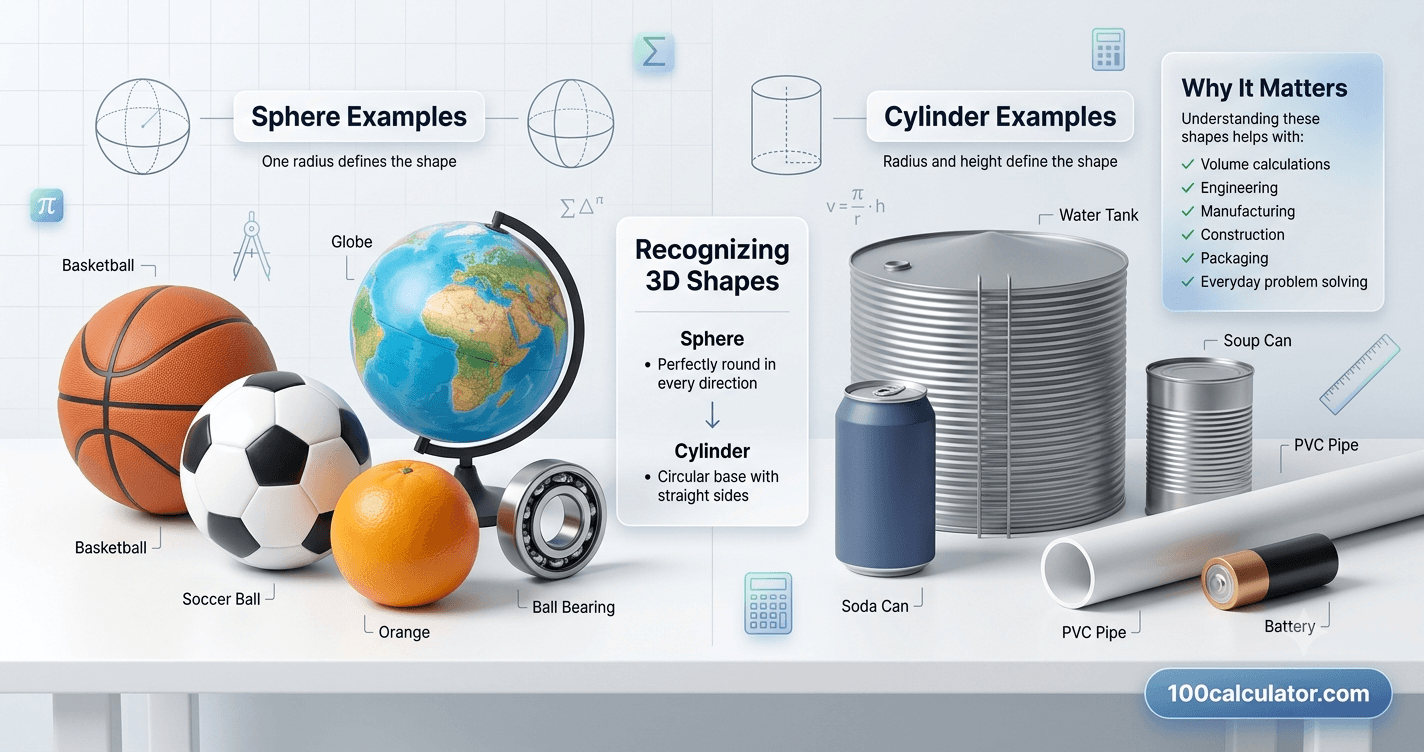
Sphere volume is useful anywhere a round object's capacity or material content matters: estimating the volume of a storage tank's spherical dome, working out how much material goes into manufacturing balls or ball bearings, and rough scientific estimates that model round objects — from cells to planets — as approximate spheres.
When Cylinder Volume Comes Up
Cylinder volume shows up even more often in daily life, since so many manufactured objects are cylindrical: soup cans, water bottles, pipes, silos, drums, and columns. Engineers use it to size pipes and storage tanks, packaging designers use it to work out how much a container holds, and it's one of the first volume formulas most people apply outside of a classroom.
Both formulas are also foundational for more advanced measurement work, like estimating the volume of irregular objects by approximating them as a combination of simpler shapes.
Sphere vs Cylinder: Which Formula Do You Need?
If you're not sure which formula applies to your object, look at its actual shape rather than assuming. Here's a simple way to decide:
Use the Sphere Formula
If your object…
- Is round in every direction, like a ball
- Has no flat sides or edges anywhere
- Looks the same no matter which way you turn it
- Only has one measurement to give: the radius or diameter
Use the Cylinder Formula
If your object…
- Has two flat, circular ends
- Looks the same from the top all the way down
- Has a clear height that's different from its width
- Needs two separate measurements: radius and height
Real objects don't always match a textbook shape perfectly. A gently rounded water bottle, for example, is closer to a cylinder with rounded ends than a pure cylinder, so treat these formulas as strong estimates for imperfect real-world shapes rather than exact answers.
Once you know which formula applies, plugging in your own numbers only takes a minute, but 100 Calculator's Volume of a Sphere Calculator is there whenever you want an instant, error-free result. If your next problem involves data instead of geometry, our Z Score Calculator, P Value Calculator, Mean Absolute Deviation Calculator, and Interval of Convergence Calculator cover some of the other Math & Statistics topics on the site.
Related Calculators
Put what you just read into practice, try these free tools instantly, no sign-up required.
Interval of Convergence Calculator
Find the interval of convergence for any power series.
Mean Absolute Deviation Calculator
Calculate the mean absolute deviation for any data set.
P Value Calculator
Calculate the p-value for your hypothesis test statistic.
Volume of a Sphere Calculator
Calculate the volume of a sphere from its radius or diameter.
Z Score Calculator
Calculate the z-score for a value within a normal distribution.
More From Our Math & Statistics Guides
Curious about other topics in this series? These related guides cover more of the calculators and formulas featured in our Math & Statistics collection.
Frequently Asked Questions
What is the formula for the volume of a sphere?
The volume of a sphere is V = (4/3)πr³, where r is the radius and π is approximately 3.14159. To use it, cube the radius (multiply it by itself three times), multiply that result by π, then multiply by 4/3. A sphere with a 4 cm radius, for example, has a volume of about 268.08 cm³. The formula only needs one measurement, the radius, because a sphere's entire shape is determined by that single value.
What is the formula for the volume of a cylinder?
The volume of a cylinder is V = πr²h, where r is the radius of the circular base and h is the height between the two bases. Square the radius, multiply by π to get the base's area, then multiply by the height. A cylinder with a 3 cm radius and a 10 cm height, for example, has a volume of about 282.74 cm³. Unlike a sphere, a cylinder needs two separate measurements to calculate.
How do you find the volume of a sphere if you only know the diameter?
Divide the diameter by 2 to get the radius, then use the standard formula V = (4/3)πr³. You can also use the diameter directly with V = πd³/6, which comes from substituting r = d/2 into the original formula. Both methods give the same result, so use whichever is easier to remember. Just be careful not to plug the diameter directly into the radius formula, since that makes the answer eight times too large.
Is a sphere's volume always smaller than a cylinder's volume?
Not necessarily — it depends entirely on the cylinder's height. A sphere's volume is only guaranteed to be smaller than a cylinder sharing its radius if that cylinder is tall enough. When a sphere fits exactly inside a cylinder (radius equal, height equal to the diameter), the sphere's volume is always exactly two-thirds of the cylinder's. A short, wide cylinder can actually hold less volume than a sphere with the same radius.
Why is a sphere's volume exactly two-thirds of its surrounding cylinder's volume?
This comes from a proof by the ancient Greek mathematician Archimedes, who showed that a sphere inscribed in a cylinder — touching the top, bottom, and sides — always has a volume equal to exactly 2/3 of the cylinder's volume, no matter the size. You can verify it yourself: a cylinder with radius r and height 2r has volume 2πr³, and a sphere with radius r has volume 4/3πr³ — divide the second by the first and you get 2/3 every time.
What units should I use for sphere and cylinder volume?
Volume is always expressed in cubic units, matching whatever unit you measured the radius and height in. A radius in centimeters gives a volume in cubic centimeters (cm³); working in inches, meters, or feet gives cubic inches, cubic meters, or cubic feet. Make sure the radius and height use the same unit before calculating a cylinder's volume, or convert one of them first.
How do you calculate the volume of a cylinder if you only know the diameter?
Divide the diameter by 2 to find the radius, then use V = πr²h as usual. You can also skip that step with the direct formula V = πd²h/4. Both approaches produce the same answer. As with the sphere formula, the most common mistake here is accidentally using the diameter in place of the radius, which makes the final volume four times larger than it should be.
What's the difference between volume and surface area?
Volume measures the amount of three-dimensional space inside a shape, expressed in cubic units. Surface area measures the total area covering the outside of that shape, expressed in square units. A sphere's volume formula is 4/3πr³, while its surface area formula is 4πr² — notice the surface area formula has no cubing at all, since it describes a 2D "wrapping" around a 3D object rather than the space that object contains.
Can I use these formulas for a hemisphere or half-cylinder?
Not directly, but they're an easy starting point. A hemisphere (half a sphere) has a volume of exactly half the full sphere formula: (2/3)πr³. A half-cylinder, cut lengthwise, similarly has half the volume of a full cylinder: (1/2)πr²h. Both shortcuts assume a clean, even cut straight through the center of the shape.
Why does the cylinder formula use r² while the sphere formula uses r³?
The exponent reflects how many dimensions each measurement affects. A cylinder's radius only shapes its flat circular base, a two-dimensional area, so it's squared (r²) before being multiplied by the height for the third dimension. A sphere's radius shapes every direction of the solid at once, so it needs to be cubed (r³) to account for all three dimensions, and the 4/3 constant comes from the specific geometry of a curved sphere rather than a straight-sided shape.
What's a real-world example of when you'd need the sphere volume formula?
Sphere volume comes up whenever you need to estimate the capacity or material inside a round object — for instance, figuring out how much material goes into manufacturing a rubber ball, estimating the volume of a spherical storage tank dome, or roughly modeling round natural objects like cells, seeds, or planets for a science project. It's less common than cylinder volume in daily life, but it appears often in manufacturing and scientific estimation.
What's a real-world example of when you'd need the cylinder volume formula?
Cylinder volume is everywhere: sizing a water pipe, figuring out how much liquid a can or bottle holds, calculating the capacity of a storage silo or drum, or estimating how much concrete fills a cylindrical column. Because so many manufactured containers and structural supports are cylindrical, this is usually the more frequently used of the two formulas outside a math classroom.
Do I need calculus to understand where these formulas come from?
Not to use the formulas, but calculus — or an equivalent ancient method — is how they were originally derived. The cylinder formula follows from simple area multiplication, no calculus required. The sphere formula is more involved, since a sphere's cross-sections constantly change size. Archimedes worked it out roughly 2,000 years before calculus existed using a comparison method that closely resembles it, and today it's usually taught as an early example of integral calculus.
How accurate do my radius and height measurements need to be?
It depends on what you're using the result for. For a homework problem or quick estimate, rounding your radius and height to a reasonable number of decimal places is fine. For engineering, manufacturing, or anything involving cost or safety, measure as precisely as your tools allow, since small measurement errors get amplified — especially in the sphere formula, where the radius is cubed, so a small measuring mistake becomes a much larger error in the final volume.
What is Cavalieri's principle, and how does it relate to these formulas?
Cavalieri's principle states that two solids with equal-area cross-sections at every corresponding height also have equal volumes. It's one of the classic tools used to derive the sphere volume formula, by comparing a hemisphere's cross-sections to those of a cylinder with a cone removed from it. You don't need to know Cavalieri's principle to use the sphere formula day-to-day, but it explains why the formula works rather than just what it is.
Can I calculate sphere or cylinder volume online without doing the math by hand?
Yes. 100 Calculator's Volume of a Sphere Calculator lets you enter a radius or diameter and returns the exact volume instantly, along with the steps used to reach that answer. It's a fast way to double-check homework, verify a manual calculation, or skip the arithmetic entirely when you just need a number.
What's the fastest way to check if I calculated sphere volume correctly?
Compare your answer against the sphere's inscribed cylinder using the 2/3 relationship: calculate the volume of a cylinder with the same radius and a height equal to the diameter, then check that your sphere volume is exactly two-thirds of that number. If the ratio isn't close to 0.6667, recheck your work, since one of the two calculations likely has an error.
Why did Archimedes consider the sphere-cylinder relationship his greatest discovery?
According to historical accounts, Archimedes valued this proof above his many other achievements in mathematics, physics, and engineering, and he requested that a sphere inscribed in a cylinder be carved on his tombstone to mark it. More than a century later, the Roman writer Cicero reportedly identified Archimedes' neglected, overgrown grave in Syracuse specifically by recognizing that carving, which is how the story survived long enough to be documented.
About 100 Calculator
100 Calculator is a free hub of online calculators and educational guides covering health, finance, trading, crypto, education, math, and more. Every tool is built to be fast, accurate, and genuinely free, with no account or signup required.
We built this guide, and tools like the Volume of a Sphere Calculator referenced throughout it, to make everyday math questions easier to work through. Head back to the 100 Calculator homepage to explore the full library of tools, or learn more about the team behind them on our About Us page.